4.07 Ice, Evaporation or Insulation? Designing a Pantry Cooler
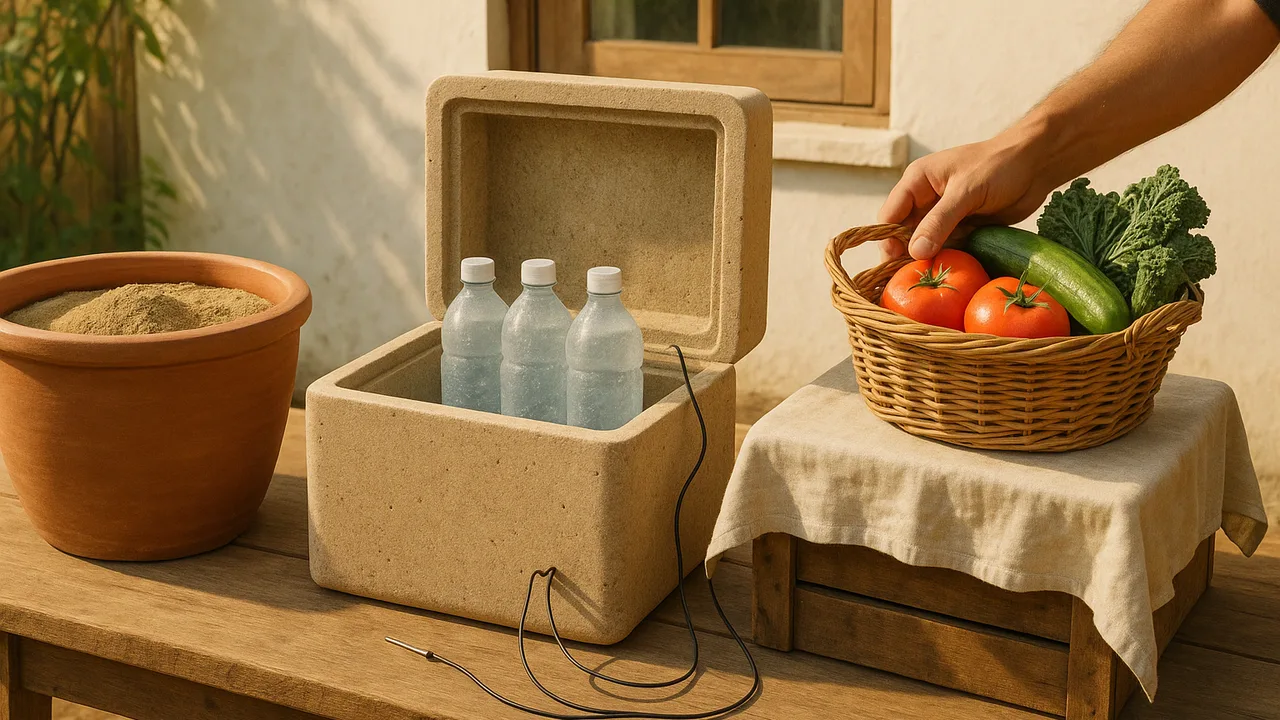
compare competing ways to keep produce cold without electricity using collision theory and a weighted decision matrix, evaluate irradiation as an option, and build and test version 1 of my team’s cooler.
- I can analyze data to identify that increasing the concentration of reactants increases the reaction rate, and decreasing concentration decreases the rate.
- I can analyze data to identify that increasing the temperature usually increases the reaction rate, and decreasing temperature decreases the rate.
- I can describe and prioritize the criteria and constraints for refining a chemical system, including factors like cost, energy needed, safety, and resource availability, and quantify them when possible.
- I can model and explain the differences in the types of energy (like kinetic energy and electromagnetic radiation) and particles (like alpha and beta particles) released during alpha, beta, and gamma decay, and describe how these decays can change one element into another.
Phase 4: Build
Warm-Up ~5 min
Do Now. From your Ideate list, pick the cooler idea you like best. Write the one measurement that would prove it works.
A clay pot sits inside a larger clay pot with wet sand between them, in a dry, breezy spot. What happens to the temperature inside the inner pot?
Instruction ~10 min
The design brief. Partner pantries receive a delivery of produce in the morning and hand it out through the afternoon. Many have no walk-in cooler and no outlet near their tables. Our job: design a cooler that keeps a day of produce cold without electricity, and back the design with data. The rate model from 4.06 says the lever is temperature: every 10 °C of cooling slows spoilage reactions roughly two-fold.
Four competing concepts.
- A. Ice-pack cooler. An insulated picnic cooler with frozen gel packs or frozen water bottles. Melting ice absorbs energy from the produce.
- B. Pot-in-pot evaporative cooler. A clay pot inside a larger clay pot with wet sand between, covered with a damp cloth. Evaporating water absorbs energy.
- C. Wet-burlap crate. A plastic crate wrapped in damp burlap, in shade. Cheap and light, but works only in dry air.
- D. Foam box with frozen bottles and a reflective cover. Thick foam slows heat flowing in; a foil cover reflects sunlight.
A fifth option the board asked about: irradiation. Some produce can be treated at a licensed facility with gamma rays from cobalt-60. Cobalt-60 (27 protons) undergoes beta-minus decay to nickel-60 (28 protons), and the excited nickel nucleus then emits gamma rays: a beta particle (a fast electron with mass) followed by pure electromagnetic energy. The gamma rays pass through the food, damaging the DNA of insects and microbes and slowing ripening in some produce. The food does not become radioactive. Irradiation does not replace cold, and it must be done before delivery, so we score it in the matrix but do not build it.
Class criteria and constraints (sample values set by the class). A pantry cooler must (1) bring the air inside to 10 °C or below within 20 minutes and hold it there for the rest of the test; (2) slow the antacid test reaction: a tablet in 150 mL of water stored inside for 20 minutes must take at least 1.5 times as long as one in room-temperature water; (3) use no electricity; (4) cost no more than 12 sample budget points; and (5) weigh no more than 10 kg when loaded, so one volunteer can carry it.
Two bench tests. Temperature test: load each prototype with 1 kg of room-temperature water bottles standing in for produce, put a thermometer in the air space, and record every 5 minutes. Rate test: after 20 minutes, take a 150 mL cup of water that was stored inside the cooler, drop in an antacid tablet and time it; compare with a room-temperature cup.
Worked example 1: the rate test as evidence (sample data). Room-temperature cup (21 °C): 46 s. Cup from an ice-pack cooler (8 °C): 81 s. Ratio 81 ÷ 46 = 1.8, which meets criterion 2. Relative rates 100 ÷ 46 = 2.2 and 100 ÷ 81 = 1.2: cooling by 13 °C nearly halved the rate, roughly what the rule of thumb predicts.
Worked example 2: a weighted decision matrix (sample scores). Weights: temperature held ×3, no electricity ×2, cost ×1, weight ×1, works in humid weather ×2. Scores 1–3.
| Criterion (weight) | A Ice | B Pot | C Burlap | D Foam | E Irradiation |
|---|---|---|---|---|---|
| Temperature held (×3) | 3 → 9 | 2 → 6 | 1 → 3 | 3 → 9 | 1 → 3 |
| No electricity at pantry (×2) | 2 → 4 | 3 → 6 | 3 → 6 | 2 → 4 | 3 → 6 |
| Cost (×1) | 2 → 2 | 2 → 2 | 3 → 3 | 2 → 2 | 1 → 1 |
| Weight (×1) | 2 → 2 | 1 → 1 | 3 → 3 | 3 → 3 | 3 → 3 |
| Works in humid weather (×2) | 3 → 6 | 1 → 2 | 1 → 2 | 3 → 6 | 3 → 6 |
| Total | 23 | 17 | 17 | 24 | 19 |
The foam box edges out the ice cooler, but both need ice frozen somewhere with electricity, which scored them 2, not 3. The matrix makes that hidden constraint visible, and a trade-off: more ice keeps it colder longer but adds weight.
| Measure | Room control | Version 1 | Meets criterion? |
|---|---|---|---|
| Air temp at 20 min / 40 min (°C) | |||
| Antacid time (s) and ratio | |||
| Budget points | |||
| Loaded mass (kg) |
Guided Exercises ~15 min
Answer before you choose your concept.
Independent Practice ~10 min
Fill your own decision matrix and record version 1.
Score all five options with your team's weights. Write a claim about which to build, citing two rows of the matrix and one collision-theory reason.
Record your version 1 temperature and antacid data and mark each criterion met or not met. Graph air temperature against time.
Closure ~5 min
Version 1 exists and has data. Next class: gallery critique, a retest and version 2.
Exit ticket: a donor says irradiation “should replace refrigeration.” Use what gamma rays do and do not do to explain why the food bank still needs cold storage.
Teacher notes
Materials (per team): small foam or picnic coolers, frozen gel packs or frozen water bottles (prepared the day before), two nested unglazed clay pots with sand, burlap and a plastic crate, foil, tape, 1 kg of room-temperature water bottles as the test load, thermometers, cups, 150 mL measures, antacid tablets, timers, a bathroom or kitchen scale, goggles.
Setup: sample budget prices: cooler 4 points, gel pack 2, frozen bottle 1, clay pots 4, sand 1, burlap 1, foam sheet 2, foil 1. The rate test cups sit inside the coolers from the start. The irradiation option is evaluated, never built.
Listen for: “cold flows in from the ice”; “irradiated food is radioactive”; teams opening coolers between readings.
Support / stretch: a sub-problem flowchart template. Stretch: estimate how much ice melts to cool 1 kg of water by 10 °C (41.8 kJ needed; ice absorbs about 334 J/g as it melts, so about 125 g).