2.06 From Particles to Properties: Revising the Salt Pond Model
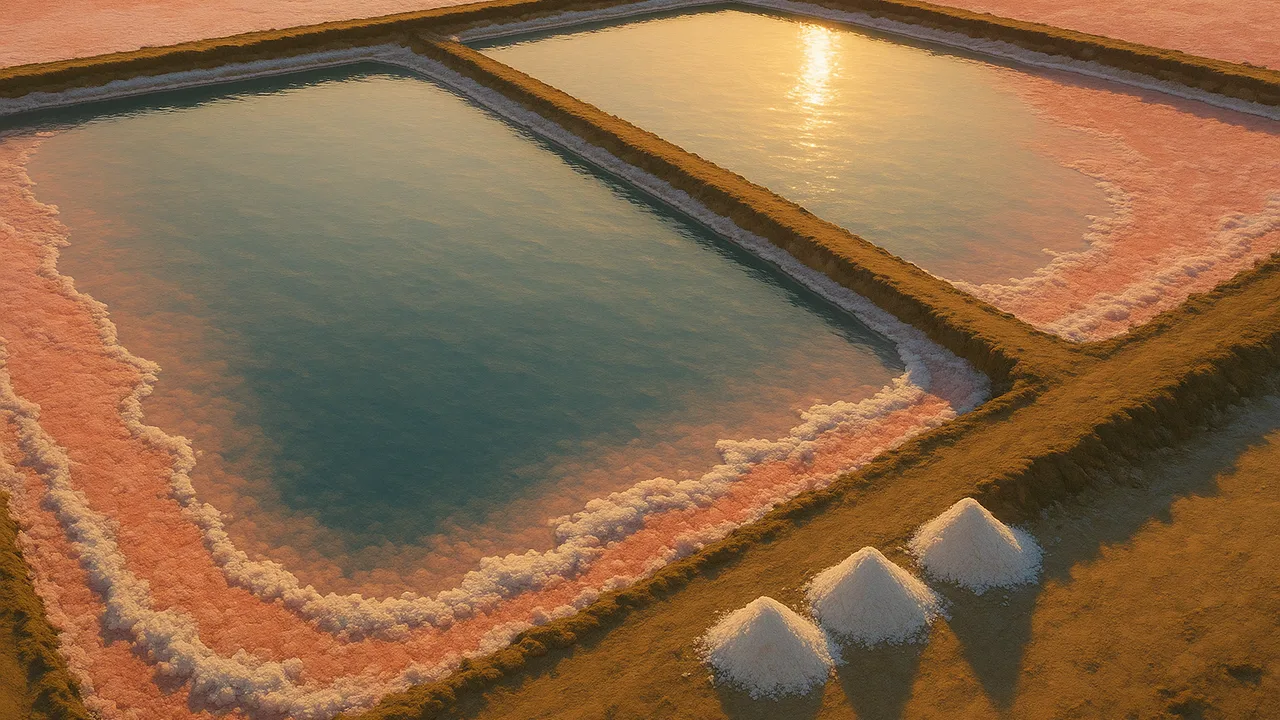
revise our model of the salt ponds with the unit’s evidence, communicate a structure-function idea in two formats, refine an investigation plan, and brainstorm soil-water solutions for the co-op.
- I can describe how attractive and repulsive electrical forces between molecules affect the arrangement and structure of a designed material, such as whether it forms a solid, liquid, gas, network solid, or polymer.
- I can describe how electrostatic forces at the atomic and molecular scale result in contact forces like friction, normal forces, or stickiness that we observe on the macroscopic scale.
- I can refine my investigation plan to improve the accuracy, precision, and usefulness of my data if needed.
Phase 3: Make Sense
Warm-Up ~5 min
Do Now. Draw your first salt-pond model from 2.01 again from memory. Circle one part that the mystery-solids lab or the boiling-point data would now make you change.
Which substance from the unit is held together by forces that act in every direction through the whole sample?
Instruction ~10 min
One model for the whole unit. Every property we measured traces to electrical attraction and repulsion between particles. Strong, all-direction attractions (ionic lattices, covalent networks) give solids with high melting points. Separate molecules held by weaker attractions melt and boil lower, and the attraction grows with molecule size (dispersion) and polarity (dipoles, hydrogen bonds). Repulsion matters too: electron pairs spread apart to set shape, and atoms pushed too close repel, which is why solids resist being squeezed.
Worked example 1: the revised salt-pond model. Mei’s revised drawing shows water molecules linked by hydrogen bonds, some escaping the surface when they gain energy from sunlight; the escaped molecules are still H2O, just far apart. Na+ and Cl− ions stay in solution, each wrapped in water molecules that point their oppositely charged ends at it. As water leaves, there are too few water molecules to keep the ions apart, and ions lock back into the cubic lattice. One picture now explains evaporation, dissolving and crystallization.
Worked example 2: one idea, two formats. Communicating technical information well often means two formats. Diego explained surface tension in words (“water molecules at the surface are pulled inward and sideways by hydrogen bonds, so the surface acts like a stretched skin”) and as a bar graph of published surface tension at 20 °C: water about 72.8 mN/m, ethanol about 22.3 mN/m. The graph shows the size of the difference; the words explain it.
Refining an investigation. A team counted drops of water and of rubbing alcohol that fit on a coin before spilling. Sample data, three trials: water 31, 24, 36 drops; alcohol 11, 12, 10 drops. The alcohol data are precise; the water data spread widely. The team traced the spread to drops of different sizes (they squeezed the dropper differently) and a coin that was not always level. Their refined plan: one dropper held vertically, a level surface, a coin cleaned and dried between trials, and five trials instead of three. Refining a plan targets the specific cause of the problem in the data.
| Problem in the data | Likely cause | Change to the plan | How you will know it worked |
|---|---|---|---|
Ideate for the co-op. Brainstorm at least six ways to keep irrigation water in the root zone longer, then tag each with the particle idea it uses: charged groups that attract water, a polymer network that holds water, organic matter with many polar groups (compost), a surface layer that slows evaporation (mulch), or a mix. Add one wild idea. Defer judgment; quantity first.
Guided Exercises ~15 min
Use the revised model and the drop data.
Independent Practice ~10 min
Ideate, then communicate.
List at least six soil-water ideas with the particle idea each uses. Star two to test.
For one starred idea, communicate how it works in two formats: a labeled particle diagram AND a three-sentence written explanation.
Closure ~5 min
The model is revised and the idea list is long. Next phase: design and test soil mixes.
Exit ticket: which Wonder Board question can you now answer? Write the question and your answer.
Teacher notes
Materials: first models from 2.01, colored pencils, the surface-tension values, optional coins, droppers and rubbing alcohol for a quick demo (no flames nearby, goggles on).
Setup: 15 minutes model revision, 15 minutes drop-data refinement, 15 minutes ideation. The drop counts are sample data, not standards.
Listen for: “ions dissolve into nothing”; “friction is just rough surfaces.”
Support / stretch: give a cause → change → check organizer for the refinement. Stretch: propose a way to measure surface tension more directly than counting drops.