2.05 Structure and Function in Designed Materials
draw and use structural models of molecules, network solids and polymers to explain how molecular-level structure gives a designed material its useful properties.
- I can identify and explain how the molecular-level structure and atomic interactions of a designed material determine its function.
- I can communicate how the properties of a material make it suitable for its intended use.
- I can represent and clearly identify the molecular structure of a chosen designed material using an appropriate model or diagram.
- I can describe how a material’s function and macroscopic properties, such as strength, conductivity, or durability, relate to its molecular-level structure.
- I can explain how intermolecular forces and molecular polarity affect a material’s function and properties.
- I can describe how the ability of electrons to move freely in metals relates to their properties and uses.
Phase 3: Make Sense
Warm-Up ~5 min
Do Now. A pencil, a nonstick pan and a diaper sit on the front table. Pick one and guess what about its particles makes it good at its job.
A molecule can contain polar bonds and still be nonpolar overall.
Instruction ~10 min
From particles to products. Engineers choose and design materials by their particle structure. A nonstick pan, a diaper, the silicon in a rooftop solar panel and the water-holding gel fire crews spray on buildings all work because of how their atoms are bonded and arranged. HS-PS2-6 asks you to communicate why that molecular-level structure matters. First we need models.
Electron-dot (Lewis) models. Show each atom’s valence electrons as dots and each shared pair as a line. Hydrogen shares one pair; oxygen, with 6 valence electrons, shares two pairs and keeps two lone pairs; carbon, with 4, shares four pairs. So methane is CH4 with four C–H bonds, water is H–O–H with two lone pairs on O, and carbon dioxide is O=C=O with two double bonds. Every atom except hydrogen ends with 8 electrons around it, the stable noble-gas arrangement from Unit 1.
Shape and polarity. Electron pairs repel each other and spread out as far as possible. In CO2 the two double bonds point in opposite directions, so the molecule is linear and the two polar C=O bonds cancel: CO2 is nonpolar. In water the two lone pairs push the bonds into a bent shape (about 104.5°), so the polar bonds do not cancel and the molecule is polar. Same kinds of polar bonds, different shapes, opposite results. Shape decides polarity, and polarity decides which substances mix and how strongly molecules attract.
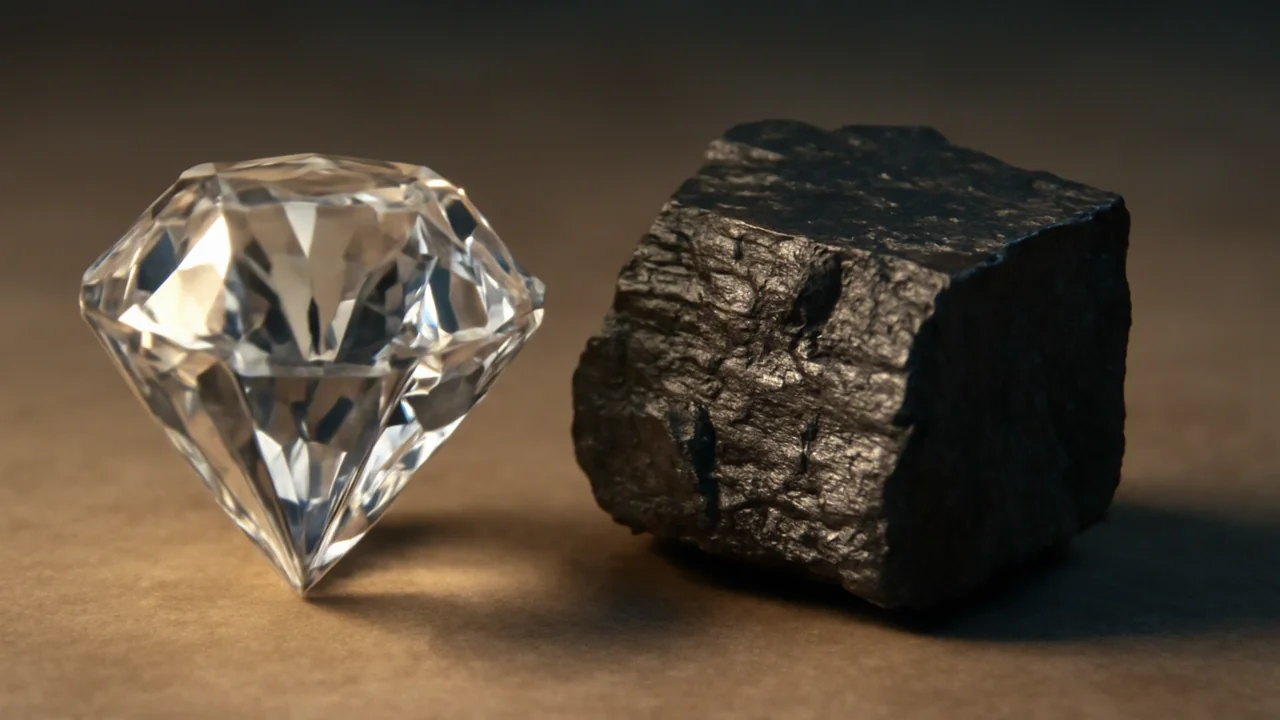
Networks. In diamond each carbon atom is covalently bonded to four others in a three-dimensional network, making it the hardest natural material. In graphite, carbon atoms bond in flat sheets of hexagons; the sheets are held to each other only by weak dispersion forces, so they slide (pencil lead) and electrons move along the sheets (conduction). Silicon, carbon’s neighbor in group 14, forms a diamond-like network; adding traces of other elements lets it conduct in a controlled way, the basis of solar cells. In metals, freely moving electrons carry current and let layers of ions slide without breaking, which is why copper makes good wire.
Polymers. A polymer is a very long chain of repeating units. Polyethylene is thousands of CH2 units in a row. Long chains tangle and attract each other along their whole length, so the material is tough and flexible. Change the side groups and you change the function:
- PTFE (nonstick coating): the hydrogens of polyethylene are replaced by fluorine. The C–F bonds are very strong, and the tightly held fluorine sheath gives other molecules almost nothing to attract, so food and water do not stick.
- Sodium polyacrylate (superabsorbent polymer): the chain carries many ionic groups (–COO− with Na+). Polar water molecules are strongly attracted to these charged groups and are drawn into the lightly cross-linked network, which swells. It can hold many times its own mass of pure water. It is used in diapers and has been sold as a soil additive to hold water near plant roots.
- Aramid fiber (as in protective vests): rigid chains line up in parallel and are linked to neighboring chains by many hydrogen bonds, giving very high strength for their weight.
From particle forces to contact forces. Friction, the push of a table on a book, and stickiness all come from electrical forces between the atoms at two surfaces. A gecko’s toes carry millions of tiny branching hairs that get so close to a wall that dispersion forces alone hold the gecko up. Adhesive tape works because its soft polymer flows into tiny bumps and gets close enough to attract. PTFE is slippery because its fluorine surface attracts almost nothing.
How to write a structure-function explanation. Use a three-step chain: (1) name the structure at the particle level; (2) name the force or bond it produces; (3) connect that force to the bulk property and the use. Example: “PTFE’s chain is sheathed in fluorine atoms (structure); the tightly held electrons give very weak dispersion attraction to other molecules (force); so almost nothing adheres to the surface, which is why it coats cookware (function).”
Guided Exercises ~15 min
Draw the model first, then answer.
Independent Practice ~10 min
Model three structures for the co-op file.
Draw and label a structural model of a short piece of sodium polyacrylate network: chains, charged groups, cross-links and water molecules drawn in. Then write its three-step structure-force-function chain.
Closure ~5 min
We can model designed materials now. Next class, we revise our model of the salt ponds and start ideating for the co-op.
Exit ticket: predict whether the polymer will absorb more pure water or more salty water, and give a particle-level reason.
Teacher notes
Materials: molecular model kits or gumdrops and toothpicks, a pencil, a nonstick pan sample or photo, a diaper cut open (teacher only), devices for PhET.
Listen for: “nonpolar means no bonds”; “the polymer dissolves.” Friction explained as “bumps catching” only, with no mention of attraction.
Support / stretch: give a structure → force → function frame. Stretch: explain why a polymer with more cross-links swells less but holds its shape better.