3.07 Paint, Zinc or Wax? Designing Rust Protection for the Bridge
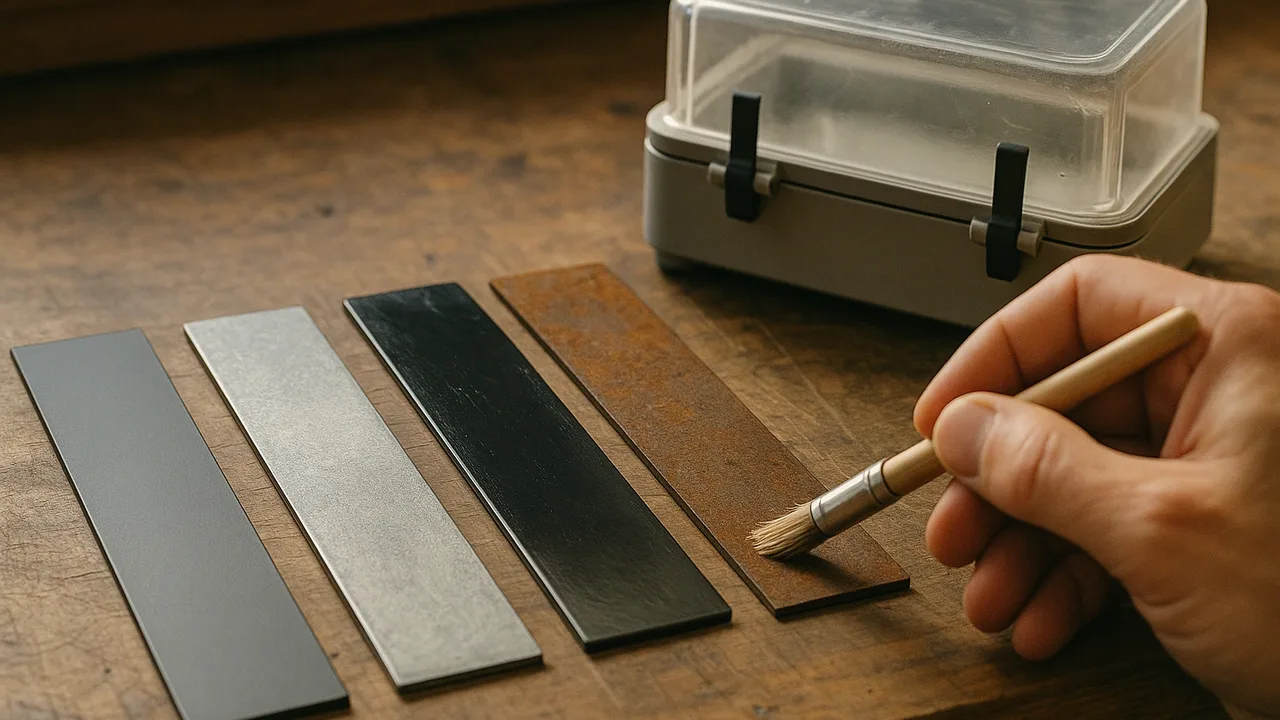
compare competing ways to protect steel from salt-fog corrosion using the rust model and a weighted decision matrix, predict the rust mass at stake, and build and start testing version 1 of my team’s method.
- I can describe how observable patterns of reactivity in the periodic table are caused by the patterns of outermost electrons and relative electronegativity of each atom.
- I can predict the relative number of atoms in the reactants and products of a chemical reaction using mathematical representations.
- I can calculate the mass of any substance in a chemical reaction if I know the mass of another substance involved.
Phase 4: Build
Warm-Up ~5 min
Do Now. From your Ideate list, pick the protection idea you like best. Write one way it could fail on a real bridge (a scratch, sunlight, years of fog).
Two nails are scratched through their coatings and left on a salt-water towel for two days: one painted, one galvanized (zinc-coated). Which shows red rust at the scratch?
Instruction ~10 min
The design brief. The bridge authority will replace a set of steel bolts and brackets on the deck. Our job is to recommend how to protect them, and to back that recommendation with bench data. The rust model from 3.06 tells us where to attack: keep out oxygen and salt water, supply electrons from a more reactive metal, or change the metal.
What is at stake (worked example 1). A sample bracket contains 2.40 kg of iron. If 5% of it (120 g) rusted before the next inspection, how much rust would form? 120 ÷ 55.845 = 2.149 mol Fe → 1.074 mol Fe2O3 × 159.687 = 171.6 g of rust, taking 51.6 g of oxygen from the air. That rust takes up more space than the iron it replaced and pushes on the joints around it.
Four competing concepts.
- A. Paint barrier. Two coats of paint keep oxygen and salt water off the steel. Cheap and easy to touch up, but useless where scratched.
- B. Zinc coating (galvanizing). Zinc (electronegativity 1.65) gives up electrons more easily than iron (1.83), so the zinc is oxidized first even where the steel is exposed. In the lab we use store-bought galvanized nails.
- C. Wax or grease film. A water-repelling film of wax or petroleum jelly keeps salt water off. Easy to apply, but it can wash or wear away.
- D. Sacrificial metal strip. A strip of a more reactive metal (zinc or magnesium) is attached in contact with the steel and corrodes in its place. Real ships and pipelines use large blocks of zinc, aluminum or magnesium this way.
Class criteria and constraints (sample values set by the class). A protection method for the new bolts and brackets must (1) keep the temperature rise of a treated steel-wool sample in the 10-minute heat test to 1.0 °C or less (less heat means slower rusting); (2) keep a scratched treated nail at a rust score of 1 or less (0 none to 4 heavy) after 48 hours on a salt-water towel; (3) cost no more than 10 sample budget points per sample; (4) be repairable in place by the painting crew with hand tools; and (5) create as little hazardous waste as possible.
Two bench tests. Heat test (today, 10 minutes). Rusting releases energy, so a rusting sample warms its surroundings. Soak a 1 g pad of steel wool in vinegar for 1 minute to strip its factory oil, squeeze it, apply your treatment, dip it in salt water, and seal it in a jar around a thermometer. Record the temperature every 2 minutes. A faster temperature rise means faster rusting. Scratch test (read in 3.08, 48 hours). Treat a nail, scratch an X through the treatment with a second nail, and lay it on a paper towel soaked in salt water in a covered cup. Always run an untreated control alongside.
Worked example 2: a weighted decision matrix (sample scores). Weights: protects when scratched ×3, heat test ×2, repair in place ×2, cost ×1, waste ×1. Scores 1–3.
| Criterion (weight) | A Paint | B Zinc | C Wax | D Strip |
|---|---|---|---|---|
| Protects when scratched (×3) | 1 → 3 | 3 → 9 | 1 → 3 | 2 → 6 |
| Heat test (×2) | 2 → 4 | 3 → 6 | 2 → 4 | 2 → 4 |
| Repair in place (×2) | 3 → 6 | 1 → 2 | 3 → 6 | 2 → 4 |
| Cost (×1) | 3 → 3 | 2 → 2 | 3 → 3 | 2 → 2 |
| Waste (×1) | 2 → 2 | 2 → 2 | 2 → 2 | 3 → 3 |
| Total | 18 | 21 | 18 | 19 |
Zinc wins narrowly, but it scores worst on repair in place: a galvanized part must be dipped in a factory, not on the bridge. The matrix shows the trade-off instead of hiding it, and a combination (zinc under paint) may beat any single concept.
Build version 1 (second half of the period). Each team chooses one concept (or a combination), treats one steel-wool pad and two nails, runs the heat test now, and sets up the scratch test with a control.
| Measure | Control | Version 1 | Meets criterion? |
|---|---|---|---|
| Heat test rise in 10 min (°C) | |||
| Scratch test rust score at 48 h (0–4) | |||
| Budget points | |||
| Repairable in place? |
Guided Exercises ~15 min
Answer before you choose your concept.
Independent Practice ~10 min
Fill your own decision matrix and record version 1.
Score all four concepts with your team's weights. Write a claim about which to build, citing two rows of the matrix and one reason based on outer electrons or reactivity.
Record your heat-test data and your scratch-test setup in the table. Predict the 48-hour rust score for your treated nail and the control, with a reason.
Closure ~5 min
Version 1 is built and the scratch test is running. Next class: gallery critique, the 48-hour results and version 2.
Exit ticket: copper bolts would not rust, but a copper bolt touching a steel bracket in salt fog makes the steel rust faster. Use reactivity to explain why.
Teacher notes
Materials (per team): fine steel wool cut into 1 g pads, white vinegar, salt water (about 1 tablespoon of salt per cup of water), glass jars with lids, thermometers or temperature probes, plain steel nails, galvanized nails, water-based craft paint and brushes, paraffin wax or petroleum jelly, zinc strips (or a zinc washer) and 2 cm magnesium ribbon pieces (teacher issued), paper towels, covered cups, balance, goggles and gloves.
Setup: sample budget prices: steel wool pad 1 point, nail 1, galvanized nail 3, paint 2, wax 1, zinc strip 3, magnesium piece 3. Painted nails need about 20 minutes to dry before scratching; have spare pre-painted nails. Label every cup with team and treatment. The scratch test is read in 3.08 after at least 48 hours; if 3.08 follows the next day, start the scratch nails at the end of 3.06.
Listen for: “zinc is just a tougher paint”; “any metal strip will protect steel”; teams changing two variables between samples.
Support / stretch: give a sub-problem flowchart template. Stretch: predict, from electronegativity, whether aluminum (1.61) would protect steel, and explain why aluminum’s own oxide film complicates the answer.