1.08 Gallery Critique and Version 2: Testing Against the Criteria
give and use evidence-based critique, test my team’s cleanup step against every criterion, and justify the changes in version 2 with periodic-table reasoning.
- I can use the periodic table to predict how elements behave based on the attraction and repulsion between charged particles and the patterns of outermost electrons that affect an atom’s reactivity.
- I can predict the number and types of bonds an element can form, and the kinds of bonds formed between elements.
- I can predict the number and charges of stable ions that form from atoms in a group of the periodic table.
- I can analyze and compare trends in reactivity, electronegativity, and atomic size across rows and down groups in the periodic table, based on the attraction of valence electrons to the nucleus.
Phase 4: Build
Warm-Up ~5 min
Do Now. Reread your version 1 table. Circle the criterion you came closest to missing. Write one change that might fix it without breaking another criterion.
A resin column passed the 3-drop test for the first 50 mL but failed after 75 mL. What is the most likely cause?
Instruction ~10 min
Gallery critique protocol. Each team posts its design sketch, decision matrix and version 1 table. Visitors leave three sticky notes: I like… (a strength tied to a criterion), I wonder… (a question about evidence or the science), and What if… (one specific change). Notes must cite a number or a periodic-table reason; “looks good” does not count.
Class criteria and constraints (sample values set by the class). For 100 mL of model brine, the cleanup step must (1) leave liquid that stays clear for 1 minute after 3 drops of test solution (washing-soda solution), meaning the 2+ ions are removed; (2) use no more than 20 mL of reagent solution or 15 g of resin beads; (3) finish in 15 minutes or less; (4) use no more than 50 mL of extra fresh water for rinsing; (5) cost no more than 10 sample budget points; and (6) leave waste that is safe for the classroom trash once dry.
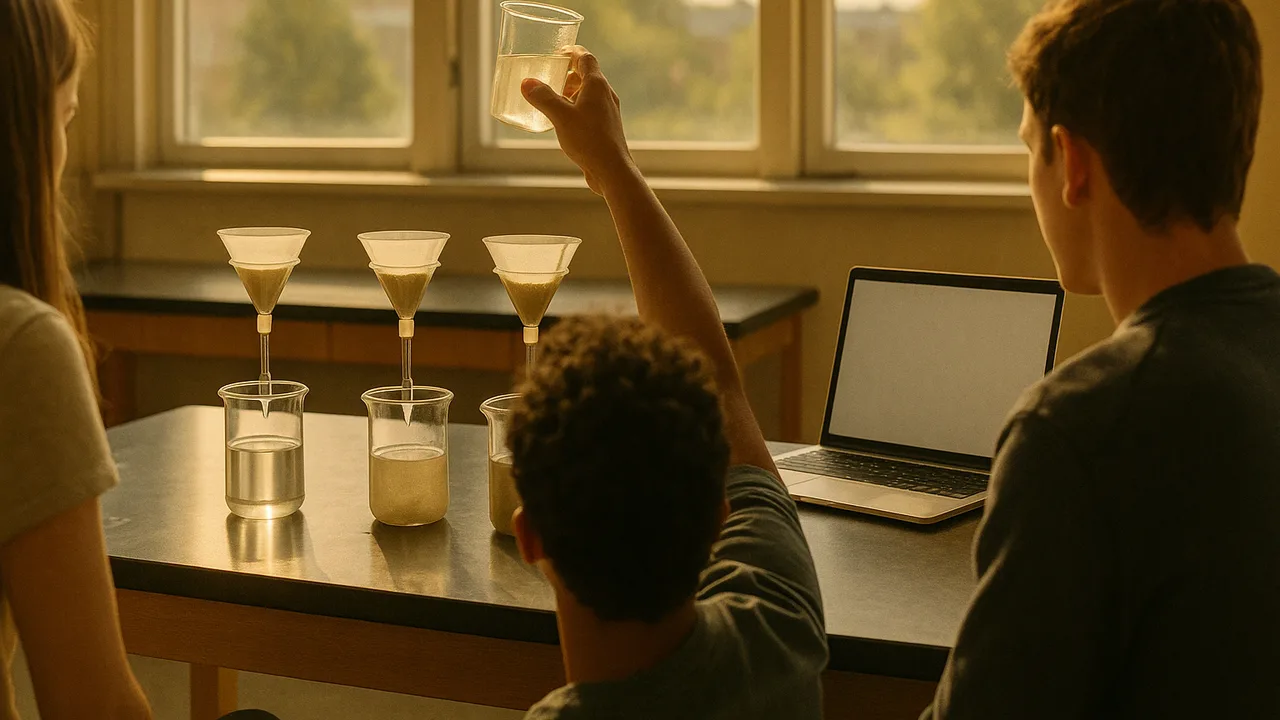
Worked example 1: turning critique into a change. Priya’s team (concept A) got the note: “I wonder if you added enough washing soda. Your liquid went cloudy on the test.” Their reasoning: each Ca2+ needs one CO32−, so too little reagent leaves 2+ ions behind. Version 1 used 3 mL. Version 2 added reagent in 1 mL steps, testing a few drops of filtered liquid after each, and stopped when the test stayed clear. Result (sample data): passed with 6 mL, well under the 20 mL limit.
Worked example 2: a trade-off made visible. Diego’s team (concept B) doubled the resin to 15 g and slowed the flow. Sample data: passed the test for all 100 mL, but took 18 minutes, over the 15-minute limit. They chose a taller, narrower column of the same 15 g, which kept contact time and passed in 14 minutes. Version 2 is not just “more”; it is a targeted change backed by a reason.
| Criterion | Version 1 | Change made | Version 2 | Met? |
|---|---|---|---|---|
| 3-drop test | ||||
| Reagent / resin | ||||
| Time | ||||
| Fresh water | ||||
| Budget | ||||
| Waste |
What our bench test cannot show. Real brine is hot, far more concentrated, and holds lithium. Its very high Na+ concentration also competes for resin sites, which is why salty brine is used to recharge water-softener resin. Scaling up changes time, energy and water use. Your recommendation must name at least one limit of the model.
Guided Exercises ~15 min
Use your version 1 data and the sticky notes you received.
Independent Practice ~10 min
Run version 2 and complete the comparison table.
Compare version 1 and version 2 on every criterion. Which criterion improved most, and what did you give up to get it?
🔎 Mini case study: Lithium from high-desert salt flats, and newer extraction methods ~8 min
Much of the world’s lithium comes from brines under salt flats in the high deserts of South America. The traditional method pumps the brine into large evaporation ponds and lets the sun remove water over many months. As the brine concentrates, other salts crystallize out first, and magnesium and calcium are removed chemically before lithium carbonate is produced.
The method uses little energy, but it is slow, needs a lot of land, and removes water from very dry basins where farmers, herders and Indigenous communities also depend on water. Those concerns have pushed companies and researchers to test direct lithium extraction: sorbents or ion-exchange materials whose structure is chosen to grab the small Li+ ion and let the rest of the brine flow back underground. Pilot projects, including some at geothermal plants, are testing whether these methods work reliably at full scale.
Think about it: Which of our class criteria match the trade-offs in this case, and which community or environmental constraint should the co-op add to its plan?
Closure ~5 min
Version 2 is tested and justified. Next phase, you write the element brief and present to the co-op.
Exit ticket: in two sentences, explain why separating Li+ from Na+ is harder than separating Mg2+ from Na+. Use the periodic table.
Teacher notes
Materials: version 1 setups, sticky notes in three colors, the same reagents as 1.07, fresh model brine, timers.
Timing: critique 15 minutes, version 2 build and test 25 minutes, comparison write-up 10 minutes. Concept C teams read their evaporation trays today and discuss why the crystals are mixed.
Listen for: “more is always better”; changes with no reason; critique that targets people instead of designs.
Support / stretch: provide critique sentence starters. Stretch: estimate how many times the resin bed would need to be recharged to treat 1 L of model brine, from your breakthrough volume.