1.07 Settle, Swap or Evaporate? Designing the Brine Cleanup Step
compare three ways to remove the 2+ ions from a model brine using the periodic table and a weighted decision matrix, then build and run version 1 of my team’s method.
- I can predict the number and types of bonds an element can form, and the kinds of bonds formed between elements.
- I can predict the number and charges of stable ions that form from atoms in a group of the periodic table.
- I can analyze and compare trends in reactivity, electronegativity, and atomic size across rows and down groups in the periodic table, based on the attraction of valence electrons to the nucleus.
- I can use the periodic table to predict how elements behave based on the attraction and repulsion between charged particles and the patterns of outermost electrons that affect an atom’s reactivity.
Phase 4: Build
Warm-Up ~5 min
Do Now. Hard tap water leaves white crust in kettles. That crust is mostly calcium carbonate. Write what this suggests about what happens when Ca2+ meets carbonate ions (CO32−) in water.
You add washing-soda solution (sodium carbonate) to clear water that holds dissolved Ca2+ and Mg2+. What happens?
Instruction ~10 min
Why remove the 2+ ions first? In many real lithium-from-brine processes, calcium and magnesium are removed early, because they would otherwise contaminate the lithium product. Our co-op asked us to design that step at bench scale. The periodic table tells us which ions to target: group 2 elements form 2+ ions; group 1 elements, lithium included, form +1 ions.
Our model brine. 100 mL of water with 1 g table salt (Na+, Cl−) and 0.5 g calcium chloride (Ca2+). No lithium compound is used; sodium stands in for lithium, since both are +1 group 1 ions. Calcium stands in for both 2+ ions. Magnesium is left out because magnesium carbonate dissolves too much for a clean classroom test; real plants usually remove magnesium with a different reagent, such as lime, which turns it into solid magnesium hydroxide.
Three competing concepts.
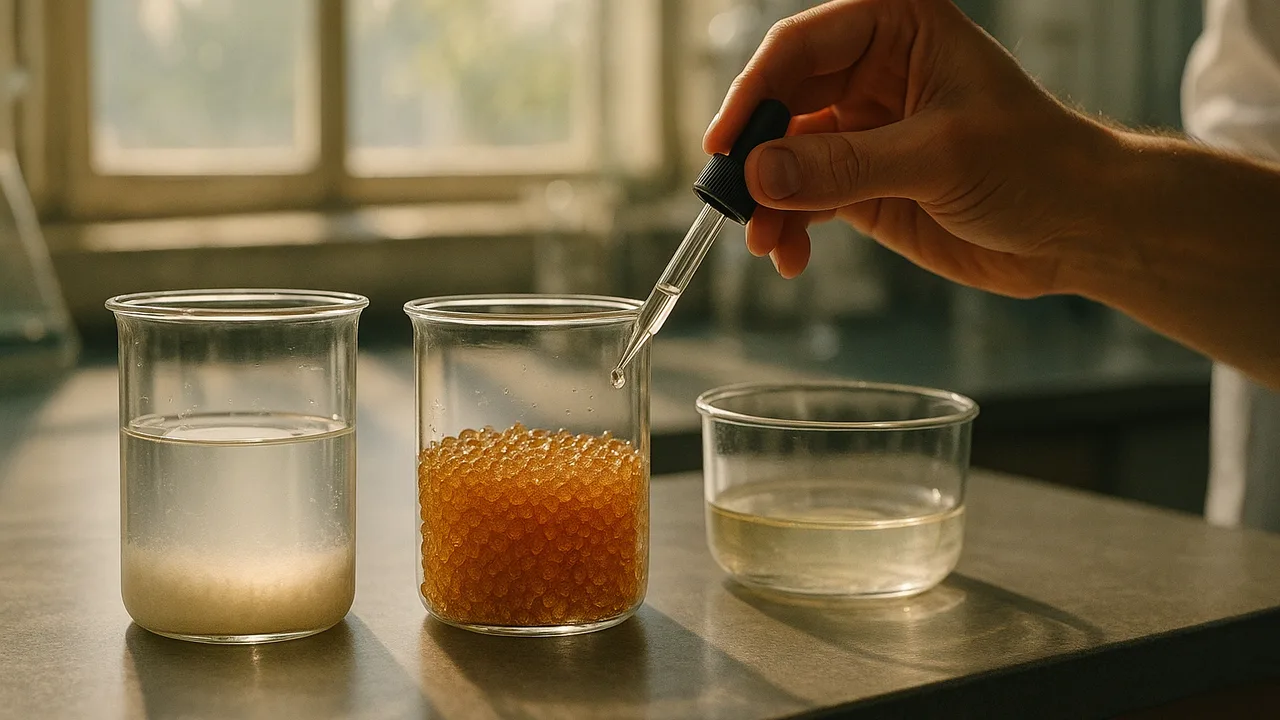
- A. Settle (precipitate). Add washing-soda solution so the 2+ ions form solid carbonates, then filter through a coffee filter.
- B. Swap (ion exchange). Pour the brine through a column of water-softener resin beads. The beads carry fixed negative sites holding Na+; 2+ ions, with twice the charge, are held more strongly, so they trade places with the sodium.
- C. Evaporate. Leave the brine in a shallow tray under a lamp so water leaves and the least soluble salts crystallize first.
Class criteria and constraints (sample values set by the class). For 100 mL of model brine, the cleanup step must (1) leave liquid that stays clear for 1 minute after 3 drops of test solution (washing-soda solution), meaning the 2+ ions are removed; (2) use no more than 20 mL of reagent solution or 15 g of resin beads; (3) finish in 15 minutes or less; (4) use no more than 50 mL of extra fresh water for rinsing; (5) cost no more than 10 sample budget points; and (6) leave waste that is safe for the classroom trash once dry.
Worked example 1: sub-problems. Jamal’s team split concept B into three sub-problems: hold the beads in a column (a cut plastic bottle with a coffee-filter plug), control the flow (a rate of about one drop per second), and decide when the beads are “full” (test the outflow every 25 mL). Solving each in order made the whole design testable (HS-ETS1-2).
Worked example 2: a weighted decision matrix (sample scores). Weights: removes 2+ ions ×3, time ×2, fresh water ×2, cost ×1, waste ×1. Scores 1–3.
| Criterion (weight) | A Settle | B Swap | C Evaporate |
|---|---|---|---|
| Removes 2+ ions (×3) | 3 → 9 | 3 → 9 | 1 → 3 |
| Time (×2) | 3 → 6 | 2 → 4 | 1 → 2 |
| Fresh water (×2) | 2 → 4 | 2 → 4 | 3 → 6 |
| Cost (×1) | 3 → 3 | 2 → 2 | 3 → 3 |
| Waste (×1) | 2 → 2 | 3 → 3 | 2 → 2 |
| Total | 24 | 22 | 16 |
A wins narrowly, but B scores best on waste: the matrix shows the trade-off instead of hiding it. Evaporation scores low because it takes days and leaves all the salts mixed together, a real problem with evaporation ponds too.
Build version 1 (second half of the period). Each team builds and runs one concept on 100 mL of model brine, then tests the liquid with 3 drops of washing-soda solution and records the result.
| Measure | Version 1 result | Meets criterion? |
|---|---|---|
| 3-drop test: clear for 1 min? | ||
| Reagent used (mL) or resin used (g) | ||
| Time (min) | ||
| Extra fresh water (mL) | ||
| Budget points |
Guided Exercises ~15 min
Answer before you choose your concept.
Independent Practice ~10 min
Fill your own decision matrix and record version 1.
Score all three concepts with your team's weights. Write a claim about which to build, citing two rows of the matrix and one periodic-table reason.
Record your version 1 results in the table and mark each criterion met or not met.
Closure ~5 min
Version 1 exists and has data. Next class: gallery critique, a retest and version 2.
Exit ticket: predict the charge of a barium ion (group 2) and say whether your design would remove it. Explain using the periodic table.
Teacher notes
Materials (per team): table salt, calcium chloride (lab grade or plain de-icing pellets), washing soda (sodium carbonate) solution about 10 g per 100 mL (about 5 mL precipitates the calcium from 0.5 g of calcium chloride), water-softener cation-exchange resin beads, two 500 mL plastic bottles cut as columns, coffee filters, funnels, cups, 10 mL and 100 mL graduated cylinders, balance, timers, a desk lamp and shallow tray for concept C, goggles and gloves.
Setup: premix the model brine for speed. Concept C teams start their tray today and read it in 1.08; give them a second, faster task (a resin or precipitate trial) so they have data. Sample budget prices: 10 mL reagent 2 points, 5 g resin 2 points, filter 1 point, column 1 point.
Listen for: “the precipitate is the lithium”; teams changing two variables between trials.
Support / stretch: give a sub-problem flowchart template. Stretch: explain why sodium carbonate removes Ca2+ but would also start to precipitate lithium carbonate if the lithium were very concentrated.