3.10 Unit 3 Checkpoint: Reactions, Energy and the Mole
show what I learned about chemical reactions, bond energy, conservation of mass and the mole by answering data questions, a scenario set and short constructed responses.
- I can explain how the total number of atoms of each element stays the same before and after a chemical reaction.
- I can describe the types of bonds (ionic or covalent) formed in a reaction, using information about valence electrons and electronegativity.
- I can use the periodic table to predict the outermost electron states of atoms and discuss how these patterns help determine the type of reaction that occurs.
- I can use my model to illustrate that the energy change in a chemical reaction comes from the difference in bond energies between reactants and products.
- I can explain that breaking bonds requires energy input and forming bonds releases energy, and that energy transfer between the system and surroundings happens during molecular collisions.
- I can use my model to show that the total energy of the system and surroundings is conserved during a chemical reaction, and that changes in bond energy account for the relative potential energies of reactants and products.
- I can explain how my mathematical work (like stoichiometric calculations) supports the idea that atoms and mass are conserved in a chemical reaction.
Phase 5: Prove It
Warm-Up ~5 min
Do Now. Back to the phenomenon: in three sentences, explain what rust is, why it weighs more than the iron, and why salty fog makes it worse.
In every chemical reaction, the number of atoms of each element is the same before and after.
Instruction ~10 min
Chemists, this is the unit checkpoint. Part A is multiple choice with data. Part B is a scenario set: several questions share one situation. Part C is short constructed responses, each scored 0–3. Read each question twice and show your reasoning and units.
How a 0–3 answer is scored. 3: a correct claim, accurate evidence (a value, a calculation or an observation) and reasoning that names the mechanism (outer electrons, bonds broken and formed, atoms conserved). 2: correct claim and evidence, with reasoning that is incomplete. 1: a correct claim with little or no support, or a partly correct answer. 0: incorrect or blank.
Worked example: from 1 point to 3. “Is burning methane exothermic?” “Yes” earns 1. “Yes, bonds broken total 2,648 kJ and bonds formed total 3,454 kJ” earns 2. Adding “so 806 kJ more is released forming the stronger C=O and O–H bonds than is absorbed breaking the reactant bonds, and that energy goes to the surroundings” earns 3.
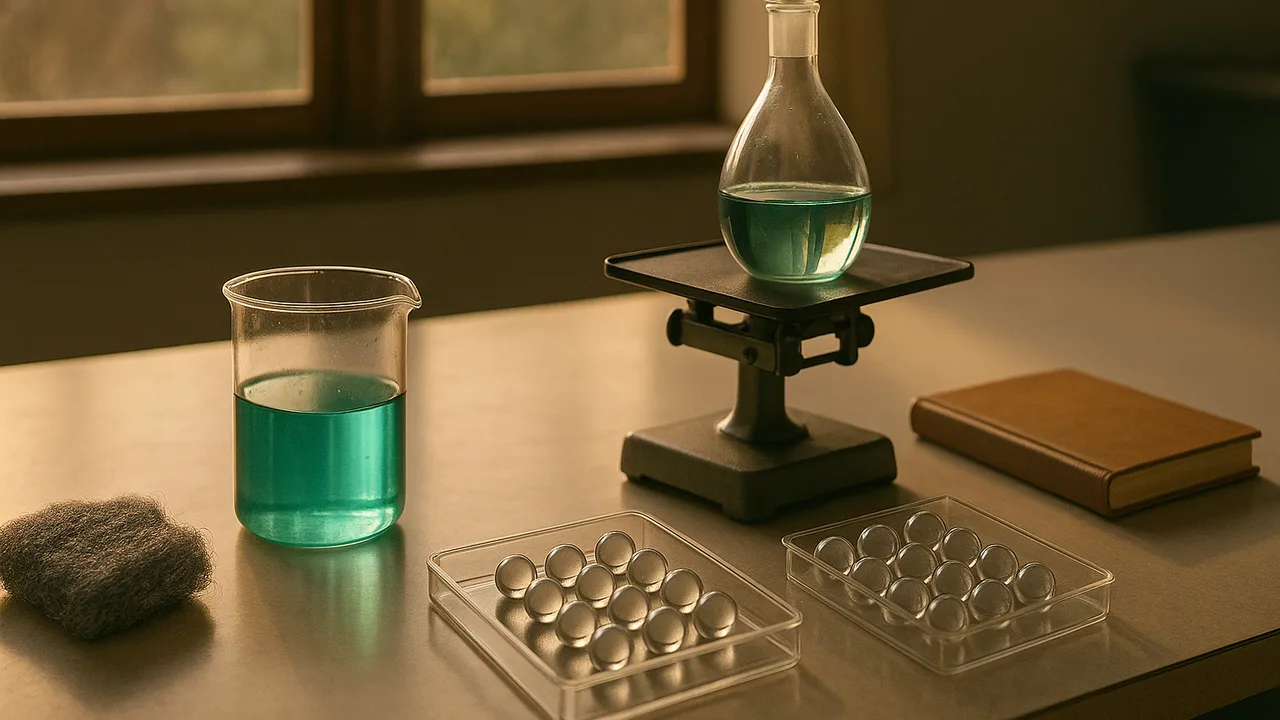
Scenario data (sample class data): steel wool in a sealed flask. A team sealed 5.585 g of vinegar-cleaned, salt-dampened steel wool in a flask of air with a thermometer, and weighed the whole flask before and after one week.
| Measurement | Start | After 1 week |
|---|---|---|
| Mass of sealed flask and contents (g) | 212.4 | 212.4 |
| Temperature inside in the first 10 min (°C) | 21.0 | 24.5 at 10 min |
| Mass of steel wool + rust, removed and dried (g) | 5.585 | 6.105 |
Useful values: Fe 55.845, O2 31.998, Fe2O3 159.687 g/mol; Avogadro’s number 6.022 × 10²³; bond energies H–H 436, O=O 498, O–H 464, C–H 413, C=O 799, N≡N 946, N–H 391 kJ/mol.
Guided Exercises ~15 min
Parts A and B: answer on your own. Your teacher reviews answers after everyone finishes.
Independent Practice ~10 min
Part C: constructed responses, each scored 0–3.
13. Magnesium burns in oxygen: 2Mg + O2 → 2MgO. Identify the reactants and products, the bonds broken and formed, and explain from outer electrons and electronegativity why the product is MgO. Show the atom count. (0–3)
14. Use bond energies to calculate the energy change for N2 + 3H2 → 2NH3. Draw and label an energy diagram with system, surroundings and the direction of energy transfer, and explain why the energy change of the surroundings is equal and opposite. (0–3)
15. How many grams of oxygen are needed to rust 11.17 g of iron completely, and what mass of rust forms? Show the path and explain how your numbers show that mass is conserved. (0–3)
16. A student says, “When wood burns, mass is destroyed, because only a little ash is left.” Rebut the claim using atoms, open and closed systems, and the sealed-bag lab. (0–3)
Closure ~5 min
Finished, chemists. Next unit, we ask how fast reactions go, when they stop, and what happens when the nucleus itself changes.
Exit ticket: which item was hardest, and which idea do you want to practice before Unit 4?
How confident are you that you can I can explain reactions with electrons and bond energy and use moles to show that mass is conserved.
Teacher notes
Materials: printed checkpoint with the data table, periodic tables, calculators, scoring guide for items 13–16.
Setup: about 40 minutes, then a brief review. Item tags: 1, 6, 12 and 13 → HS-PS1-2:1a; 1, 2 and 13 → 2a; 2 and 13 → 3a; 3 → 3b; 10 → 4a; 5, 11 and 14 → HS-PS1-4:1a; 5 and 14 → 4:2a; 4, 11 and 14 → 4:3a; 9 and 15 → HS-PS1-7:1a, 2b; 9, 10 and 15 → 7:1b; 6, 7 and 16 → 7:1c; 8 → 7:2a, 3b; 15 and 16 → 7:3a. Use the tags to regroup students for re-teaching.
Answers: item 14: −92 kJ. Item 15: 11.17 g Fe = 0.2000 mol; O2 0.1500 mol = 4.80 g; Fe2O3 0.1000 mol = 15.97 g; 11.17 + 4.80 = 15.97 g.
Support / stretch: read items aloud on request and allow a blank mole-map sheet. Stretch: from item 10, calculate the percentage of the iron that rusted (0.520 g O2 → 0.01625 mol O2 → 0.02167 mol Fe, about 22%).