4.02 Project Brief and Wonder Board: The Food Bank’s Fresh Produce
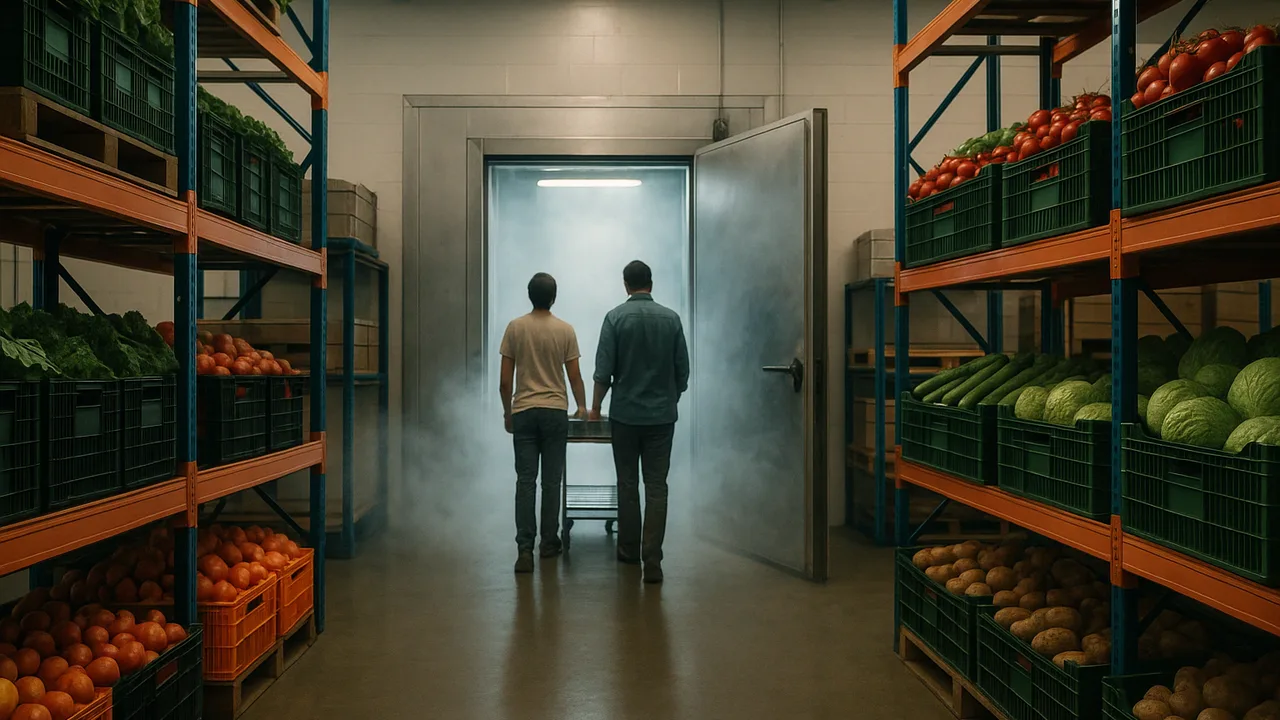
Keeping Rescued Produce Fresh: A Rates, Equilibrium and Nucleus Brief for a Food Bank
Why does cold keep food fresh, how can a chemical system be pushed to make more of what we need, and what do changes in the nucleus have to do with the food on our tables?
The mystery: Berry growers rush picked fruit from the field into cooling sheds within hours, and refrigerated trucks keep it cold all the way to the store. A flat left in the summer sun for an afternoon softens and molds days sooner than one chilled right away.
Questions we will figure out together in this unit:
- Why does one bruise make a whole apple spoil faster?
- How cold is cold enough, and can produce be too cold?
- Can we keep food cold without electricity?
- Why do bananas ripen other fruit near them?
- Does irradiating food make it radioactive?
- Where does nitrogen fertilizer come from if air is mostly nitrogen already?
- How can a reaction run forward and backward at the same time?
- How much energy does a refrigerated truck use?
explain the food bank’s request, describe how temperature and particle energy control spoilage rates, and turn our questions into need-to-knows, criteria and constraints for the project.
- I can explain that molecules must collide to break bonds and form new molecules during a reaction.
- I can describe how the probability of bonds breaking in a collision depends on whether the colliding molecules have enough kinetic energy.
- I can explain that higher temperature means molecules have more kinetic energy, so collisions are more likely to break bonds and form new molecules.
- I can describe and prioritize the criteria and constraints for refining a chemical system, including factors like cost, energy needed, safety, and resource availability, and quantify them when possible.
Phase 1: Spark
Warm-Up ~5 min
Do Now. Food banks collect surplus fresh fruit and vegetables from farms and stores. Write two problems you think a food bank faces in getting fresh produce to families before it spoils.
Which change would slow the spoilage of a crate of donated peaches the most?
Instruction ~10 min
Meet the client. A regional food bank has written to our class. Its trucks collect surplus produce from farms and grocery stores, store it in a warehouse, and deliver it to dozens of small partner pantries. Many pantries are in church basements and community centers with no walk-in cooler. Too much donated produce spoils before families take it home. The food bank’s board has three requests:
- An explanation, in plain language backed by evidence, of why quick cooling and careful handling slow spoilage.
- A low-cost cold-storage design that a pantry without a walk-in cooler could use for a day of produce, tested against criteria and constraints.
- Answers to two questions the board keeps hearing from donors: “Is irradiated produce safe, and does it make food radioactive?” and “Where does the nitrogen fertilizer that grows all this food come from?”
Driving question. Why does cold keep food fresh, how can a chemical system be pushed to make more of what we need, and what do changes in the nucleus have to do with the food on our tables?
Temperature, particle energy and bonds. Spoilage is many reactions at once: respiration, softening, browning and the growth of molds and bacteria, all driven by enzymes. For any of them, molecules must collide with enough kinetic energy to break existing bonds so new ones can form. At higher temperature more molecules carry that much energy, so more collisions break bonds.
Worked example 1: a fraction, not an average. Imagine 1,000 molecules (sample numbers). At 5 °C, perhaps 10 have enough energy to react in a collision; at 25 °C, perhaps 40. The average speed rose only a little, but the number of energetic molecules quadrupled. That is why a few degrees matter so much.
Worked example 2: criteria and constraints. Priya’s team turned the board’s second request into an engineering problem (HS-ETS1-1). Criteria (what success means): keep produce at or below 10 °C for 8 hours; slow a test reaction measurably. Constraints (limits): cost under a set budget, no electricity, safe for volunteers to carry, uses easy-to-find materials. Ranking them is itself a choice: the team put “no electricity” first because many pantries lack outlets near their tables.
Team roles. Teams of four rotate weekly: Lead Chemist (keeps the team on the question), Data Analyst (timers, graphs, calculations), Lab Manager (materials and safety checks) and Communicator (shares findings and questions with the client).
Guided Exercises ~15 min
Use the client letter and the collision model.
Independent Practice ~10 min
Start your Rates Notebook and the team charter.
In 3–4 sentences, restate the food bank's three requests and break the project into at least three sub-problems.
Add two questions to the Wonder Board: one about reaction rates and one about the donors' questions (irradiation or fertilizer).
Closure ~5 min
We know the client, the driving question and our teams. Next phase, we race antacid tablets to measure how temperature and surface area change rates.
Exit ticket: explain, with molecules and bonds, why a 20-degree drop in temperature slows spoilage far more than you might expect from the small change in average speed.
Teacher notes
Materials: the client letter (generic, on food bank letterhead you design), role cards, chart paper for the Wonder Board, a thermometer for the warm-up.
Setup: keep the Wonder Board posted all unit; 4.06 and 4.09 return to it. The food bank is fictional; keep real spoilage statistics out of the letter so students do not treat sample data as fact.
Listen for: “cold kills germs” (it mostly slows them); confusion between criteria and constraints; “irradiated food glows.”
Support / stretch: give a need-to-know frame (“We need to know ___ so that we can ___”). Stretch: sketch two energy distribution curves (5 °C and 25 °C) and shade the area beyond the activation energy.