1.03 Metals, Nonmetals and Reactivity Patterns
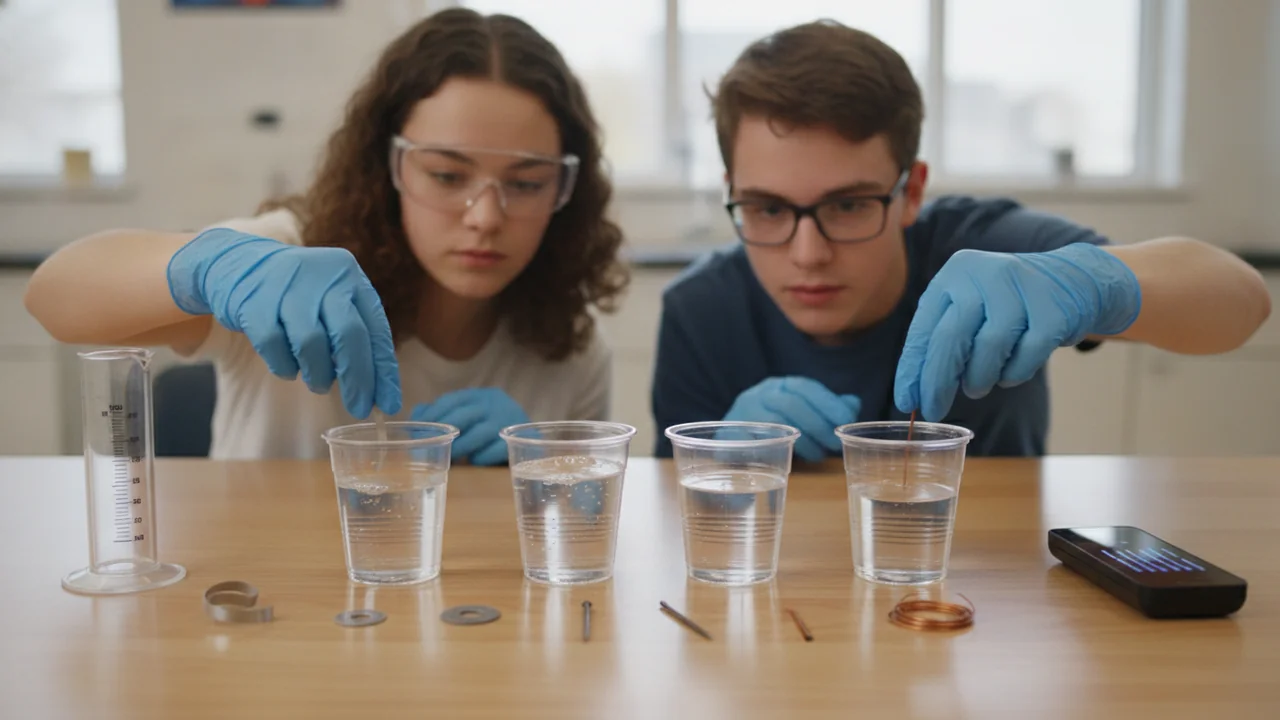
test samples of elements for conductivity and reactivity with vinegar, and relate the patterns I observe to each element’s position on the periodic table.
- I can explain how the arrangement of the main groups in the periodic table shows patterns in the outermost electrons of atoms.
- I can describe how elements are organized in the periodic table by the number of protons in their atoms.
- I can use the periodic table to predict how elements behave based on the attraction and repulsion between charged particles and the patterns of outermost electrons that affect an atom’s reactivity.
Phase 2: Investigate
Warm-Up ~5 min
Do Now. Before any samples come out: rank magnesium, zinc, iron and copper by how fast you expect them to bubble in vinegar. Write one reason for your top choice.
Rank magnesium, zinc, iron and copper by how fast you expect them to bubble in vinegar.
Instruction ~10 min
Why a lab here. The periodic table is a model, and a model is only useful if it predicts what we observe. Today you test that model with real samples. You will measure two properties: whether a sample conducts electricity, and how vigorously a metal reacts with an acid (white vinegar, about 5% acetic acid). This lab runs two 50-minute periods.
Metals and nonmetals. About three-quarters of the elements are metals. They sit to the left of the staircase line on the periodic table. Metals are shiny when freshly cut, conduct electricity and heat, and can be bent or hammered without shattering. Nonmetals sit to the right of the line; as solids they are usually dull and brittle and conduct poorly. Elements along the line (such as silicon) are metalloids, with intermediate properties. Graphite, a form of carbon, is the famous exception: a nonmetal that conducts. You will test it.
What the model says about reactivity. Metals react by losing their outer electrons. Elements in the same group (column) have the same number of outer electrons, so they react in similar ways. Metals that give up electrons easily react more vigorously. Magnesium is in group 2 near the top left; zinc and iron are transition metals in the middle; copper is also a transition metal but holds its electrons more tightly; gold holds them most tightly of all. The model predicts this order of reactivity with acid: magnesium > zinc > iron > copper.
The reaction you will see. A reactive metal in vinegar gives off bubbles of hydrogen gas. For magnesium: Mg + 2CH3COOH → Mg(CH3COO)2 + H2. A 0.10 g piece of magnesium ribbon that reacts completely makes only about 0.0083 g of hydrogen, a small amount that escapes harmlessly in a ventilated room. The bubbles are your evidence.
Controlling variables. The independent variable is the metal. Keep the controlled variables the same: 10 mL of vinegar, room temperature, and pieces of about the same surface area (1 cm strips or small squares). The dependent variable is the rate of bubbling, scored 0–3 and described in words. Scoring by eye is a source of uncertainty; that is why two partners score independently and then compare.
Procedure. (1) Record each sample’s appearance (luster, color) and whether it bends or snaps. (2) Touch both tester leads to each solid sample and record whether the LED lights. (3) Pour 10 mL of vinegar into each of four labeled cups; add Mg, Zn, Fe and Cu at the same moment and start the timer. (4) Each partner scores bubbling at 30 s, 2 min and 5 min (0 none, 1 a few, 2 steady, 3 vigorous), then compare. (5) Record the time for the magnesium piece to disappear, if it does. (6) Record each element’s group and period beside your data.
| Sample | Group, period | Luster / bends? | Conducts? | Bubbling 30 s / 2 min / 5 min (0–3) | Notes |
|---|---|---|---|---|---|
| Mg | |||||
| Zn | |||||
| Fe | |||||
| Cu | |||||
| Al, graphite, S | n/a |
Reading the result. Expect vigorous bubbling from magnesium within seconds, slow bubbles on zinc, very few on iron (a nail may take many minutes), and none on copper. If your iron shows nothing, that is not a failed lab: note it, and think about what you could change (time, temperature, cleaning the surface) to detect a slow reaction. Iron’s slowness in vinegar and its rusting in wet air are both real; rusting needs oxygen and water together and happens over days.
Guided Exercises ~15 min
Answer as you collect data; return to the cards after clean-up.
Independent Practice ~10 min
Lab analysis, in your Element Notebook.
Which sample broke the metal / nonmetal pattern for conductivity? Explain why one exception does not destroy the periodic-table model.
Name two sources of error (for example, surface area or an oxide coating on the nail) and how each could change your ranking. Then use your results to explain why the miners' iron tools rusted while the gold did not.
Closure ~5 min
Your data ranks the metals. Next class, published data lets us argue why the ranking comes out this way.
Exit ticket: lithium sits in group 1, to the left of magnesium. Predict whether lithium is more or less reactive than magnesium, and give one reason based on its position.
Teacher notes
Materials (per team): copper wire, aluminum foil, a sanded iron nail, a zinc-plated washer, 1 cm magnesium ribbon pieces (teacher issued), graphite pencil lead, sulfur powder in a sealed vial (observe only); a tester of 2 AA batteries, an LED and three alligator leads; white vinegar (5%), cups, a 10 mL graduated cylinder, sandpaper, timer, hand lens, splash goggles.
Two periods: day 1 conductivity and reactivity; day 2 analysis and the CER. No-lab alternative: the teacher’s video of the four metals in vinegar plus the PhET Circuit Construction Kit: DC for conductivity.
Listen for: “bubbles are the metal boiling”; “copper did nothing so the lab failed.”
Support / stretch: give a CER frame with the evidence column pre-labeled. Stretch: design a follow-up that measures rate by collecting gas volume, keeping all variables but one fixed.