2.04 Why Water Boils So High: Arguing About Intermolecular Forces
use published boiling-point data to argue how molecule size and polarity affect the strength of intermolecular forces, and explain water’s unusually high boiling point.
- I can explain how measurable properties like melting point, boiling point, vapor pressure, and surface tension relate to the strength of electrical forces between particles in a substance.
- I can explain how changes in particle spacing during an experiment can occur without changing the identity of the particles (for example, water molecules remain the same when boiled but move farther apart).
- I can describe how adding thermal energy affects the electrical attraction between particles and their ability to stay close together.
- I can analyze how patterns of interactions at the molecular scale are reflected in the behavior of substances at the macroscopic scale.
- I can assess the accuracy and precision of my data and identify any limitations in my investigation.
- I can evaluate whether my data provides the evidence needed to support my conclusions.
Phase 2: Investigate
Warm-Up ~5 min
Do Now. Oxygen (O2, 32 u) and nitrogen (N2, 28 u) are gases at room temperature. Water (H2O, 18 u) is lighter, yet it is a liquid. Write one hypothesis for why.
H2S, H2Se and H2Te boil at −60, −41 and −2 °C. Following that trend backward, where would you expect water to boil?
Instruction ~10 min
A strange liquid. A water molecule has a mass of only 18 u, lighter than the oxygen (32 u) and nitrogen (28 u) molecules in the air, yet water is a liquid at room temperature and they are gases. Water fills the salt ponds, lakes and most of your body. Something holds water molecules together more strongly than their size would suggest. Today you argue what that is from data.
Boiling point as a measure of attraction. To boil, molecules must separate from their neighbors in the liquid. They move farther apart, but they stay the same molecules: steam is still H2O. The stronger the intermolecular forces, the more energy is needed and the higher the boiling point. So boiling points are evidence about forces.
Data set 1: noble gases (boiling points at 1 atm, as tabulated in OpenStax Chemistry 2e and standard references): helium −268.9 °C, neon −246.0 °C, argon −185.8 °C, krypton −153.4 °C, xenon −108.1 °C. These atoms are not charged and not polar, yet they attract each other weakly, and the attraction grows with size. The reason is dispersion forces: an atom’s electron cloud can shift for an instant, making a temporary positive and negative side that attracts the neighboring atom. Bigger atoms have larger, looser electron clouds that shift more easily, so the attraction is stronger. Every molecule has dispersion forces.
Data set 2: hydrides (compounds with hydrogen). Group 14: CH4 −161.5 °C. Group 15: NH3 −33.3 °C. Group 17: HF 19.5 °C. Group 16: H2O 100.0 °C, H2S −60.3 °C, H2Se −41.3 °C, H2Te −2.2 °C. From H2S to H2Te the boiling point rises with size, as dispersion forces predict. Extend that trend backward and water “should” boil somewhere below −60 °C. It boils at 100 °C instead: an anomaly of more than 150 degrees.
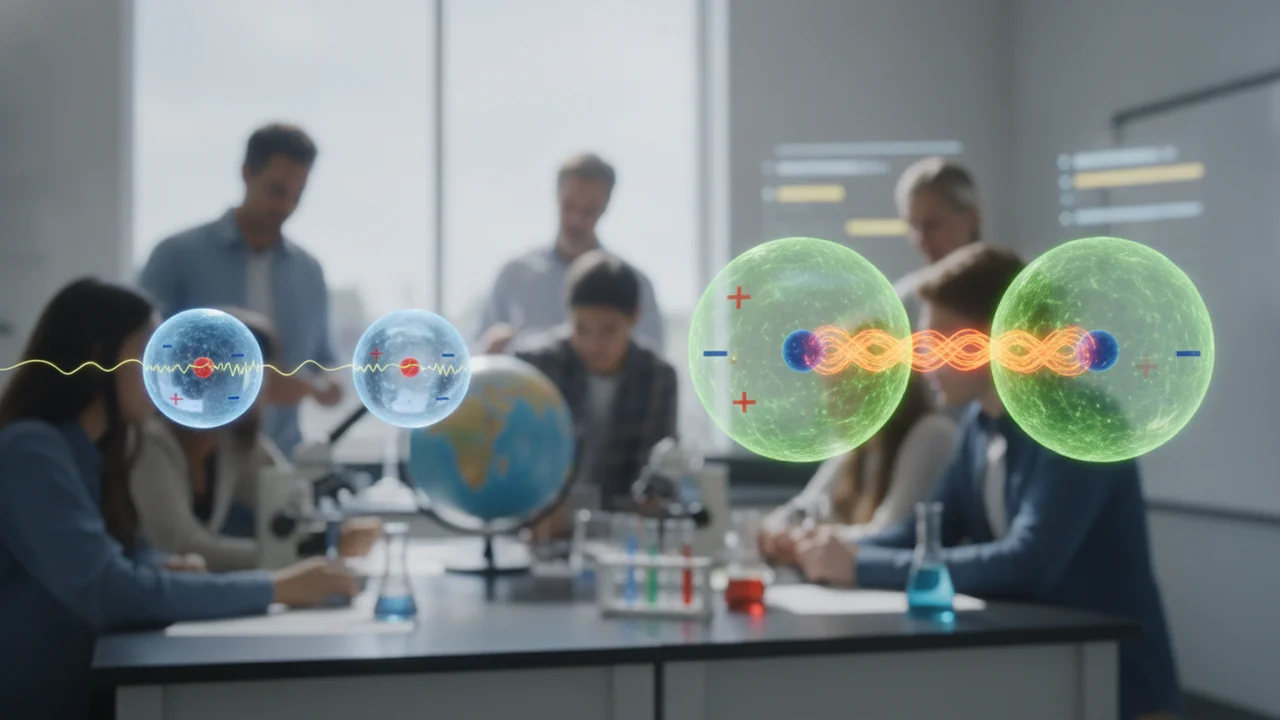
The explanation: hydrogen bonds. In water, oxygen is much more electronegative than hydrogen (3.44 against 2.20), so each O–H bond is strongly polar and the hydrogen is left with a significant partial positive charge. That small, exposed hydrogen is strongly attracted to a lone pair of electrons on the oxygen of a neighboring molecule. This attraction, called a hydrogen bond, occurs when H is bonded to N, O or F. It is far weaker than a covalent bond but much stronger than dispersion forces between small molecules. HF and NH3 also sit above their group trends for the same reason. Water, with two hydrogens and two lone pairs per molecule, forms an extended network of hydrogen bonds, which is why its anomaly is the largest.
Making the argument. Graph the data first: period on the x-axis, boiling point on the y-axis, one line per group. The pattern jumps out visually in a way it does not in a list. A strong claim names the cause (hydrogen bonding between water molecules), cites specific values (H2O 100.0 °C against H2S −60.3 °C), and reasons with the mechanism (a strongly polar O–H bond and lone pairs). A strong rebuttal answers a counter-claim with data. If a classmate says “water boils high because it is heavier,” point out that H2S (34 u) is almost twice as heavy and boils 160 degrees lower.
Judging the data. These are published values measured many times, so they are accurate and precise. Your own class boiling-point readings with a school thermometer would be less precise (often ±1–2 °C) and shift with air pressure. Ask of any data set: is it accurate, is it precise, and is it enough to support the claim?
Why it matters. Hydrogen bonding explains why ice floats, why lakes freeze from the top down, and why water absorbs so much heat, which keeps coastal climates mild. It is also why water is drawn to polar and charged groups on materials, a clue for the co-op’s polymer.
Guided Exercises ~15 min
Graph the two data sets, then answer.
Independent Practice ~10 min
Graph and argue.
Turn in your graph of both data sets. Under it, write a CER that explains water's anomaly, and add one sentence on how heating water changes the spacing of its molecules but not the molecules themselves.
Closure ~5 min
Forces between molecules explain liquids. Next phase, we model molecules, networks and polymers to explain designed materials.
Exit ticket: rank CH4, NH3 and H2O by boiling point and explain the ranking in two sentences.
Teacher notes
Materials: printed data tables, graph paper or a spreadsheet, a discourse protocol card.
Discourse: pairs present, another pair counters, the first pair rebuts using two values. Post the norm “evidence, not volume.”
Listen for: “boiling breaks the bonds in water”; “hydrogen bonds are covalent bonds to hydrogen.”
Support / stretch: pre-label the graph axes. Stretch: explain why HF has the highest boiling point among the group 17 hydrides but lower than water, using the number of hydrogen bonds per molecule.