4.01 Why Do Corn Kernels Come in Ratios?
The True-to-Type Seed Library
Why do the traits in a crop come in regular ratios and also vary, how much of that variation is inherited and how much comes from the environment, and how can a seed library use that knowledge to keep its seeds true to type?
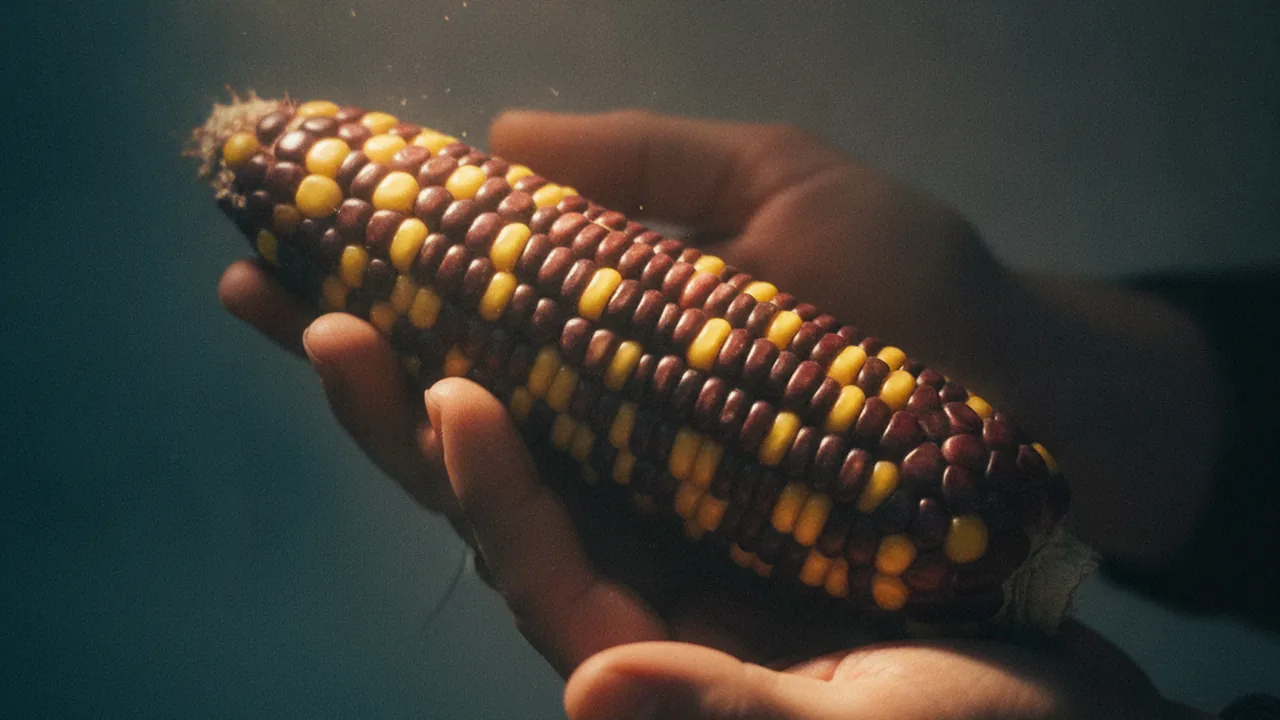
The mystery: Counted one by one, the purple and yellow kernels on an ear of corn come out close to three to one, even though every kernel is a separate chance event.
explain how alleles on homologous chromosomes separate during meiosis, use Punnett squares to predict the results of a cross, and ask questions about the ratios seen on an ear of corn.
- I can use a model of DNA to ask questions that help clarify how DNA codes for proteins and how those proteins cause traits in an organism.
- I can use a model of DNA to ask questions about how cells regulate which DNA and chromosomes are used.
- I can use a model of DNA to ask questions about the functions of non-protein coding sections of DNA, such as their role in regulation.
- I can ask questions about DNA and chromosomes that scientists could test with experiments or observations.
- I can describe evidence that inheritable genetic variations can result from chromosome sections exchanging places during meiosis.
- I can explain how genetic mutations can occur due to errors during DNA replication or from environmental factors.
- I can describe how genetic material is passed from one generation to the next.
Phase 1: Spark
Warm-Up ~5 min
Do Now. Toss a coin 8 times and record heads and tails. Did you get exactly 4 and 4? Compare with two neighbors.
Two Pp corn plants are crossed and an ear of 400 kernels forms. How many yellow (pp) kernels do you expect?
Instruction ~10 min
The phenomenon. Hold up an ear of genetic corn from a biology supply company. Some kernels are deep purple and some are yellow, scattered with no obvious pattern. Count a few rows and something strange appears: about three purple kernels for every yellow one. Each kernel is a separate offspring, produced when a separate pollen grain fertilized a separate ovule. Why should hundreds of separate chance events add up to such a regular ratio?
Mendel’s answer. Gregor Mendel asked the same question of pea plants in the 1860s. When he crossed pure-breeding round-seeded plants with pure-breeding wrinkled-seeded plants, every offspring had round seeds. When he let those offspring self-pollinate, the next generation had 5,474 round and 1,850 wrinkled seeds, a ratio of 5,474 ÷ 1,850 ≈ 2.96 to 1. He explained it with inherited factors that come in pairs, one from each parent, and separate when reproductive cells form. We now call the factors genes, and the different versions of a gene alleles.
Chromosomes carry the alleles. A body cell carries two copies of each chromosome, one from each parent; the pair are homologous chromosomes. The same gene sits at the same position on both, but the alleles may differ. Reproductive cells (pollen, eggs, sperm) form by meiosis, a two-step division that separates the homologous pairs, so each gamete gets one chromosome from each pair and therefore one allele of each gene. Human body cells have 46 chromosomes and gametes have 23; onion body cells have 16 and gametes 8. That is how genetic material passes from one generation to the next: half from each parent, carried on chromosomes.
Worked example 1: a Punnett square. Let P be the allele for purple kernels and p the allele for yellow. P is dominant: one copy is enough for purple, so PP and Pp kernels are purple and only pp kernels are yellow. Cross two Pp plants. Each parent’s gametes are half P and half p. The square has four equally likely boxes: PP, Pp, Pp, pp. The genotype ratio is 1 PP : 2 Pp : 1 pp, and the phenotype ratio is 3 purple : 1 yellow. On an ear of 500 kernels you would expect about 375 purple and 125 yellow, but not exactly, because each kernel is a chance event, like a coin toss.
| P (from parent 2) | p (from parent 2) | |
|---|---|---|
| P (from parent 1) | PP purple | Pp purple |
| p (from parent 1) | Pp purple | pp yellow |
Worked example 2: reading a pedigree. Geneticists also trace traits through families with a pedigree chart: squares for males, circles for females, shaded symbols for individuals who show the trait. In this course we use hypothetical pedigrees only; you will never be asked about your own family’s health. Here is one: two unaffected parents have an affected child. The trait must be recessive, and both parents must be carriers (Aa). Their unaffected children are AA or Aa; of those three equally likely boxes, two are Aa, so an unaffected child has a 2/3 chance of being a carrier.
Questions to ask. How close to 3 : 1 is close enough? What would a 9 : 3 : 3 : 1 ear look like? And if meiosis simply splits pairs, where does new variation come from? The unit answers each one with evidence. Notice that a good question names something we can count or observe.
Reading: OpenStax Biology 2e, chapters 11, Meiosis and Sexual Reproduction, and 12, Mendel’s Experiments and Heredity (CC BY 4.0).
Guided Exercises ~15 min
Work with your table group. Draw every Punnett square.
Independent Practice ~10 min
Start your Lab Notebook for the unit.
Draw a model of meiosis for one homologous pair carrying P and p. Show how each gamete gets one allele, then use a Punnett square to explain the 3 : 1 ratio. Write one question your model raises about what happens when two genes sit on different chromosomes.
Closure ~5 min
Next lesson we meet the client who depends on these ratios every season.
Exit ticket: why does an ear from Pp × Pp show about 3 purple to 1 yellow, but almost never exactly 3 to 1?
How confident are you that you can explain how alleles separate in meiosis and predict a cross with a Punnett square.
Teacher notes
Materials: one or two genetic corn ears (or a large photo), coins, Punnett square templates, Lab Notebooks.
Sensitivity: keep pedigrees hypothetical; never ask students about their own families’ traits or health.
Listen for: “dominant means more common” (it means one copy shows the trait); “the ratio must be exact”; confusing genotype with phenotype.
Support / stretch: give a filled example square to copy. Stretch: predict the ratio of an ear from PP × Pp, and explain why a breeder could not tell the two parents’ genotypes apart by color alone.