3.02 Project Brief and Wonder Board: The Regrowth Exhibit
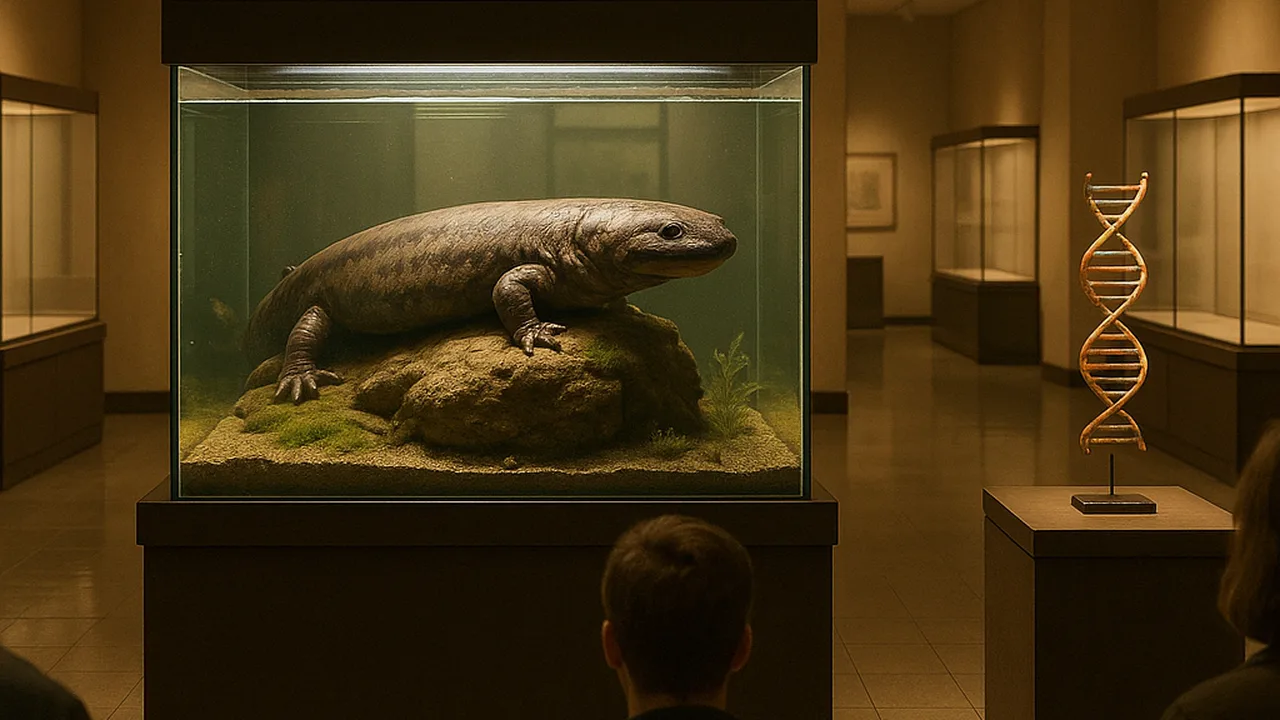
The Regrowth Exhibit
How does a small stump of cells rebuild a whole tail, from the code in DNA to new tissue, and how can we design an exhibit that makes that process clear to museum visitors?
The mystery: A small lizard drops its tail to escape a predator, and over the following weeks a new tail grows from the stump, but the new tail is not an exact copy of the old one.
Questions we will figure out together in this unit:
- Where do the new tail cells come from?
- Do the new cells have the same DNA as the old ones?
- How does a cell know whether to become muscle or skin?
- Why is the new tail made of cartilage instead of bone?
- How fast do cells divide when something is regrowing?
- What tells the cells to stop dividing?
- What does the DNA between genes do?
- Could people ever regrow body parts the way lizards do?
define the museum’s exhibit problem, ask questions about how DNA and chromosomes control growth that we can test or check, and organize our teams for the unit project.
- I can use a model of DNA to ask questions that help clarify how DNA codes for proteins and how those proteins cause traits in an organism.
- I can use a model of DNA to ask questions about how cells regulate which DNA and chromosomes are used.
- I can use a model of DNA to ask questions about the functions of non-protein coding sections of DNA, such as their role in regulation.
- I can ask questions about DNA and chromosomes that scientists could test with experiments or observations.
Phase 1: Spark
Warm-Up ~5 min
Do Now. Read the client letter on the board. Underline every need the museum names, and circle one science word a ten-year-old visitor might not know.
Which is the best first step for a team asked to design a museum exhibit about tail regrowth?
Instruction ~10 min
Meet the client. The education team of a regional natural history museum has written to our class. Its new gallery on living things needs a hands-on tabletop exhibit. The team writes: “Our visitors love the lizard in our live-animal room, especially when we tell them it can regrow its tail. But when we ask how, most say ‘magic’ or ‘it was stored inside.’ We want an exhibit that shows, in a few minutes, how a tail is rebuilt from DNA to tissue. It must be accurate, hands-on, sturdy and cheap to build.”
The driving question. How does a small stump of cells rebuild a whole tail, from the code in DNA to new tissue, and how can we design an exhibit that makes that process clear to museum visitors?
The project. Biologists, you will (1) investigate cell division and DNA in the lab; (2) explain how genes become proteins and proteins make specialized cells; (3) design, test and improve a tabletop exhibit model; and (4) write and present a scientific explanation of tail regrowth that the museum can use as the exhibit’s backing text.
Questions about DNA and chromosomes. Good science starts with good questions. Look at a simple model of DNA: a chromosome is one long DNA molecule; a gene is a stretch of it that codes for a protein; between genes are long stretches that do not code for protein. That model raises questions: How does a cell know which genes to use? What do the stretches between genes do? How does a gene’s code become a protein, and the protein a trait? Some questions are empirically testable: they can be answered by an experiment or an observation. Others need to be sharpened first.
Worked example 1: sharpening a question. Priya asked, “How does the tail know to grow?” Her team rewrote it: “Are more cells in mitosis near the tip of a regrowing tail than in the base of a normal tail?” The new question names what to observe (cells in mitosis), where (two locations) and what to compare. Scientists could test it by counting dividing cells in stained tissue slices.
Worked example 2: a question about regulation. Malik asked, “Do muscle cells and skin cells in the new tail have the same genes?” That is testable: compare DNA sequences from the two cell types. A follow-up is also testable: “Do they use the same genes?” Compare which messenger RNAs each cell type makes. Questions about how cells regulate which DNA is used are at the frontier of biology, and you will meet the evidence in 3.04 and 3.05.
Need-to-knows. Sort the class’s need-to-knows into three bins: the cell (How fast do cells divide? How do they specialize?), the code (How does DNA make a protein? Do all cells keep all genes?) and the exhibit (What do visitors misunderstand? What can they touch in 4 minutes?).
| Need-to-know | Bin (cell, code or exhibit) | Lesson that answers it |
|---|---|---|
Teams and roles. Teams of four rotate weekly: Principal Investigator (keeps the team on the question), Data Analyst (tables, calculations), Lab Manager (materials and safety) and Communicator (shares findings with the class and the client).
Guided Exercises ~15 min
Use the client letter and your initial models from 3.01.
Independent Practice ~10 min
Add to the class Wonder Board.
Write three questions for the Wonder Board: one about how cells divide, one about how a cell decides which genes to use, and one about DNA that scientists could test. For the last, say what they would measure or observe.
Closure ~5 min
We have a client, a driving question and teams. Next phase, we investigate: dividing cells first, then DNA itself.
Exit ticket: rewrite “How does the tail know to grow?” as a question that scientists could test with observations.
Teacher notes
Materials: printed client letter (generic natural history museum), chart paper for the Wonder Board and need-to-knows, role cards, a simple paper chromosome strip with genes and non-coding regions marked.
Setup: keep the Wonder Board and need-to-know chart posted all unit; 3.06 and 3.09 return to them.
Listen for: design before science (“just put a toy lizard on the table”) and untestable “why” questions; coach students to name what would be observed or measured.
Support / stretch: provide question stems (“Does ___ change when ___?”). Stretch: find out what fraction of the human genome codes for protein, cite the source, and add a question it raises.