1.06 Sensor to Sweat: Revising the Body’s Cooling Model
revise my system model of how the body sheds heat, compare it with real body systems, improve our feedback investigation, and brainstorm cooling solutions grounded in the science.
- I can use my model to show how interactions between body systems provide specific functions in multicellular organisms.
- I can compare my model to actual body systems and explain how my model is similar to and different from the real systems.
- I can revise my investigation plan to collect data that is more generalizable if needed.
Phase 3: Make Sense
Warm-Up ~5 min
Do Now. Take out your initial model from 1.01. Circle one part that our labs proved right, and cross out one part you now think is wrong or missing.
Which lab gave evidence that the body must keep its temperature in a narrow range?
Instruction ~10 min
Pulling the science together. We now have evidence at three levels. Cells: membranes let water cross by osmosis, so losing water and salt in sweat changes cell volume (1.03). Proteins: enzymes work best near 37 °C and denature above about 40 °C (1.05). Whole body: negative feedback pulls a variable back to its set point, with corrections that shrink as it gets closer (1.04). A revised model links all three.
The revised cooling model.
- Sensors: temperature receptors in the skin and in the brain.
- Control center: the hypothalamus compares core temperature with a set point near 37 °C.
- Effectors: sweat glands (integumentary), smooth muscle in skin blood vessels (circulatory), the heart, which beats faster to supply both skin and muscles, and the kidneys, which save water when the hypothalamus signals the pituitary gland to release antidiuretic hormone (ADH) during dehydration (excretory and endocrine).
- Heat flows: in from muscles, sun and hot air; out mainly by evaporation of sweat.
Worked example 1: one interaction, explained. Priya’s team wrote: “Sweating moves water out of the blood. Blood volume falls, so each heartbeat pumps less blood and the heart beats faster to keep blood moving to muscles and skin. The kidneys make less urine to save water. Three systems respond to one change.” Each sentence names a system and what it does for the others.
Worked example 2: model versus reality. Jamal’s model drew one arrow from the hypothalamus to “sweat.” Real bodies have millions of sweat glands, nerve signals that travel in both directions, hormones that act more slowly than nerves, and set points that shift (during a fever the set point rises). He added a note: “My model shows the main loop but not the timing or the number of parts.” Naming how a model differs from the real system is part of using it well.
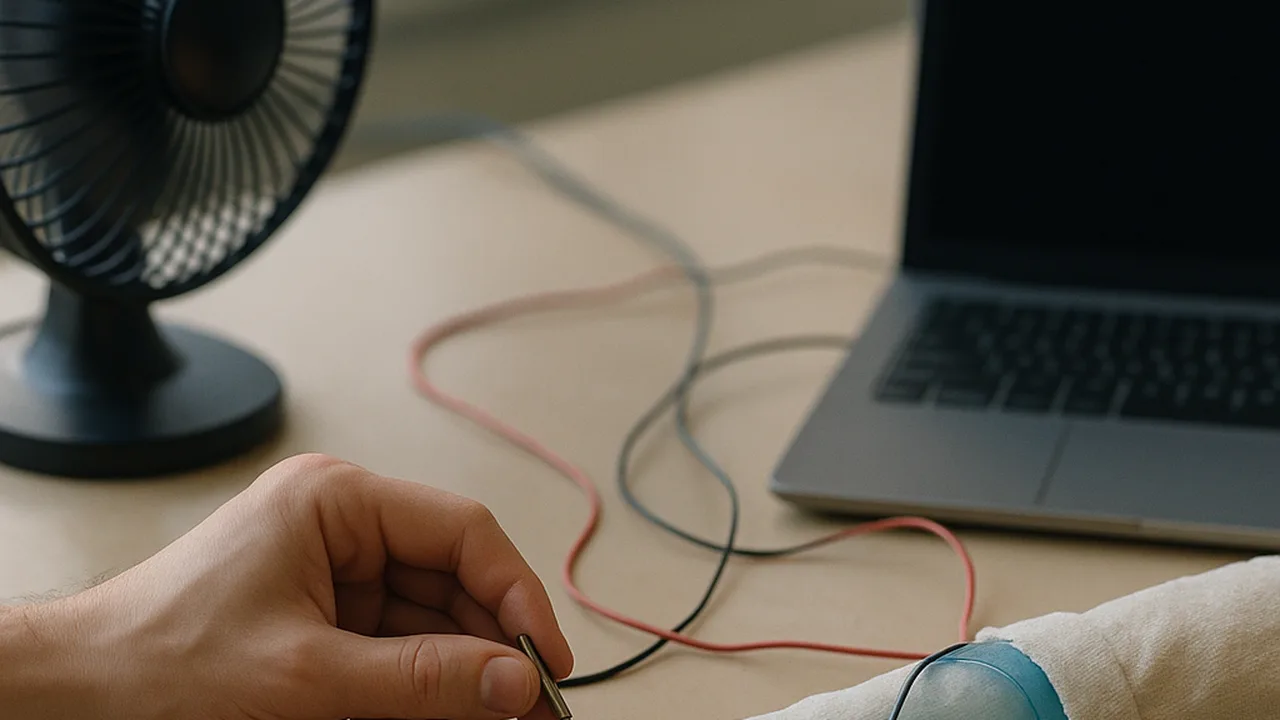
Improving the investigation. Our pulse data came from one class, in one room, on one day, with 15-second counts. To make it more generalizable, we could test more people, repeat each person three times, record room temperature and humidity, use a pulse sensor instead of counting, and compare a cool room with a warm room. A revised plan states what will change and why the new data would be stronger evidence.
Ideate. Now brainstorm how to help the body when heat pushes the loop to its limit. Good ideas target a specific step: increase evaporation (wet, breathable fabric plus airflow), reduce heat gain (shade, light colors), replace water and salt (drink schedule), and lower muscle heat (work-rest cycles).
| Idea | Loop step it helps | Science that supports it | Object, process or system? |
|---|---|---|---|
Guided Exercises ~15 min
Revise your model with your team, then answer on your own.
Independent Practice ~10 min
Finalize your revised model.
Draw your revised cooling model with at least four organ systems. Under it, write three ways it is similar to the real body and two ways it is different.
Ideate: list at least four cooling ideas in the table. Star the two your team will develop, and explain the science behind each.
Closure ~5 min
Revisit the Wonder Board: mark every question we can now answer. Next phase, we build.
Exit ticket: explain how a problem in one body system (sweat glands working hard) shows up in another system.
Teacher notes
Materials: students’ 1.01 models, colored pencils, chart paper, the class Wonder Board and need-to-know chart.
Listen for: models with arrows but no named interactions; “the brain cools the body” (the brain controls; effectors cool).
Support / stretch: provide a loop template with blank boxes. Stretch: add the timing of nerve versus hormone signals and explain why sweating starts in seconds while water-saving by the kidneys takes longer.