3.03 Onion Root Tips: Counting the Cell Cycle
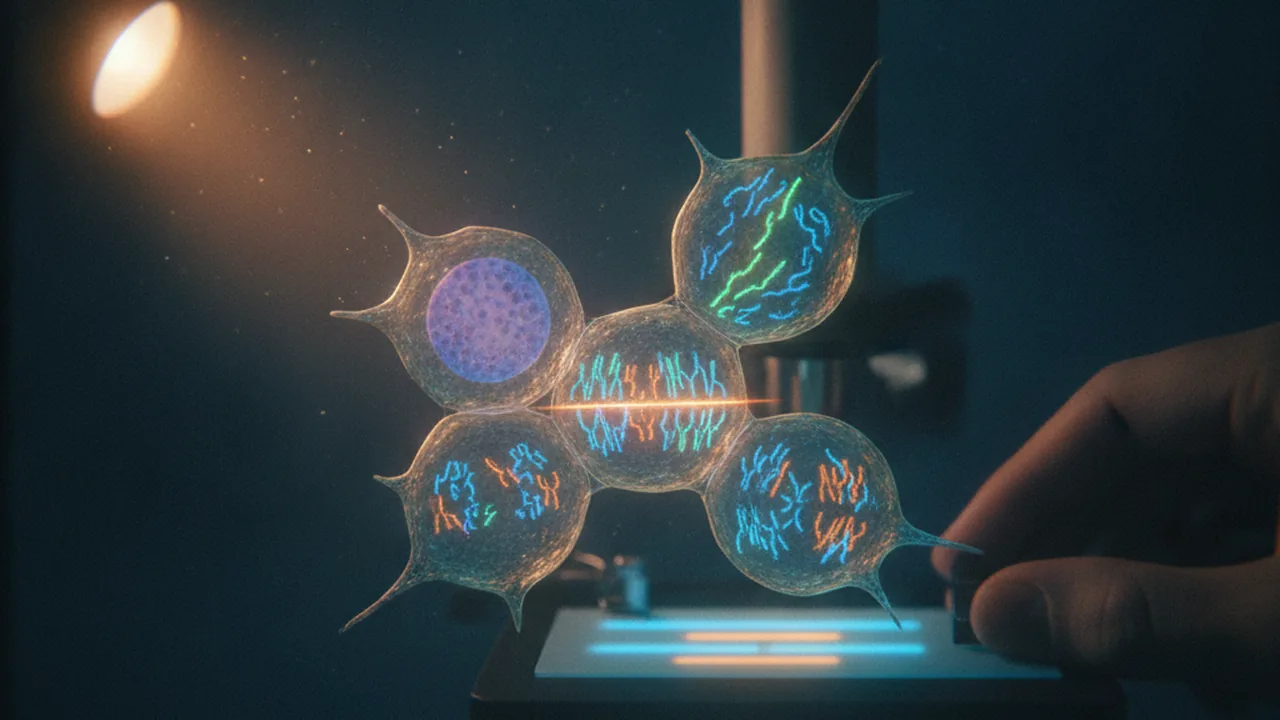
identify the stages of mitosis in onion root tip cells, count cells in each stage, and use the counts to estimate how long each stage lasts and where the root grows.
- I can identify and describe how genetic material from both parents is represented in a model of mitosis and differentiation.
- I can identify and describe parent and daughter cells as shown in a model of mitosis.
- I can identify and describe how a model shows a multicellular organism as a collection of differentiated cells.
- I can use a model to show that mitotic cell division results in more cells, allowing the organism to grow.
- I can use a model to show that new cells from mitosis can differentiate to create different cell types.
- I can use a model to show that mitosis can replace dead cells to help maintain a complex organism.
Phase 2: Investigate
Warm-Up ~5 min
Do Now. A photo of a crowd is taken at one instant. If 10 of 100 people are sneezing in the photo, what can you guess about how much of the time people spend sneezing? What would you need to assume?
In a snapshot of a growing root tip, which stage do you expect to find most cells in?
Instruction ~10 min
Why onion roots? A plant grows longer at the tips of its roots and shoots, in regions called meristems, where cells divide rapidly. Just behind the root tip is a zone where cells lengthen, and behind that a zone where they differentiate into specialized cells. Onion (Allium cepa) root tips are a classic tissue for seeing mitosis because onion cells have only 16 chromosomes, which are large and easy to stain. Commercial prepared slides show thin, stained slices through the tip.
Recognizing the stages. In interphase the nucleus is round and evenly stained, with no separate chromosomes visible. In prophase the chromosomes appear as threads inside the nucleus. In metaphase they form a line across the middle of the cell. In anaphase two groups of chromosomes move apart, often in a V shape. In telophase two dense clusters sit at opposite ends and a new cell wall (the cell plate) begins to form between them. Plant cells cannot pinch in two the way animal cells do, because of the rigid wall, so they build a new wall down the middle.
Worked example 1: from counts to time (illustrative data). A slide is a snapshot. If cells are dividing at random times, the fraction of cells caught in a stage is proportional to the fraction of the cycle that stage takes. That is the key assumption behind today’s calculation. Suppose a group counts 250 cells: 205 in interphase, 26 in prophase, 9 in metaphase, 4 in anaphase and 6 in telophase. The fraction in prophase is 26 ÷ 250 = 0.104. If the whole cycle takes about 24 hours (an assumed value for this example; published estimates for onion root tips vary with temperature), prophase lasts about 0.104 × 24 = 2.5 hours, or about 150 minutes. Metaphase: 9 ÷ 250 = 0.036, and 0.036 × 1,440 minutes ≈ 52 minutes. Anaphase: 4 ÷ 250 = 0.016, about 23 minutes. Telophase: 6 ÷ 250 = 0.024, about 35 minutes. Interphase: 205 ÷ 250 = 0.82, about 19.7 hours.
Worked example 2: the mitotic index. The mitotic index is the fraction of cells in any stage of mitosis: (26 + 9 + 4 + 6) ÷ 250 = 45 ÷ 250 = 0.18, or 18%. A higher mitotic index means more cells are dividing. Comparing the index at the very tip with the index a few millimeters back is a direct test of where the root grows. If 50 cells counted 2 mm back include only 2 in mitosis, that index is 2 ÷ 50 = 4%.
Why pool data? Anaphase is short, so a single group might count only one or two anaphase cells, and one miscounted cell changes the estimate a lot. Pooling the whole class’s counts gives a larger sample and a steadier estimate. The pattern you should expect, and should test rather than assume, is that interphase takes most of the cycle and anaphase is the shortest stage.
Reading the model. Each slide is also a model of growth: the parent cells in the meristem give rise to daughter cells with the same chromosomes, those daughters move into the elongation zone as new cells are made below them, and further back they differentiate into root hairs and transport cells. One slide shows the whole story, division to differentiation, laid out in space.
Lab procedure: mitosis counts in onion root tips. Question: what fraction of the cell cycle does each stage of mitosis take, and are more cells dividing at the tip than further back?
- Optional, one week before: suspend an onion bulb over a cup of water with toothpicks so the base touches the water. Measure the longest root each school day and record its length.
- Focus the prepared slide at 40x and find the root cap and the meristem just behind it, where cells are small and square with large nuclei. Switch to 400x.
- Starting at one edge of the meristem, classify every cell in the field as interphase, prophase, metaphase, anaphase or telophase. Record tallies. Move to an adjacent field and continue until you have classified at least 100 cells.
- Move about 2 mm back from the tip, into the zone where cells are longer, and classify 50 more cells there.
- Enter your counts in the class table and total each column.
- Using the class totals and an assumed 24-hour cycle, calculate the mitotic index and the time spent in each stage.
| Stage | Our count (meristem) | Class total | Fraction of cells | Estimated time (min) |
|---|---|---|---|---|
| Interphase | ||||
| Prophase | ||||
| Metaphase | ||||
| Anaphase | ||||
| Telophase | ||||
| Total / mitotic index | — | |||
| 2 mm back: dividing / total | — |
No microscope? Use the illustrative field-by-field record your teacher provides: four meristem fields totaling 250 cells, plus one field of 50 cells 2 mm back from the tip. Total the columns yourself and do the same calculations. It earns full credit.
Reading: OpenStax Biology 2e, section 10.2, The Cell Cycle (CC BY 4.0).
Guided Exercises ~15 min
Use your tallies and the class table.
Independent Practice ~10 min
Finish your lab analysis.
Rank the stages from longest to shortest using the class data. Does your ranking match OpenStax Biology 2e, section 10.2? Then explain what would go wrong with the method if most cells divided at the same time of day.
Name two sources of error in classifying cells (for example, cells cut at an angle, or prophase confused with interphase) and how you would reduce each.
Closure ~5 min
We know where and how fast cells divide. Next, we look at the DNA every new cell inherits.
Exit ticket: what is the mitotic index, and what does a high mitotic index in a regrowing tail tip tell a biologist?
How confident are you that you can identify mitotic stages under the microscope and estimate their durations from counts.
Teacher notes
Materials: compound microscopes (40x–400x), prepared stained onion root tip slides (longitudinal section, one per pair), tally sheets or counters, calculators, goggles; optional onion bulbs, clear cups and toothpicks.
Timing: this lab spans two 50-minute periods: counting on day 1, pooling and calculations on day 2.
Listen for: “interphase is a resting phase” (the cell is growing and copying DNA); counting the same cell twice across fields; using percentages where fractions of 1,440 minutes are needed.
Support / stretch: give a stage-identification card with photos. Stretch: compare each group’s anaphase-duration estimate with the pooled class estimate, and explain why the shortest stages give the noisiest estimates.