3.05 From Gene to Protein: Modeling Transcription and Translation
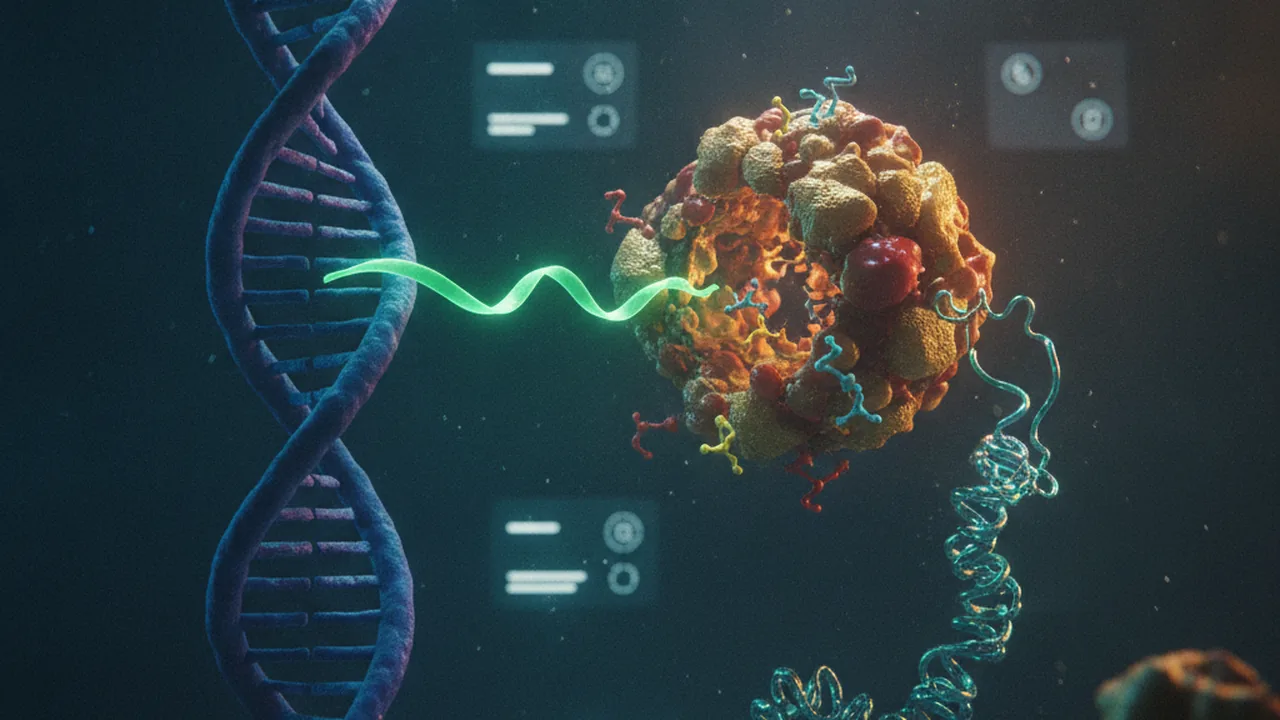
transcribe a DNA template into mRNA, translate the mRNA into amino acids with the genetic code, and explain how a change in one base can change a protein’s structure and the function of a tissue.
- I can explain how genes, which are regions of DNA, determine the structure of proteins that carry out essential functions in specialized cells.
- I can use reasoning to connect evidence and scientific principles to explain how genes in DNA code for proteins in all cells.
- I can describe how specialized cells in tissues rely on proteins to carry out their functions, and how proper protein function is necessary for cells to work correctly.
- I can explain how changes in gene sequences can affect protein function and, in turn, the function of body tissues.
- I can use a model of DNA to ask questions that help clarify how DNA codes for proteins and how those proteins cause traits in an organism.
- I can use a model of DNA to ask questions about how cells regulate which DNA and chromosomes are used.
- I can use a model of DNA to ask questions about the functions of non-protein coding sections of DNA, such as their role in regulation.
Phase 3: Make Sense
Warm-Up ~5 min
Do Now. A recipe written in a book that never leaves the library must still get to the kitchen. Describe two ways a cook could get the recipe without taking the book.
DNA stays in the nucleus, but proteins are built in the cytoplasm. How does the information get out?
Instruction ~10 min
The central idea. DNA stays in the nucleus, but proteins are built on ribosomes in the cytoplasm. The cell copies a gene’s information into a messenger molecule and carries it out. The flow of information is DNA → RNA → protein. Proteins then do the work: enzymes such as catalase, structural proteins such as keratin, motor proteins such as myosin, and signals such as insulin. A protein’s function depends on its shape, and its shape depends on the order of its amino acids.
Transcription. An enzyme called RNA polymerase unzips a short section of DNA and builds a strand of messenger RNA (mRNA) that is complementary to one DNA strand, the template strand. RNA uses uracil (U) in place of thymine, so the pairing rules are: template A → mRNA U, T → A, G → C and C → G. Whether a gene is transcribed at all depends on proteins called transcription factors, which bind to DNA near the gene, often at non-coding stretches that act as switches. This is one way a muscle cell and a skin cell, with the same genes, end up making different proteins.
Worked example 1: transcription. The template TAC AAA CCG TTT ATT is transcribed as AUG UUU GGC AAA UAA.
Translation. At the ribosome, the mRNA is read three bases at a time. Each triplet is a codon. Transfer RNA molecules carry amino acids and match their anticodons to the codons, and the ribosome links the amino acids into a chain. Why three bases? There are 20 amino acids. Codons of two bases would give only 42 = 16 combinations, not enough; three bases give 43 = 64, enough for all 20 plus start and stop signals.
Worked example 2: translation. Using the standard genetic code table (OpenStax Biology 2e, section 15.1), our mRNA AUG UUU GGC AAA UAA reads: AUG = methionine (the start codon), UUU = phenylalanine, GGC = glycine, AAA = lysine, UAA = stop. The protein fragment is Met-Phe-Gly-Lys. Because several codons can code for the same amino acid (GAA and GAG both code for glutamic acid), the code is described as redundant.
When one base changes. A point mutation changes a single base. Its effect depends on where it lands:
- A silent mutation changes a codon to another codon for the same amino acid: GAA → GAG still gives glutamic acid.
- A missense mutation changes the amino acid. In sickle cell disease, the sixth codon of the β-globin gene changes from GAG to GUG, so glutamic acid becomes valine. That one change makes hemoglobin molecules stick together when oxygen is low, which bends red blood cells into a sickle shape; the stiff cells can block small blood vessels, so a change in one gene affects a whole tissue.
- A nonsense mutation creates a stop codon early. AUG GCU UGG AAA UAG (Met-Ala-Trp-Lys) becomes AUG GCU UGA … if the G in UGG changes to A, and the chain stops after two amino acids.
- An insertion or deletion of one base shifts the reading frame, changing every codon after it.
Back to the lizard. A regrowing tail needs collagen and cartilage proteins in its new support tube, contractile proteins in its muscle and keratin in its scales. The cells all carry the same genes; each cell type transcribes a different set of them. The model you build today connects the level of the gene to the level of the tissue.
Lab procedure: paper and bead model of protein synthesis. Question: how does a sequence of DNA bases determine a sequence of amino acids, and what happens to the protein when one base changes?
- Place the DNA template strip on the table labeled ‘nucleus’. Write the complementary mRNA bases on a blank strip, using U in place of T.
- Carry the mRNA strip to the table labeled ‘ribosome’. Mark off codons in groups of three from the start codon AUG.
- Use the codon table to pick the matching amino-acid card or bead for each codon, and thread the beads on a pipe cleaner in order until you reach a stop codon.
- Mutate your gene. Choose one: Option A changes one base of the template, Option B deletes one base, Option C changes a different base. Write the mutated template out in full, then repeat steps 1–3 with it.
- Compare the two chains and classify the mutation as silent, missense, nonsense or frameshift.
| DNA template | mRNA | Amino-acid sequence | |
|---|---|---|---|
| Original gene | |||
| Mutated gene | |||
| Type of mutation |
Reading: OpenStax Biology 2e, chapter 15, Genes and Proteins, and section 16.2 (CC BY 4.0); NHGRI Talking Glossary entries for transcription and translation (public domain).
Guided Exercises ~15 min
Use your strips, beads and the codon table.
Independent Practice ~10 min
Analyze your mutation.
Show your original and mutated chains, classify the mutation, and predict whether the protein would still work. Then name one way your paper model is unlike real transcription and translation and why the difference matters or does not.
Closure ~5 min
We can now trace the code from gene to protein. Next lesson, we put every level of the tail model together.
Exit ticket: explain how the order of bases in a gene determines the shape, and so the function, of a protein in a specialized cell.
How confident are you that you can transcribe and translate a gene and explain how one base change can change a protein and a tissue.
Teacher notes
Materials: DNA template strips (four genes) and blank mRNA strips, codon table cards, pop beads in 20 colors with a key or amino-acid cards, pipe cleaners, scissors, tape; devices for the PhET sim.
Timing: this workshop spans two 50-minute periods: the model and sim on day 1, mutations and explanation on day 2.
Listen for: reading the DNA template directly as codons (transcribe first); “mutations are always harmful”; “each amino acid has one codon”. PhET link: confirm the Gene Expression Essentials sim loads on school devices before class; the printed diagram is the backup.
Support / stretch: give a pre-filled first codon. Stretch: find the shortest change to the TAC AAA CCG TTT ATT template that stops the chain after one amino acid.