compare the extent, interaction and impact of African, European, American and Asian trade networks; describe how new sources of wealth affected cultures; compare the origins, development and effects of coerced labor systems; and explain how geography shaped the availability and movement of resources.
Instruction
By 1600 the world’s trade networks had begun to join into one. African, European, American and Asian networks, each already long established, now met at ports, mines and rivers. This lesson asks three questions. What moved along those networks? What new wealth did they create, and for whom? And what kinds of labor produced the goods? Adam Smith, writing in 1776, called the discovery of America and the passage to the East Indies “the two greatest and most important events recorded in the history of mankind.” He also wrote that for the natives “all the commercial benefits” were “sunk and lost in the dreadful misfortunes which they have occasioned.” Keep both of his claims in mind.
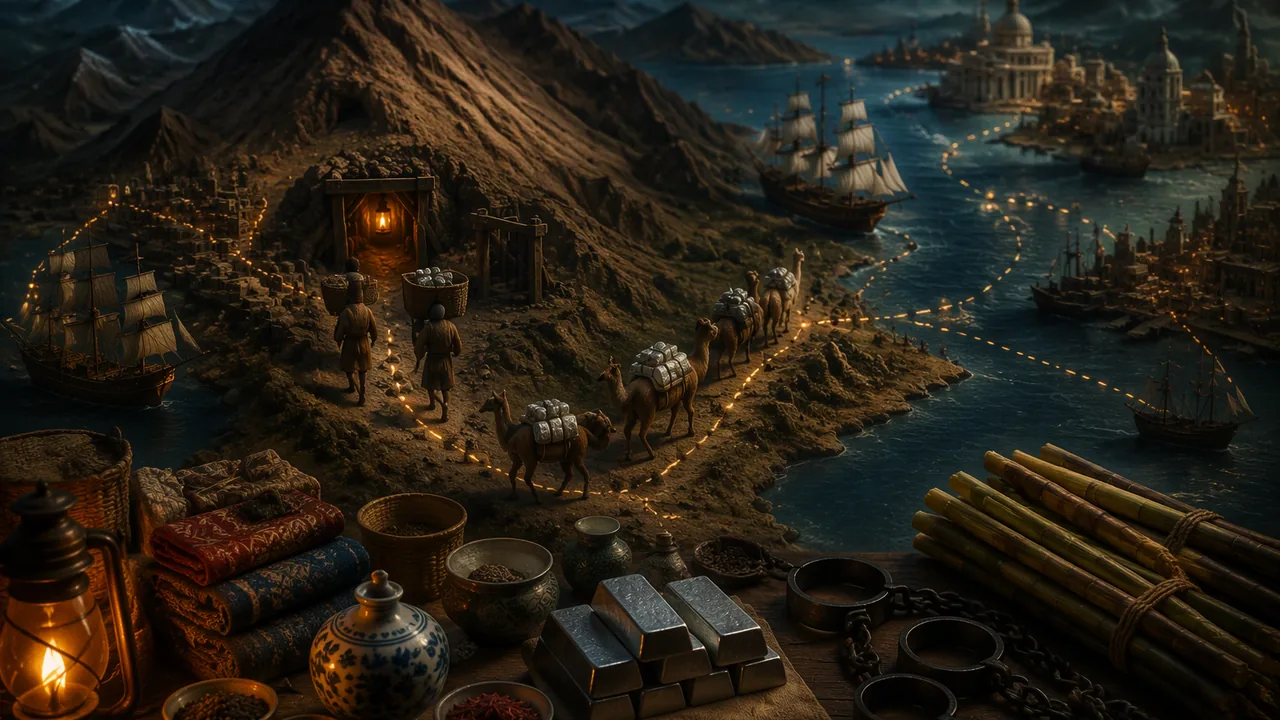
Silver and the geography of resources. Resources are not spread evenly; geography decides where they are and how hard they are to move. The Cerro Rico (“rich mountain”) above Potosí in the high Andes was credited to a prospector in 1545 and became the major supply of silver for the Spanish Empire. Indigenous laborers were required to work its mines through the Spanish mita system of forced labor, drawn from an area of almost 200,000 square miles. The silver crossed the Atlantic to Spain and the Pacific by way of the Manila galleon route to Asia, where it bought goods. A mountain at 4,000 meters changed the economies of three continents.
Coerced labor, compared. Many societies used labor that people could not refuse. In the Americas, the Spanish encomienda and the mita forced Indigenous people to work, and from about 1450 the sugar plantations of Madeira and the Canary Islands, and then the Americas, used slaves brought from sub-Saharan Africa. The current estimate is that about 12.75 million Africans were loaded onto slave ships for the Americas, and up to 2 million died on the voyage. About 8 million Africans were enslaved and remained on the African continent. In Europe, serfdom persisted in Russia, where agricultural kholops had been converted into serfs in 1679 and where Peter the Great’s 1721 decree let factory owners buy serfs. In the Ottoman Empire, the devshirme forcibly recruited children of Balkan Christian families to serve as soldiers and officials. These systems differed in origin and effects, but each bound the worker to someone else’s will.
The voice of the enslaved. Equiano, kidnapped as a boy, describes a slave ship with “a multitude of black people of every description chained together.” He says the crowding “almost suffocated us” and the heat and sickness caused many to die “thus falling victims to the improvident avarice, as I may call it, of their purchasers.” His narrative is a first-person source set against the numbers, which cannot convey what the voyage was.
Fur, rivers and the middle of the continent. The fur trade shows a network in North America. European contact with North America made the continent a major supplier of fur pelts in the seventeenth century, particularly beaver for the fur felt hat trade of Europe. In 1673 Marquette and Jolliet floated past the mouth of the Missouri River, where “large and entire trees, branches, and floating islands” came out with such force that passage was dangerous. Farther down the Mississippi he met people who had “guns, hatchets, hoes, Knives, beads,” who told him they “bought cloth and all other goods from the Europeans who lived to The east.” European goods had reached the middle of the continent along Indigenous trade routes before most Europeans had. Within two generations the Osage, who allied with the French in 1724, controlled much of the Illinois Country west of the Mississippi, and Pierre Laclède and his stepson Auguste Chouteau, fur traders, founded St. Louis in 1764 in what was then Spanish Upper Louisiana. By the late eighteenth century the Osage did extensive business with René Auguste Chouteau of St. Louis. The Missouri and Mississippi rivers were the highways of that network.
New wealth and its effects. Silver, sugar, tobacco and fur made merchants, ports and governments rich, and in Europe they helped support new tastes and new classes of consumers. They also hardened systems of coerced labor and, for the Osage and other nations, tied their economies to markets they did not control. When you judge the impact of new wealth, ask who got it, who made it, and what happened to the people and places where it was made.
📖 Read for this lesson
The reading opens over the lesson; close it to come back to exactly where you were. The checks below draw on it.
Formative check
Work through these before moving on. They are not graded — they tell you whether the standard below has landed yet.
Missouri standard: 9-12.WH.3.EC.C
Which sentence from Adam Smith best expresses his view of the effect of the new routes on the native peoples?
Missouri standard: 9-12.WH.3.EC.B
The mita was a system of forced labor in the silver mines of Potosí.
Missouri standard: 9-12.WH.3.EC.B
The current estimate is that about million Africans were loaded onto slave ships for the Americas, and up to million died on the voyage.
Missouri standard: 9-12.WH.3.EC.A
In Marquette’s 1673 journal, what did the people he met on the Mississippi have that shows European goods had reached the interior?
Missouri standard: 9-12.WH.3.G.A
Why is the Cerro Rico at Potosí an example of how physical geography affects the availability and movement of resources?
Missouri standard: 9-12.WH.3.EC.A, 9-12.WH.3.EC.B, 9-12.WH.3.EC.C, 9-12.WH.3.G.A
Choose three commodities (silver, sugar or tobacco, and fur). For each give the source region, the route it traveled, the destination, who labored to produce it, and under what system. Then write two sentences comparing two of the coerced labor systems in the lesson, using a figure or a quotation as evidence.
How confident are you that you can compare early modern trade networks and coerced labor systems, and explain how new wealth and geography shaped them?
Practice
Work these on paper or in your notebook, then open Check your answer. Aim for all of Fluency and Application; try at least one Challenge.
Printable version: this unit’s practice workbook (PDF)
Fluency
Build speed and accuracy with the core skill.
- About 12.75 million Africans were loaded onto slave ships and up to 2 million died on the voyage. What is the largest percent that died, to one decimal place?
Check your answer
Answer: 2 / 12.75 = 0.1569, so up to about 15.7 percent.Divide deaths by the number loaded and convert to a percent. - Marquette traveled the Mississippi in 1673 and St. Louis was founded in 1764. How many years apart?
Check your answer
Answer: 1764 – 1673 = 91 years.Subtract.
Application
Use the skill in context. Show your reasoning.
- At the mouth of the river he calls the Pekitanoui, what did Marquette hope to find by following it, according to his journal?
Check your answer
Answer: He hoped that by ascending the river he would find a route to the western sea; he writes that he hopes by its means to reach it.Marquette treats the Missouri River as a possible road to another ocean. - Name two coerced labor systems from the lesson, one in the Americas and one outside it, and give one effect of each.
Check your answer
Answer: Americas: mita (Indigenous workers forced into the Potosí mines; silver for Spain) or plantation slavery (millions of Africans transported; many died). Outside: Russian serfdom (peasants tied to land until 1861) or devshirme (Christian children forcibly taken to serve the Ottoman state).Different origins and effects; compare, do not merge them. - Equiano says the crowding and heat “almost suffocated us.” What kind of source is his narrative, and what can it tell a historian that the shipping numbers cannot?
Check your answer
Answer: A first-person account written years later. It shows the experience of those on board, which a count of people loaded and lost does not. It should be checked against other evidence because it was written in 1789 about events in his childhood.Numbers and testimony answer different questions.
Review
Keep earlier skills sharp.
- Review (sourcing): Marquette’s journal reaches us through a translation in the Jesuit Relations. Name one reason a historian checks the edition.
Check your answer
Answer: Editors and translators made choices (including the spelling of the Missouri River as Pekitanoui and period words for Native peoples), and the journal’s authorship has been debated; knowing the edition lets the reader judge how close the text is to the original.The edition is part of the evidence.
Silver, Slaves and Furs: Three Witnesses to the First Global Economy
Adam Smith, An Inquiry into the Nature and Causes of the Wealth of Nations (1776), Book IV, chapter 7, Project Gutenberg #3300; Olaudah Equiano, The Interesting Narrative of the Life of Olaudah Equiano (London, 1789), chapter 2, Project Gutenberg #15399; Jacques Marquette, journal of the 1673 voyage with Louis Jolliet, in The Jesuit Relations and Allied Documents, ed. R. G. Thwaites, vol. 59 (Cleveland, 1899), text at the Kripke Center, Creighton University · Public domain
Why this reading. Lesson 5.6 asks you to compare trade networks, new sources of wealth and systems of coerced labor. These are three first-hand witnesses. An economist in 1776 says what the new trade routes were worth, and who paid for them. A man who was kidnapped in West Africa as a boy describes the ship that carried him across the Atlantic. A French Jesuit canoeing the Mississippi in 1673 records how far European trade goods had already reached into the middle of North America, and what he found at the mouth of the Missouri River.
A. What the new routes were worth, and who paid
Adam Smith, The Wealth of Nations (1776), Book IV, chapter 7. Project Gutenberg #3300. Public domain.
“The discovery of America, and that of a passage to the East Indies by the Cape of Good Hope, are the two greatest and most important events recorded in the history of mankind. Their consequences have already been great; but, in the short period of between two and three centuries which has elapsed since these discoveries were made, it is impossible that the whole extent of their consequences can have been seen. What benefits or what misfortunes to mankind may hereafter result from those great events, no human wisdom can foresee.”
“To the natives, however, both of the East and West Indies, all the commercial benefits which can have resulted from those events have been sunk and lost in the dreadful misfortunes which they have occasioned. These misfortunes, however, seem to have arisen rather from accident than from any thing in the nature of those events themselves. At the particular time when these discoveries were made, the superiority of force happened to be so great on the side of the Europeans, that they were enabled to commit with impunity every sort of injustice in those remote countries.”
B. A boy crosses the Atlantic
Olaudah Equiano, The Interesting Narrative of the Life of Olaudah Equiano, or Gustavus Vassa, the African (1789), chapter 2. Project Gutenberg #15399. Public domain. The passage describes violence and suffering. Equiano wrote in 1789 about events in his childhood; his account of his birthplace and of the voyage has been studied and debated by historians, and it remains one of the most-read first-person accounts of the Middle Passage.
“The first object which saluted my eyes when I arrived on the coast was the sea, and a slave ship, which was then riding at anchor, and waiting for its cargo. These filled me with astonishment, which was soon converted into terror when I was carried on board. I was immediately handled and tossed up to see if I were sound by some of the crew; and I was now persuaded that I had gotten into a world of bad spirits, and that they were going to kill me. Their complexions too differing so much from ours, their long hair, and the language they spoke, (which was very different from any I had ever heard) united to confirm me in this belief. Indeed such were the horrors of my views and fears at the moment, that, if ten thousand worlds had been my own, I would have freely parted with them all to have exchanged my condition with that of the meanest slave in my own country. When I looked round the ship too and saw a large furnace or copper boiling, and a multitude of black people of every description chained together, every one of their countenances expressing dejection and sorrow, I no longer doubted of my fate; and, quite overpowered with horror and anguish, I fell motionless on the deck and fainted.”
“The closeness of the place, and the heat of the climate, added to the number in the ship, which was so crowded that each had scarcely room to turn himself, almost suffocated us. This produced copious perspirations, so that the air soon became unfit for respiration, from a variety of loathsome smells, and brought on a sickness among the slaves, of which many died, thus falling victims to the improvident avarice, as I may call it, of their purchasers. This wretched situation was again aggravated by the galling of the chains, now become insupportable; and the filth of the necessary tubs, into which the children often fell, and were almost suffocated. The shrieks of the women, and the groans of the dying, rendered the whole a scene of horror almost inconceivable.”
C. The Mississippi and the Missouri in 1673
Jacques Marquette, journal of the 1673 voyage down the Mississippi, in The Jesuit Relations and Allied Documents, vol. 59, edited by Reuben G. Thwaites, text hosted by the Kripke Center, Creighton University. Public domain. The translation uses “savages” and other period words, and the edition reproduces Marquette’s Pekitanoui for the Missouri River. Bracketed page numbers of the printed volume are removed.
“An accumulation of large and entire trees, branches, and floating islands, was issuing from The mouth of The river pekistanouï, with such impetuosity that we could not without great danger risk passing through it. So great was the agitation that the water was very muddy, and could not become clear. Pekitanouï is a river of Considerable size, coming from the Northwest, from a great Distance; and it discharges into the Missisipi.”
“They have guns, hatchets, hoes, Knives, beads, and flasks of double glass, in which they put Their powder. They wear Their hair long, and tattoo their bodies after the hiroquois fashion. The women wear head-dresses and garments like those of the huron women. They assured us that we were no more than ten days’ journey from The sea; that they bought cloth and all other goods from the Europeans who lived to The east, that these Europeans had rosaries and pictures; that they played upon Instruments; that some of them looked Like me, and had been received by these savages kindly.”
About these excerpts. Every excerpt is word for word, with footnote numbers and printed page numbers removed. Passages not shown are omitted, not changed.
Sources: Adam Smith, The Wealth of Nations (Project Gutenberg #3300) (gutenberg.org); The Interesting Narrative of the Life of Olaudah Equiano (Project Gutenberg #15399) (gutenberg.org); The Jesuit Relations and Allied Documents, vol. 59 (Kripke Center, Creighton University) (moses.creighton.edu)