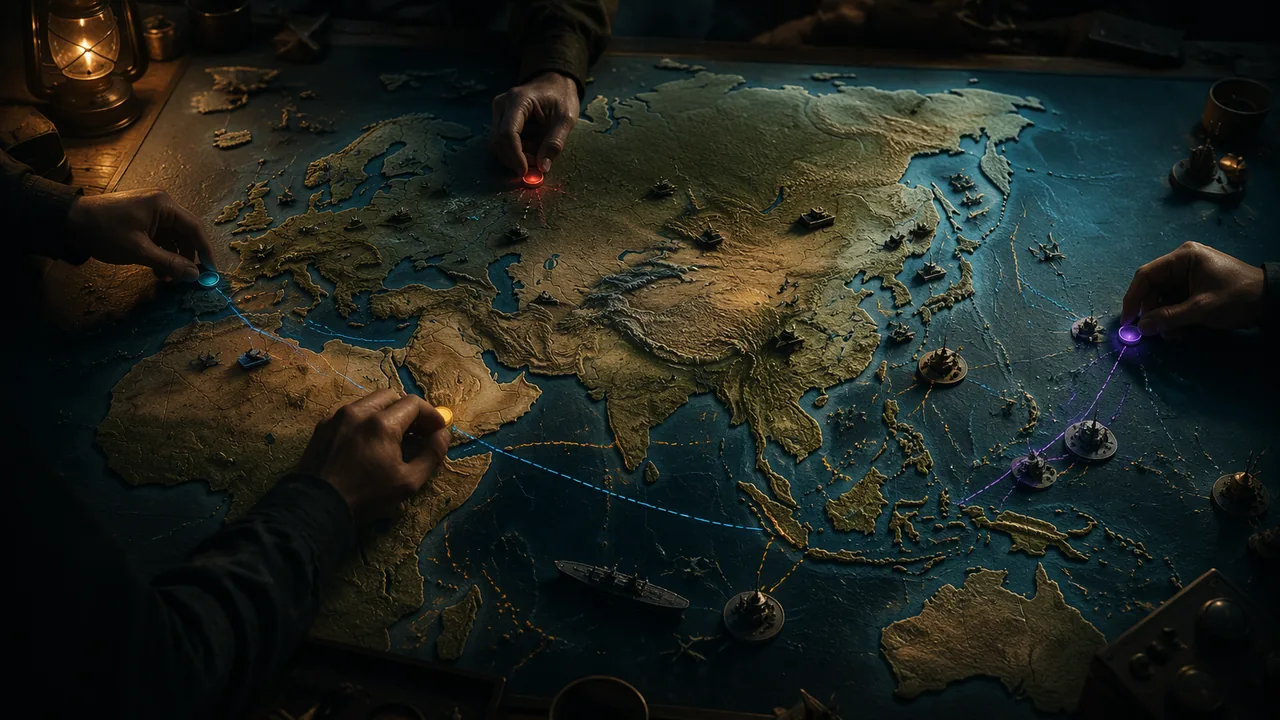
locate the Allied and Axis powers, explain the major turning points, principal theaters and key strategic decisions of the war with emphasis on geography, describe its principal leaders, and explain the outcomes of the wartime conferences.
Instruction
The two sides. The Axis: Germany, Italy and Japan (Tripartite Pact, 1940), with Hungary, Romania, Bulgaria and puppet states in Slovakia and Croatia. The Allies: Britain and its empire and Commonwealth, France (until its defeat in 1940, then the Free French under Charles de Gaulle), China, the Soviet Union from June 1941, the United States from December 1941, and many others, including Poland’s government-in-exile and, from 1942, Mexico and Brazil.
1939-1941: the Axis advance. Germany’s Blitzkrieg — tanks and aircraft concentrated for fast breakthroughs — conquered Poland, then Denmark, Norway, the Netherlands, Belgium and France by June 1940. Geography: the English Channel saved Britain; Germany could not invade without control of the air, and lost the Battle of Britain in 1940. On 22 June 1941 Germany invaded the Soviet Union. Geography again: vast distances, poor roads, autumn mud and winter cold stopped the Germans outside Moscow in December 1941.
The Pacific. Japan needed oil; when the United States and others cut off oil exports in 1941, Japan’s leaders decided to seize the oil of the Dutch East Indies and to strike the U.S. Pacific Fleet first. On 7 December 1941 Japan attacked Pearl Harbor and, within hours, the Philippines, Malaya and Hong Kong. By mid-1942 Japan controlled a huge ocean empire. Geography: the Pacific’s distances made aircraft carriers and island bases decisive.
Turning points, 1942-1943.
- Midway (June 1942): the U.S. Navy, having broken Japanese codes, sank four Japanese carriers; Japan never again took the offensive at sea.
- El Alamein (October-November 1942): British and Commonwealth forces stopped the Axis drive toward the Suez Canal in Egypt.
- Stalingrad (August 1942-February 1943): the Soviet army encircled and destroyed a German army on the Volga, the war’s bloodiest battle; after the German defeat at Kursk in July 1943, the Red Army advanced west almost continuously.
Key strategic decisions. “Europe first”: the United States and Britain agreed to defeat Germany before Japan. “Unconditional surrender” (Casablanca, 1943): no negotiated peace. Strategic bombing of cities. “Island hopping” in the Pacific: seize key islands, bypass others. And the timing of a second front in France, which Stalin demanded for years: it came on D-Day, 6 June 1944, when Allied troops landed in Normandy.
The end. Germany surrendered on 8 May 1945 after Soviet troops took Berlin and Hitler killed himself. In the Pacific, Americans fought through Iwo Jima and Okinawa; the United States dropped atomic bombs on Hiroshima (6 August) and Nagasaki (9 August), the Soviet Union declared war on Japan (8 August), and Emperor Hirohito announced surrender on 15 August. Japan signed on 2 September 1945.
Leaders (WH.10.8.4). Allied: Winston Churchill (Britain), Franklin D. Roosevelt and, after his death in April 1945, Harry Truman (United States), Joseph Stalin (Soviet Union), Chiang Kai-shek (China), Charles de Gaulle (Free France); generals Dwight Eisenhower (Europe), Douglas MacArthur (Southwest Pacific) and Georgy Zhukov (Soviet Union). Axis: Adolf Hitler, Benito Mussolini (overthrown 1943, killed 1945), Emperor Hirohito, and General Hideki Tojo, Japan’s prime minister from 1941 to 1944.
Conferences and resolutions. Tehran (1943) agreed on the second front. Yalta (February 1945) agreed to divide Germany into occupation zones, promised free elections in liberated Europe, set Soviet entry into the Pacific war, and planned the United Nations. Potsdam (July-August 1945) set terms for Germany’s occupation and demanded Japan’s unconditional surrender. The disagreements at these meetings, especially over Poland, foreshadowed the Cold War.
📖 Read for this lesson
The reading opens over the lesson; close it to come back to exactly where you were. The checks below draw on it.
Reading: Two Allied statements
The Atlantic Charter, joint declaration of Franklin D. Roosevelt and Winston Churchill, 14 August 1941, third principle; Franklin D. Roosevelt, address to Congress, 8 December 1941 · Public domain (U.S. government works)
Colonized peoples read the Atlantic Charter’s third principle as a promise to them. Churchill later said it applied to Nazi-occupied Europe, not the British Empire.
Atlantic Charter: Third, they respect the right of all peoples to choose the form of government under which they will live; and they wish to see sovereign rights and self government restored to those who have been forcibly deprived of them;
Roosevelt: Yesterday, December 7, 1941—a date which will live in infamy—the United States of America was suddenly and deliberately attacked by naval and air forces of the Empire of Japan.
Formative check
Work through these before moving on. They are not graded — they tell you whether the standard below has landed yet.
Which geographic factor most helped Britain survive in 1940?
The turning point at sea in the Pacific was (June 1942); the Soviet victory on the Volga was ; the Allied landings in Normandy took place on 1944.
Who was Japan’s prime minister for most of the war, from 1941 to 1944?
On a blank world map, shade Axis and Allied powers at their greatest extent in 1942, and mark six turning points with dates. For each, write one sentence on how geography affected the outcome. Then complete a table of eight leaders: country, role, and one key decision each made.
Simulation & tools
Map the turning points as a story map
Optional digital route for the map above. In StoryMapJS (free Google sign-in; use the paper alternative if you cannot), make a story map of six turning points in time order: Battle of Britain, Moscow, Midway, El Alamein, Stalingrad and D-Day. For each slide, set the location, add the date and a headline, and write two sentences: what happened, and which geographic factor (water, distance, climate, terrain or resources) shaped the outcome. Add one public-domain image per slide from the U.S. National Archives or Library of Congress, with its credit. On the last slide, answer: which geographic factor appears most often in your six turning points? Submit the link. No-tool alternative: the paper map with numbered annotations earns equal credit.
Open Knight Lab ↗ · Knight Lab, Northwestern University (TimelineJS, StoryMapJS) · MPL-2.0 open source
How confident are you that you can locate the powers, explain the turning points and geography of the war, and describe its leaders and conferences?
Practice
Work these on paper or in your notebook, then open Check your answer. Aim for all of Fluency and Application; try at least one Challenge.
Printable version: this unit’s practice workbook (PDF)
Fluency
Build speed and accuracy with the core skill.
- Order: (a) Stalingrad ends; (b) D-Day; (c) Midway; (d) Yalta Conference; (e) Battle of Britain.
Check your answer
Answer: (e) 1940 → (c) June 1942 → (a) February 1943 → (b) 6 June 1944 → (d) February 1945.The 1942-1943 turning points came in the Pacific, North Africa and the Soviet Union before the landing in France. - Match each leader to a role: Tojo, Zhukov, MacArthur, Chiang Kai-shek. (Roles: Soviet general; Japanese prime minister 1941-1944; leader of China; U.S. commander in the Southwest Pacific.)
Check your answer
Answer: Tojo–Japanese prime minister; Zhukov–Soviet general; MacArthur–U.S. commander in the Southwest Pacific; Chiang Kai-shek–leader of China.A strong answer can add one key decision for each.
Application
Use the skill in context. Show your reasoning.
- The Atlantic Charter (1941) says the Allies “respect the right of all peoples to choose the form of government under which they will live.” How might a nationalist in India and Winston Churchill each read this sentence?
Check your answer
Answer: The Indian nationalist: a promise that applied to colonies too. Churchill: a principle for Nazi-occupied Europe, not the British Empire, as he later said.A strong answer quotes the principle, gives each reading in its holder’s terms, and notes how the gap fed postwar independence movements. - Explain one geographic factor as a cause in the war in the Pacific.
Check your answer
Answer: The ocean’s vast distances made aircraft carriers and island bases decisive, so the United States used ‘island hopping’ — seizing key islands and bypassing others. Also: Japan’s need for oil led it to seize the Dutch East Indies.A strong answer links the geographic feature to a decision or outcome with ‘so’ or ‘because’. - Cause or sequence? “The United States declared war in December 1941, and the Axis lost the war in 1945.” Give two other causes of Allied victory from the lesson.
Check your answer
Answer: Examples: the Soviet victories at Moscow, Stalingrad and Kursk; the Midway victory after breaking Japanese codes; the Europe-first strategy and D-Day’s second front; the vast distances and resource needs that overstretched Germany and Japan.A strong answer names specific turning points and avoids a single-country explanation.
Review
Keep earlier skills sharp.
- Review (World History A, Unit 4): compare the Western Front of 1914-1918 with the German campaigns of 1939-1940. What changed?
Check your answer
Answer: In 1914-1918 machine guns, artillery and wire made defense stronger than attack and the front barely moved. In 1939-1940 Blitzkrieg concentrated tanks and aircraft for rapid breakthroughs.A strong answer names the technology and tactics behind each outcome.
What the Allies Actually Signed: the Atlantic Charter and the Yalta Declarations
The Atlantic Charter, 14 August 1941; Protocol of the Proceedings of the Crimea Conference (Yalta), 11 February 1945: the Declaration on Liberated Europe and the declaration on Poland · Public domain
Why this reading. Lesson 2.2 asks you to mark turning points on a map and to complete a table of eight leaders with one key decision each, and it ends with the wartime conferences. The two sentences the lesson quotes cannot show you what the Allies actually agreed to, or where the agreements were vague enough to break. Here are the Atlantic Charter in full and the two Yalta agreements that mattered most — short documents that decide a great deal.
A. The Atlantic Charter, 14 August 1941
Joint declaration of President Franklin D. Roosevelt and Prime Minister Winston Churchill, made aboard ship off Newfoundland, 14 August 1941. US government work: public domain.
“The President of the United States of America and the Prime Minister, Mr. Churchill, representing His Majesty’s Government in the United Kingdom, being met together, deem it right to make known certain common principles in the national policies of their respective countries on which they base their hopes for a better future for the world.
First, their countries seek no aggrandizement, territorial or other;
Second, they desire to see no territorial changes that do not accord with the freely expressed wishes of the peoples concerned;
Third, they respect the right of all peoples to choose the form of government under which they will live; and they wish to see sovereign rights and self government restored to those who have been forcibly deprived of them;
Fourth, they will endeavor, with due respect for their existing obligations, to further the enjoyment by all States, great or small, victor or vanquished, of access, on equal terms, to the trade and to the raw materials of the world which are needed for their economic prosperity;
Fifth, they desire to bring about the fullest collaboration between all nations in the economic field with the object of securing, for all, improved labor standards, economic advancement and social security;
Sixth, after the final destruction of the Nazi tyranny, they hope to see established a peace which will afford to all nations the means of dwelling in safety within their own boundaries, and which will afford assurance that all the men in all lands may live out their lives in freedom from fear and want;
Seventh, such a peace should enable all men to traverse the high seas and oceans without hindrance;
Eighth, they believe that all of the nations of the world, for realistic as well as spiritual reasons must come to the abandonment of the use of force. … they believe, pending the establishment of a wider and permanent system of general security, that the disarmament of such nations is essential.”
Two facts about this document do most of the work. First, the United States was not yet in the war: this is a statement of aims by a neutral. Second, the third principle — the right of all peoples to choose their government — was read in London as applying to Europe under German occupation, and read in India, in Africa and across the colonized world as applying to everyone. Churchill said in the Commons that he had not meant the British Empire. That argument runs through Unit 4 of this course.
B. Yalta: the Declaration on Liberated Europe, February 1945
Protocol of the proceedings of the Crimea (Yalta) Conference, 11 February 1945; first section published 13 February 1945. US government publication: public domain.
“The establishment of order in Europe and the rebuilding of national economic life must be achieved by processes which will enable the liberated peoples to destroy the last vestiges of nazism and fascism and to create democratic institutions of their own choice. This is a principle of the Atlantic Charter — the right of all people to choose the form of government under which they will live — the restoration of sovereign rights and self-government to those peoples who have been forcibly deprived to them by the aggressor nations.
To foster the conditions in which the liberated people may exercise these rights, the three governments will jointly assist the people in any European liberated state or former Axis state in Europe where, in their judgment conditions require, (a) to establish conditions of internal peace; (b) to carry out emergency relief measures for the relief of distressed peoples; (c) to form interim governmental authorities broadly representative of all democratic elements in the population and pledged to the earliest possible establishment through free elections of Governments responsive to the will of the people; and (d) to facilitate where necessary the holding of such elections.”
C. Yalta: the declaration on Poland
“A new situation has been created in Poland as a result of her complete liberation by the Red Army. This calls for the establishment of a Polish Provisional Government which can be more broadly based than was possible before the recent liberation of the western part of Poland. The Provisional Government which is now functioning in Poland should therefore be reorganized on a broader democratic basis with the inclusion of democratic leaders from Poland itself and from Poles abroad. This new Government should then be called the Polish Provisional Government of National Unity. … This Polish Provisional Government of National Unity shall be pledged to the holding of free and unfettered elections as soon as possible on the basis of universal suffrage and secret ballot. In these elections all democratic and anti-Nazi parties shall have the right to take part and to put forward candidates.”
Read these two for their verbs, and you will understand the Cold War. “Free and unfettered elections” sounds unambiguous. Now ask the questions a lawyer would ask: who decides which parties count as “democratic and anti-Nazi”? Who supervises the count? What happens if the pledge is broken — which article provides for that? There is no such article. The agreement had no enforcement in a country already occupied by the Red Army, which is both the defense of Roosevelt and Churchill (there was nothing they could enforce) and the charge against them (they signed anyway). Elections were held in Poland in January 1947 and were neither free nor unfettered.
For the leaders table. Every leader in your table can be given a decision that is documented rather than asserted: Roosevelt and Churchill in the Atlantic Charter and at Yalta; Stalin in the secret protocol of August 1939 (lesson 2.1) and in the Polish declaration above; Hitler in the Hossbach memorandum (lesson 2.1); Tojo, Hirohito, Chiang Kai-shek, de Gaulle, Eisenhower, MacArthur and Zhukov by the operations they ordered. Prefer a decision you can attach to a document or a date over a decision you have only read described.
Sources: The Atlantic Charter, 14 August 1941 (Avalon Project, Yale Law School) (avalon.law.yale.edu); Protocol of the Proceedings of the Crimea Conference, 11 February 1945 (Avalon Project) (avalon.law.yale.edu)