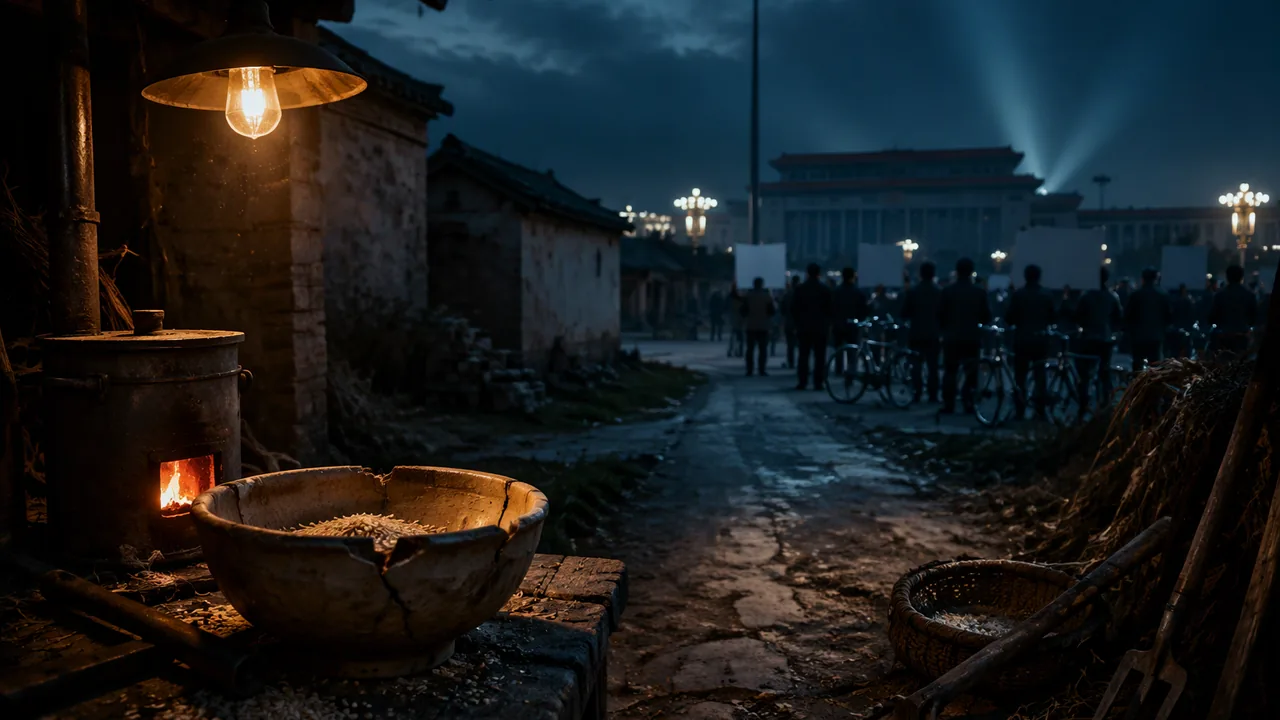
analyze the Chinese Civil War, the rise of Mao Zedong and the political and economic upheavals that followed — the Great Leap Forward, the Cultural Revolution and the Tiananmen Square protests — and discuss how Mao’s legacy should be judged.
Instruction
The civil war. After the 1911 revolution, China fragmented among warlords. In the 1920s the Nationalist Party (Guomindang), led after Sun Yat-sen’s death by Chiang Kai-shek, and the Chinese Communist Party, founded in 1921, first cooperated, then fought; in 1927 Chiang turned on the Communists and massacred thousands in Shanghai. Mao Zedong (spelled Mao Tse-tung in older sources) argued that in China the revolution would be made by peasants, not factory workers. During the Long March of 1934-1935, the Communists retreated some 9,000 kilometers to the northwest, and Mao emerged as leader. The war against Japan (1937-1945) forced a truce, and the Communists grew as a guerrilla force behind Japanese lines while Nationalist armies bore much of the conventional fighting. Civil war resumed in 1946. The Communists won peasant support with land reform, while the Nationalist government was weakened by inflation and corruption. On 1 October 1949 Mao proclaimed the People’s Republic of China in Beijing; Chiang retreated to Taiwan.
Remaking China. Land reform redistributed land and killed landlords in large numbers — estimates range from hundreds of thousands to more than a million. Women won legal equality in marriage. China fought the United States in Korea and adopted Soviet-style five-year plans. In 1956-1957 Mao invited criticism in the “Hundred Flowers” campaign, then punished hundreds of thousands of critics as “rightists.”
The Great Leap Forward (1958-1962). Mao aimed to overtake Britain’s industrial output within years by mass mobilization: peasants were organized into huge communes and ordered to make steel in backyard furnaces. Officials, afraid to report failure, inflated harvest figures; the state took grain based on those false numbers. The result was the deadliest famine in history. Scholarly estimates of excess deaths range widely, from about 15 million to 45 million, with many historians citing figures around 30 million.
The Cultural Revolution (1966-1976). Sidelined after the famine, Mao mobilized students as Red Guards to attack “bourgeois” and traditional influences — and his rivals in the party. Teachers, intellectuals and officials were humiliated, beaten, imprisoned or killed; temples and artifacts were destroyed; millions of urban youths were sent to the countryside. Hundreds of thousands, perhaps more, died. Mao died in 1976.
Reform and Tiananmen. Deng Xiaoping, himself purged twice under Mao, led market-oriented reforms from 1978 (you will study their results in Unit 4). In spring 1989, students and workers gathered in Tiananmen Square in Beijing to call for political reform, free speech and an end to corruption. On the night of 3-4 June, the army cleared the square and surrounding streets with troops and tanks. The death toll has never been officially disclosed; estimates range from hundreds to several thousand. The event is censored in mainland China today but has been commemorated in Hong Kong, Taiwan and Chinese diaspora communities around the world.
How to judge Mao? (HR.3) In 1981 the Chinese Communist Party officially judged that Mao’s contributions far outweighed his mistakes, while condemning the Cultural Revolution. Many historians outside China, such as Frank Dikötter in his study of the famine, place Mao’s policies among the deadliest of the twentieth century. Others emphasize that the revolution unified China, ended foreign domination, raised literacy and life expectancy, and laid foundations for later growth. Each interpretation selects and weighs evidence differently.
Seminar question. Should the Chinese Revolution be judged mainly by what it achieved or by what it cost — and who has the right to decide? Before challenging a position, restate it in terms its holder would accept (SL.9-10.1.d); when evaluating a speaker, check whether their evidence supports the scale of their claim (SL.9-10.3). Remember that many Chinese American families carry direct memories of these events, and views differ within communities; argue from evidence, respectfully.
📖 Read for this lesson
The reading opens over the lesson; close it to come back to exactly where you were. The checks below draw on it.
Formative check
Work through these before moving on. They are not graded — they tell you whether the standard below has landed yet.
What made the famine of the Great Leap Forward so deadly?
Mao proclaimed the People’s Republic on 1 October ; the Nationalists retreated to ; the Tiananmen crackdown took place on 3-4 June .
The Chinese Communist Party’s official 1981 judgment and Frank Dikötter’s history reach the same verdict on Mao.
Prepare an evidence sheet with two achievements and two costs of the revolution, each with a date, a figure or range, and a source. After the seminar (written, recorded, or talked through with a parent, guardian or study partner), write a 150-200 word summary of the strongest position you disagreed with, stated in terms its holder would accept, and explain what evidence would change your mind.
How confident are you that you can analyze the Chinese Revolution and its upheavals and weigh competing judgments of Mao’s legacy?
Practice
Work these on paper or in your notebook, then open Check your answer. Aim for all of Fluency and Application; try at least one Challenge.
Printable version: this unit’s practice workbook (PDF)
Fluency
Build speed and accuracy with the core skill.
- Order: (a) Great Leap Forward begins; (b) Long March; (c) People’s Republic proclaimed; (d) Tiananmen crackdown; (e) Cultural Revolution begins.
Check your answer
Answer: (b) 1934-1935 → (c) 1 October 1949 → (a) 1958 → (e) 1966 → (d) 3-4 June 1989.Mao died in 1976; Deng’s reforms began in 1978. - Define Red Guards and Guomindang.
Check your answer
Answer: Red Guards: students mobilized by Mao in the Cultural Revolution to attack ‘bourgeois’ influences and his rivals. Guomindang: the Chinese Nationalist Party founded by Sun Yat-sen and later led by Chiang Kai-shek.A strong answer places each in its period.
Application
Use the skill in context. Show your reasoning.
- Interpretations: compare the Chinese Communist Party’s 1981 judgment of Mao with Frank Dikötter’s. Why might they differ?
Check your answer
Answer: The 1981 resolution judged that Mao’s contributions far outweighed his mistakes, while condemning the Cultural Revolution. Dikötter places Mao’s policies among the deadliest of the century. They differ in purpose and perspective: the party’s legitimacy depends on the revolution; an outside historian can weigh its costs without that constraint.A strong answer attributes each view, explains how purpose shapes interpretation, and does not dismiss either without evidence. - Cause or sequence? “The Great Leap Forward began in 1958; famine followed.” Explain the causal chain.
Check your answer
Answer: Peasants were forced into huge communes and diverted to backyard steel-making; officials, afraid to report failure, inflated harvest figures; the state took grain based on those false numbers. Scholarly estimates of excess deaths range from about 15 to 45 million, many around 30 million.A strong answer names each link and gives the death toll as an attributed range. - Why do we not know how many people died in the Tiananmen crackdown, and what does that tell a historian about evidence in a censored society?
Check your answer
Answer: The government has never officially disclosed the toll and censors discussion in mainland China; estimates range from hundreds to several thousand. Historians must rely on witnesses, foreign reporting, diaspora records and leaked documents, and state their uncertainty.A strong answer connects missing evidence to censorship and models how to report uncertainty.
Review
Keep earlier skills sharp.
- Review (World History A, Unit 4): whose Three Principles of the People did the Guomindang claim as its founding program?
Check your answer
Answer: Sun Yat-sen’s: nationalism, democracy and people’s livelihood.A strong answer links the 1911 revolution to the civil war of 1946-1949.
Four Documents on the Chinese Revolution: Acheson, Mao, the Death Rate, and a Cable from Beijing
Acheson’s letter of transmittal, United States Relations with China (US GPO, 1949); Miscellany of Mao Tse-tung Thought (1949-1968), Part I, JPRS 61269-1 (1974); World Bank World Development Indicators (CC BY 4.0); American Embassy Beijing cable 16446, 22 June 1989, and the Secretary’s Morning Summary, 4 June 1989 · Public domain
Why this reading. Lesson 3.3 asks you to bring an evidence sheet with two achievements and two costs of the Chinese Revolution, each with a date, a figure or a range, and a source — and then to argue about how Mao should be judged. The lesson supplies no documents. This reading supplies four kinds: an American official explaining why the Nationalists lost, Mao in his own words, the demographic record of the famine, and an American embassy’s account of the night of 3–4 June 1989.
The translation problem, and how this reading solves it. Almost every Chinese text you would want here exists in English only in translations that are still in copyright. Two of the sources below are United States government translations, which we are free to reprint, and we name them. One source — the Chinese Communist Party’s own 1981 verdict on Mao — exists in English only in the Foreign Languages Press edition, which we cannot reproduce, so we summarize it in our own words and say so. That is a limitation of this reading, and you should mention it if you use the summary.
A. Why the Nationalists lost: the United States explains its own failure
Dean Acheson, Secretary of State, letter of transmittal, 30 July 1949, in US Department of State, United States Relations with China, with Special Reference to the Period 1944–1949 (the “China White Paper”), Department of State Publication 3573 (Washington: US Government Printing Office, August 1949). Public domain.
“The reports of United States military and diplomatic officers reveal a growing conviction through 1943 and 1944 that the Government and the Kuomintang had apparently lost the crusading spirit that won them the people’s loyalty during the early years of the war. In the opinion of many observers they had sunk into corruption, into a scramble for place and power, and into reliance on the United States to win the war for them and to preserve their own domestic supremacy.”
“Our military observers on the spot have reported that the Nationalist armies did not lose a single battle during the crucial year of 1948 through lack of arms or ammunition. The fact was that the decay which our observers had detected in Chungking early in the war had fatally sapped the powers of resistance of the Kuomintang. Its leaders had proved incapable of meeting the crisis confronting them, its troops had lost the will to fight, and its Government had lost popular support. … The Nationalist armies did not have to be defeated; they disintegrated.”
“In no small measure, the predicament in which the National Government finds itself today is due to its failure to provide China with enough to eat.”
Sourcing. This was published to defend the Truman administration against the charge that it had “lost” China; the Secretary of State has an obvious interest in showing that the outcome was beyond American control. That interest, though, cuts against the passage’s content: an American official is here crediting a communist victory to the failures of the side the United States had armed. A source conceding something damaging to its own case is usually a source worth trusting on that point.
B. Mao on the Great Leap Forward, in a United States government translation
Miscellany of Mao Tse-tung Thought (1949–1968), Part I, JPRS 61269-1, Joint Publications Research Service, 20 February 1974, translated from Chinese compilations of Mao’s speeches circulated in 1967 and 1969. JPRS was a United States government translation service and its translations are public domain. Note that the Chinese originals were unauthorized compilations made during the Cultural Revolution, not official party publications — which is a limitation you should state.
Speech to a conference of provincial and municipal committee secretaries, 2 February 1959 (pp. 150–151):
“After one year’s effort, a great leap forward situation has unfolded. Is this something temporary? Will there be a leap forward every year for the next several years? With a nation like ours, large population, vast area, and resources, and the Soviet Union’s experience, it is possible. … Be it a great, medium, or small leap forward, we probably will leap forward. If not a great leap forward, we will make a small leap forward. Most likely it will be a great leap forward every year.”
On people who pointed out what was going wrong (p. 151):
“When discussing the defects of last year, some people dwell on the defects. With dozens of defects in their mind, they fail to see any achievement at all. It is the question of nine fingers and one finger.”
“Why Do Right Opportunists Now Launch an Offensive?”, 16 August 1959, after the Lushan conference at which Marshal Peng Dehuai had criticized the Leap (pp. 184–185):
“Comrades who committed errors of right opportunism did not air their opinions at the Changchow conference last November, nor at the Pei-tai-ho conference on high production targets, nor at the Wu-chang conference last November, nor at the Peking conference last January, nor at the Chengchow conference last February, nor at the Shanghai conference toward the end of last March and the beginning of last April, but they did air them at the Lu-shan conference.”
“Nine fingers and one finger” is the most important phrase in this reading. It is Mao’s formula for saying that the successes vastly outweigh the problems, and it is being applied in February 1959, when the famine had already begun. The second passage shows what happened to a man who said otherwise: criticism raised at Lushan in July 1959 was treated as an offensive by “right opportunists”, Peng was purged, and officials below him learned not to report failure. Put these two passages beside the death-rate table below and you have the mechanism of the famine in three sources.
C. What the population record shows
World Bank, World Development Indicators, indicators SP.DYN.CDRT.IN (crude death rate per 1,000), SP.DYN.CBRT.IN (crude birth rate per 1,000) and SP.POP.TOTL (total population), China. The underlying figures originate with China’s State Statistical Bureau and were released retrospectively. World Bank Open Data, licensed CC BY 4.0. The series begins in 1960, so it covers the end of the famine but not its beginning.
| Year | Deaths per 1,000 | Births per 1,000 | Total population |
|---|---|---|---|
| 1960 | 25.43 | 20.86 | 667,070,000 |
| 1961 | 14.24 | 18.02 | 660,330,000 |
| 1962 | 10.02 | 37.01 | 665,770,000 |
| 1963 | 10.04 | — | 682,335,000 |
| 1965 | 9.50 | — | — |
Read the three columns together. In 1960 the death rate is 25.4 per thousand against a normal level under 10, and for the only time in the country’s modern record more people died than were born — the population falls by about 6.7 million between 1960 and 1961. Then look at 1962: a birth rate of 37 per thousand, the rebound of families who had delayed or lost children. This is China’s own statistical office describing the catastrophe in the only language a statistical office has. Scholarly estimates of total excess deaths range from about 15 million to 45 million, with many historians citing figures around 30 million; those estimates are built by comparing the actual rates above with the rates that would have been expected, and the width of the range comes from disagreement about what to expect and about how good the underlying counts are.
D. Tiananmen, 3–4 June 1989, reported by the American embassy
American Embassy Beijing to the Secretary of State, cable “What Happened on the Night of June 3/4?”, BEIJING 16446, 22 June 1989, signed Ambassador James R. Lilley; declassified in part, State Department FOIA case 9205307, released 16 January 1996. A US Department of State document: public domain. Cables were transmitted in capitals; we keep the original.
“WE CONCLUDE THAT, CONTRARY TO A NUMBER OF EARLY WESTERN PRESS ACCOUNTS, THE MASSACRE TOOK PLACE ON CHANGAN AVENUE AND OTHER OF BEIJING’S MAIN THOROUGHFARES RATHER THAN IN TIANANMEN SQUARE ITSELF. MANY — IF NOT MOST — OF THE DEATHS OCCURRED AS THE MILITARY MOVED TOWARD THE SQUARE FROM THE WEST.”
“THE PLA DID NOT FIRE DIRECTLY ON STUDENTS GATHERED AROUND THE MARTYRS MONUMENT ON TIANANMEN SQUARE. TROOPS BEAT, AND PROBABLY KILLED SOME STUDENTS AFTER THEY EXITED THE SQUARE, HOWEVER. OTHER STUDENTS WHO FACED OFF TROOPS IN THE STREETS AROUND THE SQUARE WERE SHOT. MANY MEMBERS OF THE CROWDS ATTEMPTING TO SLOW THE PLA ADVANCE THREW BRICKS AND STONES AT SOLDIERS AND BEAT AND/OR KILLED A NUMBER OF THEM. BUT GIVEN THE PREPONDERANCE OF FORCE ON THE MILITARY SIDE, IT IS INCONCEIVABLE THAT MILITARY CASUALTIES EXCEEDED THOSE ON THE CIVILIAN SIDE. CIVILIAN DEATHS PROBABLY DID NOT REACH THE FIGURE OF 3,000 USED IN SOME PRESS ACCOUNTS, BUT THEY SURELY FAR OUTNUMBERED OFFICIAL FIGURES.”
“IT SHOULD BE KEPT IN MIND THAT WHATEVER THE CASUALTY FIGURES, WHATEVER THE OCCUPATION OF THE CIVILIANS WHO WERE KILLED, AND HOWEVER VIOLENT SOME MEMBERS OF THE CROWD MAY HAVE BECOME, THE ORDER TO MOVE HEAVILY ARMED TROOPS ON TIANANMEN WAS CYNICAL AND INHUMANE.”
An earlier and much less certain estimate, from the State Department’s classified Secretary’s Morning Summary of 4 June 1989: “CASUALTY FIGURES REMAIN UNCERTAIN AND UNCONFIRMED, BUT REPORTS OF DEATHS FROM THE MILITARY ASSAULT ON TIANANMEN SQUARE RANGE FROM 180 TO 500; THOUSANDS MORE HAVE BEEN INJURED.”
Two documents, eighteen days apart, and a lesson about numbers. The first estimate, written within hours, gives 180 to 500 and says it is unconfirmed. The second, written after three weeks of collecting eyewitness accounts, refuses to give a figure at all and instead brackets it: below 3,000, far above the official count. The ambassador is doing the correct thing, which is declining to invent precision. If you see a confident single figure for the Tiananmen dead, ask where it comes from — the death toll has never been officially disclosed.
E. How China’s own party judged Mao
The following paragraph is a summary written by the course authors. The Chinese Communist Party’s “Resolution on Certain Questions in the History of Our Party Since the Founding of the People’s Republic of China” (27 June 1981) exists in English only in the Beijing Foreign Languages Press translation, which we are not free to reprint, so we describe it rather than quote it.
The 1981 Resolution is the official verdict of the party Mao led. It calls him a great Marxist and revolutionary, says he made serious errors in his later years, and judges that his contributions to the Chinese revolution far outweigh his mistakes — a formula usually summarized as merits primary, errors secondary. It condemns the Cultural Revolution outright as the gravest setback and heaviest loss suffered by the party, the state and the people since 1949, and it assigns Mao chief responsibility for it. It says much less about the Great Leap Forward and the famine.
Set that alongside historians outside China, such as Frank Dikötter, who place the famine among the deadliest events of the twentieth century, and alongside the case that the revolution unified the country, ended foreign domination and raised literacy and life expectancy. Three judgments, three selections of evidence. For your evidence sheet, take two achievements and two costs and give each a date, a figure or range, and a named source from this reading — then say, in one sentence, which piece of evidence a person who disagrees with you would find hardest to answer.
Sources: United States Relations with China (the China White Paper), US GPO 1949 (full text) (archive.org); Miscellany of Mao Tse-tung Thought (1949-1968), Part I, JPRS 61269-1 (1974) (archive.org); Embassy Beijing cable, ‘What Happened on the Night of June 3/4?’, 22 June 1989 (nsarchive2.gwu.edu); World Bank Open Data: death rate, birth rate and population, China (CC BY 4.0) (data.worldbank.org)