compare the economic and military power shifts caused by the war — Yalta, nuclear weapons, Soviet control of Eastern Europe and the recoveries of Germany and Japan — and explain the purposes and work of the United Nations, NATO, the Warsaw Pact, SEATO and the OAS.
Instruction
In 1939 the world’s great powers were Britain, France, Germany, Japan, Italy, the Soviet Union and the United States. By 1946 only two remained truly great: the United States and the Soviet Union. The war had shifted power more than any event in modern history.
Winners and losers. The United States ended the war with the world’s largest economy — undamaged at home, producing roughly half of the world’s manufactured goods — and, until 1949, a monopoly on atomic weapons. The Soviet Union had lost more people than any other country, but its army occupied Eastern Europe and half of Germany. Britain and France were victors but exhausted and in debt, and their empires would soon break up. Germany and Japan were occupied and in ruins.
Yalta (February 1945). Roosevelt, Churchill and Stalin agreed to divide Germany into occupation zones, to hold free elections in the liberated countries of Eastern Europe, and that the Soviet Union would enter the war against Japan; they also planned the United Nations. The Western leaders accepted Soviet influence in Poland in exchange for a promise of free elections — a promise Stalin did not keep. Critics later called Yalta a betrayal; defenders answered that the Red Army already occupied the region, so there was little the West could do.
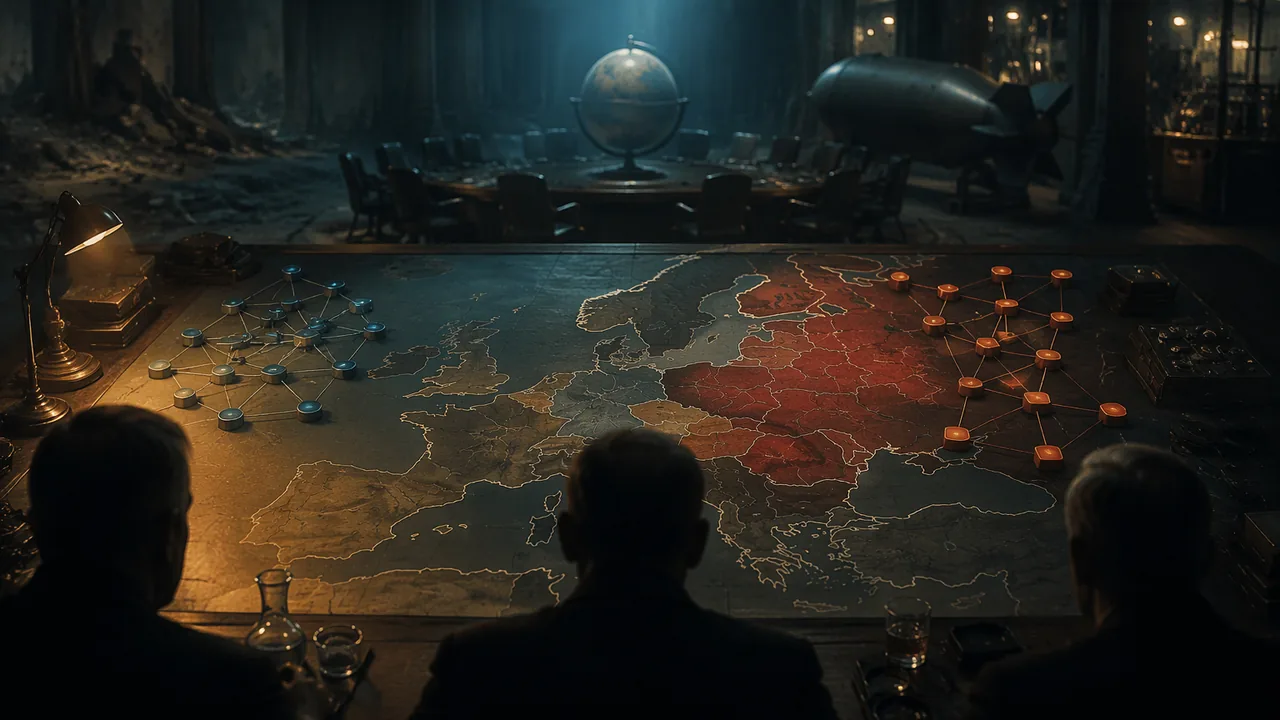
Soviet control of Eastern Europe. Between 1945 and 1948, communist parties backed by Soviet power took control in Poland, Hungary, Romania, Bulgaria, Czechoslovakia and East Germany, often by rigging elections, splitting opposition parties and using secret police. Yugoslavia’s communists, who had liberated their own country, broke with Stalin in 1948.
Nuclear weapons. The United States used atomic bombs in 1945; the Soviet Union tested its own in August 1949. Both then built hydrogen bombs and missiles. By the 1960s each could destroy the other — a situation called mutually assured destruction, which made direct war between them unthinkable and pushed their rivalry into other arenas.
Recoveries. West Germany, founded in 1949, rebuilt rapidly with Marshall Plan aid, currency reform and a market economy — the Wirtschaftswunder (“economic miracle”). Japan, under American occupation until 1952, adopted a new democratic constitution in 1947 that renounced war; U.S. purchases during the Korean War and close cooperation between government and industry helped it become the world’s second-largest economy by the late 1960s. Former enemies became allies.
The United Nations (1945). Founded in October 1945 with 51 members, the UN aimed, as its Charter says, to save later generations “from the scourge of war.” Its General Assembly gives every member a vote. Its Security Council has five permanent members — the United States, Soviet Union (now Russia), Britain, France and China — each with a veto, which during the Cold War often paralyzed it. The UN’s agencies fed refugees, fought disease and sent peacekeepers; its Universal Declaration of Human Rights (1948), drafted by a committee chaired by Eleanor Roosevelt, set a common standard. The Genocide Convention (1948) made genocide a crime under international law.
The alliances.
| Alliance | Founded | Members and purpose |
|---|---|---|
| Organization of American States (OAS) | 1948 | States of the Americas; regional cooperation and, in the Cold War, opposition to communism in the hemisphere |
| NATO | 1949 | United States, Canada and Western European states; collective defense (Article 5) |
| SEATO | 1954 | United States, Britain, France, Australia, New Zealand, Pakistan, the Philippines and Thailand; containing communism in Southeast Asia; dissolved 1977 |
| Warsaw Pact | 1955 | The Soviet Union and its Eastern European satellites; a Soviet-led military alliance, whose armies invaded member state Czechoslovakia in 1968; dissolved 1991 |
📖 Read for this lesson
The reading opens over the lesson; close it to come back to exactly where you were. The checks below draw on it.
Reading: A new weapon and a new alliance
Harry S. Truman, statement announcing the use of the atomic bomb at Hiroshima, 6 August 1945; North Atlantic Treaty, Washington, 4 April 1949, Article 5 · Public domain (U.S. government works)
Article 5 has been invoked once: after the attacks of 11 September 2001 on the United States.
Truman: It is an atomic bomb. It is a harnessing of the basic power of the universe.
North Atlantic Treaty, Article 5: The Parties agree that an armed attack against one or more of them in Europe or North America shall be considered an attack against them all and consequently they agree that, if such an armed attack occurs, each of them, in exercise of the right of individual or collective self-defence recognised by Article 51 of the Charter of the United Nations, will assist the Party or Parties so attacked by taking forthwith, individually and in concert with the other Parties, such action as it deems necessary, including the use of armed force, to restore and maintain the security of the North Atlantic area.
Formative check
Work through these before moving on. They are not graded — they tell you whether the standard below has landed yet.
What did the Western leaders obtain at Yalta regarding Eastern Europe?
Why was the UN Security Council often unable to act during the Cold War?
NATO was founded in ; the Soviet-led Pact in 1955; the regional organization of the Americas is the .
Make a power-shift chart comparing 1939 and 1950 for the United States, the Soviet Union, Britain, Germany and Japan (economy, military, empire or occupation). Then write a paragraph: which change caused by the war mattered most for the next forty years, and which alliance or institution was built to respond to it? Quote one of the readings.
How confident are you that you can compare the power shifts caused by the war and explain the purposes of the UN and the Cold War alliances?
Practice
Work these on paper or in your notebook, then open Check your answer. Aim for all of Fluency and Application; try at least one Challenge.
Printable version: this unit’s practice workbook (PDF)
Fluency
Build speed and accuracy with the core skill.
- Order the founding of: (a) the Warsaw Pact; (b) NATO; (c) the United Nations; (d) SEATO; (e) the Organization of American States.
Check your answer
Answer: (c) 1945 → (e) 1948 → (b) 1949 → (d) 1954 → (a) 1955.The Warsaw Pact came after West Germany joined NATO; SEATO was dissolved in 1977. - Define satellite state and collective defense, with one example of each.
Check your answer
Answer: Satellite state: formally independent but controlled by a more powerful neighbor — Poland or Hungary under Soviet control. Collective defense: an agreement that an attack on one ally is an attack on all — NATO’s Article 5.A strong answer ties each term to a specific case.
Application
Use the skill in context. Show your reasoning.
- Read NATO’s Article 5: an armed attack on one member “shall be considered an attack against them all.” Why did Western European states want this promise in 1949, and when has it been invoked?
Check your answer
Answer: They feared Soviet power after the Red Army’s occupation of Eastern Europe and the Berlin Blockade, and wanted a U.S. guarantee. It has been invoked once, after the attacks of 11 September 2001 on the United States.A strong answer connects the treaty to its context and notes the irony that its only use defended the United States. - Perspectives: critics called Yalta a betrayal of Eastern Europe; defenders disagreed. State both positions fairly.
Check your answer
Answer: Critics: Western leaders accepted Soviet influence in Poland in exchange for a promise of free elections that Stalin did not keep. Defenders: the Red Army already occupied the region, so there was little the West could do short of war.A strong answer states each view in terms its holder would accept and names the evidence each relies on. - Cause or sequence? “Japan was occupied until 1952 and became the world’s second-largest economy by the late 1960s.” Name two mechanisms behind its recovery.
Check your answer
Answer: Examples: U.S. purchases during the Korean War; close cooperation between government and industry; the 1947 constitution and occupation reforms that brought stability.A strong answer names specific mechanisms, not just the order of events.
Review
Keep earlier skills sharp.
- Review (Unit 1): why was the United Nations given a Security Council with permanent members and vetoes, when the League of Nations had failed?
Check your answer
Answer: The League lacked enforcement and lacked the great powers (the United States never joined). The UN tried to keep the great powers inside by giving them permanent seats and vetoes — though vetoes often paralyzed it during the Cold War.A strong answer links a design choice to the lesson of the League’s failure.
What Each One Actually Promised: the UN Charter, NATO, the Warsaw Pact, SEATO and the OAS
Charter of the United Nations (1945), Articles 1(1), 2(4), 27(3) and 51; North Atlantic Treaty (1949), Article 5; Warsaw Treaty (1955), Article 4, in American Foreign Policy 1950-1955: Basic Documents, vol. 1 (US GPO, 1957); Southeast Asia Collective Defense Treaty (1954), Article IV(1); Charter of the Organization of American States, as amended, Articles 1 and 28 · Public domain
Why this reading. Lesson 3.1 asks you to build an alliance comparison table for the United Nations, NATO, the Warsaw Pact, SEATO and the OAS, and to quote one of the readings. The lesson quotes NATO’s Article 5 and nothing else, so four of the five bodies in your table have no text behind them. Here are the founding commitments, side by side. Read them for how much each one actually promises — the differences are sharper than the summaries suggest.
A. The United Nations Charter, 26 June 1945
Charter of the United Nations, English text as published by the United Nations. Articles 23 and 27 are quoted as amended in 1965, when the Security Council was enlarged to fifteen members. A United Nations official document.
Article 1(1). “To maintain international peace and security, and to that end: to take effective collective measures for the prevention and removal of threats to the peace, and for the suppression of acts of aggression or other breaches of the peace, and to bring about by peaceful means, and in conformity with the principles of justice and international law, adjustment or settlement of international disputes or situations which might lead to a breach of the peace;”
Article 2(4). “All Members shall refrain in their international relations from the threat or use of force against the territorial integrity or political independence of any state, or in any other manner inconsistent with the Purposes of the United Nations.”
Article 27(3) — the veto. “Decisions of the Security Council on all other matters shall be made by an affirmative vote of nine members including the concurring votes of the permanent members; provided that, in decisions under Chapter VI, and under paragraph 3 of Article 52, a party to a dispute shall abstain from voting.”
Article 51. “Nothing in the present Charter shall impair the inherent right of individual or collective self-defence if an armed attack occurs against a Member of the United Nations, until the Security Council has taken measures necessary to maintain international peace and security. Measures taken by Members in the exercise of this right of self-defence shall be immediately reported to the Security Council …”
Articles 27(3) and 51 explain most of the Cold War at the United Nations. The veto means the Council cannot act against a great power or its friends; Article 51 means that alliances outside the Council are legal. Every treaty below cites Article 51 by name. The system did not fail and then produce alliances — it was built with the door to alliances written into it.
B. NATO, 4 April 1949
North Atlantic Treaty, Washington, 4 April 1949, Article 5, quoted in the lesson. Public domain (US government publication).
The lesson has the full text. For your table, note the exact commitment: each party will assist “by taking forthwith … such action as it deems necessary, including the use of armed force”. As it deems necessary is the phrase the United States Senate insisted on. It is not an automatic promise to fight.
C. The Warsaw Treaty, 14 May 1955
Treaty of Friendship, Co-operation and Mutual Assistance, Warsaw, 14 May 1955, Article 4. English text as published in US Department of State, American Foreign Policy 1950–1955: Basic Documents, vol. 1 (Washington: US Government Printing Office, 1957), which reprints the English rendering published in Moscow in New Times, 21 May 1955. A US government publication: public domain. We name the chain because this is a translation of a Russian text made by the Soviet government and reprinted by the American one — two interested parties, no independent translator.
“In the event of armed attack in Europe on one or more of the Parties to the Treaty by any state or group of states, each of the Parties to the Treaty, in the exercise of its right to individual or collective self-defence in accordance with Article 51 of the Charter of the United Nations Organization, shall immediately, either individually or in agreement with other Parties to the Treaty, come to the assistance of the state or states attacked with all such means as it deems necessary, including armed force. The Parties to the Treaty shall immediately consult concerning the necessary measures to be taken by them jointly in order to restore and maintain international peace and security. Measures taken on the basis of this Article shall be reported to the Security Council in conformity with the provisions of the Charter of the United Nations Organization.”
Put this beside NATO’s Article 5 and the resemblance is startling — the same reference to Article 51, the same “as it deems necessary”, the same duty to report. It was modeled on it. The difference is not in the text at all; it is that in 1968 the Warsaw Pact’s armies invaded one of its own members. A treaty text tells you what was promised, never what was done, and this pair is the best evidence in the course for that distinction.
D. SEATO, 8 September 1954
Southeast Asia Collective Defense Treaty, Manila, 8 September 1954, Article IV(1). US Department of State publication; TIAS 3170, 6 UST 81. Public domain.
“Each Party recognizes that aggression by means of armed attack in the treaty area against any of the Parties or against any State or territory which the Parties by unanimous agreement may hereafter designate, would endanger its own peace and safety, and agrees that it will in that event act to meet the common danger in accordance with its constitutional processes. Measures taken under this paragraph shall be immediately reported to the Security Council of the United Nations.”
Weaker than NATO: “act to meet the common danger in accordance with its constitutional processes” promises no force at all. The United States also attached an understanding that Article IV(1) applied to it only in the case of communist aggression — a defense pact against one named ideology rather than against attack. Only two of the eight members were in Southeast Asia. SEATO was dissolved in 1977.
E. The Organization of American States
Charter of the Organization of American States, signed at Bogotá in 1948; quoted here as amended by the Protocols of Buenos Aires (1967), Cartagena de Indias (1985), Washington (1992) and Managua (1993), in the authentic English text published by the OAS. The 1948 original numbered these provisions differently; we could not obtain the as-signed 1948 text, and say so.
Article 1. “The American States establish by this Charter the international organization that they have developed to achieve an order of peace and justice, to promote their solidarity, to strengthen their collaboration, and to defend their sovereignty, their territorial integrity, and their independence. Within the United Nations, the Organization of American States is a regional agency. The Organization of American States has no powers other than those expressly conferred upon it by this Charter, none of whose provisions authorizes it to intervene in matters that are within the internal jurisdiction of the Member States.”
Article 28. “Every act of aggression by a State against the territorial integrity or the inviolability of the territory or against the sovereignty or political independence of an American State shall be considered an act of aggression against the other American States.”
The last sentence of Article 1 — no power to intervene in the internal affairs of members — is the one to hold on to, because lesson 3.2 will show you the United States intervening repeatedly in the internal affairs of American states during exactly this period. A commitment a member state breaks is still evidence: it tells you what that state had agreed the rule was.
F. Building the comparison table
| Founded | What a member actually promises | Who decides | |
|---|---|---|---|
| United Nations | 1945 | Not to use force (Art. 2(4)); to accept Council decisions | Security Council, subject to the veto (Art. 27(3)) |
| OAS | 1948 | To treat an attack on one American state as an attack on all (Art. 28); not to intervene internally (Art. 1) | The member states, through special treaties |
| NATO | 1949 | Assistance including armed force, “such action as it deems necessary” | Each member, individually |
| SEATO | 1954 | To “act to meet the common danger in accordance with its constitutional processes” | Each member’s own government and legislature |
| Warsaw Pact | 1955 | Assistance “with all such means as it deems necessary, including armed force” | In text, each member; in practice, Moscow |
For the power-shift chart. Use facts you can attach to a document or a date rather than impressions: in 1939 there were seven great powers and by 1949 two of them had nuclear weapons (the United States from July 1945, the Soviet Union from August 1949); the United Nations was founded with 51 members in 1945; Germany was divided into occupation zones by the Yalta protocol (lesson 2.2) and into two states in 1949; Japan was occupied by the United States until 1952; Britain and France, both victors, were by 1949 in an alliance whose decisive member was the United States. Say which of those changes you think mattered most, and why — that is the paragraph the lesson asks for.
Sources: Charter of the United Nations, Chapters I, V and VII (United Nations) (un.org); The Warsaw Security Pact, 14 May 1955 (Avalon Project, Yale Law School) (avalon.law.yale.edu); Southeast Asia Collective Defense Treaty, 8 September 1954 (Avalon Project) (avalon.law.yale.edu); Charter of the Organization of American States (OAS Department of International Law) (oas.org)