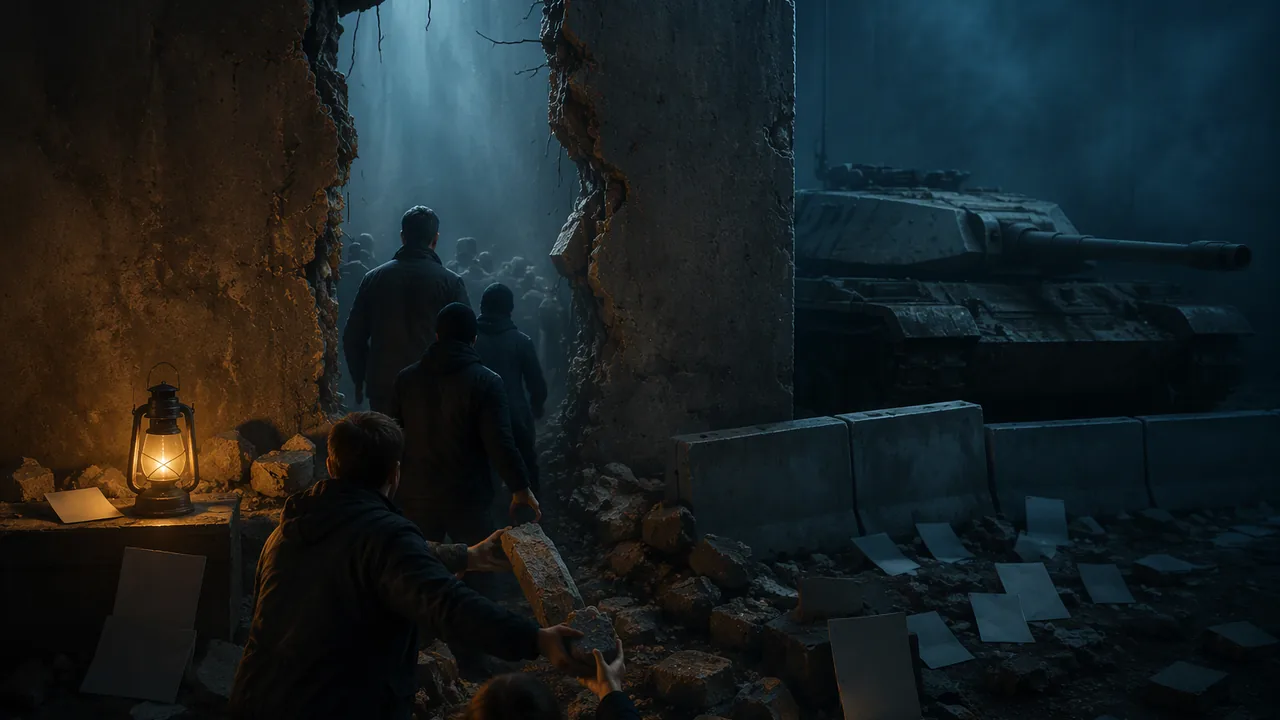
argue both sides of whether the Soviet collapse was caused mainly by outside pressure or internal weakness and resistance, including the uprisings in the satellite states, and write a reasoned synthesis.
Instruction
The question. Was the collapse of the Soviet Union caused mainly by outside pressure, or by internal weakness and resistance?
Resistance in the satellites (WH.10.9.5). People in Soviet-controlled Europe rose again and again. In Poland in 1956, workers in Poznań protested low wages and food shortages; troops killed dozens, but the crisis brought the reformer Władysław Gomułka to power without a Soviet invasion. In Hungary in 1956, a student demonstration grew into a national revolution; Prime Minister Imre Nagy announced that Hungary would leave the Warsaw Pact. Soviet tanks crushed the revolution in November; about 2,500 Hungarians were killed, some 200,000 fled, and Nagy was later executed. In Czechoslovakia in 1968, Alexander Dubček’s “Prague Spring” promised “socialism with a human face” — freer speech and less censorship. In August, Warsaw Pact armies invaded. Leonid Brezhnev then declared that the Soviet bloc would intervene wherever socialism was threatened (the Brezhnev Doctrine).
Resurgence, 1970s-1980s. In the 1975 Helsinki Accords, the Soviet bloc signed human rights commitments; dissidents such as the playwright Václav Havel, a founder of Charter 77 in Czechoslovakia, held their governments to them. In 1978 a Polish cardinal became Pope John Paul II; his 1979 visit to Poland drew millions. In August 1980, shipyard workers in Gdańsk led by Lech Wałęsa founded Solidarity, the bloc’s first independent trade union, with about ten million members. Martial law in December 1981 drove it underground, but it survived. In 1989 it won Poland’s partly free elections in June, beginning the revolutions of that year: Hungary opened its border; the Berlin Wall was opened on 9 November; Czechoslovakia’s Velvet Revolution brought Havel to the presidency; Romania’s dictatorship fell violently in December.
The Soviet Union itself (WH.10.9.7). Evidence for internal weakness: the command economy, run by central planners, produced tanks and steel but could not keep up with technology or supply consumer goods; growth slowed to near zero by the 1980s; the country spent a far larger share of its economy on the military than the United States did; and when world oil prices fell in the mid-1980s, its main export earnings collapsed. The war in Afghanistan (1979-1989) cost lives, money and prestige. The Chernobyl nuclear disaster of 1986, at first concealed, exposed the system’s secrecy. Mikhail Gorbachev, leader from 1985, tried to save the system through glasnost (openness) and perestroika (restructuring), and he refused to use force to hold Eastern Europe in 1989. Evidence for outside pressure: the American arms build-up under Reagan and his Strategic Defense Initiative raised the cost of competition; U.S. support for Afghan fighters raised the war’s price; Western radio broadcasts and contacts spread information. And evidence for resistance: non-Russian republics demanded independence. On 23 August 1989 about two million people joined hands across Estonia, Latvia and Lithuania in the “Baltic Way”; Lithuania declared independence in March 1990. After hard-liners’ failed coup against Gorbachev in August 1991, the republics left one by one; Ukraine voted overwhelmingly for independence on 1 December 1991. The Soviet Union was dissolved at the end of December 1991.
Historians’ debate (HR.3). Some, especially American conservatives, credit Reagan’s pressure. Others, such as Stephen Kotkin, argue that the Soviet system was failing from within and that Gorbachev’s reforms unintentionally dissolved it. Still others stress nationalism in the republics and people power in Eastern Europe.
How the SAC works. On your own, or with a parent, guardian or study partner: argue “outside pressure” first and “internal weakness and resistance” second; restate each case until you could say its holder would agree it is accurate; switch sides and add new evidence; then drop the roles and seek the most defensible answer. Adapt your speech to the setting (SL.9-10.6): formal when presenting a case, conversational when seeking consensus.
📖 Read for this lesson
The reading opens over the lesson; close it to come back to exactly where you were. The checks below draw on it.
Reading: A challenge at the Wall
Ronald Reagan, remarks at the Brandenburg Gate, West Berlin, 12 June 1987 · Public domain (U.S. government works)
The Wall fell two and a half years later. Does that make the speech a cause?
General Secretary Gorbachev, if you seek peace, if you seek prosperity for the Soviet Union and Eastern Europe, if you seek liberalization: Come here to this gate! Mr. Gorbachev, open this gate! Mr. Gorbachev, tear down this wall!
Formative check
Work through these before moving on. They are not graded — they tell you whether the standard below has landed yet.
What happened after Imre Nagy announced in 1956 that Hungary would leave the Warsaw Pact?
Resistance from non-Russian Soviet republics, such as the Baltic states and Ukraine, played a role in the Soviet collapse.
How confident are you that you can argue both sides of the Soviet collapse fairly and write a reasoned synthesis?
Unit 3 checkpoint
Do this before you start the task. It covers the whole unit and tells you what to review first.
What did the Western leaders obtain at Yalta about Eastern Europe?
The Soviet Union tested its first atomic bomb in .
Why was the UN Security Council often paralyzed?
Marshall Plan aid was offered to the Soviet bloc, but Stalin refused it.
In which country did the United States work covertly against an elected socialist president before a 1973 coup?
What was the Cultural Revolution?
The Chinese government has officially disclosed the death toll of the Tiananmen crackdown.
The UN voted to partition Palestine on 29 November ; Israel was declared on 14 May .
What happened in Hungary in November 1956?
What was Solidarity?
Resistance in non-Russian Soviet republics, such as the Baltic states and Ukraine, helped bring about the Soviet collapse.
Which is a causal claim, not just sequence?
Submit: SAC evidence cards, recorded controversy and synthesis paper (700-900 words)
Task: Take part in a structured academic controversy on why the Soviet Union collapsed, then write a synthesis paper stating and defending the most reasonable answer.
Submission workflow
- Stage 1 — Plan. Ten evidence cards, five for each side, including at least one card each on 1956, 1968, Solidarity, the Baltic republics and the Soviet economy, each with a source.
- Stage 2 — Self-checked draft. After the controversy, draft your synthesis. Check that each original position is stated fairly; save a revision note listing what you changed.
- Stage 3 — Revised final. 700-900 words: the strongest case on each side, your synthesis weighing causes, and one historian’s interpretation evaluated.
- Stage 4 — Presentation. The recorded or live controversy plus a two-minute statement of your shared conclusion and remaining disagreement.
How it is scored
| Criterion | What proficient looks like |
|---|---|
| Collaborative discussion (SL.9-10.1, SL.9-10.1.d) | Prepared; restates the other side accurately; qualifies own view in light of evidence. |
| Historical accuracy (WH.10.9.5, WH.10.9.7) | Accurate account of the satellite uprisings and resurgence, and of the Soviet collapse. |
| Weighing causes (WHST.9-10.1, 9-12.WH.1.CC.D) | Both sides developed with evidence; synthesis weighs causes and evaluates a named interpretation. |
| Revision (WHST.9-10.5) | Final responds substantively to your self-check. |
| Speech adapted to context (SL.9-10.6) | Formal in presenting a case, collaborative in seeking consensus. |
Inside the Collapse: Hungary 1956, Helsinki 1975, and the CIA on the Soviet Economy
Report of the Special Committee on the Problem of Hungary, UN doc. A/3592 (1957); Conference on Security and Co-operation in Europe, Final Act, 1 August 1975, Principle VII; James Noren, ‘CIA’s Analysis of the Soviet Economy’, in Watching the Bear (CIA Center for the Study of Intelligence) · Public domain
Why this reading. The task in lesson 3.5 asks for ten evidence cards — at least one each on 1956, 1968, Solidarity, the Baltic republics and the Soviet economy, each with a source — before you argue both sides of why the Soviet Union collapsed. The lesson hosts one document, a speech by an American president. You cannot build a five-card case for internal weakness and resistance out of Reagan at the Brandenburg Gate. Here are documents for the inside of the story: a United Nations investigation of Hungary, the human-rights commitment the Soviet bloc signed in 1975, and the CIA’s own account of what it thought the Soviet economy was doing.
A. Hungary, 1956: a United Nations investigation
United Nations, Report of the Special Committee on the Problem of Hungary, General Assembly Official Records, Eleventh Session, Supplement No. 18 (UN document A/3592), New York, 1957. United Nations official records.
The last broadcast. The Committee records that at 5.20 a.m. on 4 November 1956 the Prime Minister spoke from Free Radio Kossuth in Budapest:
“This is Imre Nagy speaking, the President of the Council of Ministers of the Hungarian People’s Republic. Today at daybreak Soviet troops attacked our capital with the obvious intention of overthrowing the legal Hungarian democratic Government. Our troops are in combat. The Government is at its post. I notify the people of our country and the entire world of this fact.”
A further statement, read out after it, added: “This fight is the fight for freedom by the Hungarian people against the Russian intervention, and it is possible that I shall only be able to stay at my post for one or two hours. The whole world will see how the Russian armed forces, contrary to all treaties and conventions, are crushing the resistance of the Hungarian people…”
The cost, and the Committee’s care with numbers. “The Committee is not in possession of what it would regard as reliable figures for the casualties that occurred during the Hungarian uprising.” Citing an official Hungarian statistical source, it reports that registered deaths from October to December 1956 were 27,400, ten per cent above the same months of 1955, and that on that basis “the number of people who died in the fighting … can be estimated at some 1,800-2,000 in Budapest and 2,500-3,000 in the whole country”, with about 13,000 wounded treated in hospitals. It records that Prime Minister Nehru of India had told the Indian Parliament that about 25,000 Hungarians and 7,000 Russians had died, and adds: “The Committee, however, received the impression that this figure may well be too high.” On refugees, it cites the UN High Commissioner for Refugees: 193,316 people had left for Austria and Yugoslavia by 30 April 1957.
Two cards from one document. Card one: a Warsaw Pact member tried to leave and was invaded by the alliance whose Article 4 promised mutual assistance — put this beside the treaty text in the lesson 3.1 reading. Card two: how to handle a contested figure. The Committee gives its source, gives a range, reports a much higher figure from a head of government, and says it doubts it. Do that on your cards and you will be doing history rather than repeating it.
B. What the Soviet bloc signed in 1975
Conference on Security and Co-operation in Europe, Final Act, Helsinki, 1 August 1975, Principle VII, as published by the OSCE. Signed by 35 states including the Soviet Union and every European communist government.
“VII. Respect for human rights and fundamental freedoms, including the freedom of thought, conscience, religion or belief
The participating States will respect human rights and fundamental freedoms, including the freedom of thought, conscience, religion or belief, for all without distinction as to race, sex, language or religion.
They will promote and encourage the effective exercise of civil, political, economic, social, cultural and other rights and freedoms all of which derive from the inherent dignity of the human person and are essential for his free and full development. …
They confirm the right of the individual to know and act upon his rights and duties in this field.
In the field of human rights and fundamental freedoms, the participating States will act in conformity with the purposes and principles of the Charter of the United Nations and with the Universal Declaration of Human Rights. They will also fulfil their obligations as set forth in the international declarations and agreements in this field, including inter alia the International Covenants on Human Rights, by which they may be bound.”
One sentence here changed politics in eastern Europe: “They confirm the right of the individual to know and act upon his rights and duties in this field.” The Soviet leadership signed Helsinki for the first basket — recognition of Europe’s postwar borders. It regarded the third basket as words. But the text was published in the official press of the signatory states, and dissidents used it exactly as written: Charter 77 in Czechoslovakia, the Moscow Helsinki Group, and others held their own governments to a document those governments had signed and printed. This is your strongest card for the argument that the collapse came from inside, because the lever was a commitment the regimes made themselves.
C. The economy, as the CIA described it to itself
James Noren, “CIA’s Analysis of the Soviet Economy”, chapter II of Watching the Bear: Essays on CIA’s Analysis of the Soviet Union, Center for the Study of Intelligence, Central Intelligence Agency. A US government work: public domain.
On the defense burden after the CIA’s major revision of 1976: “Since 1970, defense requirements had been absorbing 11-13 percent of GNP (instead of less than 8 percent) depending on whether defense was defined narrowly (US definition) or broadly (Soviet definition).”
On the size of the revision: “the rate of growth of defense spending in 1970 prices was now thought to be 4 to 5 percent per year instead of the 3 percent per year reported in previous estimates.”
On what the agency expected of the 1980s: “The model’s baseline projection of growth in GNP was 2.5 percent per year from 1981 to 1985.” And, revising downwards: “In a 1982 paper, the baseline projection for GNP growth in the 1980s had dropped to less than 2 percent per year. Moreover, the projections assumed that defense spending would increase at 4.5 percent per year, pushing growth in consumption and investment down to the lowest levels in the postwar years.”
Why this document is worth more than a statistic. It is an intelligence agency describing how it changed its own mind, and by how much: the estimate of the Soviet defense burden roughly doubled in a single revision. Two conclusions follow, and they point in opposite directions, which is exactly what a structured academic controversy needs. For internal weakness: a country spending 11–13 per cent of its output on the military while growth fell below 2 per cent was consuming its future. For outside pressure: an American build-up raised the price of a competition the Soviet Union was already straining to afford. The same numbers serve both sides. Say so when you switch sides.
D. Three events we summarize rather than quote
The three paragraphs below are written by the course authors. We were not able to obtain public-domain English texts of the key documents — the Brezhnev Doctrine as published in Pravda in September 1968, the Gdańsk Agreement of 31 August 1980, and the Lithuanian Act of 11 March 1990 — in editions we could verify and are free to reprint. Cite these as our summaries, not as quotations, and say so on your cards.
Czechoslovakia, 1968. Alexander Dubček’s government relaxed censorship and promised “socialism with a human face”. On the night of 20–21 August 1968, armies of five Warsaw Pact states invaded. Czechoslovakia’s representative raised the invasion at the UN Security Council, where the Soviet representative defended it as assistance requested by Czechoslovak officials; a resolution condemning the invasion was vetoed. Soviet writing afterwards set out what became known as the Brezhnev Doctrine: that the socialist states had a duty to intervene wherever socialism was threatened in one of them. Read that beside Article 4 of the Warsaw Treaty in the lesson 3.1 reading — the doctrine is what the treaty turned out to mean.
Poland, 1980–1989. In August 1980 a strike at the Lenin Shipyard in Gdańsk, led by the electrician Lech Wałęsa, spread along the Baltic coast. The government signed an agreement conceding the right to form trade unions independent of the party — the first such concession anywhere in the bloc. Solidarity grew to roughly ten million members within a year. Martial law in December 1981 drove it underground, where it survived with support from the Catholic Church and from a Polish pope. In the partly free elections of June 1989 Solidarity candidates won every seat they were allowed to contest.
The Baltic republics, 1989–1991. On 23 August 1989, the fiftieth anniversary of the German-Soviet pact whose secret protocol you read in lesson 2.1, roughly two million people joined hands in a chain stretching across Estonia, Latvia and Lithuania. The demand was not reform but the annulment of that protocol and the restoration of independence. Lithuania declared independence in March 1990; after the failed coup against Gorbachev in August 1991 the republics left one by one, and Ukraine voted overwhelmingly for independence on 1 December 1991. The Soviet Union was dissolved at the end of that month.
E. Ten cards, five each way
| Internal weakness and resistance | Outside pressure |
|---|---|
| Hungary 1956: a member state tried to leave and was invaded (A/3592) | Reagan at the Brandenburg Gate, 12 June 1987 (in the lesson) |
| Czechoslovakia 1968 and the Brezhnev Doctrine (our summary, section D) | The American build-up raising the cost of competition (Noren, section C) |
| Helsinki 1975: dissidents used a text their own governments signed (section B) | Western broadcasting and contacts spreading information |
| Solidarity, ten million members by 1981 (our summary, section D) | The war in Afghanistan, 1979–1989, in money, lives and prestige |
| Defense at 11–13% of GNP with growth below 2% (Noren, section C) | The fall in world oil prices in the mid-1980s, which cut export earnings |
A warning about your synthesis. The same document can sit on both sides — the CIA estimate does. That is not a problem to be tidied away; it is the finding. The strongest synthesis papers usually argue that outside pressure mattered because of an internal weakness that made the system unable to absorb it, and then say precisely which weakness and how. The weakest ones split the difference and call it balance.
Sources: Report of the Special Committee on the Problem of Hungary, UN doc. A/3592 (1957), full scan (mek.oszk.hu); Helsinki Final Act, 1 August 1975 (OSCE) (cdn.osce.org); James Noren, ‘CIA’s Analysis of the Soviet Economy’, Watching the Bear (Central Intelligence Agency) (cia.gov)