analyze the historical context of the Protestant Reformation and the Scientific Revolution, explain the new institutions and ways of thinking they produced, and trace the effects of religious reform on exploration, interactions and conflicts among nations and groups.
Instruction
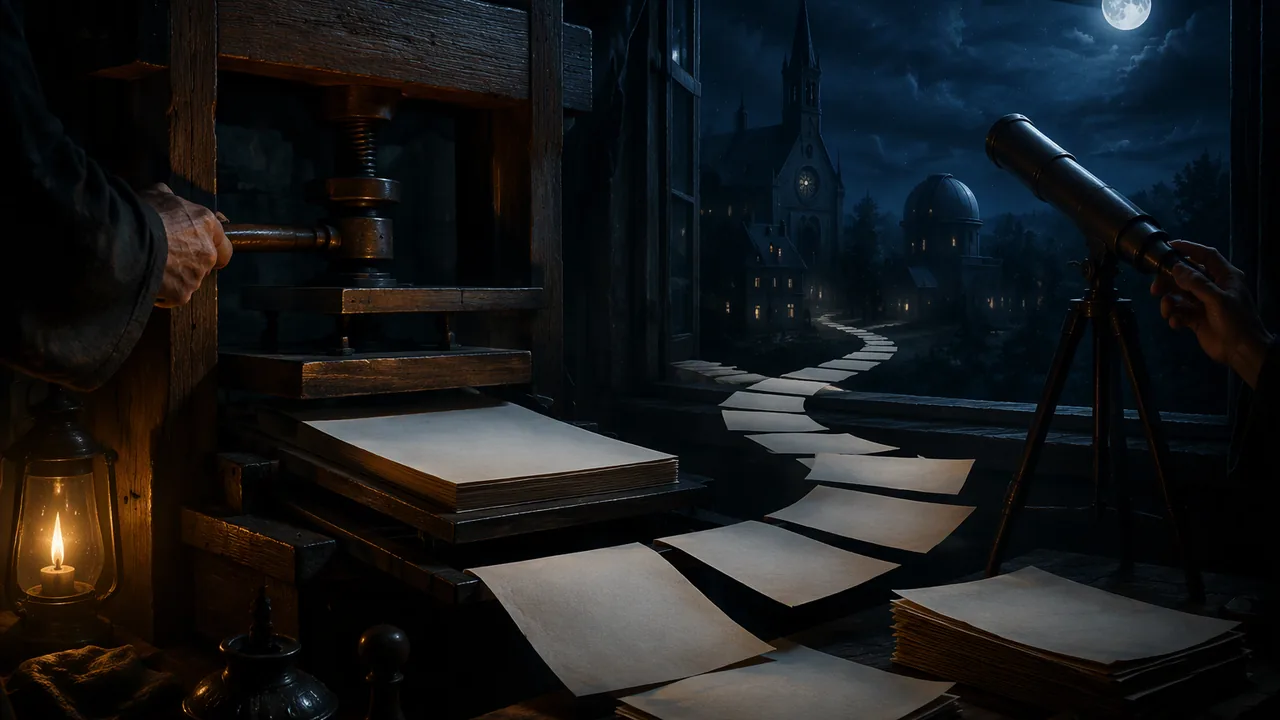
Between about 1500 and 1700 two movements challenged the idea that truth comes down from established authority. In religion, reformers argued that Christians could test Church teaching against Scripture. In nature, observers argued that anyone with the right instrument could test old books against the sky. Both movements used the same new tool, the printing press, and both led to new institutions and new ways of thinking. They also led to wars.
The Reformation. On 31 October 1517 Martin Luther, a professor of moral theology at the University of Wittenberg, circulated ninety-five propositions for academic debate. They attacked the sale of indulgences, which the Church treated as part of the economy of salvation. Read thesis 27 and thesis 28 together: Luther mocks the preachers who say the soul flies out of purgatory “so soon as the penny jingles into the money-box,” and answers that “gain and avarice can be increased” but the Church’s intercession is “in the power of God alone.” Thesis 86 asks why the pope, whose wealth is greater than the riches of the richest, does not build St. Peter’s with his own money rather than “the money of poor believers.” The theses are retrospectively seen as launching the Protestant Reformation. From Saxony, reformers such as Zwingli and Calvin built other traditions; Cranmer and Knox led the Reformation in England and Scotland. Luther was convinced that only educated people could serve God and the community, and public schools and libraries opened under his influence. New institutions meant new churches, new schools and new ideas about who may interpret the Bible.
Religious reform and conflict. The Peace of Augsburg of 25 September 1555 let rulers in the Holy Roman Empire choose either Lutheranism or Roman Catholicism as the official confession of their state, which made the legal division of Christianity permanent within the Empire. It did not end the conflict. The Thirty Years’ War, fought mainly in Central Europe between 1618 and 1648, killed an estimated 4.5 to 8 million soldiers and civilians, and parts of Germany lost more than half of their population. Religious reform also shaped relations beyond Europe: the next lesson shows that Christian conversion was one stated motive for European voyages, and that the same quarrels reached the New World.
The Scientific Revolution. The period is often said to have begun in 1543, when Vesalius published a book on the human body and Copernicus a book on the revolutions of the heavenly spheres, and to have culminated with Newton’s Principia in 1687. In 1610 Galileo published Sidereus Nuncius, the first scientific work based on telescope observations. In it he reports that the Moon “does not possess a smooth and polished surface” but is rough and uneven “just like the face of the Earth itself.” On 7 January 1610 he saw three small stars near Jupiter, and within days realized they were not fixed stars. He named them the Medicean Stars; today we call them the Galilean moons. What Galileo changed was not only a fact about the sky but a method: look, record, repeat, and invite others to check. He was proposing that observation could overturn the authority of ancient books.
Impact. Socially, both movements widened who could take part in arguments about ultimate questions. Politically, rulers gained or lost power when they chose a confession. Economically, the sale of indulgences came under attack, schools multiplied, and science fed navigation, instrument-making and later industry. The two movements were not the same: Luther started from Scripture and faith, Galileo from measurement. But historians study them together because both show that, after 1500, Europeans could argue in public about authority itself.
📖 Read for this lesson
The reading opens over the lesson; close it to come back to exactly where you were. The checks below draw on it.
Formative check
Work through these before moving on. They are not graded — they tell you whether the standard below has landed yet.
Missouri standard: 9-12.WH.3.CC.A
What was Luther’s target in the Ninety-Five Theses?
Missouri standard: 9-12.WH.3.PC.D
The Peace of Augsburg in 1555 ended religious conflict in Europe.
Missouri standard: 9-12.WH.3.CC.A
In 1610 Galileo wrote that the Moon is not smooth and polished but and uneven.
Missouri standard: 9-12.WH.3.CC.A
Which change did both the Reformation and the Scientific Revolution depend on?
Missouri standard: 9-12.WH.3.PC.D
The Peace of Augsburg let a ruler pick the official confession of his state. What was a consequence for conflict?
Missouri standard: 9-12.WH.3.CC.A, 9-12.WH.3.PC.D
Build the two-column comparison. For the Reformation and the Scientific Revolution give: what authority each challenged, one new institution or method, and one social, political or economic effect. Quote one sentence from Luther or Galileo to support your point. Then explain in two sentences how a religious conflict you studied here shaped relations among groups.
How confident are you that you can analyze the Reformation and the Scientific Revolution and explain the new institutions, ways of thinking and conflicts they produced?
Practice
Work these on paper or in your notebook, then open Check your answer. Aim for all of Fluency and Application; try at least one Challenge.
Printable version: this unit’s practice workbook (PDF)
Fluency
Build speed and accuracy with the core skill.
- How many years passed between the Ninety-Five Theses (1517) and the Peace of Augsburg (1555)?
Check your answer
Answer: 1555 – 1517 = 38 years.Subtract. - How long did the Thirty Years’ War last by its own dates, 1618 to 1648? Is the name accurate?
Check your answer
Answer: 1648 – 1618 = 30 years, so the name is accurate for the dates given.Check the arithmetic against the title.
Application
Use the skill in context. Show your reasoning.
- In thesis 28, what does Luther say can be increased when the penny jingles in the box, and what does he say belongs to God alone?
Check your answer
Answer: “gain and avarice” can be increased; “the result of the intercession of the Church is in the power of God alone.”Quote exactly. - Estimates say 4.5 to 8 million people died in the Thirty Years’ War. What is the range, and why do historians give a range?
Check your answer
Answer: 8 – 4.5 = 3.5 million is the width of the range. Records are incomplete, deaths came from battle, famine and disease, and different scholars count differently.Ranges signal honest uncertainty. - Galileo saw three small stars near Jupiter on 7 January 1610 and “believed them to belong to the number of the fixed stars.” What happened on 8 January that changed his mind, according to the reading?
Check your answer
Answer: He found three little stars all west of Jupiter and nearer together than the night before, and wondered how Jupiter could be east of the stars one day when the day before it had been west of two of them. Fixed stars should not behave so, and his surprise began the inquiry.Evidence from repeated observation overturned a first guess.
Review
Keep earlier skills sharp.
- Review (sourcing): the Luther text in this lesson is the 1915 Holman translation by Jacobs. Why is it a primary source even though it is a translation?
Check your answer
Answer: The ideas and the document are Luther’s from 1517; the translation changes the language, not the date or authorship, though a careful historian checks key terms against the original.Primary means created at the time by a participant.
Ninety-Five Theses and the Starry Messenger
Martin Luther, Disputation on the Power and Efficacy of Indulgences (Ninety-Five Theses), 31 October 1517, in Works of Martin Luther, trans. and ed. A. Spaeth, L. D. Reed, H. E. Jacobs et al. (Philadelphia: A. J. Holman, 1915), vol. 1, Project Gutenberg #274; Galileo Galilei, The Sidereal Messenger (Sidereus Nuncius, 1610), trans. Edward Stafford Carlos (London: Rivingtons, 1880), Wikisource · Public domain
Why this reading. Lesson 5.4 pairs the two great challenges to authority in early modern Europe. One was a monk’s list of propositions about the Church’s sale of indulgences; the other was a mathematician’s report of what he saw through a telescope. Read both in their own words and ask what each was challenging, and how each spread.
A. Wittenberg, 31 October 1517
Martin Luther, Disputation on the Power and Efficacy of Indulgences (the Ninety-Five Theses), selected propositions, in Works of Martin Luther (Philadelphia: Holman, 1915), vol. 1. Project Gutenberg #274. Public domain. The numbers are Luther’s. Square brackets are the translator’s.
“Out of love for the truth and the desire to bring it to light, the following propositions will be discussed at Wittenberg, under the presidency of the Reverend Father Martin Luther, Master of Arts and of Sacred Theology, and Lecturer in Ordinary on the same at that place. Wherefore he requests that those who are unable to be present and debate orally with us, may do so by letter. In the Name our Lord Jesus Christ. Amen.”
“1. Our Lord and Master Jesus Christ, when He said Poenitentiam agite, willed that the whole life of believers should be repentance.”
“27. They preach man who say that so soon as the penny jingles into the money-box, the soul flies out [of purgatory].”
“28. It is certain that when the penny jingles into the money-box, gain and avarice can be increased, but the result of the intercession of the Church is in the power of God alone.”
“36. Every truly repentant Christian has a right to full remission of penalty and guilt, even without letters of pardon.”
“62. The true treasure of the Church is the Most Holy Gospel of the glory and the grace of God.”
“86. Again:–“Why does not the pope, whose wealth is to-day greater than the riches of the richest, build just this one church of St. Peter with his own money, rather than with the money of poor believers?”
B. Padua and Venice, 1610
Galileo Galilei, The Sidereal Messenger (Sidereus Nuncius, 1610), translated by Edward Stafford Carlos (London, 1880), via Wikisource. Public domain. The first excerpt is from the author’s preface; the second is from the account of his discovery.
“any one may know with the certainty that is due to the use of our senses, that the Moon certainly does not possess a smooth and polished surface, but one rough and uneven, and, just like the face of the Earth itself, is everywhere full of vast protuberances, deep chasms, and sinuosities.”
“On the 7th day of January in the present year, 1610, in the first hour of the following night, when I was viewing the constellations of the heavens through a telescope, the planet Jupiter presented itself to my view, and as I had prepared for myself a very excellent instrument, I noticed a circumstance which I had never been able to notice before, owing to want of power in my other telescope, namely, that three little stars, small but very bright, were near the planet; and although I believed them to belong to the number of the fixed stars, yet they made me somewhat wonder, because they seemed to be arranged exactly in a straight line, parallel to the ecliptic, and to be brighter than the rest of the stars, equal to them in magnitude.”
About these excerpts. Every excerpt is word for word from the translation named. Theses and passages not shown are omitted, not changed.
Sources: Martin Luther, Disputation on the Power and Efficacy of Indulgences (Project Gutenberg #274) (gutenberg.org); Galileo, The Sidereal Messenger, trans. E. S. Carlos (Wikisource) (en.wikisource.org)