analyze the causes and consequences of European overseas expansion for peoples in Europe, Asia, Africa and the Americas, evaluate the extent and impact of the Columbian Exchange, and describe the changes in migration and settlement it produced.
Instruction
Between about 1430 and 1600 sailors from Portugal and Spain linked continents that had never been in regular contact. Historians call this the Age of Discovery, though “discovery” describes the Europeans’ point of view: the lands and seas were already known to the peoples who lived there. This lesson examines why Europeans went, what their voyages did to people on four continents, and what the Columbian Exchange carried across the Atlantic.
Causes. Portuguese voyages along the African coast began in the early 1400s and culminated in 1498, when Vasco da Gama reached India by sailing around Africa, opening direct trade with Asia. Spain made Columbus’s voyages (1492-1504), the Magellan expedition (1519-1522), the conquest of Mexico (1519-1521) and of Peru (1532-1533). The motives mixed profit, religion and rivalry. Columbus’s own letter shows all three: he reports “extensive mines of gold,” says he gave gifts “that they might be led to become Christians,” and describes a city on Hispaniola placed for “the working of the gold mines” and for “vast commerce and great profit.” The Treaty of Tordesillas, ratified by Pope Julius II, divided the claims of Portugal and Spain.
Europe, Africa and Asia. In Africa, the Portuguese reached the Gold Coast at Elmina in 1471, where a thriving gold trade already existed among Africans and Arab and Berber traders. In Asia, they set up trading posts at Kochi and Calicut in 1501 and Goa in 1510, entering existing Indian Ocean networks rather than creating new ones. Spain’s Manila galleon route (1565-1815) linked the Americas to Asia across the Pacific. For Europe, the voyages brought silver, new foods and new rivalries.
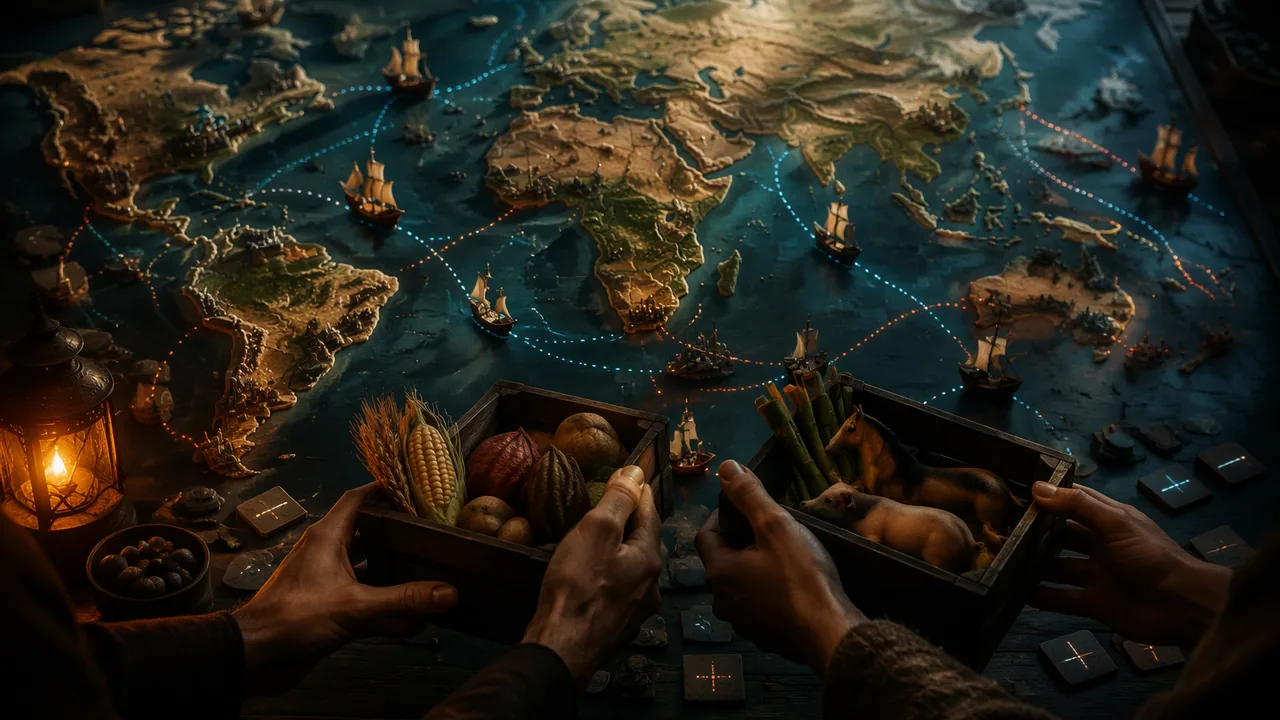
The Americas and the Columbian Exchange. The Columbian Exchange is the transfer of plants, animals and diseases between the Western and Eastern Hemispheres from the late fifteenth century on. Its effects were enormously unequal. Communicable diseases of Old World origin caused an 80 to 95 percent reduction in the Indigenous population of the Americas over the following centuries and nearly extinguished the peoples of the Caribbean. American crops such as maize, potatoes, tomatoes, tobacco, cassava, sweet potatoes and chili peppers became important crops around the world, supporting growth of the population in the Old World. Old World rice, wheat, sugar cane and livestock became important in the New World. Las Casas, who wrote in 1552 after decades in the Caribbean, claims that of three million people who lived on Hispaniola “there is at present but the inconsiderable remnant of scarce Three Hundred.” The figure is his own claim and is disputed, but the direction of the change, a collapse of the Indigenous population, matches the modern estimate.
Migration and settlement. The exchange changed where people lived. Europeans settled in the Americas and the Spanish Crown awarded encomiendas, which gave colonists the labor of Indigenous communities and in practice often resembled forced labor. Africans were taken to the Americas in far greater numbers than Europeans in the first three centuries after Columbus; the next lesson treats that forced migration. In Asia, European trading posts clustered on coasts. Later you will see French traders and missionaries move up the Mississippi into what is now Missouri, a settlement pattern that followed the same logic as Goa: a river or sea route, a post, and a trade.
Cultural exchange and disruption. The word “exchange” can hide the imbalance. Columbus tells the Spanish court that the islanders gave everything they had for worthless things, and also says he “took by force” some of them. A valid judgment of the extent and impact of the exchange keeps both the gains (new foods, new routes, new knowledge) and the losses (death, enslavement, loss of land and culture) in the same account.
📖 Read for this lesson
The reading opens over the lesson; close it to come back to exactly where you were. The checks below draw on it.
Formative check
Work through these before moving on. They are not graded — they tell you whether the standard below has landed yet.
Missouri standard: 9-12.WH.3.CC.B
In Columbus’s letter, which motive is NOT stated?
Missouri standard: 9-12.WH.3.PC.B
The Columbian Exchange moved plants, animals and diseases in both directions between the hemispheres.
Missouri standard: 9-12.WH.3.PC.B
Communicable diseases of Old World origin caused a reduction of to percent of the Indigenous population of the Americas.
Missouri standard: 9-12.WH.3.PC.A
Which route did Vasco da Gama open in 1498?
Missouri standard: 9-12.WH.3.G.B
Which statement best describes changes in migration and settlement after Columbus?
Missouri standard: 9-12.WH.3.CC.B, 9-12.WH.3.PC.B, 9-12.WH.3.PC.A, 9-12.WH.3.G.B
Complete the four-continent chart. For Europe, Africa, Asia and the Americas name one gain, one loss and one piece of evidence from the reading or lesson. Then use Columbus and Las Casas to write one sentence about the Columbian Exchange that is fair to both sides, and note which number in the reading is a claim rather than a measurement.
How confident are you that you can analyze the causes and consequences of European expansion and evaluate the Columbian Exchange?
Practice
Work these on paper or in your notebook, then open Check your answer. Aim for all of Fluency and Application; try at least one Challenge.
Printable version: this unit’s practice workbook (PDF)
Fluency
Build speed and accuracy with the core skill.
- Columbus sailed in 1492 and Vasco da Gama reached India in 1498. How many years apart?
Check your answer
Answer: 1498 – 1492 = 6 years.Subtract. - Las Casas says three million people lived on Hispaniola and “scarce Three Hundred” remain. What fraction of the original population is that, and what percent?
Check your answer
Answer: 300 / 3,000,000 = 1/10,000, or 0.01 percent.Divide, then convert to a percent.
Application
Use the skill in context. Show your reasoning.
- Compare Las Casas’s implied loss on Hispaniola (0.01 percent remaining) with the modern estimate that Old World diseases reduced the Indigenous population of the Americas by 80 to 95 percent. Why can both be true and still differ so much?
Check your answer
Answer: The modern figure is a range for the whole hemisphere over centuries, from several causes; Las Casas describes one island in the first decades and says nearly all were killed. His number is a claim, and the Caribbean was hit earliest and hardest.Different place, different time span, different kind of source. - Give two pieces of evidence from Columbus’s letter that the islanders knew the seas and traded among themselves.
Check your answer
Answer: They “navigate all these seas” and “carry on their traffic” in canoes, some carrying seventy and eighty men.Quote the letter. - Name two American crops and two Old World crops that were carried across the Atlantic and say who benefited.
Check your answer
Answer: American: maize, potatoes (also tomatoes, tobacco, cassava). Old World: wheat, rice (also sugar cane, livestock). Food supplies and populations grew in the Old World; the New World gained new crops and animals but lost its Indigenous population to disease.The benefits were unevenly shared.
Review
Keep earlier skills sharp.
- Review (sourcing): the 1689 edition of Las Casas has a title page that attacks the “Popish Spanish Party.” How does that affect how a historian uses it?
Check your answer
Answer: The printer was an English Protestant who wanted to use the book against Catholic Spain. The text is still Las Casas’s, but the packaging shows a motive for printing it and the translation may carry bias, so the historian checks the claims against other sources.Evaluate both the author and the printer.
Two Accounts of the Caribbean: Columbus in 1493 and Las Casas in 1552
Christopher Columbus, letter on the first voyage, in Select Letters of Christopher Columbus, trans. R. H. Major (London: Hakluyt Society, 1870), Project Gutenberg #77820; Bartolomé de las Casas, A Brief Account of the Destruction of the Indies (1552), English edition printed in London for R. Hewson, 1689, Project Gutenberg #20321 · Public domain
Why this reading. Lesson 5.5 asks what European expansion did to people in Europe, the Americas, Africa and Asia, and the lesson’s numbers about the Columbian Exchange come from modern scholars. This reading gives you two voices from the first generations: the admiral who reached the Caribbean and wrote home about what he saw, and the friar who spent decades there and wrote a protest against what he saw. Read the two against each other, and notice what the 1689 title page shows about who was printing Las Casas, and why.
A. Columbus writes home, 1493
Christopher Columbus, letter on his first voyage, translated by R. H. Major, in Select Letters of Christopher Columbus (Hakluyt Society, 1870). Project Gutenberg #77820. Public domain. Italicized place names are marked in the original.
“In this island there are many spices and extensive mines of gold and other metals.”
“I gave away a thousand good and pretty articles which I had brought with me in order to win their affection; and that they might be led to become Christians, and be well inclined to love and serve their Highnesses and the whole Spanish nation, and that they might aid us by giving us things of which we stand in need, but which they possess in abundance.”
“On my reaching the Indies, I took by force, in the first island that I discovered, some of these natives, that they might learn our language and give me information in regard to what existed in these parts; and it so happened that they soon understood us and we them, either by words or signs, and they have been very serviceable to us.”
“Although I have taken possession of all these islands in the name of their Highnesses, and they are all more abundant in wealth than I am able to express; and although I hold them all for their Highnesses, so that they can dispose of them quite as absolutely as they can of the kingdoms of Castile, yet there was one large town in Española of which especially I took possession, situated in a locality well adapted for the working of the gold mines, and for all kinds of commerce, either with the main land on this side, or with that beyond which is the land of the great Khan, with which there will be vast commerce and great profit.”
B. Las Casas protests, 1552 (English edition of 1689)
Bartolomé de las Casas, A Brief Account of the Destruction of the Indies, as printed in London in 1689 under the title Popery Truly Display’d in its Bloody Colours. Project Gutenberg #20321. Public domain. The Gutenberg preparer notes that the archaic spelling and punctuation of the 1689 edition are retained. The title page of this edition describes the book as an account of cruelties “committed by the Popish Spanish Party”: an English Protestant printer used a Spanish Catholic friar’s protest against Spain. Treat the numbers as Las Casas’s own claims.
“The Spaniards first assaulted the innocent Sheep, so qualified by the Almighty, as is premention’d, like most cruel Tygers, Wolves and Lions hunger-starv’d, studying nothing, for the space of Forty Years, after their first landing, but the Massacre of these Wretches, whom they have so inhumanely and barbarously butcher’d and harass’d with several kinds of Torments, never before known, or heard (of which you shall have some account in the following Discourse) that of Three Millions of Persons, which lived in Hispaniola itself, there is at present but the inconsiderable remnant of scarce Three Hundred.”
“Nay the Isle of Cuba, which extends as far, as Valledolid in Spain is distant from Rome, lies now uncultivated, like a Desert, and intomb’d in its own Ruins. You may also find the Isles of St. John, and Jamaica, both large and fruitful places, unpeopled and desolate.”
About these excerpts. Every excerpt is word for word, with footnote numbers removed. Passages not shown are omitted, not changed. Both authors describe the Taino and neighboring peoples through European eyes.
Sources: Select Letters of Christopher Columbus, trans. R. H. Major (Project Gutenberg #77820) (gutenberg.org); A Brief Account of the Destruction of the Indies, Las Casas (Project Gutenberg #20321) (gutenberg.org)