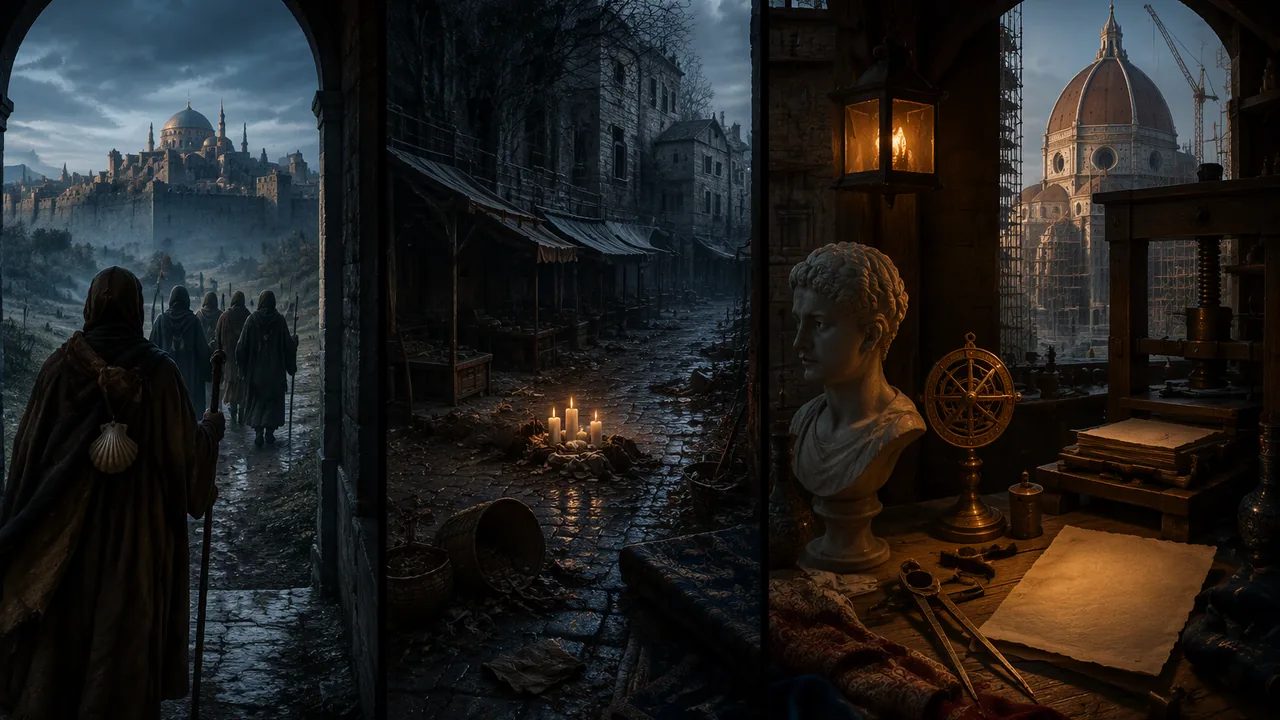
explain how the Crusades, the Black Death, new technology and exchanges with other regions changed Europe and helped bring about the Renaissance, and analyze Renaissance intellectual, architectural and artistic achievements as a rebirth of classical ideas.
Instruction
Historians often explain the Renaissance as the result of a chain of events. This lesson follows the chain and asks you to test each link with evidence. A chain is a claim about cause and effect, and each link can be argued: did the Crusades really change Europe, or did trade already do so? Did the plague destroy a world or make room for a new one? And in what sense was the Renaissance a rebirth of ancient ideas?
Link one: the Crusades. The First Crusade (1096-1099) began when Pope Urban II, at the Council of Clermont in 1095, urged Christians to answer a request for aid from the Byzantine emperor Alexios I, whose empire was under attack from the Seljuk Turks. In the account in this lesson, the pope offers “immediate remission of sins” to those who die on the way. Crusaders took Jerusalem on 15 July 1099 and a large share of its residents were massacred. The effects on Europe were mixed and are still debated: by the eleventh century the population of Europe had already increased greatly as technological and agricultural innovations allowed trade to flourish, so the Crusades were one cause among several.
Link two: the Black Death. The plague pandemic struck Europe from 1346 to 1353 and killed up to 50 million people, around 30 to 60 percent of the European population. Boccaccio describes its arrival in Florence in 1348, tumors in the groin or armpit “as large as a common apple,” and death usually within three days. He also reports that it spread by contact. The consequences were social as well as medical. With so many workers dead, wages rose in many places, though workers living on wages alone often lost real income to inflation. The old order of lords and laborers was weakened, and the survivors had to rethink how they lived.
Link three: new technology and old ideas. Around 1440 Johannes Gutenberg invented the movable-type printing press. By 1500 presses in Western Europe had produced over 20 million copies, and by 1600 an estimated 150 to 200 million. Books moved faster than any letter or copyist could carry them, and ideas now spread across regions at a pace they never had. At the same time, the fall of Constantinople in 1453 sent a wave of Greek scholars and manuscripts to Italy. Renaissance scholars, unlike medieval ones, were most interested in recovering classical literary, historical and oratorical texts.
Link four: the Renaissance itself. The Renaissance, from the fourteenth century to the seventeenth, was first centered in the Republic of Florence. Its humanists revived classical learning; its artists and architects revived classical forms. Vasari’s life of Filippo Brunelleschi is a case study in rebirth. Brunelleschi went to Rome and, in Vasari’s words, “became capable of entirely reconstructing the city in his imagination.” He then proposed a dome for the cathedral of Florence larger than any the ancients had raised. The Renaissance borrowed from the past, but it did not copy it: the new dome had to solve a problem Rome never faced.
Evaluating the chain. No link is certain. Plague, printing and migration of scholars all helped, and so did the wealth of Florence and the patronage of its dominant family, the Medici. A good answer to “what caused the Renaissance?” names several causes, ranks them, and says what evidence would change the ranking.
📖 Read for this lesson
The reading opens over the lesson; close it to come back to exactly where you were. The checks below draw on it.
Formative check
Work through these before moving on. They are not graded — they tell you whether the standard below has landed yet.
Missouri standard: 9-12.WH.2.CC.C
According to Fulcher’s report, what spiritual reward did Urban II promise those who died on the way to fight?
Missouri standard: 9-12.WH.2.CC.C
Boccaccio says the plague spread only by the air and could not be caught from touching the clothes of the sick.
Missouri standard: 9-12.WH.2.PC.A
Movable-type printing was invented by Johannes around the year .
Missouri standard: 9-12.WH.2.PC.A
Why did the fall of Constantinople in 1453 matter for the Renaissance?
Missouri standard: 9-12.WH.2.PC.B
What did Vasari say Brunelleschi did in Rome that shows a “rebirth” of classical ideas?
Missouri standard: 9-12.WH.2.CC.C, 9-12.WH.2.PC.A, 9-12.WH.2.PC.B
Write a four-link cause-and-effect chain from the Crusades to the Renaissance. For each link cite one phrase from the reading or lesson. Then name one link you find weakest and say what additional evidence would strengthen it.
How confident are you that you can trace the causes that led from the Crusades and the Black Death to the Renaissance and analyze Renaissance achievements as a rebirth of classical ideas?
Practice
Work these on paper or in your notebook, then open Check your answer. Aim for all of Fluency and Application; try at least one Challenge.
Printable version: this unit’s practice workbook (PDF)
Fluency
Build speed and accuracy with the core skill.
- The Council of Clermont met in 1095 and Boccaccio describes the plague in Florence in 1348. How many years separate them?
Check your answer
Answer: 1348 – 1095 = 253 years.Subtract the earlier year from the later. - By 1500 presses in Western Europe had produced over 20 million copies; by 1600 an estimated 150 to 200 million. By what factor, at least, did output grow from 1500 to 1600?
Check your answer
Answer: 150 / 20 = 7.5, so at least about 7.5 times (and about 10 times at the upper estimate).Divide the lower 1600 estimate by the 1500 figure.
Application
Use the skill in context. Show your reasoning.
- Boccaccio writes that almost everyone who caught the plague died “within three days.” What does that detail tell a historian, and what should the historian check before relying on it?
Check your answer
Answer: It suggests how quickly and fatally the disease acted in Florence. The historian checks who is speaking and whether he saw the events; the translator’s introduction says Boccaccio was probably not in Florence and relied on witnesses.Evaluate the source, not just the claim. - Explain, using the reading, one way Brunelleschi’s dome was a rebirth of classical ideas and one way it was new.
Check your answer
Answer: Rebirth: he studied Roman ruins and recovered their methods and orders. New: Vasari has him say the ancients never raised so enormous a vault, so he had to invent scaffolding and a way of dovetailing and enchaining the stones for an eight-sided dome.Both claims come from Vasari’s account. - Explain how printing and the fall of Constantinople together made classical learning spread faster in the 1400s.
Check your answer
Answer: Greek scholars and manuscripts reached Italy after 1453, and printing from about 1440 made it possible to copy and circulate texts quickly in many copies instead of by hand.Name both a supply of texts and a way to spread them.
Review
Keep earlier skills sharp.
- Review (sourcing): Fulcher wrote his account of the pope’s speech some years after the council. Why does the date of writing matter to a historian?
Check your answer
Answer: A report written after the fact may reflect what the writer thought the pope should have said or what later events made seem important, so it is evidence of the writer’s view as well as the pope’s.Distance in time weakens a source as a transcript.
A Crusade Sermon, a Plague Year and a Dome
Urban II, speech at Clermont according to Fulcher of Chartres, from O. J. Thatcher and E. H. McNeal, A Source Book for Medieval History (New York: Scribners, 1905), Fordham Internet Medieval Sourcebook; Boccaccio, The Decameron, Introduction to the First Day, trans. J. M. Rigg, Project Gutenberg #3726; Vasari, Lives of the Most Excellent Painters, Sculptors, and Architects, Life of Filippo Brunelleschi, trans. Mrs. Jonathan Foster (London: Bohn), Wikisource · Public domain
Why this reading. Lesson 5.3 follows a chain of cause and effect from the Crusades, through the Black Death, to the Renaissance. A chain is only as strong as its evidence, so this reading gives you one witness for each link: a churchman’s version of the call to the First Crusade, a poet’s description of the plague in Florence in 1348, and a biographer’s account of the architect who studied Rome’s ruins and then raised the largest dome of his age.
A. The call to crusade, 1095
Urban II’s speech at the Council of Clermont, as reported by Fulcher of Chartres, from Thatcher and McNeal, A Source Book for Medieval History (1905), Fordham Internet Medieval Sourcebook. Public domain. Fulcher wrote the speech down some years after the council, so these are his words about what the pope said, not a transcript. The speech uses hostile language about Muslims that students should read as evidence of the medieval propaganda of holy war, not as fact.
“For your brethren who live in the east are in urgent need of your help, and you must hasten to give them the aid which has often been promised them. For, as the most of you have heard, the Turks and Arabs have attacked them and have conquered the territory of Romania [the Greek empire] as far west as the shore of the Mediterranean and the Hellespont, which is called the Arm of St. George. They have occupied more and more of the lands of those Christians, and have overcome them in seven battles. They have killed and captured many, and have destroyed the churches and devastated the empire.”
“All who die by the way, whether by land or by sea, or in battle against the pagans, shall have immediate remission of sins. This I grant them through the power of God with which I am invested. O what a disgrace if such a despised and base race, which worships demons, should conquer a people which has the faith of omnipotent God and is made glorious with the name of Christ! With what reproaches will the Lord overwhelm us if you do not aid those who, with us, profess the Christian religion! Let those who have been accustomed unjustly to wage private warfare against the faithful now go against the infidels and end with victory this war which should have been begun long ago. Let those who for a long time, have been robbers, now become knights.”
B. The plague in Florence, 1348
Giovanni Boccaccio, The Decameron, Introduction to the First Day, translated by J. M. Rigg. Project Gutenberg #3726. Public domain. Boccaccio’s account may not be an eyewitness report; the translator’s introduction says that he was probably not in Florence during the plague but would have had reports from witnesses.
“I say, then, that the years of the beatific incarnation of the Son of God had reached the tale of one thousand three hundred and forty-eight when in the illustrious city of Florence, the fairest of all the cities of Italy, there made its appearance that deadly pestilence, which, whether disseminated by the influence of the celestial bodies, or sent upon us mortals by God in His just wrath by way of retribution for our iniquities, had had its origin some years before in the East, whence, after destroying an innumerable multitude of living beings, it had propagated itself without respite from place to place, and so, calamitously, had spread into the West. In Florence, despite all that human wisdom and forethought could devise to avert it, as the cleansing of the city from many impurities by officials appointed for the purpose, the refusal of entrance to all sick folk, and the adoption of many precautions for the preservation of health; despite also humble supplications addressed to God, and often repeated both in public procession and otherwise, by the devout; towards the beginning of the spring of the said year the doleful effects of the pestilence began to be horribly apparent by symptoms that shewed as if miraculous. Not such were they as in the East, where an issue of blood from the nose was a manifest sign of inevitable death; but in men and women alike it first betrayed itself by the emergence of certain tumours in the groin or the armpits, some of which grew as large as a common apple, others as an egg, some more, some less, which the common folk called gavoccioli. From the two said parts of the body this deadly gavocciolo soon began to propagate and spread itself in all directions indifferently; after which the form of the malady began to change, black spots or livid making their appearance in many cases on the arm or the thigh or elsewhere, now few and large, now minute and numerous. And as the gavocciolo had been and still was an infallible token of approaching death, such also were these spots on whomsoever they shewed themselves. Which maladies seemed to set entirely at naught both the art of the physician and the virtues of physic; indeed, whether it was that the disorder was of a nature to defy such treatment, or that the physicians were at fault–besides the qualified there was now a multitude both of men and of women who practised without having received the slightest tincture of medical science–and, being in ignorance of its source, failed to apply the proper remedies; in either case, not merely were those that recovered few, but almost all within three days from the appearance of the said symptoms, sooner or later, died, and in most cases without any fever or other attendant malady.”
“Moreover, the virulence of the pest was the greater by reason that intercourse was apt to convey it from the sick to the whole, just as fire devours things dry or greasy when they are brought close to it. Nay, the evil went yet further, for not merely by speech or association with the sick was the malady communicated to the healthy with consequent peril of common death; but any that touched the cloth of the sick or aught else that had been touched or used by them, seemed thereby to contract the disease.”
C. A student of Rome raises a dome
Giorgio Vasari, Lives of the Most Excellent Painters, Sculptors, and Architects, Life of Filippo Brunelleschi, translated by Mrs. Jonathan Foster (London: Henry G. Bohn), via Wikisource. Public domain. Vasari wrote in the 1500s, more than a century after the events he describes, so the speech is his reconstruction.
“Nor did he rest until he had drawn every description of fabric—temples, round, square, or octagon; basilicas, aqueducts, baths, arches, the Colosseum, Amphitheatres, and every church built of bricks, of which he examined all the modes of binding and clamping, as well as the turning of the vaults and arches; he took note likewise of all the methods used for uniting the stones, as well as of the means used for securing the equilibrium and close conjunction of all the parts; and having found that in all the larger stones there was a hole, formed exactly in the centre of each on the under side, he discovered that this was for the insertion of the iron instrument with which the stones are drawn up, and which is called by us the mason’s clamps (la ulivella), an invention, the use of which he restored and ever afterwards put in practice. The different orders were next divided by his cares, each order, Doric, Ionic, or Corinthian being placed apart; and such was the effect of his zeal in that study, that he became capable of entirely reconstructing the city in his imagination, and of beholding Rome as she had been before she was ruined.”
“Gentlemen Superintendents, there is no doubt that great undertakings always present difficulties in their execution; and if none ever did so before, this of vours does it to an extent of which you are not perhaps even yet fully aware, for I do not know that even the ancients ever raised so enormous a vault as this will be. I, who have many times reflected on the scaffoldings required, both within and without, and on the method to be pursued for working securely at this erection, have never been able to come to a decision; and I am confounded, no less by the breadth than the height of the edifice. Now if the Cupola could be arched in a circular form, we might pursue the method adopted by the Romans in erecting the Pantheon of Rome; that is, the Rotunda. But here we must follow the eight sides of the building, dovetailing, and so, to speak, enchaining the stones, which will be a very difficult thing. Yet, remembering that this is a temple consecrated to God and the Virgin, I confidently trust, that for a work executed to their honour, they will not fail to infuse knowledge where it is now wanting, and will bestow strength, wisdom, and genius on him who shall be the author of such a project.”
About these excerpts. Every excerpt is word for word from the translation named, with footnote numbers removed.
Sources: Urban II: Speech at Council of Clermont, 1095, according to Fulcher of Chartres (Fordham Internet Medieval Sourcebook) (sourcebooks.fordham.edu); The Decameron, trans. J. M. Rigg, vol. 1 (Project Gutenberg #3726) (gutenberg.org); Vasari, Lives of the Most Excellent Painters, Sculptors, and Architects, Filippo Brunelleschi (Wikisource) (en.wikisource.org)