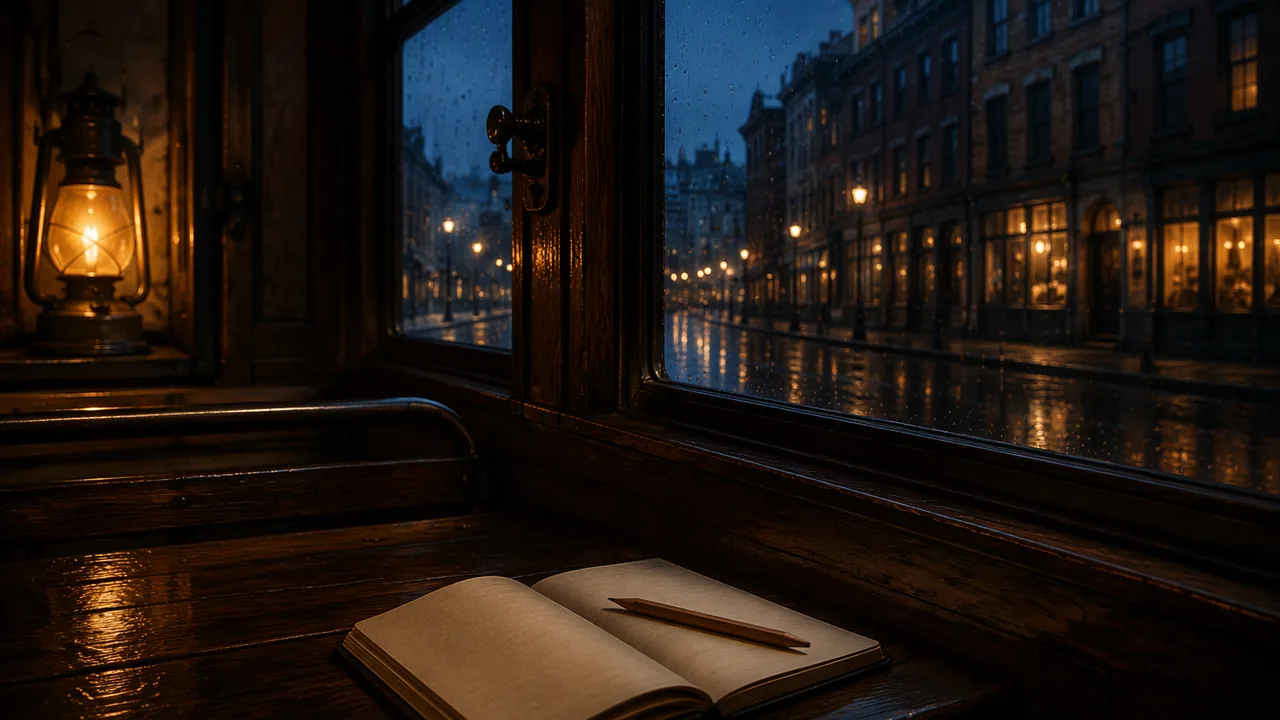
write a narrative scene that renders the experience a poem implies, using precise words, telling details and sensory language, without quoting the poem or stating its theme.
Instruction
Every poem in this anthology implies a scene it does not show. Cullen’s “Incident” implies a child’s ride through Baltimore and the moment another child changes everything. Owen’s poem implies the hours before the gas attack. Hughes’s “I, Too” implies a kitchen, a dinner table, and a future day when “Nobody’ll dare / Say to me, / ‘Eat in the kitchen.'” Your task is to write that scene.
The rules. You may not quote the poem. You may not state its theme. Everything the poem says directly, your scene must carry indirectly — through what happens and what a character notices. That constraint is what makes this a lesson in narrative craft (9-10.W.2.A: precise words and phrases, telling details and sensory language to convey a vivid picture).
Telling detail. General description tells the reader what to think: The kitchen was hot and crowded and he felt excluded. A telling detail lets the reader reach the conclusion: Through the swinging door he could hear the silverware. One exact detail does more than three adjectives.
The camera test. Could a camera photograph it? Excluded cannot be photographed; a door swinging shut can. Afraid cannot; a hand that will not let go of a sleeve can.
Beyond sight. Most student narrative is visual only. Add at least one detail from another sense: the smell of wet wool, the sound of boots in mud, the heat of a railway car, the taste of dust. One non-visual detail changes the texture of a whole page.
Verbs. Lesson 2.2’s work applies directly. “Walked” is a placeholder; “shuffled,” “marched,” “picked her way” each carry a mood. Choose the strongest verb and delete the adverb.
Narrative techniques (9-10.W.2.A). Use at least one of: dialogue, pacing (slowing down at the moment that matters), description, reflection, or multiple plot lines. Engage the reader early and build toward a moment of change.
Write the place and the people carefully. Several poems concern experiences of racism and war. If you write from a perspective not your own, write with the poem’s dignity: avoid stereotype and caricature, and let one precise detail carry what a slogan would flatten. You may instead write a parallel scene from your own world that implies the same thing.
Revision exercise (9-10.W.3.A). Take one paragraph of your draft. Find the three most general words. Replace one with a photographable detail and cut the other two. Keep both versions and decide honestly which is stronger. Routine writing (9-10.W.2.A): add today’s draft to your writing log with the date.
Reading: The scene a poem implies: poems, mentor paragraphs, a model and criteria
Countee Cullen, “Incident,” Color (1925), via Wikisource (https://en.wikisource.org/w/index.php?action=render&title=Color_%28Cullen%29/Incident). Langston Hughes, “Epilogue” (the poem later titled “I, Too”), The Weary Blues (1926), via Wikisource (https://en.wikisource.org/w/index.php?action=render&title=The_Weary_Blues_%28collection%29/Epilogue). Wilfred Owen, “Dulce et Decorum est,” Poems by Wilfred Owen (1920), via Wikisource (https://en.wikisource.org/w/index.php?action=render&title=Poems_by_Wilfred_Owen/Dulce_et_Decorum_est). Helen Keller, The Story of My Life (1903), Project Gutenberg eBook #2397, https://www.gutenberg.org/ebooks/2397, retrieved 2026-09-26. Retrieved 2026-09-26. Wikisource transcriptions are copied by script; editorial line numbers and footnote markers in the source were removed, and the line numbers printed here are counted from the first line of each poem. · SLS original; quoted poems and memoir are public domain (Cullen, 1925; Hughes, 1926; Owen, 1920; Keller, 1903)
Poems and mentor paragraphs copied by script and checked verbatim. The model scene, camera test, revision and criteria are SLS original.
Your scene starts from a poem, so the poems are printed here in full with line numbers. Two mentor paragraphs from a published memoir show telling detail and non-visual detail at work. A student model scene, a before-and-after revision and the criteria for your Stage 1 draft follow. The poems and the memoir are quoted; the model, revision and criteria are SLS original.
Content note
“Incident” quotes a racial slur, as its poet wrote it. It appears once, and the poem hangs on that one word. Read it silently. The class norm is that no one reads the slur aloud, and your scene must not repeat it.
“Incident,” Countee Cullen (1925)
ONCE riding in old Baltimore,
Heart-filled, head-filled with glee,
I saw a Baltimorean
Keep looking straight at me.
5 Now I was eight and very small,
And he was no whit bigger,
And so I smiled, but he poked out
His tongue, and called me, “Nigger.”
I saw the whole of Baltimore
10 From May until December;
Of all the things that happened there
That’s all that I remember.
“I, Too,” Langston Hughes (1926)
I, too, sing America.
I am the darker brother.
They send me to eat in the kitchen
When company comes,
5 But I laugh,
And eat well,
And grow strong.
Tomorrow,
I’ll sit at the table
10 When company comes.
Nobody’ll dare
Say to me,
“Eat in the kitchen,”
Then.
15 Besides,
They’ll see how beautiful I am
And be ashamed,—
I, too, am America.
“Dulce et Decorum est,” Wilfred Owen (published 1920)
Bent double, like old beggars under sacks,
Knock-kneed, coughing like hags, we cursed through sludge,
Till on the haunting flares we turned our backs
And towards our distant rest began to trudge.
5 Men marched asleep. Many had lost their boots
But limped on, blood-shod. All went lame; all blind;
Drunk with fatigue; deaf even to the hoots
Of gas-shells dropping softly behind.
Gas! GAS! Quick, boys!—An ecstasy of fumbling
10 Fitting the clumsy helmets just in time,
But someone still was yelling out and stumbling
And flound’ring like a man in fire or lime.—
Dim, through the misty panes and thick green light,
As under a green sea, I saw him drowning.
15 In all my dreams before my helpless sight
He plunges at me, guttering, choking, drowning.
If in some smothering dreams you too could pace
Behind the wagon that we flung him in,
And watch the white eyes writhing in his face,
20 His hanging face, like a devil’s sick of sin,
If you could hear, at every jolt, the blood
Come gargling from the froth-corrupted lungs,
Bitter as the cud
Of vile, incurable sores on innocent tongues,—
25 My friend, you would not tell with such high zest
To children ardent for some desperate glory,
The old Lie: Dulce et decorum est
Pro patria mori.
Mentor paragraphs: telling detail (Helen Keller, 1903)
Keller was blind and deaf, and she wrote from touch, smell and movement. Watch what she puts in place of the color and sound that another writer would use.
On the afternoon of that eventful day, I stood on the porch, dumb, expectant. I guessed vaguely from my mother’s signs and from the hurrying to and fro in the house that something unusual was about to happen, so I went to the door and waited on the steps. The afternoon sun penetrated the mass of honeysuckle that covered the porch, and fell on my upturned face. My fingers lingered almost unconsciously on the familiar leaves and blossoms which had just come forth to greet the sweet southern spring. I did not know what the future held of marvel or surprise for me. Anger and bitterness had preyed upon me continually for weeks and a deep languor had succeeded this passionate struggle.
Suddenly a change passed over the tree. All the sun’s warmth left the air. I knew the sky was black, because all the heat, which meant light to me, had died out of the atmosphere. A strange odour came up from the earth. I knew it, it was the odour that always precedes a thunderstorm, and a nameless fear clutched at my heart. I felt absolutely alone, cut off from my friends and the firm earth. The immense, the unknown, enfolded me. I remained still and expectant; a chilling terror crept over me.
What to notice (SLS original). In the first paragraph, the sun is felt on her upturned face, and the leaves are known by her fingers; the writer never says “she was waiting.” In the second, the sky is black because “the heat, which meant light to me, had died out.” Each piece of information comes through touch, smell or temperature. That is your model for at least one non-visual detail.
The camera test, worked (SLS original)
| Cannot be photographed | Can |
|---|---|
| He felt excluded. | Through the swinging door he could hear the silverware. |
| She was afraid. | Her hand would not let go of his sleeve. |
| The room was unpleasant. | The radiator knocked twice and the window was fogged over. |
A camera cannot record a smell either, but a smell can be written. Add at least one detail from another sense: wet wool, boots in mud, the heat of a railway car, the taste of dust.
A student model scene (SLS original), for “I, Too”
The swinging door had a round window the size of a dinner plate, and Marcus had learned that if he pressed the side of his head against the wall he could see one corner of the long table: a hand, the edge of a lace cloth, the silver as it was set down. The cook set a bowl of stew in front of him without a word. It smelled of onions and wet wool from the coats hanging by the back door, and it was hot enough that he ate slowly, one spoonful at a time. Through the door came a burst of laughter, then a chair scraping, then a voice asking for more bread. Marcus wiped the bowl with the heel of his own bread, though nobody was watching, and sat up straighter on the stool, which was a little too tall for him. When the platters came back, he was the one who carried them to the sink, and he took the heaviest first. He hummed under his breath, low, so that the cook, drying a pan, glanced over and did not tell him to stop. In the morning he would come in before anyone else, and he would set the table himself, one fork at a time, so that he would know where each place was.
Why it works (SLS original). It never quotes the poem and never states its theme. The exclusion is carried by the door window and the sound of the silverware; the pride by the way he sits and carries the platters; the future by the final sentence, which is an action and not a lesson. It includes non-visual details (the smell of onions and wool, the laughter through the door, the hum), a strong verb (“carried,” “wiped”) and one moment of slowed pacing at the door.
A before-and-after revision (SLS original)
Before: The kitchen was hot and crowded and unpleasant, and he felt left out and sad. It was a very unfair situation.
After: Through the swinging door he could hear the silverware, and he ate faster, as if someone might come to check.
Which is stronger, and why. The second. The first tells the reader what to think and uses the three most general words (unpleasant, sad, unfair). The second has one photographable detail, the sound of silverware, and one action that shows the feeling. Keeping both versions and choosing honestly is the exercise.
Criteria for your Stage 1 draft (SLS original)
| Criterion | Strong | Not yet |
|---|---|---|
| The implied scene | Names the poem and the scene it implies, then renders that scene. | Retells the poem in prose. |
| No quotation, no stated theme | Nothing from the poem appears; the last sentence is an action or an image. | Ends with a sentence that explains the meaning. |
| Telling detail | Concrete details that pass the camera test. | General adjectives. |
| Beyond sight | At least one detail from another sense. | Only visual. |
| Verbs | Strong verbs; few adverbs propping weak ones. | “Walked slowly,” “said angrily.” |
| Technique | At least one of dialogue, pacing, description, reflection or multiple plot lines, used on purpose. | A list of events. |
| Revision exercise | Before and after versions of one paragraph, with an honest judgment. | Only the final paragraph. |
Write with the poem’s dignity. Avoid stereotype; let one exact detail do what a slogan would flatten. You may instead write a parallel scene from your own world that implies the same thing.
Formative check
Work through these before moving on. They are not graded — they tell you whether the standard below has landed yet.
Which sentence uses a telling detail?
Your narrative should end with a sentence stating the poem’s theme so the reader understands it.
Submit Stage 1: name the poem and the scene it implies; draft 400-500 words of that scene with at least one non-visual detail and no statement of theme; paste one paragraph before and after the revision exercise and say which is stronger and why.
How confident are you that you can render an implied scene through telling detail and sensory language without stating its meaning?