analyze how Shakespeare’s first act sets up the play’s structure (the crowd, the alternation of public action and private persuasion, the gathering omens) and how Brutus, Cassius and Caesar are introduced through their choices and their speech.
Instruction
Julius Caesar is named for a man who dies before the play is half over. That is the first clue to its structure: the play is less about Caesar than about what people do with his power, his death and his memory. This lesson reads Act 1 as the foundation of that design.
The shape you are about to read. A tragedy of state is built around a public act. Here the killing of Caesar falls in Act 3, at the center of five acts, which splits the play in two: the first half asks whether Caesar should die, and the second asks what his death will mean and what it will cost. Test that design as you read. For now, notice that Act 1 never shows Caesar doing anything tyrannical. It shows people talking about what he is and what he might become, which tells you the play will be decided by persuasion as much as by force (9-10.RL.2.A).
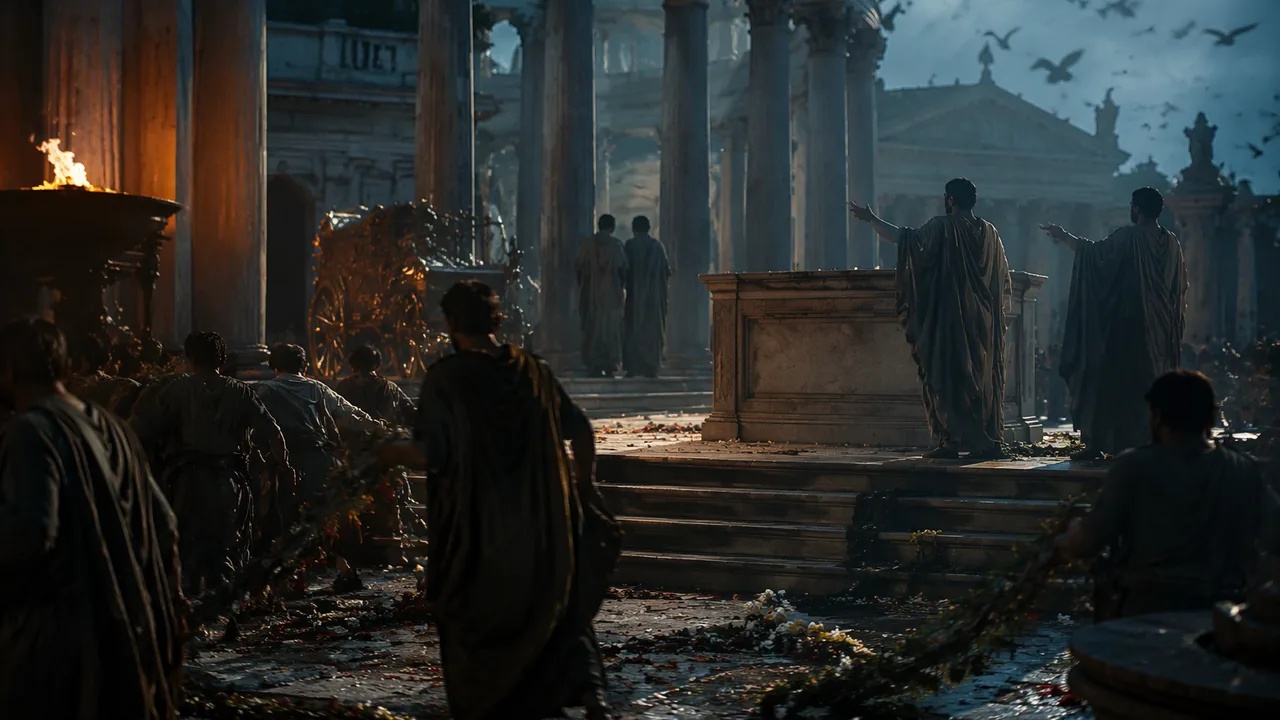
Scene 1: the crowd before the leaders. The play opens not with Caesar but with working men on holiday and two officials, the tribunes Flavius and Marullus, who scold them. Marullus reminds them that they once climbed to the chimney tops to cheer Pompey, and asks: “And do you now strew flowers in his way, / That comes in triumph over Pompey’s blood?” Before any great man speaks, Shakespeare shows us a crowd that changes its loyalties quickly. Keep that crowd in mind.
Scene 2: public and private. The long second scene is built in layers. In public, Caesar’s procession passes, a soothsayer warns him to “Beware the Ides of March,” and Caesar dismisses him: “He is a dreamer.” Then the stage empties except for Brutus and Cassius, and the real business begins while shouts from offstage interrupt them. Each shout makes Brutus fear that “the people / Choose Caesar for their king,” and Cassius uses each one. He tells how he saved Caesar from drowning in the Tiber, describes Caesar shaking with fever “As a sick girl,” and builds to the Colossus image and the claim that “The fault, dear Brutus, is not in our stars, / But in ourselves.” When Caesar returns, we see him through his own words: he distrusts Cassius’s “lean and hungry look,” insists “always I am Caesar,” and in the same breath admits “this ear is deaf.” Then Casca reports, in sour prose, the offstage event the shouts were about: Antony offered Caesar a crown three times, and Caesar refused it, though Casca thinks “he would fain have had it.”
Scene 3: the storm. A night of omens follows. Casca sees a “tempest dropping fire” and reads it as a warning from the gods; Cicero answers that “men may construe things after their fashion, / Clean from the purpose of the things themselves.” Cassius reads the same storm as a picture of Caesar. The act ends with Cassius arranging for letters to be left where Brutus will find them, and with Casca explaining why Brutus matters: what would look like an offense in the others, Brutus’s reputation “Will change to virtue and to worthiness.”
How the characters are introduced (9-10.RL.2.D). Brutus enters “with himself at war” and says he loves “The name of honour more than I fear death.” Cassius is a reader of other people: alone at the end of scene 2, he admits that Brutus’s “honourable metal may be wrought / From that it is dispos’d,” and plans to work it. Caesar is two figures at once, the public name that “doth bestride the narrow world” and the deaf, feverish man who falls down in the marketplace. Shakespeare gives us all three before anyone has committed a crime, so that when the decisions come we can judge them against what we already know.
Reading the verse. Most of the play is in blank verse, unrhymed lines of iambic pentameter, ten syllables with the stress on every second one: “The FAULT, dear BRU-tus, IS not IN our STARS.” Prose appears for the commoners and for Casca’s report. Where Shakespeare switches between verse and prose is itself a choice to analyze.
Range and complexity (9-10.RL.3.D). Shakespeare’s language is demanding. Read Act 1 with the text and a recording together if you can; paraphrase difficult speeches line by line in your log; and read key speeches aloud, because the play was written to be heard.
📖 Before this lesson, read: Julius Caesar, Act 1
The reading opens over the lesson; close it to come back to exactly where you were.
Reading: Act 1 up close: the scene map, six passages and a worked trace
William Shakespeare, The Tragedy of Julius Caesar (c. 1599), public-domain text, Project Gutenberg eBook #1522 (PG Shakespeare Team), https://www.gutenberg.org/ebooks/1522, retrieved 2026-09-26. Line numbers were counted by SLS from this text (verse lines; a line shared between two speakers counts once). · SLS original; quoted passages are public domain (William Shakespeare, Julius Caesar, c. 1599)
Scene headings and passages are copied from the Gutenberg text and checked verbatim. Map rows, the trace table and the model paragraph are SLS original.
Act 1 is assigned in full in the reading card above. This kit gives you the map of the play’s scenes and pulls out the six Act 1 passages your structure map and character trace work from. Read each passage aloud once before you annotate it. The play is quoted from the public-domain text named below; the map rows, the trace and the model paragraph are SLS original.
The scenes of the play
Use these headings, exactly as the edition prints them, as the rows of your structure map. Fill in the three Act 1 rows now and add the others as you read each act.
ACT I
Scene I. Rome. A street
Scene II. The same. A public place
Scene III. The same. A streetACT II
Scene I. Rome. Brutus’ orchard
Scene II. A room in Caesar’s palace
Scene III. A street near the Capitol
Scene IV. Another part of the same street, before the house of BrutusACT III
Scene I. Rome. Before the Capitol; the Senate sitting
Scene II. The same. The Forum
Scene III. The same. A streetACT IV
Scene I. A room in Antony’s house
Scene II. Before Brutus’ tent, in the camp near Sardis
Scene III. Within the tent of BrutusACT V
Scene I. The plains of Philippi
Scene II. The same. The field of battle
Scene III. Another part of the field
Scene IV. Another part of the field
Scene V. Another part of the field
Passage 1: Cassius recruits Brutus (1.2.133-139)
[Cassius.] Why, man, he doth bestride the narrow world
Like a Colossus, and we petty men
135 Walk under his huge legs, and peep about
To find ourselves dishonourable graves.
Men at some time are masters of their fates:
The fault, dear Brutus, is not in our stars,
But in ourselves, that we are underlings.
Passage 2: Brutus answers (1.2)
[Brutus.] If it be aught toward the general good,
Set honour in one eye and death i’ the other,
And I will look on both indifferently;
For let the gods so speed me as I love
The name of honour more than I fear death.
Passage 3: Caesar on Cassius (1.2)
[Caesar.] Would he were fatter! But I fear him not:
Yet if my name were liable to fear,
I do not know the man I should avoid
So soon as that spare Cassius. He reads much,
He is a great observer, and he looks
Quite through the deeds of men. He loves no plays,
As thou dost, Antony; he hears no music.
Seldom he smiles; and smiles in such a sort
As if he mock’d himself and scorn’d his spirit
That could be mov’d to smile at anything.
Such men as he be never at heart’s ease
Whiles they behold a greater than themselves,
And therefore are they very dangerous.
I rather tell thee what is to be fear’d
Than what I fear; for always I am Caesar.
Come on my right hand, for this ear is deaf,
And tell me truly what thou think’st of him.
Passage 4: Casca’s report, in prose (1.2)
[Casca.] I can as well be hang’d, as tell the manner of it: it was mere foolery; I did not mark it. I saw Mark Antony offer him a crown; yet ’twas not a crown neither, ’twas one of these coronets; and, as I told you, he put it by once: but, for all that, to my thinking, he would fain have had it.
Passage 5: Cassius alone (1.2)
[Cassius.] Well, Brutus, thou art noble; yet I see,
Thy honourable metal may be wrought
From that it is dispos’d: therefore ’tis meet
That noble minds keep ever with their likes;
For who so firm that cannot be seduc’d?
Caesar doth bear me hard, but he loves Brutus.
If I were Brutus now, and he were Cassius,
He should not humour me. I will this night,
In several hands, in at his windows throw,
As if they came from several citizens,
Writings, all tending to the great opinion
That Rome holds of his name; wherein obscurely
Caesar’s ambition shall be glanced at.
And after this, let Caesar seat him sure,
For we will shake him, or worse days endure.
Passage 6: two readings of the night, and of Brutus (1.3)
[Cicero.] Indeed, it is a strange-disposed time.
But men may construe things after their fashion,
Clean from the purpose of the things themselves.
[Casca.] O, he sits high in all the people’s hearts!
And that which would appear offence in us,
His countenance, like richest alchemy,
Will change to virtue and to worthiness.
About the numbers. The small numbers in the passages are line numbers counted in this hosted text, marked every fifth line. Printed editions differ from one another by a few lines, so a citation in another edition may be a line or several off from the numbers here. Cite from the numbers printed in these readings, and name this text in your Works Cited. Passages printed without line numbers are cited by act and scene.
Worked example: the three Act 1 rows of a structure map (SLS original)
- 1.1, a street. The tribunes scold the commoners for celebrating Caesar’s triumph over Pompey and go to strip the decorations from Caesar’s statues. Purpose: before Caesar appears, it shows a crowd that changes loyalty quickly and officials who already fear his rise.
- 1.2, a public place. A public procession and a warning; then a private persuasion of Brutus, interrupted by shouts from an offstage crowning that the audience never sees; Caesar’s judgment of Cassius; Casca’s prose report; Cassius alone. Purpose: it starts the conspiracy by persuasion, not by evidence, and sets Caesar’s public power against his private weakness.
- 1.3, a street at night. The storm, three different readings of it, Casca recruited, and letters sent to Brutus. Purpose: it makes the political danger feel cosmic and shows that every sign can be read to fit an argument.
Worked example: tracing Brutus across Act 1 (SLS original)
| Moment | Quotation | What it shows |
|---|---|---|
| Before Cassius begins (1.2) | “with himself at war” | Brutus is already troubled; Cassius does not create his doubts, he finds them. |
| His first answer to Cassius (1.2) | “Set honour in one eye and death i’ the other” | Honor is the value that governs him, and it is the one Cassius builds his case on. |
| His last word to Cassius in the scene (1.2) | “Brutus had rather be a villager / Than to repute himself a son of Rome” | He has moved toward action but will not commit; he asks for time. |
Model paragraph (SLS original). Act 1 ends with a plan, not a crime, and the plan is aimed at Brutus. Shakespeare lets us watch Cassius work: he flatters Brutus’s name, shrinks Caesar into a man who cried “As a sick girl,” and then, alone, admits that Brutus’s “honourable metal may be wrought / From that it is dispos’d.” The soliloquy changes how we hear everything Cassius said before it. Casca’s lines in scene 3 explain why the conspirators need Brutus at all: his reputation, “like richest alchemy,” will turn what looks like an offense into virtue. By the end of the act, the audience knows that the conspiracy depends on one honest man and that the man has been chosen for his honesty, which is the tension the next act will test.
Formative check
Work through these before moving on. They are not graded — they tell you whether the standard below has landed yet.
Caesar dies in Act 3 of five. Before reading on, what do you expect the last two acts to be about?
Alone at the end of Act 1, scene 2, Cassius says that Brutus’s “honourable metal may be wrought / From that it is dispos’d.” What does the line reveal?
Shakespeare places the assassination at the very end of the play to create suspense.
Cassius tells Brutus, “The fault, dear Brutus, is not in our , / But in ourselves”; Caesar distrusts Cassius’s “lean and look.”
Build your structure map of Act 1: one line per scene saying what happens and what the scene is for, and mark where public action and private persuasion alternate. Then trace Brutus, Cassius or Caesar across three moments in Act 1, quoting each, and write a paragraph arguing what the act leads you to expect of that character when the decisions come. End with a one-sentence prediction for Act 2.
How confident are you that you can explain how a play’s opening act sets up its structure and introduces its major characters?
Printable: Unit 1 Student Workbook
Every organizer for this unit in one booklet — the reading schedule, the vocabulary pages, all five lesson organizers, the peer review sheet and the scoring rubric. Print it before the unit starts and bring the page to each lesson.
Read the complete work: Julius Caesar
This unit only close-reads part of the text in any one lesson. The complete, unabridged public-domain text of Julius Caesar is also here as a single printable PDF, for anyone who wants to read ahead or read it straight through.
Julius Caesar, Act 1
Julius Caesar, Act 1, Scene 1: Rome. A street. Bridge summary — not the primary text
This is a short recap written for this course, not William Shakespeare’s own words, so you can follow the story between close-reading lessons.
{summary}Julius Caesar, Act 1, Scene 2: The same. A public place.
Source: William Shakespeare, The Tragedy of Julius Caesar (c. 1599), Project Gutenberg eBook #1522 (gutenberg.org) · Public domain
Enter, in procession, with music, Caesar; Antony, for the course; Calphurnia, Portia, Decius, Cicero, Brutus, Cassius and Casca; a great crowd following, among them a Soothsayer.
CAESAR.
Calphurnia.
CASCA.
Peace, ho! Caesar speaks.
[Music ceases.]
CAESAR.
Calphurnia.
CALPHURNIA.
Here, my lord.
CAESAR.
Stand you directly in Antonius’ way,
When he doth run his course. Antonius.
ANTONY.
Caesar, my lord?
CAESAR.
Forget not in your speed, Antonius,
To touch Calphurnia; for our elders say,
The barren, touched in this holy chase,
Shake off their sterile curse.
ANTONY.
I shall remember.
When Caesar says “Do this,” it is perform’d.
CAESAR.
Set on; and leave no ceremony out.
[Music.]
SOOTHSAYER.
Caesar!
CAESAR.
Ha! Who calls?
CASCA.
Bid every noise be still; peace yet again!
[Music ceases.]
CAESAR.
Who is it in the press that calls on me?
I hear a tongue shriller than all the music,
Cry “Caesar”! Speak. Caesar is turn’d to hear.
SOOTHSAYER.
Beware the Ides of March.
CAESAR.
What man is that?
BRUTUS.
A soothsayer bids you beware the Ides of March.
CAESAR.
Set him before me; let me see his face.
CASSIUS.
Fellow, come from the throng; look upon Caesar.
CAESAR.
What say’st thou to me now? Speak once again.
SOOTHSAYER.
Beware the Ides of March.
CAESAR.
He is a dreamer; let us leave him. Pass.
[Sennet. Exeunt all but Brutus and Cassius.]
CASSIUS.
Will you go see the order of the course?
BRUTUS.
Not I.
CASSIUS.
I pray you, do.
BRUTUS.
I am not gamesome: I do lack some part
Of that quick spirit that is in Antony.
Let me not hinder, Cassius, your desires;
I’ll leave you.
CASSIUS.
Brutus, I do observe you now of late:
I have not from your eyes that gentleness
And show of love as I was wont to have.
You bear too stubborn and too strange a hand
Over your friend that loves you.
BRUTUS.
Cassius,
Be not deceived: if I have veil’d my look,
I turn the trouble of my countenance
Merely upon myself. Vexed I am
Of late with passions of some difference,
Conceptions only proper to myself,
Which give some soil perhaps to my behaviors;
But let not therefore my good friends be grieved
(Among which number, Cassius, be you one)
Nor construe any further my neglect,
Than that poor Brutus, with himself at war,
Forgets the shows of love to other men.
CASSIUS.
Then, Brutus, I have much mistook your passion;
By means whereof this breast of mine hath buried
Thoughts of great value, worthy cogitations.
Tell me, good Brutus, can you see your face?
BRUTUS.
No, Cassius, for the eye sees not itself
But by reflection, by some other thing.
CASSIUS.
’Tis just:
And it is very much lamented, Brutus,
That you have no such mirrors as will turn
Your hidden worthiness into your eye,
That you might see your shadow. I have heard
Where many of the best respect in Rome,
(Except immortal Caesar) speaking of Brutus,
And groaning underneath this age’s yoke,
Have wish’d that noble Brutus had his eyes.
BRUTUS.
Into what dangers would you lead me, Cassius,
That you would have me seek into myself
For that which is not in me?
CASSIUS.
Therefore, good Brutus, be prepared to hear;
And since you know you cannot see yourself
So well as by reflection, I, your glass,
Will modestly discover to yourself
That of yourself which you yet know not of.
And be not jealous on me, gentle Brutus:
Were I a common laugher, or did use
To stale with ordinary oaths my love
To every new protester; if you know
That I do fawn on men, and hug them hard,
And after scandal them; or if you know
That I profess myself in banqueting,
To all the rout, then hold me dangerous.
[Flourish and shout.]
BRUTUS.
What means this shouting? I do fear the people
Choose Caesar for their king.
CASSIUS.
Ay, do you fear it?
Then must I think you would not have it so.
BRUTUS.
I would not, Cassius; yet I love him well,
But wherefore do you hold me here so long?
What is it that you would impart to me?
If it be aught toward the general good,
Set honour in one eye and death i’ the other,
And I will look on both indifferently;
For let the gods so speed me as I love
The name of honour more than I fear death.
CASSIUS.
I know that virtue to be in you, Brutus,
As well as I do know your outward favour.
Well, honour is the subject of my story.
I cannot tell what you and other men
Think of this life; but, for my single self,
I had as lief not be as live to be
In awe of such a thing as I myself.
I was born free as Caesar; so were you;
We both have fed as well, and we can both
Endure the winter’s cold as well as he:
For once, upon a raw and gusty day,
The troubled Tiber chafing with her shores,
Caesar said to me, “Dar’st thou, Cassius, now
Leap in with me into this angry flood,
And swim to yonder point?” Upon the word,
Accoutred as I was, I plunged in,
And bade him follow: so indeed he did.
The torrent roar’d, and we did buffet it
With lusty sinews, throwing it aside
And stemming it with hearts of controversy.
But ere we could arrive the point propos’d,
Caesar cried, “Help me, Cassius, or I sink!”
I, as Aeneas, our great ancestor,
Did from the flames of Troy upon his shoulder
The old Anchises bear, so from the waves of Tiber
Did I the tired Caesar. And this man
Is now become a god; and Cassius is
A wretched creature, and must bend his body,
If Caesar carelessly but nod on him.
He had a fever when he was in Spain,
And when the fit was on him I did mark
How he did shake: ’tis true, this god did shake:
His coward lips did from their colour fly,
And that same eye whose bend doth awe the world
Did lose his lustre. I did hear him groan:
Ay, and that tongue of his, that bade the Romans
Mark him, and write his speeches in their books,
Alas, it cried, “Give me some drink, Titinius,”
As a sick girl. Ye gods, it doth amaze me,
A man of such a feeble temper should
So get the start of the majestic world,
And bear the palm alone.
[Shout. Flourish.]
BRUTUS.
Another general shout?
I do believe that these applauses are
For some new honours that are heap’d on Caesar.
CASSIUS.
Why, man, he doth bestride the narrow world
Like a Colossus, and we petty men
Walk under his huge legs, and peep about
To find ourselves dishonourable graves.
Men at some time are masters of their fates:
The fault, dear Brutus, is not in our stars,
But in ourselves, that we are underlings.
“Brutus” and “Caesar”: what should be in that “Caesar”?
Why should that name be sounded more than yours?
Write them together, yours is as fair a name;
Sound them, it doth become the mouth as well;
Weigh them, it is as heavy; conjure with ’em,
“Brutus” will start a spirit as soon as “Caesar.”
Now in the names of all the gods at once,
Upon what meat doth this our Caesar feed,
That he is grown so great? Age, thou art sham’d!
Rome, thou hast lost the breed of noble bloods!
When went there by an age since the great flood,
But it was fam’d with more than with one man?
When could they say, till now, that talk’d of Rome,
That her wide walls encompass’d but one man?
Now is it Rome indeed, and room enough,
When there is in it but one only man.
O, you and I have heard our fathers say,
There was a Brutus once that would have brook’d
Th’ eternal devil to keep his state in Rome,
As easily as a king!
BRUTUS.
That you do love me, I am nothing jealous;
What you would work me to, I have some aim:
How I have thought of this, and of these times,
I shall recount hereafter. For this present,
I would not, so with love I might entreat you,
Be any further mov’d. What you have said,
I will consider; what you have to say
I will with patience hear; and find a time
Both meet to hear and answer such high things.
Till then, my noble friend, chew upon this:
Brutus had rather be a villager
Than to repute himself a son of Rome
Under these hard conditions as this time
Is like to lay upon us.
CASSIUS.
I am glad that my weak words
Have struck but thus much show of fire from Brutus.
Enter Caesar and his Train.
BRUTUS.
The games are done, and Caesar is returning.
CASSIUS.
As they pass by, pluck Casca by the sleeve,
And he will, after his sour fashion, tell you
What hath proceeded worthy note today.
BRUTUS.
I will do so. But, look you, Cassius,
The angry spot doth glow on Caesar’s brow,
And all the rest look like a chidden train:
Calphurnia’s cheek is pale; and Cicero
Looks with such ferret and such fiery eyes
As we have seen him in the Capitol,
Being cross’d in conference by some senators.
CASSIUS.
Casca will tell us what the matter is.
CAESAR.
Antonius.
ANTONY.
Caesar?
CAESAR.
Let me have men about me that are fat,
Sleek-headed men, and such as sleep a-nights:
Yond Cassius has a lean and hungry look;
He thinks too much: such men are dangerous.
ANTONY.
Fear him not, Caesar; he’s not dangerous;
He is a noble Roman and well given.
CAESAR.
Would he were fatter! But I fear him not:
Yet if my name were liable to fear,
I do not know the man I should avoid
So soon as that spare Cassius. He reads much,
He is a great observer, and he looks
Quite through the deeds of men. He loves no plays,
As thou dost, Antony; he hears no music.
Seldom he smiles; and smiles in such a sort
As if he mock’d himself and scorn’d his spirit
That could be mov’d to smile at anything.
Such men as he be never at heart’s ease
Whiles they behold a greater than themselves,
And therefore are they very dangerous.
I rather tell thee what is to be fear’d
Than what I fear; for always I am Caesar.
Come on my right hand, for this ear is deaf,
And tell me truly what thou think’st of him.
[Exeunt Caesar and his Train. Casca stays.]
CASCA.
You pull’d me by the cloak; would you speak with me?
BRUTUS.
Ay, Casca, tell us what hath chanc’d today,
That Caesar looks so sad.
CASCA.
Why, you were with him, were you not?
BRUTUS.
I should not then ask Casca what had chanc’d.
CASCA.
Why, there was a crown offer’d him; and being offer’d him, he put it by
with the back of his hand, thus; and then the people fell a-shouting.
BRUTUS.
What was the second noise for?
CASCA.
Why, for that too.
CASSIUS.
They shouted thrice: what was the last cry for?
CASCA.
Why, for that too.
BRUTUS.
Was the crown offer’d him thrice?
CASCA.
Ay, marry, was’t, and he put it by thrice, every time gentler than
other; and at every putting-by mine honest neighbours shouted.
CASSIUS.
Who offer’d him the crown?
CASCA.
Why, Antony.
BRUTUS.
Tell us the manner of it, gentle Casca.
CASCA.
I can as well be hang’d, as tell the manner of it: it was mere foolery;
I did not mark it. I saw Mark Antony offer him a crown; yet ’twas not a
crown neither, ’twas one of these coronets; and, as I told you, he put
it by once: but, for all that, to my thinking, he would fain have had
it. Then he offered it to him again: then he put it by again: but, to
my thinking, he was very loath to lay his fingers off it. And then he
offered it the third time; he put it the third time by; and still, as
he refus’d it, the rabblement hooted, and clapp’d their chopt hands,
and threw up their sweaty night-caps, and uttered such a deal of
stinking breath because Caesar refus’d the crown, that it had, almost,
choked Caesar, for he swooned, and fell down at it. And for mine own
part, I durst not laugh, for fear of opening my lips and receiving the
bad air.
CASSIUS.
But, soft! I pray you. What, did Caesar swoon?
CASCA.
He fell down in the market-place, and foam’d at mouth, and was
speechless.
BRUTUS.
’Tis very like: he hath the falling-sickness.
CASSIUS.
No, Caesar hath it not; but you, and I,
And honest Casca, we have the falling-sickness.
CASCA.
I know not what you mean by that; but I am sure Caesar fell down. If
the tag-rag people did not clap him and hiss him, according as he
pleased and displeased them, as they use to do the players in the
theatre, I am no true man.
BRUTUS.
What said he when he came unto himself?
CASCA.
Marry, before he fell down, when he perceived the common herd was glad
he refused the crown, he pluck’d me ope his doublet, and offer’d them
his throat to cut. And I had been a man of any occupation, if I would
not have taken him at a word, I would I might go to hell among the
rogues. And so he fell. When he came to himself again, he said, if he
had done or said anything amiss, he desir’d their worships to think it
was his infirmity. Three or four wenches where I stood cried, “Alas,
good soul!” and forgave him with all their hearts. But there’s no heed
to be taken of them: if Caesar had stabb’d their mothers, they would
have done no less.
BRUTUS.
And, after that, he came thus sad away?
CASCA.
Ay.
CASSIUS.
Did Cicero say anything?
CASCA.
Ay, he spoke Greek.
CASSIUS.
To what effect?
CASCA.
Nay, and I tell you that, I’ll ne’er look you i’ the face again. But
those that understood him smil’d at one another and shook their heads;
but for mine own part, it was Greek to me. I could tell you more news
too: Marullus and Flavius, for pulling scarfs off Caesar’s images, are
put to silence. Fare you well. There was more foolery yet, if I could
remember it.
CASSIUS.
Will you sup with me tonight, Casca?
CASCA.
No, I am promis’d forth.
CASSIUS.
Will you dine with me tomorrow?
CASCA.
Ay, if I be alive, and your mind hold, and your dinner worth the
eating.
CASSIUS.
Good. I will expect you.
CASCA.
Do so; farewell both.
[Exit Casca.]
BRUTUS.
What a blunt fellow is this grown to be!
He was quick mettle when he went to school.
CASSIUS.
So is he now in execution
Of any bold or noble enterprise,
However he puts on this tardy form.
This rudeness is a sauce to his good wit,
Which gives men stomach to digest his words
With better appetite.
BRUTUS.
And so it is. For this time I will leave you:
Tomorrow, if you please to speak with me,
I will come home to you; or, if you will,
Come home to me, and I will wait for you.
CASSIUS.
I will do so: till then, think of the world.
[Exit Brutus.]
Well, Brutus, thou art noble; yet I see, Thy honourable metal may be wrought From that it is dispos’d: therefore ’tis meet That noble minds keep ever with their likes; For who so firm that cannot be seduc’d? Caesar doth bear me hard, but he loves Brutus. If I were Brutus now, and he were Cassius, He should not humour me. I will this night, In several hands, in at his windows throw, As if they came from several citizens, Writings, all tending to the great opinion That Rome holds of his name; wherein obscurely Caesar’s ambition shall be glanced at. And after this, let Caesar seat him sure, For we will shake him, or worse days endure.
[Exit.]
Julius Caesar, Act 1, Scene 3: The same. A street. Bridge summary — not the primary text
This is a short recap written for this course, not William Shakespeare’s own words, so you can follow the story between close-reading lessons.
{summary}