analyze how a poem’s formal choices — line, stanza, meter, rhyme and the turn — shape its meaning and tone, beginning with Shelley and Lazarus.
Instruction
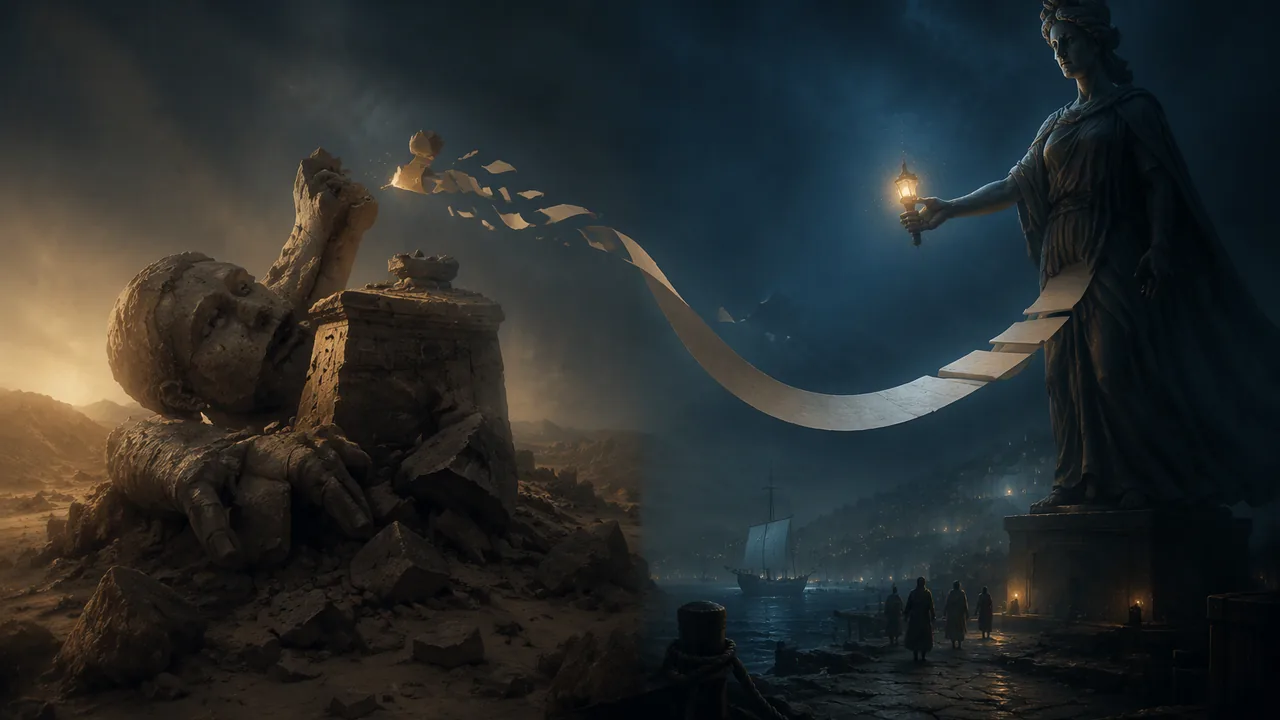
The last unit ended with Cassius comparing Caesar to a Colossus. This unit begins with two poems about colossal statues, and they could hardly disagree more about what power is for.
Ask how a poem means, not only what. A paraphrase of “Ozymandias” — a king’s statue is ruined in the desert — loses almost everything. The poem’s power is in its arrangement: the voice at three removes (the speaker met a traveler who read a king’s words), the boast carved on the pedestal, and then a single devastating half-line: “Nothing beside remains.” 9-10.RL.1.B / 9-10.RL.2.C asks for the cumulative impact of word choices on meaning and tone; 9-10.RL.2.A asks how structure creates effects. In poetry, the two are inseparable.
The line. Where a line ends, a reader pauses, however briefly. A line that ends where the sense ends is end-stopped; one whose sense runs on is enjambed. Enjambment holds a phrase in suspension: “Round the decay / Of that colossal wreck” makes the reader wait for what the decay surrounds.
The sonnet and the turn. Both poems are sonnets — fourteen lines of (roughly) iambic pentameter with a set rhyme scheme and a volta, or turn, where the argument shifts. In “Ozymandias” the turn comes with the inscription and its answer: the king’s command to “despair” at his works, followed by the empty sands. The irony is structural: the words meant to prove his power prove its end.
“The New Colossus” was written in 1883 to raise money for the pedestal of the Statue of Liberty, and later mounted inside it. It begins by rejecting the ancient Colossus of Rhodes — “Not like the brazen giant of Greek fame, / With conquering limbs astride from land to land” — and replaces conquest with welcome. Its turn gives the statue a voice, and the voice speaks not to the powerful but to “your tired, your poor.” Lazarus, a Jewish American poet who worked with refugees, answers the tradition of the conqueror with a mother of exiles.
Reading together. Set side by side, the poems make an argument neither makes alone: power that commands is dust; power that shelters endures. You will read the rest of the anthology with the same questions — where does the poem turn, what does the form do, and whose voice speaks?
Range (9-10.RL.3.D). Poems reward rereading more than any other text. Read each poem at least three times — once for sense, once aloud for sound, once with a pencil for form — before you annotate.
Reading: Two sonnets about colossal statues: complete poems, vocabulary and a worked chart
Percy Bysshe Shelley, “Ozymandias” (first published in The Examiner, 11 January 1818), text of The Complete Poetical Works of Percy Bysshe Shelley, ed. Thomas Hutchinson (1914), via Wikisource (https://en.wikisource.org/w/index.php?action=render&title=The_Complete_Poetical_Works_of_Percy_Bysshe_Shelley_%28ed._Hutchinson%2C_1914%29/Ozymandias). Emma Lazarus, “The New Colossus” (1883), via Wikisource (https://en.wikisource.org/w/index.php?action=render&title=The_New_Colossus). “Ozymandias” was also checked word for word against Project Gutenberg eBook #4800 (The Complete Poetical Works of Percy Bysshe Shelley), https://www.gutenberg.org/ebooks/4800, because the Wikisource page prints editorial line-number markup inside the poem. Retrieved 2026-09-26. Wikisource transcriptions are copied by script; editorial line numbers and footnote markers in the source were removed, and the line numbers printed here are counted from the first line of each poem. · SLS original; quoted poems are public domain (Shelley, 1818; Lazarus, 1883)
Poems copied by script and checked verbatim; editorial numbers removed as stated. The vocabulary, chart and model paragraph are SLS original.
Two sonnets about colossal statues, printed complete with line numbers (every fifth line). Read each three times before you annotate: once for sense, once aloud for sound, once with a pencil for form. Then use the vocabulary and the worked chart. The vocabulary, chart and model paragraph are SLS original.
Poem 1: “Ozymandias,” Percy Bysshe Shelley (1818)
I met a traveller from an antique land
Who said: Two vast and trunkless legs of stone
Stand in the desert … Near them, on the sand,
Half sunk, a shattered visage lies, whose frown,
And wrinkled lip, and sneer of cold command, [5]
Tell that its sculptor well those passions read
Which yet survive, stamped on these lifeless things,
The hand that mocked them, and the heart that fed:
And on the pedestal these words appear:
‘My name is Ozymandias, king of kings: [10]
Look on my works, ye Mighty, and despair!’
Nothing beside remains. Round the decay
Of that colossal wreck, boundless and bare
The lone and level sands stretch far away.
Poem 2: “The New Colossus,” Emma Lazarus (1883)
Written for a fund-raising effort for the pedestal of the Statue of Liberty.
Not like the brazen giant of Greek fame,
With conquering limbs astride from land to land;
Here at our sea-washed, sunset gates shall stand
A mighty woman with a torch, whose flame
5 Is the imprisoned lightning, and her name
Mother of Exiles. From her beacon-hand
Glows world-wide welcome; her mild eyes command
The air-bridged harbor that twin cities frame.
“Keep, ancient lands, your storied pomp!” cries she
10 With silent lips. “Give me your tired, your poor,
Your huddled masses yearning to breathe free,
The wretched refuse of your teeming shore.
Send these, the homeless, tempest-tost to me,
I lift my lamp beside the golden door!”
Vocabulary for form (SLS original)
- Line: the unit of verse; where it ends, the reader pauses, even briefly.
- End-stopped: the sense ends where the line ends. Enjambed: the sense runs over the line break.
- Sonnet: fourteen lines, usually iambic pentameter, with a set rhyme scheme.
- Volta (the turn): the place where the argument or the tone shifts. It is not always at line 9.
- Rhyme scheme: lettered by sound. Line 1 is A; a new sound gets the next letter.
Worked chart: “Ozymandias” (SLS original)
| Question | Answer | What the form choice does |
|---|---|---|
| Speaker | A speaker who repeats what a traveler said, who in turn describes what a sculptor carved of a king (lines 1-2 and 5-8). | The distance makes the king’s power something reported, not seen; power is already at three removes. |
| Rhyme scheme | ABABACDCEDEFEF. | The pattern keeps changing, so the poem never settles into a comfortable Petrarchan or Shakespearean shape, like a monument that has come apart. |
| The turn | Line 9, “And on the pedestal these words appear,” moves from what is left of the statue to what it says; line 12 then breaks the boast with “Nothing beside remains.” | The reader hears the king’s command and then the emptiness that answers it, so the words that were meant to prove his power prove its end. |
| An enjambment | Lines 12-13: “Round the decay / Of that colossal wreck.” | The sentence hangs at “decay” before it says what is decaying, and the reader waits, the way the sands wait. |
| A key word choice | “sneer” in line 5 (“sneer of cold command”). | It gives the king a face of contempt, so the ruin looks like the record of a character, not only of a fall. |
Chart to complete for “The New Colossus” (facts to start from)
Facts you can check in the poem: the rhyme scheme is ABBAABBA CDCDCD; the first line rejects “the brazen giant of Greek fame”; the statue begins to speak at line 9 with “Keep, ancient lands, your storied pomp!”; lines 4-5 and 5-6 are enjambed (“whose flame / Is the imprisoned lightning”; “her name / Mother of Exiles”). Complete the chart yourself: name the speaker, mark the turn, quote one enjambment and one key word, and say what each choice does.
A model paragraph on one poem alone (SLS original)
In “Ozymandias,” the arrangement does the arguing. The poem is carried by a speaker who quotes a traveler, so the king reaches us at several removes. When the inscription arrives, the reader expects the sonnet to praise it. Instead line 12 stops short: “Nothing beside remains.” The mid-line full stop is the poem’s sharpest break, and the two lines that follow stretch out in a single enjambed sentence across “boundless and bare” sands. A form that runs on after the king’s command has ended says what the king could not: his works are gone and the world is larger than his name.
Your paragraph
After you have completed the chart for both poems, write one paragraph that argues what the two poems say together that neither says alone. The worked example above is not that paragraph; it covers only one poem.
Formative check
Work through these before moving on. They are not graded — they tell you whether the standard below has landed yet.
The king’s inscription says ‘Look on my works, ye Mighty, and despair!’ Before reading the next line — what do you expect the traveler to report?
What does Lazarus achieve by opening with ‘Not like the brazen giant of Greek fame’?
Every sonnet’s turn comes exactly at line nine.
A sonnet has lines; its turn is called the ; a line whose sense runs on is .
Complete a form-to-meaning chart for both sonnets: speaker, turn, one enjambment, one key word choice, and what each form choice does. Then write a paragraph arguing what the two poems say together that neither says alone.
How confident are you that you can explain how a poem’s form and word choices produce its meaning?
Printable: Unit 2 Student Workbook
Every organizer for this unit in one booklet — the reading schedule, the vocabulary pages, all five lesson organizers, the peer review sheet and the scoring rubric. Print it before the unit starts and bring the page to each lesson.