make strategic use of digital media in presentations to enhance understanding and add interest, and compare accounts of Keller’s story in different mediums, including her own reflections in Chapters 17-23 on lectures, performance and the press.
Instruction
Keller’s story has been told in many mediums — her own memoir, newspaper coverage in her lifetime, newsreels, photographs, and later plays and films. Comparing them (9-10.RI.3.A / 9-10.RI.1.C) shows what each medium emphasizes; planning your own defense (9-10.SL.2.C) asks you to use media strategically yourself.
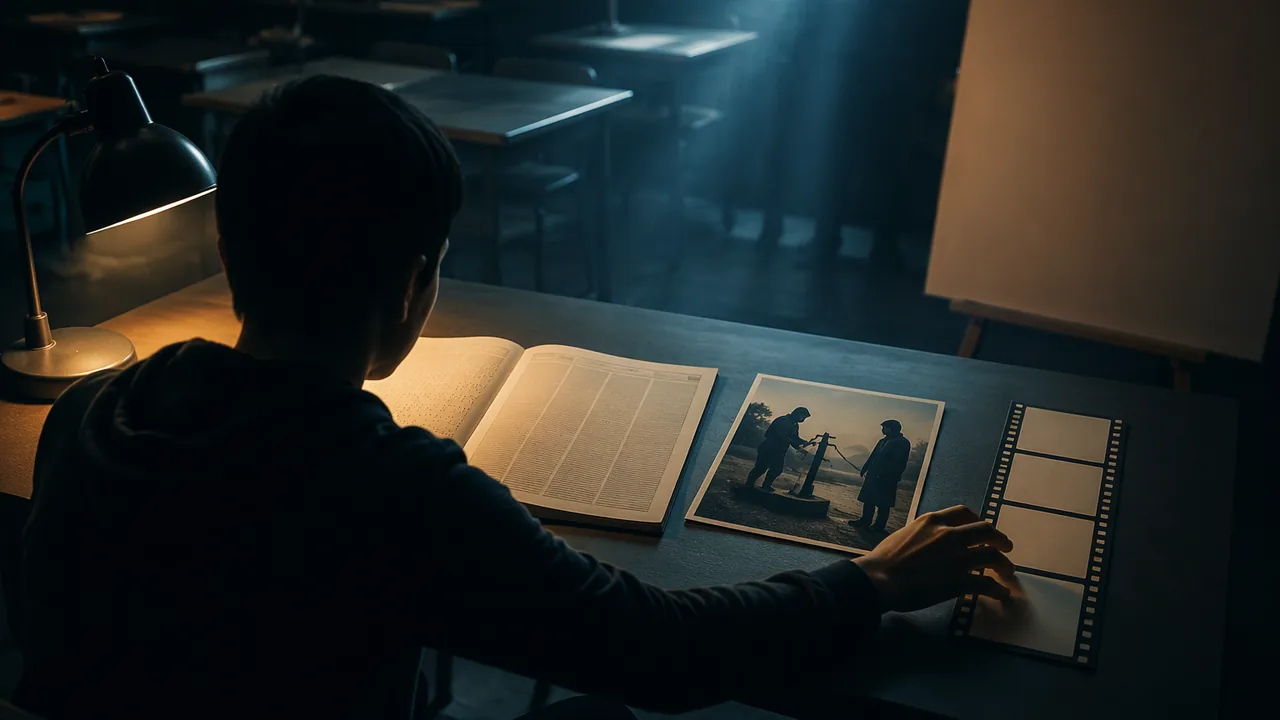
Accounts in different mediums. Keller’s memoir gives her inner experience and her own ordering of events. Newspaper stories of her time often emphasized the “miracle” and the spectacle of a deaf-blind girl speaking and writing. Photographs show Keller with Sullivan, reading Braille, or at Radcliffe, and were often staged. Later dramatizations focused on the struggle at the water pump. Each medium emphasizes something the others omit: the memoir’s interiority, the newspaper’s wonder, the photograph’s public image, the drama’s conflict. Credibility differs too (9-10.SL.1.C): an account written by Keller has authority the others lack about her experience; a newspaper has authority about public reaction.
Keller on mediums. The last chapters of Part I show Keller thinking about mediums herself. In Chapter 20, college lectures reach her only as spelling in her hand: “The words rush through my hand like hounds in pursuit of a hare which they often miss.” In Chapter 22 she says she enjoys “having a play described to me while it is being acted on the stage far more than reading it,” and when the actor Joseph Jefferson performed scenes from a comedy for her, she followed his movements with her hands and caught the humor “in a way that would have been impossible had it all been spelled to me.” In Chapter 23 she names the callers she finds least welcome: “the stupid and curious, especially of newspaper reporters.” Each of these is evidence about what a medium can and cannot carry, from a writer who received the world through unusual channels.
Strategic use of media. Strategic means each media element does something your words alone cannot. Four good reasons to include an element: it shows a relationship (a timeline of your year’s writing, a before-and-after comparison of two paragraphs); it carries the evidence itself (your earlier sentence on screen beside your later one); it provides what only that medium can (a short audio clip of your poem performance); or it marks a transition in your argument. A slide that shows the words you are saying competes with you and should be cut.
Rules of thumb. One idea per slide. Text large enough to read from the back of a room, and few enough words to read in three seconds. Every image or clip attributed. Every visual described aloud for anyone who cannot see it — a practice Keller’s life makes especially meaningful.
The portfolio defense is coming. In Lesson 4.8 you will defend your growth as a writer across the year, with evidence. Plan your media now: the three pieces you will use, the specific sentences you will show, and the one visual that will carry the most information.
Peer critique (9-10.SL.1.C). Exchange media plans with a partner. For each element, say which of the four purposes it serves. If it serves none, say so plainly, and suggest an alternative. Respond to their critique of yours by accepting, qualifying or explaining your choice with reasons.
📖 Before this lesson, read: The Story of My Life, Chapters 17-23
The reading opens over the lesson; close it to come back to exactly where you were.
Reading: Keller in three accounts, Keller on performance, and a worked media plan for the portfolio defense
Helen Keller, The Story of My Life (1903), with the supplementary account by John Albert Macy including Anne Sullivan’s letters; Project Gutenberg eBook #2397, https://www.gutenberg.org/ebooks/2397, retrieved 2026-09-26. · SLS original; quoted passages are public domain (Helen Keller, 1903; Anne Sullivan letters and John Albert Macy’s account, 1903)
Each account is quoted from the 1903 volume. The comparison chart, media plan and critique protocol are SLS original.
Your comparison needs the accounts in front of you. This lab supplies three accounts of Keller’s story in three different forms (her memoir, a teacher’s private letter, and an editor’s report on how the newspapers told it), Keller’s own description of a performance from Chapter 22, a comparison chart, a worked media plan for the portfolio defense, and a critique protocol. Photographs are described, not reproduced. The chart, plan and protocol are SLS original.
1. Three accounts
A. Memoir (Keller, chapter IV, 1903): the inner experience, in her own order.
We walked down the path to the well-house, attracted by the fragrance of the honeysuckle with which it was covered. Some one was drawing water and my teacher placed my hand under the spout. As the cool stream gushed over one hand she spelled into the other the word water, first slowly, then rapidly. I stood still, my whole attention fixed upon the motions of her fingers. Suddenly I felt a misty consciousness as of something forgotten–a thrill of returning thought; and somehow the mystery of language was revealed to me. I knew then that “w-a-t-e-r” meant the wonderful cool something that was flowing over my hand. That living word awakened my soul, gave it light, hope, joy, set it free!
B. A private letter (Anne Sullivan, April 5, 1887, printed in the supplementary account): the same morning, a few hours later.
This morning, while she was washing, she wanted to know the name for “water.” When she wants to know the name of anything, she points to it and pats my hand. I spelled “w-a-t-e-r” and thought no more about it until after breakfast. Then it occurred to me that with the help of this new word I might succeed in straightening out the “mug-milk” difficulty. We went out to the pump-house, and I made Helen hold her mug under the spout while I pumped. As the cold water gushed forth, filling the mug, I spelled “w-a-t-e-r” in Helen’s free hand. The word coming so close upon the sensation of cold water rushing over her hand seemed to startle her. She dropped the mug and stood as one transfixed. A new light came into her face. She spelled “water” several times. Then she dropped on the ground and asked for its name and pointed to the pump and the trellis, and suddenly turning round she asked for my name. I spelled “Teacher.” Just then the nurse brought Helen’s little sister into the pump-house, and Helen spelled “baby” and pointed to the nurse. All the way back to the house she was highly excited, and learned the name of every object she touched
C. The press and the institution: how the story was told in public (John Albert Macy, in the supplementary account, “Education”; and Sullivan on the same report).
“Have you seen the paper I wrote for the ‘report’? Mr. Anagnos was delighted with it. He says Helen’s progress has been ‘a triumphal march from the beginning,’ and he has many flattering things to say about her teacher. I think he is inclined to exaggerate; at all events, his language is too glowing, and simple facts are set forth in such a manner that they bewilder one. Doubtless the work of the past few months does seem like a triumphal march to him; but then people seldom see the halting and painful steps by which the most insignificant success is achieved.”
As Mr. Anagnos was the head of a great institution, what he said had much more effect than the facts in Miss Sullivan’s account on which he based his statements. The newspapers caught Mr. Anagnos’s spirit and exaggerated a hundred-fold. In a year after she first went to Helen Keller, Miss Sullivan found herself and her pupil the centre of a stupendous fiction. Then the educators all over the world said their say and for the most part did not help matters. There grew up a mass of controversial matter which it is amusing to read now. Teachers of the deaf proved a priori that what Miss Sullivan had done could not be, and some discredit was reflected on her statements, because they were surrounded by the vague eloquence of Mr. Anagnos. Thus the story of Helen Keller, incredible when told with moderation, had the misfortune to be heralded by exaggerated announcements, and naturally met either an ignorant credulity or an incredulous hostility.
D. Keller on a performance (Chapter 22): a medium that reached her through her hands.
Once while I was calling on him in Boston he acted the most striking parts of “The Rivals” for me. The reception-room where we sat served for a stage. He and his son seated themselves at the big table, and Bob Acres wrote his challenge. I followed all his movements with my hands, and caught the drollery of his blunders and gestures in a way that would have been impossible had it all been spelled to me.
Ask of D what you ask of A, B and C: what does this medium carry that the others cannot?
2. Comparison chart (SLS original)
| A. Memoir | B. Letter | C. Public report and press (as described by Macy) | |
|---|---|---|---|
| What it emphasizes | Inner experience; the release of language. | Observable events and the teacher’s method. | Wonder and progress; “a triumphal march.” |
| What it leaves out | Sullivan’s reasoning and the mug and milk confusion. | Keller’s inner experience. | “the halting and painful steps.” |
| Who is speaking, and to whom | Keller, to the public, years later. | Sullivan, to a friend, within hours. | An institution and newspapers, to the public. |
| Credible about what | Her own experience and the meaning she gives it. | What Sullivan saw and did that morning. | What the institution wanted the public to believe; Sullivan calls the language “too glowing.” |
A photograph, described (SLS original guidance). When you compare a photograph with a text, describe what you see before you say what it means: who is in the frame, what they are doing, what is not shown, and whether the pose looks arranged. A photograph of a girl reading with her hands shows the method; it does not show what she felt. If you use a photograph of Keller in your defense, name its source and date, describe it aloud, and say what it shows that words cannot.
3. Four purposes for a media element (SLS original)
- Shows a relationship (a timeline, a before-and-after).
- Carries the evidence itself (your earlier sentence and your later one, on screen together).
- Provides what only that medium can (an audio clip of your poem).
- Marks a transition in your argument.
4. A worked media plan for a portfolio defense (SLS original)
The example uses invented sentences, labeled as such. It is a model for the structure, not the content, of your plan.
| Slide | What is on it | Purpose | What I say aloud |
|---|---|---|---|
| 1 | One sentence: “I learned to make a claim about how texts relate, not what each says.” | Marks a transition (my claim about my growth) | This is the skill I am defending. |
| 2 | Two thesis sentences side by side. Left, from the fall (invented example): “Antigone is a play about duty.” Right, from the spring (invented example): “Kennedy inherits Lincoln’s idea that liberty carries obligation but redirects it.” Attribution: my own work, with dates. | Carries the evidence itself | The fall sentence names a topic; the spring sentence names a relationship, a change and a reason. |
| 3 | A timeline of the year with three dated pieces marked. | Shows a relationship | The growth came in three steps; here is where each one happened. |
| 4 | Ten seconds of audio of me reading one poem aloud (optional). | Provides what only that medium can | This is how I now use pauses; I describe what you will hear before I play it. |
| 5 | One sentence: “What I still cannot do: answer a counterclaim in my own words.” | Marks a transition (honesty) | This is what I am working on next. |
What was cut: a slide that listed all the titles of the essays (it shows no relationship), and a decorative background image. Rules of thumb: one idea per slide; text readable from the back of a room; every image or clip attributed; every visual described aloud for anyone who cannot see it.
5. Peer critique protocol and stems (SLS original)
- Exchange media plans. For each element, write which of the four purposes it serves. If it serves none, say so plainly and suggest an alternative.
- Return the plan with the critique. The owner responds to each point in one of three ways: accept, qualify, or explain the choice with reasons.
- Rewrite the plan and note what changed.
Stems. “This slide carries the evidence because …” “This slide repeats what you say, so I would cut it because …” “I would add an image description here because …” “I accept your point about … and I keep … because …”
A model response to critique (SLS original). “You said slide 3 serves no purpose. I qualify that: the timeline shows the order of the three pieces, which the audience cannot see from my words alone. I accept that the labels are too small, and I will enlarge them.”
Formative check
Work through these before moving on. They are not graded — they tell you whether the standard below has landed yet.
Which slide is most strategic for a portfolio defense?
Newspaper accounts of Keller in her lifetime tell us more about her inner experience than her memoir does.
Compare Keller’s account of one event with one other account in this lab (Sullivan’s letter, or the public report as Macy describes it), or compare Keller’s account of Joseph Jefferson’s performance with what she says reading a play gives her: what each medium emphasizes and omits, and how credible each is about what. Then submit your portfolio-defense media plan, naming the purpose of each element.
How confident are you that you can choose media elements that do what my words alone cannot?
The Story of My Life, Chapters 17-23
The Story of My Life, Part I, Chapter 17 Bridge summary — not the primary text
This is a short recap written for this course, not Helen Keller’s own words, so you can follow the story between close-reading lessons.
{summary}The Story of My Life, Part I, Chapter 18 Bridge summary — not the primary text
This is a short recap written for this course, not Helen Keller’s own words, so you can follow the story between close-reading lessons.
{summary}The Story of My Life, Part I, Chapter 19 Bridge summary — not the primary text
This is a short recap written for this course, not Helen Keller’s own words, so you can follow the story between close-reading lessons.
{summary}The Story of My Life, Part I, Chapter 20
Source: Helen Keller, The Story of My Life (New York: Doubleday, Page, 1903), Project Gutenberg eBook #2397 (gutenberg.org) · Public domain
The struggle for admission to college was ended, and I could now enter Radcliffe whenever I pleased. Before I entered college, however, it was thought best that I should study another year under Mr. Keith. It was not, therefore, until the fall of 1900 that my dream of going to college was realized.
I remember my first day at Radcliffe. It was a day full of interest for me. I had looked forward to it for years. A potent force within me, stronger than the persuasion of my friends, stronger even than the pleadings of my heart, had impelled me to try my strength by the standards of those who see and hear. I knew that there were obstacles in the way; but I was eager to overcome them. I had taken to heart the words of the wise Roman who said, “To be banished from Rome is but to live outside of Rome.” Debarred from the great highways of knowledge, I was compelled to make the journey across country by unfrequented roads–that was all; and I knew that in college there were many bypaths where I could touch hands with girls who were thinking, loving and struggling like me.
I began my studies with eagerness. Before me I saw a new world opening in beauty and light, and I felt within me the capacity to know all things. In the wonderland of Mind I should be as free as another. Its people, scenery, manners, joys, tragedies should be living, tangible interpreters of the real world. The lecture-halls seemed filled with the spirit of the great and the wise, and I thought the professors were the embodiment of wisdom. If I have since learned differently, I am not going to tell anybody.
But I soon discovered that college was not quite the romantic lyceum I had imagined. Many of the dreams that had delighted my young inexperience became beautifully less and “faded into the light of common day.” Gradually I began to find that there were disadvantages in going to college.
The one I felt and still feel most is lack of time. I used to have time to think, to reflect, my mind and I. We would sit together of an evening and listen to the inner melodies of the spirit, which one hears only in leisure moments when the words of some loved poet touch a deep, sweet chord in the soul that until then had been silent. But in college there is no time to commune with one’s thoughts. One goes to college to learn, it seems, not to think. When one enters the portals of learning, one leaves the dearest pleasures–solitude, books and imagination–outside with the whispering pines. I suppose I ought to find some comfort in the thought that I am laying up treasures for future enjoyment, but I am improvident enough to prefer present joy to hoarding riches against a rainy day.
My studies the first year were French, German, history, English composition and English literature. In the French course I read some of the works of Corneille, Moliere, Racine, Alfred de Musset and Sainte-Beuve, and in the German those of Goethe and Schiller. I reviewed rapidly the whole period of history from the fall of the Roman Empire to the eighteenth century, and in English literature studied critically Milton’s poems and “Areopagitica.”
I am frequently asked how I overcome the peculiar conditions under which I work in college. In the classroom I am of course practically alone. The professor is as remote as if he were speaking through a telephone. The lectures are spelled into my hand as rapidly as possible, and much of the individuality of the lecturer is lost to me in the effort to keep in the race. The words rush through my hand like hounds in pursuit of a hare which they often miss. But in this respect I do not think I am much worse off than the girls who take notes. If the mind is occupied with the mechanical process of hearing and putting words on paper at pell-mell speed, I should not think one could pay much attention to the subject under consideration or the manner in which it is presented. I cannot make notes during the lectures, because my hands are busy listening. Usually I jot down what I can remember of them when I get home. I write the exercises, daily themes, criticisms and hour-tests, the mid-year and final examinations, on my typewriter, so that the professors have no difficulty in finding out how little I know. When I began the study of Latin prosody, I devised and explained to my professor a system of signs indicating the different meters and quantities.
I use the Hammond typewriter. I have tried many machines, and I find the Hammond is the best adapted to the peculiar needs of my work. With this machine movable type shuttles can be used, and one can have several shuttles, each with a different set of characters–Greek, French, or mathematical, according to the kind of writing one wishes to do on the typewriter. Without it, I doubt if I could go to college.
Very few of the books required in the various courses are printed for the blind, and I am obliged to have them spelled into my hand. Consequently I need more time to prepare my lessons than other girls. The manual part takes longer, and I have perplexities which they have not. There are days when the close attention I must give to details chafes my spirit, and the thought that I must spend hours reading a few chapters, while in the world without other girls are laughing and singing and dancing, makes me rebellious; but I soon recover my buoyancy and laugh the discontent out of my heart. For, after all, every one who wishes to gain true knowledge must climb the Hill Difficulty alone, and since there is no royal road to the summit, I must zigzag it in my own way. I slip back many times, I fall, I stand still, I run against the edge of hidden obstacles, I lose my temper and find it again and keep it better, I trudge on, I gain a little, I feel encouraged, I get more eager and climb higher and begin to see the widening horizon. Every struggle is a victory. One more effort and I reach the luminous cloud, the blue depths of the sky, the uplands of my desire. I am not always alone, however, in these struggles. Mr. William Wade and Mr. E. E. Allen, Principal of the Pennsylvania Institution for the Instruction of the Blind, get for me many of the books I need in raised print. Their thoughtfulness has been more of a help and encouragement to me than they can ever know.
Last year, my second year at Radcliffe, I studied English composition, the Bible as English composition, the governments of America and Europe, the Odes of Horace, and Latin comedy. The class in composition was the pleasantest. It was very lively. The lectures were always interesting, vivacious, witty; for the instructor, Mr. Charles Townsend Copeland, more than any one else I have had until this year, brings before you literature in all its original freshness and power. For one short hour you are permitted to drink in the eternal beauty of the old masters without needless interpretation or exposition. You revel in their fine thoughts. You enjoy with all your soul the sweet thunder of the Old Testament, forgetting the existence of Jahweh and Elohim; and you go home feeling that you have had “a glimpse of that perfection in which spirit and form dwell in immortal harmony; truth and beauty bearing a new growth on the ancient stem of time.”
This year is the happiest because I am studying subjects that especially interest me, economics, Elizabethan literature, Shakespeare under Professor George L. Kittredge, and the History of Philosophy under Professor Josiah Royce. Through philosophy one enters with sympathy of comprehension into the traditions of remote ages and other modes of thought, which erewhile seemed alien and without reason.
But college is not the universal Athens I thought it was. There one does not meet the great and the wise face to face; one does not even feel their living touch. They are there, it is true; but they seem mummified. We must extract them from the crannied wall of learning and dissect and analyze them before we can be sure that we have a Milton or an Isaiah, and not merely a clever imitation. Many scholars forget, it seems to me, that our enjoyment of the great works of literature depends more upon the depth of our sympathy than upon our understanding. The trouble is that very few of their laborious explanations stick in the memory. The mind drops them as a branch drops its overripe fruit. It is possible to know a flower, root and stem and all, and all the processes of growth, and yet to have no appreciation of the flower fresh bathed in heaven’s dew. Again and again I ask impatiently, “Why concern myself with these explanations and hypotheses?” They fly hither and thither in my thought like blind birds beating the air with ineffectual wings. I do not mean to object to a thorough knowledge of the famous works we read. I object only to the interminable comments and bewildering criticisms that teach but one thing: there are as many opinions as there are men. But when a great scholar like Professor Kittredge interprets what the master said, it is “as if new sight were given the blind.” He brings back Shakespeare, the poet.
There are, however, times when I long to sweep away half the things I am expected to learn; for the overtaxed mind cannot enjoy the treasure it has secured at the greatest cost. It is impossible, I think, to read in one day four or five different books in different languages and treating of widely different subjects, and not lose sight of the very ends for which one reads. When one reads hurriedly and nervously, having in mind written tests and examinations, one’s brain becomes encumbered with a lot of choice bric-a-brac for which there seems to be little use. At the present time my mind is so full of heterogeneous matter that I almost despair of ever being able to put it in order. Whenever I enter the region that was the kingdom of my mind I feel like the proverbial bull in the china shop. A thousand odds and ends of knowledge come crashing about my head like hailstones, and when I try to escape them, theme-goblins and college nixies of all sorts pursue me, until I wish–oh, may I be forgiven the wicked wish!–that I might smash the idols I came to worship.
But the examinations are the chief bugbears of my college life. Although I have faced them many times and cast them down and made them bite the dust, yet they rise again and menace me with pale looks, until like Bob Acres I feel my courage oozing out at my finger ends. The days before these ordeals take place are spent in cramming your mind with mystic formula and indigestible dates–unpalatable diets, until you wish that books and science and you were buried in the depths of the sea.
At last the dreaded hour arrives, and you are a favoured being indeed if you feel prepared, and are able at the right time to call to your standard thoughts that will aid you in that supreme effort. It happens too often that your trumpet call is unheeded. It is most perplexing and exasperating that just at the moment when you need your memory and a nice sense of discrimination, these faculties take to themselves wings and fly away. The facts you have garnered with such infinite trouble invariably fail you at a pinch.
“Give a brief account of Huss and his work.” Huss? Who was he and what did he do? The name looks strangely familiar. You ransack your budget of historic facts much as you would hunt for a bit of silk in a rag-bag. You are sure it is somewhere in your mind near the top–you saw it there the other day when you were looking up the beginnings of the Reformation. But where is it now? You fish out all manner of odds and ends of knowledge–revolutions, schisms, massacres, systems of government; but Huss–where is he? You are amazed at all the things you know which are not on the examination paper. In desperation you seize the budget and dump everything out, and there in a corner is your man, serenely brooding on his own private thought, unconscious of the catastrophe which he has brought upon you.
Just then the proctor informs you that the time is up. With a feeling of intense disgust you kick the mass of rubbish into a corner and go home, your head full of revolutionary schemes to abolish the divine right of professors to ask questions without the consent of the questioned.
It comes over me that in the last two or three pages of this chapter I have used figures which will turn the laugh against me. Ah, here they are–the mixed metaphors mocking and strutting about before me, pointing to the bull in the china shop assailed by hailstones and the bugbears with pale looks, an unanalyzed species! Let them mock on. The words describe so exactly the atmosphere of jostling, tumbling ideas I live in that I will wink at them for once, and put on a deliberate air to say that my ideas of college have changed.
While my days at Radcliffe were still in the future, they were encircled with a halo of romance, which they have lost; but in the transition from romantic to actual I have learned many things I should never have known had I not tried the experiment. One of them is the precious science of patience, which teaches us that we should take our education as we would take a walk in the country, leisurely, our minds hospitably open to impressions of every sort. Such knowledge floods the soul unseen with a soundless tidal wave of deepening thought. “Knowledge is power.” Rather, knowledge is happiness, because to have knowledge–broad, deep knowledge–is to know true ends from false, and lofty things from low. To know the thoughts and deeds that have marked man’s progress is to feel the great heart-throbs of humanity through the centuries; and if one does not feel in these pulsations a heavenward striving, one must indeed be deaf to the harmonies of life.
The Story of My Life, Part I, Chapter 21 Bridge summary — not the primary text
This is a short recap written for this course, not Helen Keller’s own words, so you can follow the story between close-reading lessons.
{summary}The Story of My Life, Part I, Chapter 22 Bridge summary — not the primary text
This is a short recap written for this course, not Helen Keller’s own words, so you can follow the story between close-reading lessons.
{summary}The Story of My Life, Part I, Chapter 23 Bridge summary — not the primary text
This is a short recap written for this course, not Helen Keller’s own words, so you can follow the story between close-reading lessons.
{summary}