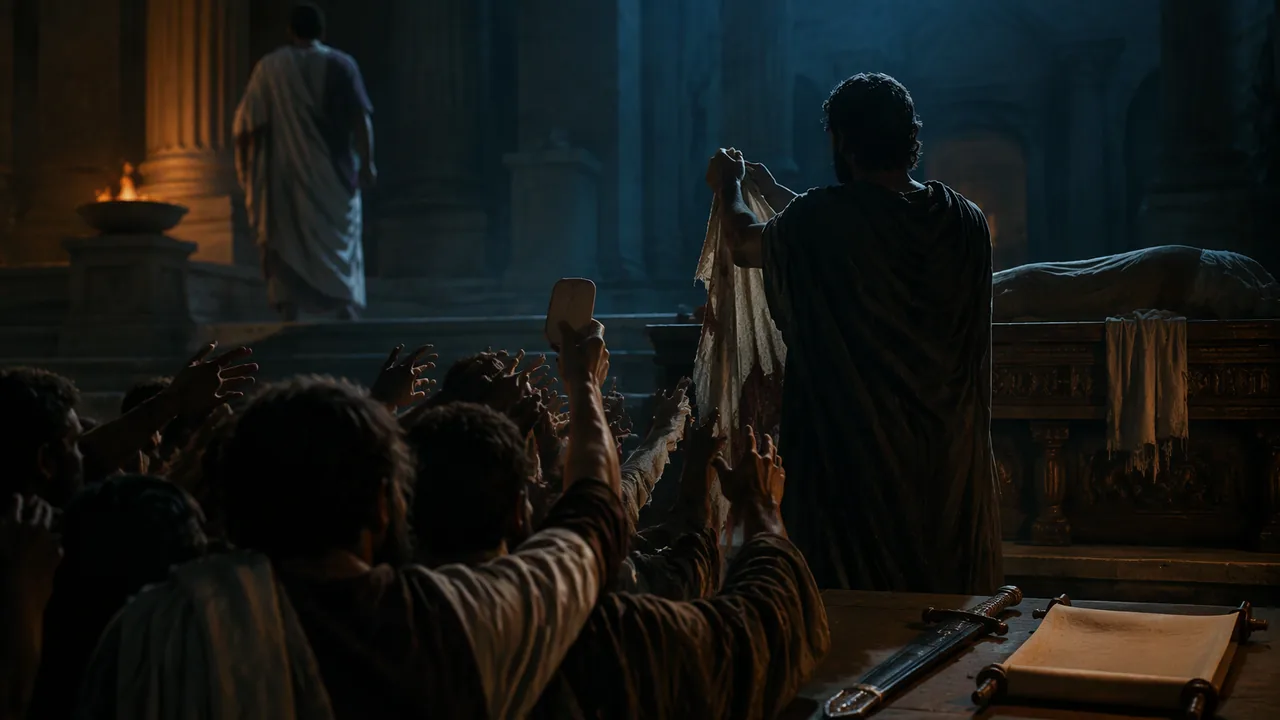
write a 900-1,100 word analytical essay comparing Brutus’s and Antony’s funeral orations, and defend orally the moment where the play becomes irreversible.
Instruction
This essay asks the question the play itself asks in Act 3: why do words, not swords, decide Rome?
Finish the play first. Act 5 is assigned above; read it before you draft, because it tests your reading of both speakers. At Philippi the generals fight with words before they fight with swords. Antony taunts Brutus, “In your bad strokes, Brutus, you give good words,” and Cassius turns on his friend: “Now, Brutus, thank yourself. / This tongue had not offended so today, / If Cassius might have rul’d.” Brutus and Cassius part “For ever, and for ever.” By the end both are dead by their own swords, and Antony, the man whose speech ruined Brutus, gives the play’s final judgment on him: “This was the noblest Roman of them all.” Decide what that last speech does to your argument. It may confirm that Brutus was undone by his own idealism, or it may show Antony once more using praise for a purpose.
The claim. Argue why Antony’s funeral speech succeeds where Brutus’s fails — or why Brutus’s speech is stronger than its outcome suggests. Either position is defensible. What matters is precision: name the choices that explain the result.
Analyze three choices in each speech. For Brutus: prose rather than verse; antithesis; the appeal to his own honor; asking the crowd to judge; leaving before Antony speaks. For Antony: the ironic refrain; the evidence against ambition; the withheld will; the descent to the body; the torn cloak and the named wounds; the final reading of the will. Explain how each choice works on the Roman crowd and on the play’s audience.
Character as construction (9-10.RL.2.D). The speeches reveal character. Brutus trusts reason because he trusts himself; Antony understands people because he understands appetite and grief. Connect each speech to how Shakespeare has developed its speaker.
The complicating passage. Every strong essay faces the evidence against its reading. If you argue Antony is purely manipulative, what do you do with his grief alone over the body (“O, pardon me, thou bleeding piece of earth”)? If you argue Brutus’s speech is stronger, what do you do with the crowd’s response — “Let him be Caesar” — which shows they missed his point entirely?
Figurative language. Interpret at least one figure in context (from Lesson 1.3’s log) and analyze its role.
Conventions. Cite verse correctly and link your sections with transitions that name relationships (Lesson 1.6). Use formal academic English (9-10.SL.2.A / 9-10.SL.2.B applies to your defense too).
The defense (9-10.SL.2.A / 9-10.SL.2.B / 9-10.SL.2.C). Record 90 seconds naming the moment in Act 3 where the play’s direction becomes irreversible — the decision to let Antony speak, the moment he descends to the body, the reading of the will — and justify it from the text.
A checklist before you submit. Does each body paragraph name a choice and its effect on both audiences? Are verse quotations marked with slashes and cited by act, scene and line? Have you faced the passage that complicates your reading? Is your formal register consistent from the first sentence to the last?
📖 Before this lesson, read: Julius Caesar, Act 5
The reading opens over the lesson; close it to come back to exactly where you were.
Reading: Key Assignment kit: prompt, located passages, rubric, model and defense
William Shakespeare, The Tragedy of Julius Caesar (c. 1599), public-domain text, Project Gutenberg eBook #1522 (PG Shakespeare Team), https://www.gutenberg.org/ebooks/1522, retrieved 2026-09-26. Line numbers were counted by SLS from this text (verse lines; a line shared between two speakers counts once). · SLS original; quoted passages are public domain (William Shakespeare, Julius Caesar, c. 1599)
Passages copied by script and checked verbatim. The prompt restates the task; the rubric, thesis, outline, exemplar paragraph and defense are SLS original.
The prompt (in full)
Compare Brutus’s and Antony’s funeral orations (3.2), analyzing three choices in each and their effects on both audiences, and argue why the speeches produce the result they do. Write 900-1,100 words in MLA style, with verse cited by act.scene.line. Then record a 90-second defense that names the moment in Act 3 where the play’s direction becomes irreversible and justifies it from the text. Your argument may run either way: Antony’s speech succeeds where Brutus’s fails, or Brutus’s speech is stronger than its outcome suggests. What matters is that you name the choices that explain the result, and that you face the passage that complicates your reading.
The key passages, located
The full scene is assigned in Lesson 1.5 and hosted in its reading. These are the passages the prompt draws on most. Line numbers are counted in the hosted text of Lesson 1.5 (see the note below).
Brutus, choice 1: antithesis, and a claim about motive (3.2, prose).
[Brutus.] assembly, any dear friend of Caesar’s, to him I say that Brutus’ love to Caesar was no less than his. If then that friend demand why Brutus rose against Caesar, this is my answer: Not that I loved Caesar less, but that I loved Rome more. Had you rather Caesar were living, and die all slaves, than that Caesar were dead, to live all free men? As Caesar loved me, I weep for him; as he was fortunate, I rejoice at it; as he was valiant, I honour him; but, as he was ambitious, I slew him. There is tears, for his love; joy for his fortune; honour for his valour; and
Brutus, choice 2: the run of questions and the pause for a reply (3.2, prose).
[Brutus.] If any, speak; for him have I offended. Who is here so rude, that would not be a Roman? If any, speak; for him have I offended. Who is here so vile, that will not love his country? If any, speak; for him have I offended. I pause for a reply.
[Citizens.] None, Brutus, none.
Brutus, choice 3: leaving before Antony speaks (3.2.49-55).
[Brutus.] Do grace to Caesar’s corpse, and grace his speech
50 Tending to Caesar’s glories, which Mark Antony,
By our permission, is allow’d to make.
I do entreat you, not a man depart,
Save I alone, till Antony have spoke.[First Citizen.] Stay, ho! and let us hear Mark Antony.
[Third Citizen.] 55 Let him go up into the public chair.
Antony, choice 1: the ironic refrain and the evidence (3.2.76-94).
[Antony.] So are they all, all honourable men,
Come I to speak in Caesar’s funeral.
He was my friend, faithful and just to me;
But Brutus says he was ambitious,
80 And Brutus is an honourable man.
He hath brought many captives home to Rome,
Whose ransoms did the general coffers fill:
Did this in Caesar seem ambitious?
When that the poor have cried, Caesar hath wept;
85 Ambition should be made of sterner stuff:
Yet Brutus says he was ambitious;
And Brutus is an honourable man.
You all did see that on the Lupercal
I thrice presented him a kingly crown,
90 Which he did thrice refuse. Was this ambition?
Yet Brutus says he was ambitious;
And sure he is an honourable man.
I speak not to disprove what Brutus spoke,
But here I am to speak what I do know.
Antony, choice 2: the will shown and withheld (3.2.123-132).
[Antony.] Let but the commons hear this testament,
Which, pardon me, I do not mean to read,
125 And they would go and kiss dead Caesar’s wounds,
And dip their napkins in his sacred blood;
Yea, beg a hair of him for memory,
And, dying, mention it within their wills,
Bequeathing it as a rich legacy
130 Unto their issue.[Fourth Citizen.] We’ll hear the will. Read it, Mark Antony.
[Citizens.] The will, the will! We will hear Caesar’s will.
Antony, choice 3: the descent, the cloak and the named wounds (3.2.158-170).
[Antony.] If you have tears, prepare to shed them now.
You all do know this mantle. I remember
160 The first time ever Caesar put it on;
’Twas on a Summer’s evening, in his tent,
That day he overcame the Nervii.
Look, in this place ran Cassius’ dagger through:
See what a rent the envious Casca made:
165 Through this the well-beloved Brutus stabb’d;
And as he pluck’d his cursed steel away,
Mark how the blood of Caesar follow’d it,
As rushing out of doors, to be resolv’d
If Brutus so unkindly knock’d, or no;
170 For Brutus, as you know, was Caesar’s angel.
The complicating passages. If you argue that Antony is purely a manipulator, face his lines alone with the body (3.1.251-258):
[Antony.] O, pardon me, thou bleeding piece of earth,
That I am meek and gentle with these butchers.
Thou art the ruins of the noblest man
That ever lived in the tide of times.
255 Woe to the hand that shed this costly blood!
Over thy wounds now do I prophesy,
Which, like dumb mouths do ope their ruby lips
To beg the voice and utterance of my tongue,
If you argue that Brutus’s speech is stronger, face the crowd’s reaction (3.2.42-47):
[Second Citizen.] Give him a statue with his ancestors.
[Third Citizen.] Let him be Caesar.
[Fourth Citizen.] Caesar’s better parts
Shall be crown’d in Brutus.[First Citizen.] 45 We’ll bring him to his house with shouts and clamours.
[Brutus.] My countrymen,—
[Second Citizen.] Peace! Silence! Brutus speaks.
[First Citizen.] Peace, ho!
[Brutus.] Good countrymen, let me depart alone,
Whichever way you argue, account for Antony’s final judgment of Brutus (5.5.66-73), spoken by the man who defeated him with a speech:
[Antony.] This was the noblest Roman of them all.
All the conspirators save only he,
Did that they did in envy of great Caesar;
He only, in a general honest thought
70 And common good to all, made one of them.
His life was gentle, and the elements
So mix’d in him that Nature might stand up
And say to all the world, “This was a man!”
About the numbers. The small numbers in the passages are line numbers counted in this hosted text, marked every fifth line. Printed editions differ from one another by a few lines, so a citation in another edition may be a line or several off from the numbers here. Cite from the numbers printed in these readings, and name this text in your Works Cited. Passages printed without line numbers are cited by act and scene. Brutus’s funeral speech is prose, so it is cited by act, scene and the words you quote rather than by line.
The rubric at four levels (SLS original)
| Criterion | 4 Exemplary | 3 Proficient | 2 Developing | 1 Beginning |
|---|---|---|---|---|
| Thesis | Arguable, names choices and effects, and explains why the outcome follows; holds to the end. | Arguable and names choices. | States a preference. | Restates the prompt. |
| Analysis of choices | Three choices per speech, each tied to an effect on both audiences. | Three per speech; effects on one audience. | Fewer than six, or effects asserted. | Summarizes what each says. |
| Character | Links each speech to how Shakespeare develops the speaker. | Links one speech to character. | Mentions character in passing. | No connection. |
| Counter-evidence | Quotes the complicating passage and answers it with a concession or a qualification. | Names the passage and answers briefly. | Names it without answering. | Ignored. |
| Conventions | Verse slashed and cited act.scene.line, prose cited by scene, brackets and ellipses correct. | Few errors. | Several errors. | No citations. |
| Defense | Names the irreversible moment, justifies it from a quoted line, formal register throughout. | Names and justifies. | Names without a line. | Off topic. |
A model thesis and outline (SLS original)
Thesis. Antony wins because he replaces Brutus’s appeal to abstract reason with concrete evidence and the sight of Caesar’s wounds, turning the crowd’s grief into rage while seeming to honor Brutus; the speeches produce their result because each one matches its speaker’s belief about what persuades people.
- Introduction: the crowd’s two reversals, and the thesis.
- Brutus’s choices: prose and antithesis; the questions and the pause; leaving before Antony speaks. Effect: the crowd approves his reasoning and does not adopt it.
- Antony’s choices: the refrain and the evidence; the withheld will; the cloak and the wounds. Effect: the crowd is given something to see and something to want.
- Character: Brutus trusts reason because he trusts himself; Antony trusts appetite and grief because he has read the crowd.
- The complicating passage and my answer.
- Conclusion: what the scene shows about power and words.
A short exemplar (SLS original; one body paragraph)
Brutus’s most revealing choice comes after his speech, when he asks the crowd to “stay here with Antony” and then leaves. He has just told them he would give his own life for Rome, and they answer by shouting that he should be Caesar. He does not correct them. A speaker who wanted his argument understood would have stayed to hear the crowd’s response and to answer Antony, but Brutus treats his own honor as sufficient. On the page we see a man who trusts a good argument to do its work; the crowd hears a hero and cheers him, but does not follow the reasoning behind him, and that is why they can be turned in the next scene. His confidence is the reason he loses.
A model defense (SLS original, about 90 seconds spoken)
“The play becomes irreversible when Brutus says “You shall, Mark Antony”. Until then the conspirators can still control the story. With those three words, they give it to the one man who prophesies vengeance over the body in the same scene, and Cassius sees the danger at once. Everything Antony does in the Forum is only the consequence of that permission. The moment is small on the page and enormous on the stage.”
Before you submit (SLS original)
- Does each body paragraph name a choice and its effect on both the Roman crowd and the play’s audience?
- Are verse quotations slashed and cited by act, scene and line, and is prose cited by scene?
- Have you quoted the complicating passage and answered it?
- Is your register formal from the first sentence to the last?
Formative check
Work through these before moving on. They are not graded — they tell you whether the standard below has landed yet.
blank verse
Tap to revealUnrhymed iambic pentameter.
verbal irony
Tap to revealSaying one thing, meaning another.
antithesis
Tap to revealContrasting ideas in balanced form.
hinge
Tap to revealThe structural turning point.
act.scene.line
Tap to revealCitation form for Shakespeare.
Which thesis best meets this assignment?
How confident are you that you can compare two speeches in a play by their choices and effects on two audiences?
Submit: Funeral Orations Analytical Essay (900-1,100 words) + 90-second scene defense
Task: Compare Brutus’s and Antony’s funeral orations, analyzing three choices in each and their effects on both audiences, and argue why the speeches produce the result they do.
Submission workflow
- Stage 1 — Organizer from Lesson 1.6: thesis, topic sentences, a linking transition, six cited quotations.
- Stage 2 — Peer-reviewed draft. A partner checks that both audiences are analyzed and the complicating passage is answered; submit a revision note.
- Stage 3 — Final essay. 900-1,100 words, MLA, verse cited by act.scene.line.
- Stage 4 — 90-second scene defense. A live defense is an equal-credit alternative.
How it is scored
| Criterion | What proficient looks like |
|---|---|
| Thesis (9-10.W.2.A) | Arguable; names choices and effects; holds across the essay. |
| Analysis of choices | Three choices per speech analyzed for effect on onstage and offstage audiences. |
| Character (9-10.RL.2.D) | Speeches connected to how Shakespeare develops each speaker. |
| Counter-evidence | Complicating passage faced and answered. |
| Conventions (9-10.W.3.A.b, 9-10.RL.1.A) | Verse and prose quoted and cited correctly. |
| Defense (9-10.SL.2.A, 9-10.SL.2.B, 9-10.SL.2.C) | Irreversible moment named and justified; formal register. |
Julius Caesar, Act 5
Julius Caesar, Act 5, Scene 1: The plains of Philippi.
Source: William Shakespeare, The Tragedy of Julius Caesar (c. 1599), Project Gutenberg eBook #1522 (gutenberg.org) · Public domain
Enter Octavius, Antony and their Army.
OCTAVIUS.
Now, Antony, our hopes are answered.
You said the enemy would not come down,
But keep the hills and upper regions.
It proves not so; their battles are at hand,
They mean to warn us at Philippi here,
Answering before we do demand of them.
ANTONY.
Tut, I am in their bosoms, and I know
Wherefore they do it. They could be content
To visit other places, and come down
With fearful bravery, thinking by this face
To fasten in our thoughts that they have courage;
But ’tis not so.
Enter a Messenger.
MESSENGER.
Prepare you, generals.
The enemy comes on in gallant show;
Their bloody sign of battle is hung out,
And something to be done immediately.
ANTONY.
Octavius, lead your battle softly on
Upon the left hand of the even field.
OCTAVIUS.
Upon the right hand I. Keep thou the left.
ANTONY.
Why do you cross me in this exigent?
OCTAVIUS.
I do not cross you; but I will do so.
[March.]
Drum. Enter Brutus, Cassius and their Army; Lucilius, Titinius, Messala and others.
BRUTUS.
They stand, and would have parley.
CASSIUS.
Stand fast, Titinius; we must out and talk.
OCTAVIUS.
Mark Antony, shall we give sign of battle?
ANTONY.
No, Caesar, we will answer on their charge.
Make forth; the generals would have some words.
OCTAVIUS.
Stir not until the signal.
BRUTUS.
Words before blows: is it so, countrymen?
OCTAVIUS.
Not that we love words better, as you do.
BRUTUS.
Good words are better than bad strokes, Octavius.
ANTONY.
In your bad strokes, Brutus, you give good words;
Witness the hole you made in Caesar’s heart,
Crying, “Long live! Hail, Caesar!”
CASSIUS.
Antony,
The posture of your blows are yet unknown;
But for your words, they rob the Hybla bees,
And leave them honeyless.
ANTONY.
Not stingless too.
BRUTUS.
O yes, and soundless too,
For you have stol’n their buzzing, Antony,
And very wisely threat before you sting.
ANTONY.
Villains, you did not so when your vile daggers
Hack’d one another in the sides of Caesar:
You show’d your teeth like apes, and fawn’d like hounds,
And bow’d like bondmen, kissing Caesar’s feet;
Whilst damned Casca, like a cur, behind
Struck Caesar on the neck. O you flatterers!
CASSIUS.
Flatterers! Now, Brutus, thank yourself.
This tongue had not offended so today,
If Cassius might have rul’d.
OCTAVIUS.
Come, come, the cause. If arguing makes us sweat,
The proof of it will turn to redder drops.
Look, I draw a sword against conspirators.
When think you that the sword goes up again?
Never, till Caesar’s three and thirty wounds
Be well aveng’d; or till another Caesar
Have added slaughter to the sword of traitors.
BRUTUS.
Caesar, thou canst not die by traitors’ hands,
Unless thou bring’st them with thee.
OCTAVIUS.
So I hope.
I was not born to die on Brutus’ sword.
BRUTUS.
O, if thou wert the noblest of thy strain,
Young man, thou couldst not die more honourable.
CASSIUS.
A peevish school-boy, worthless of such honour,
Join’d with a masker and a reveller.
ANTONY.
Old Cassius still!
OCTAVIUS.
Come, Antony; away!
Defiance, traitors, hurl we in your teeth.
If you dare fight today, come to the field;
If not, when you have stomachs.
[Exeunt Octavius, Antony and their Army.]
CASSIUS.
Why now, blow wind, swell billow, and swim bark!
The storm is up, and all is on the hazard.
BRUTUS.
Ho, Lucilius! Hark, a word with you.
LUCILIUS.
My lord?
[Brutus and Lucilius talk apart.]
CASSIUS.
Messala.
MESSALA.
What says my General?
CASSIUS.
Messala,
This is my birth-day; as this very day
Was Cassius born. Give me thy hand, Messala:
Be thou my witness that against my will
As Pompey was, am I compell’d to set
Upon one battle all our liberties.
You know that I held Epicurus strong,
And his opinion. Now I change my mind,
And partly credit things that do presage.
Coming from Sardis, on our former ensign
Two mighty eagles fell, and there they perch’d,
Gorging and feeding from our soldiers’ hands,
Who to Philippi here consorted us.
This morning are they fled away and gone,
And in their steads do ravens, crows, and kites
Fly o’er our heads, and downward look on us,
As we were sickly prey: their shadows seem
A canopy most fatal, under which
Our army lies, ready to give up the ghost.
MESSALA.
Believe not so.
CASSIUS.
I but believe it partly,
For I am fresh of spirit, and resolv’d
To meet all perils very constantly.
BRUTUS.
Even so, Lucilius.
CASSIUS.
Now, most noble Brutus,
The gods today stand friendly, that we may,
Lovers in peace, lead on our days to age!
But, since the affairs of men rest still incertain,
Let’s reason with the worst that may befall.
If we do lose this battle, then is this
The very last time we shall speak together:
What are you then determined to do?
BRUTUS.
Even by the rule of that philosophy
By which I did blame Cato for the death
Which he did give himself, I know not how,
But I do find it cowardly and vile,
For fear of what might fall, so to prevent
The time of life, arming myself with patience
To stay the providence of some high powers
That govern us below.
CASSIUS.
Then, if we lose this battle,
You are contented to be led in triumph
Thorough the streets of Rome?
BRUTUS.
No, Cassius, no: think not, thou noble Roman,
That ever Brutus will go bound to Rome;
He bears too great a mind. But this same day
Must end that work the Ides of March begun;
And whether we shall meet again I know not.
Therefore our everlasting farewell take.
For ever, and for ever, farewell, Cassius.
If we do meet again, why, we shall smile;
If not, why then this parting was well made.
CASSIUS.
For ever and for ever farewell, Brutus.
If we do meet again, we’ll smile indeed;
If not, ’tis true this parting was well made.
BRUTUS.
Why then, lead on. O, that a man might know
The end of this day’s business ere it come!
But it sufficeth that the day will end,
And then the end is known. Come, ho! away!
[Exeunt.]
Julius Caesar, Act 5, Scene 2: The same. The field of battle. Bridge summary — not the primary text
This is a short recap written for this course, not William Shakespeare’s own words, so you can follow the story between close-reading lessons.
{summary}Julius Caesar, Act 5, Scene 3: Another part of the field. Bridge summary — not the primary text
This is a short recap written for this course, not William Shakespeare’s own words, so you can follow the story between close-reading lessons.
{summary}Julius Caesar, Act 5, Scene 4: Another part of the field. Bridge summary — not the primary text
This is a short recap written for this course, not William Shakespeare’s own words, so you can follow the story between close-reading lessons.
{summary}Julius Caesar, Act 5, Scene 5: Another part of the field.
Source: William Shakespeare, The Tragedy of Julius Caesar (c. 1599), Project Gutenberg eBook #1522 (gutenberg.org) · Public domain
Enter Brutus, Dardanius, Clitus, Strato and Volumnius.
BRUTUS.
Come, poor remains of friends, rest on this rock.
CLITUS.
Statilius show’d the torch-light; but, my lord,
He came not back: he is or ta’en or slain.
BRUTUS.
Sit thee down, Clitus. Slaying is the word;
It is a deed in fashion. Hark thee, Clitus.
[Whispering.]
CLITUS.
What, I, my lord? No, not for all the world.
BRUTUS.
Peace then, no words.
CLITUS.
I’ll rather kill myself.
BRUTUS.
Hark thee, Dardanius.
[Whispers him.]
DARDANIUS.
Shall I do such a deed?
CLITUS.
O Dardanius!
DARDANIUS.
O Clitus!
CLITUS.
What ill request did Brutus make to thee?
DARDANIUS.
To kill him, Clitus. Look, he meditates.
CLITUS.
Now is that noble vessel full of grief,
That it runs over even at his eyes.
BRUTUS.
Come hither, good Volumnius; list a word.
VOLUMNIUS.
What says my lord?
BRUTUS.
Why, this, Volumnius:
The ghost of Caesar hath appear’d to me
Two several times by night; at Sardis once,
And this last night here in Philippi fields.
I know my hour is come.
VOLUMNIUS.
Not so, my lord.
BRUTUS.
Nay I am sure it is, Volumnius.
Thou seest the world, Volumnius, how it goes;
Our enemies have beat us to the pit.
[Low alarums.]
It is more worthy to leap in ourselves Than tarry till they push us. Good Volumnius, Thou know’st that we two went to school together; Even for that our love of old, I pr’ythee Hold thou my sword-hilts, whilst I run on it.
VOLUMNIUS.
That’s not an office for a friend, my lord.
[Alarums still.]
CLITUS.
Fly, fly, my lord! there is no tarrying here.
BRUTUS.
Farewell to you; and you; and you, Volumnius.
Strato, thou hast been all this while asleep;
Farewell to thee too, Strato.—Countrymen,
My heart doth joy, that yet in all my life
I found no man but he was true to me.
I shall have glory by this losing day
More than Octavius and Mark Antony
By this vile conquest shall attain unto.
So fare you well at once; for Brutus’ tongue
Hath almost ended his life’s history.
Night hangs upon mine eyes; my bones would rest,
That have but labour’d to attain this hour.
[Alarums. Cry within, “Fly, fly, fly!”.]
CLITUS.
Fly, my lord, fly!
BRUTUS.
Hence! I will follow.
[Exeunt Clitus, Dardanius and Volumnius.]
I pr’ythee, Strato, stay thou by thy lord. Thou art a fellow of a good respect; Thy life hath had some smatch of honour in it. Hold then my sword, and turn away thy face, While I do run upon it. Wilt thou, Strato?
STRATO.
Give me your hand first. Fare you well, my lord.
BRUTUS.
Farewell, good Strato.—Caesar, now be still:
I kill’d not thee with half so good a will.
[He runs on his sword, and dies.]
Alarum. Retreat. Enter Antony, Octavius, Messala, Lucilius and the Army.
OCTAVIUS.
What man is that?
MESSALA.
My master’s man. Strato, where is thy master?
STRATO.
Free from the bondage you are in, Messala.
The conquerors can but make a fire of him;
For Brutus only overcame himself,
And no man else hath honour by his death.
LUCILIUS.
So Brutus should be found. I thank thee, Brutus,
That thou hast prov’d Lucilius’ saying true.
OCTAVIUS.
All that serv’d Brutus, I will entertain them.
Fellow, wilt thou bestow thy time with me?
STRATO.
Ay, if Messala will prefer me to you.
OCTAVIUS.
Do so, good Messala.
MESSALA.
How died my master, Strato?
STRATO.
I held the sword, and he did run on it.
MESSALA.
Octavius, then take him to follow thee,
That did the latest service to my master.
ANTONY.
This was the noblest Roman of them all.
All the conspirators save only he,
Did that they did in envy of great Caesar;
He only, in a general honest thought
And common good to all, made one of them.
His life was gentle, and the elements
So mix’d in him that Nature might stand up
And say to all the world, “This was a man!”
OCTAVIUS.
According to his virtue let us use him
With all respect and rites of burial.
Within my tent his bones tonight shall lie,
Most like a soldier, order’d honourably.
So call the field to rest, and let’s away,
To part the glories of this happy day.
[Exeunt.]