perform a poem aloud with delivery choices justified from the text, and respond to classmates’ performances by analyzing their interpretations.
Instruction
Reading a poem aloud forces decisions a silent reading can avoid: where to pause, what to stress, how fast to go, how loud. Every decision is an interpretation. This lab asks you to make those decisions on purpose and defend them from the text (9-10.SL.2.A / 9-10.SL.2.B / 9-10.SL.2.C: present information and findings clearly, with organization and style appropriate to purpose and audience).
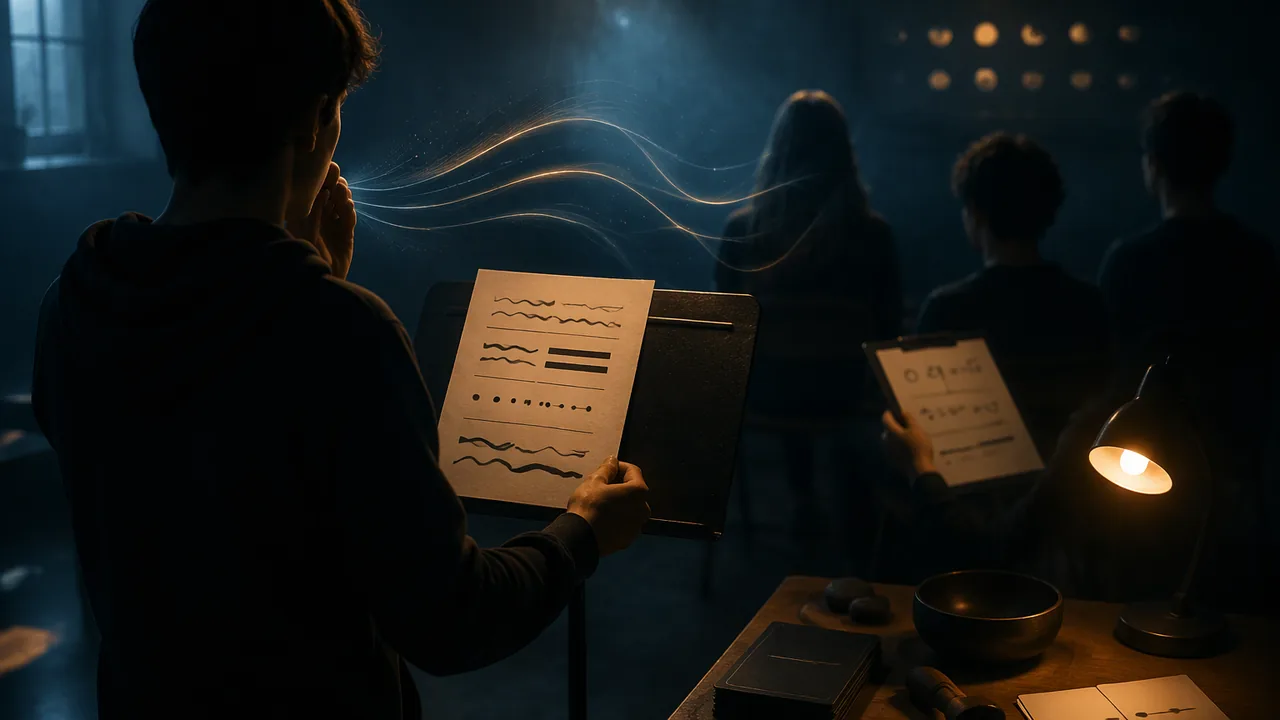
Build a performance script. Print your poem with wide margins. Mark: pauses (one slash for a short pause, two for a long one); stresses (underline); pace (arrows for speeding up or slowing down); and volume or tone changes. Then justify at least two choices in writing: “I pause after ‘Nothing beside remains’ because the full stop mid-line is the poem’s only abrupt break, and the silence is the desert.”
Line endings. An enjambed line tempts you to pause where the line ends; a performer must decide whether to honor the line or the sentence. Either choice can be right; what matters is that it is a choice.
Tone and irony. Some poems require you to perform one tone while signaling another. Dunbar’s “We Wear the Mask” speaks of grinning while the hearts are “torn and bleeding”; a flat, cheerful reading makes the mask visible. Owen’s “Dulce et Decorum Est” builds to a Latin line meaning “it is sweet and fitting to die for one’s country,” which the poem calls “The old Lie.” How you say the Latin decides how the poem lands.
Two mediums (9-10.RL.3.A / 9-10.RL.1.C). Before performing, listen to a public-domain recording of a poet or actor reading a poem from the anthology, if one exists, and compare it with your reading of the text: what did the performer emphasize that the page leaves open?
Listening is half the lab (9-10.SL.1.A, 9-10.SL.1.C). You will respond to two classmates’ performances. Do not rate the performance (“good job”); analyze the interpretation. Name one choice they made, say what reading of the poem it implies, and either extend it or name a line that complicates it. Respond to classmates who performed a different poem as well as the same one.
Accessibility. If recording is difficult for you, an annotated script plus a live performance in a scheduled session earns equal credit.
Whose voice? Several of these poets wrote from experiences not your own — Dunbar and Hughes on being Black in America, Owen on the trenches of the First World War. Performing a poem is an act of attention to its speaker. Perform with respect; avoid imitating accents or dialects, and let the poem’s words carry its experience.
Reading: Performing a poem: texts, a worked script, readings and a response protocol
Langston Hughes, “Epilogue” (the poem later titled “I, Too”), The Weary Blues (1926), via Wikisource (https://en.wikisource.org/w/index.php?action=render&title=The_Weary_Blues_%28collection%29/Epilogue). Edna St. Vincent Millay, “First Fig,” A Few Figs from Thistles (Harper & Brothers, 1922 edition), via Wikisource (https://en.wikisource.org/w/index.php?action=render&title=A_Few_Figs_from_Thistles_%28Harper_%26_Brothers%2C_1922%29/First_Fig). Walt Whitman, “I Hear America Singing,” Leaves of Grass (1882 edition), via Wikisource (https://en.wikisource.org/w/index.php?action=render&title=Leaves_of_Grass_%281882%29/Inscriptions/I_Hear_America_Singing). Percy Bysshe Shelley, “Ozymandias” (first published in The Examiner, 11 January 1818), text of The Complete Poetical Works of Percy Bysshe Shelley, ed. Thomas Hutchinson (1914), via Wikisource (https://en.wikisource.org/w/index.php?action=render&title=The_Complete_Poetical_Works_of_Percy_Bysshe_Shelley_%28ed._Hutchinson%2C_1914%29/Ozymandias). “Ozymandias” was also checked word for word against Project Gutenberg eBook #4800 (The Complete Poetical Works of Percy Bysshe Shelley), https://www.gutenberg.org/ebooks/4800, because the Wikisource page prints editorial line-number markup inside the poem. Retrieved 2026-09-26. Wikisource transcriptions are copied by script; editorial line numbers and footnote markers in the source were removed, and the line numbers printed here are counted from the first line of each poem. · SLS original; quoted poems are public domain (Hughes, 1926; Millay, 1920/1922; Whitman; Shelley, 1818)
Poems copied by script and checked verbatim; editorial numbers removed as stated. Script, readings, protocol and response are SLS original. No recording was reviewed for this reading.
Here are four poems you may perform, printed complete with line numbers (every fifth line), a worked performance script, two readings to argue about, a listening protocol with question stems, and a model response. The other anthology poems are printed in full in Lessons 2.2 (“We Wear the Mask,” “Sympathy,” “Dulce et Decorum est”) and 2.4. Everything outside the poems is SLS original.
“I, Too,” Langston Hughes (1926, printed in The Weary Blues under the title “Epilogue”)
I, too, sing America.
I am the darker brother.
They send me to eat in the kitchen
When company comes,
5 But I laugh,
And eat well,
And grow strong.
Tomorrow,
I’ll sit at the table
10 When company comes.
Nobody’ll dare
Say to me,
“Eat in the kitchen,”
Then.
15 Besides,
They’ll see how beautiful I am
And be ashamed,—
I, too, am America.
“First Fig,” Edna St. Vincent Millay (1920)
My candle burns at both ends;
It will not last the night;
But ah, my foes, and oh, my friends—
It gives a lovely light!
“I Hear America Singing,” Walt Whitman
I hear America singing, the varied carols I hear,
Those of mechanics, each one singing his as it should be blithe and strong,
The carpenter singing his as he measures his plank or beam,
The mason singing his as he makes ready for work, or leaves off work,
5 The boatman singing what belongs to him in his boat, the deckhand singing on the steamboat deck,
The shoemaker singing as he sits on his bench, the hatter singing as he stands,
The wood-cutter’s song, the ploughboy’s on his way in the morning, or at noon intermission or at sundown,
The delicious singing of the mother, or of the young wife at work, or of the girl sewing or washing,
Each singing what belongs to him or her and to none else
10 The day what belongs to the day—at night the party of young fellows, robust, friendly,
Singing with open mouths their strong melodious songs.
“Ozymandias,” Percy Bysshe Shelley (1818), for the worked script
I met a traveller from an antique land
Who said: Two vast and trunkless legs of stone
Stand in the desert … Near them, on the sand,
Half sunk, a shattered visage lies, whose frown,
And wrinkled lip, and sneer of cold command, [5]
Tell that its sculptor well those passions read
Which yet survive, stamped on these lifeless things,
The hand that mocked them, and the heart that fed:
And on the pedestal these words appear:
‘My name is Ozymandias, king of kings: [10]
Look on my works, ye Mighty, and despair!’
Nothing beside remains. Round the decay
Of that colossal wreck, boundless and bare
The lone and level sands stretch far away.
A worked performance script for lines 9-14 of “Ozymandias” (SLS original)
Marks: / a short pause, // a long pause, slow and fast for pace, up or down for pitch.
- Line 9, slow and level: the plain announcement before the quotation. Pause / after “appear.”
- Line 10: the king’s voice. Louder, up on “Ozymandias,” // after “kings.”
- Line 11: slow on “Look on my works,” / then bigger on “ye Mighty,” / and let “despair” drop down.
- Line 12: a long pause // before “Nothing beside remains,” then slow and flat. Full stop, //, and a breath before “Round the decay.”
- Lines 13-14: one long breath across the enjambment; speed up slightly and then slow on “stretch far away.”
Two written justifications (model). (1) “I pause for a long time before ‘Nothing beside remains’ because the full stop in the middle of line 12 is the poem’s only abrupt break, and the silence is the desert.” (2) “I read lines 13-14 in one breath because the sentence runs across the line ends, and the length of the breath is the length of the sands.”
Two readings to argue about (SLS original)
A performer has to choose. Here are two defensible readings of “I, Too.” Neither is the only correct one.
- Reading A: defiant. The speaker says “I am the darker brother” and “I, too, am America” as declarations to an audience that has denied him. The delivery is firm and level, with a raised chin on the last line.
- Reading B: patient and certain. The speaker laughs, eats well and grows strong; the confidence lives in the waiting (“Tomorrow”). The delivery is warm and controlled, with a smile that carries knowledge.
Test each reading against the text: which lines support it, and which line makes it uncomfortable? For A, the laughing at line 5 sits oddly. For B, the last line (“And be ashamed”) sounds less patient than pointed. A strong performance names what it chooses to emphasize and what it lets the poem leave open.
Protocol for the response round (SLS original)
- The performer states one choice they made and why, in one sentence.
- Listeners take one minute of silence to write.
- Each responder speaks in the frame below.
- The performer may answer, but not defend.
Response frame. “You (paused/sped up/stressed) ___ at ___. That suggests a reading of the poem as ___. It works because the line ___. It is complicated by ___.”
A bank of question stems (SLS original)
- What do you hear in that choice that the words alone do not say?
- Which line would change if you delivered the poem the other way?
- What did the performer treat as a full stop that the poet punctuated as a comma?
- Is that pause in the poem or added by you?
- How would the poem land for someone who could not see your face?
A model response (SLS original)
“On ‘I, Too,’ you slowed down at ‘Tomorrow,’ and left a long pause after it. That suggests a reading of the poem as a promise made to a future audience. It works because ‘Tomorrow’ is a one-word line, so the poem has already given it a pause. What complicates it for me is the line ‘They send me to eat in the kitchen,’ which you took quickly, almost lightly. I would like to hear it slowed, because the humiliation is the reason the promise matters.”
Whose voice? (SLS original)
Several of these poets wrote from experiences that are not yours. Perform with respect: do not imitate accents or dialect, and let the words carry the experience. If recording is hard, an annotated script plus a live performance in a scheduled session earns equal credit. If a public-domain recording of a poem exists, use it to compare one choice with yours; the existence of a recording, and its sound, are not checked here.
Formative check
Work through these before moving on. They are not graded — they tell you whether the standard below has landed yet.
Which justification of a delivery choice is strongest?
A good peer response to a performance says whether it was good or bad.
Submit your annotated performance script with two written justifications. If a recording of your poem exists, compare one choice the performer made with yours. Then record your performance.
How confident are you that you can perform a poem with choices I can justify from the text?