trace how Brutus reasons his way to the murder and takes command of the conspiracy, and explain how each of his decisions in Act 2, scene 1 reveals his character and sets up what follows.
Instruction
Act 2 begins in the dark, in Brutus’s orchard, a few hours before the Ides of March. Brutus has not slept. By the end of the scene he has joined a conspiracy and become its leader, and the way he gets there tells you more about him than anything he does with a sword.
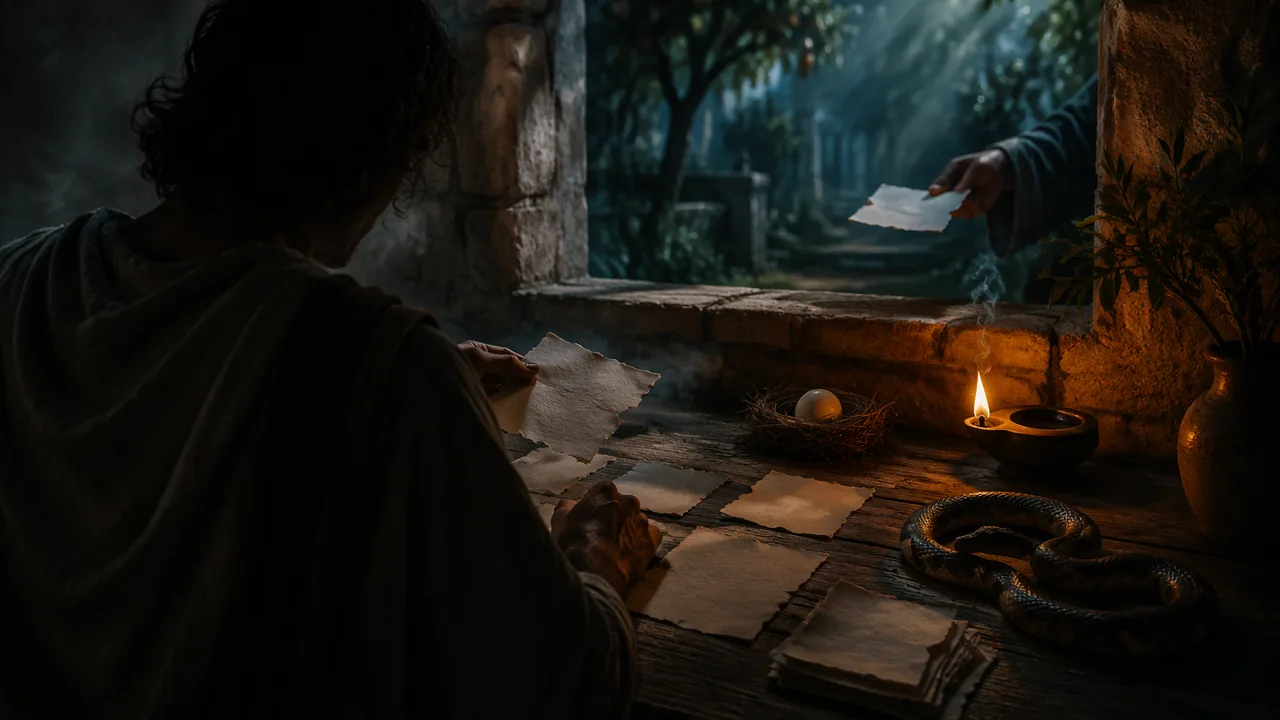
The verdict comes before the reasons. Brutus’s soliloquy opens with its conclusion: “It must be by his death.” Only then does he look for reasons, and the first thing he admits is that he has none of his own: “I know no personal cause to spurn at him, / But for the general.” His case rests on a possibility: “He would be crown’d: / How that might change his nature, there’s the question.” He grants that he has never known Caesar’s feelings to overrule his reason, then argues from what ambitious men in general do (the climber who scorns the ladder once he reaches the top) and lands on four short phrases: “So Caesar may; / Then lest he may, prevent.” Watch the verb in the next lines: “since the quarrel / Will bear no colour for the thing he is, / Fashion it thus.” Brutus knows the facts will not support the charge, so he shapes an argument that will. The image he settles on, the serpent’s egg to be killed “in the shell,” condemns Caesar for what he has not yet become.
The letter does the rest. Lucius brings a letter found at the window, one of the papers Cassius planted in Act 1. Brutus has to “piece it out,” filling the gaps himself: “Shall Rome stand under one man’s awe?” He remembers that his ancestors drove the Tarquin, the last king, from the streets of Rome. For a Roman of his family, the word king carries a history, and Brutus hears that history calling him in a letter Cassius wrote. Before the conspirators arrive he describes the waiting as “Like a phantasma, or a hideous dream,” in which “the state of man, / Like to a little kingdom, suffers then / The nature of an insurrection.” The rebellion against Caesar has begun inside Brutus first.
Brutus takes command. Once the conspirators gather, Brutus overrules Cassius on every question. He refuses an oath, because their cause should bind them without one. He rejects Cicero, who “will never follow anything / That other men begin.” And when Cassius argues that Mark Antony should die with Caesar, Brutus answers with the scene’s most famous lines: “Let us be sacrificers, but not butchers, Caius,” and “We shall be call’d purgers, not murderers.” He is managing how the act will look. Each time, Cassius gives way. The pattern (Cassius sees the practical danger, Brutus sees the principle, and Brutus wins) is the engine of the play.
Portia. After the conspirators leave, Brutus’s wife Portia kneels and asks why he is “heavy” and who the men were “who did hide their faces / Even from darkness.” She asks whether she dwells “but in the suburbs / Of your good pleasure,” and reveals a wound she gave herself in the thigh to prove her constancy. Brutus promises to tell her everything. Shakespeare sets the private cost beside the public plan: the man who means to save Rome has shut his wife out of his life.
The rest of the act. In the bridge scenes, Calphurnia’s dream nearly keeps Caesar at home until Decius reinterprets it as a good omen; a man named Artemidorus writes a warning that names every conspirator; and Portia, waiting in the street, nearly gives the secret away. Notice how often in Act 2 the same sign is read two ways.
As you read, mark each of Brutus’s decisions in scene 1, the reason he gives for it, and what Cassius wanted instead.
📖 Before this lesson, read: Julius Caesar, Act 2
The reading opens over the lesson; close it to come back to exactly where you were.
Formative check
Work through these before moving on. They are not graded — they tell you whether the standard below has landed yet.
Brutus concludes, “So Caesar may; / Then lest he may, prevent.” What does this reasoning show?
Brutus agrees with Cassius that the conspirators should swear an oath.
Brutus urges, “Let us be , but not butchers,” and hopes the conspirators will be called , not murderers.
Build a decision chart for Brutus in Act 2, scene 1: for each decision (to kill Caesar, to refuse an oath, to leave out Cicero, to spare Antony), quote the reason Brutus gives and note what Cassius wanted instead. Then write a paragraph: what pattern do the decisions share, and what does it suggest about how Brutus will act when the plan meets the real world? Add one sentence on why the memory of the Tarquin gives the word “king” such force for a Roman like Brutus.
How confident are you that you can explain how a character’s reasoning in a soliloquy and his decisions in a scene reveal who he is, using quoted lines rather than plot summary?
Julius Caesar, Act 2
Julius Caesar, Act 2, Scene 1: Rome. Brutus’ orchard.
Source: William Shakespeare, The Tragedy of Julius Caesar (c. 1599), Project Gutenberg eBook #1522 (gutenberg.org) · Public domain
Enter Brutus.
BRUTUS.
What, Lucius, ho!
I cannot, by the progress of the stars,
Give guess how near to day.—Lucius, I say!
I would it were my fault to sleep so soundly.
When, Lucius, when? Awake, I say! What, Lucius!
Enter Lucius.
LUCIUS.
Call’d you, my lord?
BRUTUS.
Get me a taper in my study, Lucius:
When it is lighted, come and call me here.
LUCIUS.
I will, my lord.
[Exit.]
BRUTUS.
It must be by his death: and for my part,
I know no personal cause to spurn at him,
But for the general. He would be crown’d:
How that might change his nature, there’s the question.
It is the bright day that brings forth the adder,
And that craves wary walking. Crown him?—that;
And then, I grant, we put a sting in him,
That at his will he may do danger with.
Th’ abuse of greatness is, when it disjoins
Remorse from power; and, to speak truth of Caesar,
I have not known when his affections sway’d
More than his reason. But ’tis a common proof,
That lowliness is young ambition’s ladder,
Whereto the climber-upward turns his face;
But when he once attains the upmost round,
He then unto the ladder turns his back,
Looks in the clouds, scorning the base degrees
By which he did ascend. So Caesar may;
Then lest he may, prevent. And since the quarrel
Will bear no colour for the thing he is,
Fashion it thus: that what he is, augmented,
Would run to these and these extremities:
And therefore think him as a serpent’s egg
Which hatch’d, would, as his kind grow mischievous;
And kill him in the shell.
Enter Lucius.
LUCIUS.
The taper burneth in your closet, sir.
Searching the window for a flint, I found
This paper, thus seal’d up, and I am sure
It did not lie there when I went to bed.
[Gives him the letter.]
BRUTUS.
Get you to bed again; it is not day.
Is not tomorrow, boy, the Ides of March?
LUCIUS.
I know not, sir.
BRUTUS.
Look in the calendar, and bring me word.
LUCIUS.
I will, sir.
[Exit.]
BRUTUS.
The exhalations, whizzing in the air
Give so much light that I may read by them.
[Opens the letter and reads.]
_Brutus, thou sleep’st: awake and see thyself. Shall Rome, &c. Speak, strike, redress!_ “Brutus, thou sleep’st: awake!” Such instigations have been often dropp’d Where I have took them up. “Shall Rome, &c.” Thus must I piece it out: Shall Rome stand under one man’s awe? What, Rome? My ancestors did from the streets of Rome The Tarquin drive, when he was call’d a king. “Speak, strike, redress!” Am I entreated To speak and strike? O Rome, I make thee promise, If the redress will follow, thou receivest Thy full petition at the hand of Brutus.
Enter Lucius.
LUCIUS.
Sir, March is wasted fifteen days.
[Knock within.]
BRUTUS.
’Tis good. Go to the gate, somebody knocks.
[Exit Lucius.]
Since Cassius first did whet me against Caesar, I have not slept. Between the acting of a dreadful thing And the first motion, all the interim is Like a phantasma, or a hideous dream: The genius and the mortal instruments Are then in council; and the state of man, Like to a little kingdom, suffers then The nature of an insurrection.
Enter Lucius.
LUCIUS.
Sir, ’tis your brother Cassius at the door,
Who doth desire to see you.
BRUTUS.
Is he alone?
LUCIUS.
No, sir, there are moe with him.
BRUTUS.
Do you know them?
LUCIUS.
No, sir, their hats are pluck’d about their ears,
And half their faces buried in their cloaks,
That by no means I may discover them
By any mark of favour.
BRUTUS.
Let ’em enter.
[Exit Lucius.]
They are the faction. O conspiracy, Sham’st thou to show thy dangerous brow by night, When evils are most free? O, then, by day Where wilt thou find a cavern dark enough To mask thy monstrous visage? Seek none, conspiracy; Hide it in smiles and affability: For if thou path, thy native semblance on, Not Erebus itself were dim enough To hide thee from prevention.
Enter Cassius, Casca, Decius, Cinna, Metellus Cimber and Trebonius.
CASSIUS.
I think we are too bold upon your rest:
Good morrow, Brutus; do we trouble you?
BRUTUS.
I have been up this hour, awake all night.
Know I these men that come along with you?
CASSIUS.
Yes, every man of them; and no man here
But honours you; and everyone doth wish
You had but that opinion of yourself
Which every noble Roman bears of you.
This is Trebonius.
BRUTUS.
He is welcome hither.
CASSIUS.
This Decius Brutus.
BRUTUS.
He is welcome too.
CASSIUS.
This, Casca; this, Cinna; and this, Metellus Cimber.
BRUTUS.
They are all welcome.
What watchful cares do interpose themselves
Betwixt your eyes and night?
CASSIUS.
Shall I entreat a word?
[They whisper.]
DECIUS.
Here lies the east: doth not the day break here?
CASCA.
No.
CINNA.
O, pardon, sir, it doth; and yon grey lines
That fret the clouds are messengers of day.
CASCA.
You shall confess that you are both deceiv’d.
Here, as I point my sword, the Sun arises;
Which is a great way growing on the South,
Weighing the youthful season of the year.
Some two months hence, up higher toward the North
He first presents his fire; and the high East
Stands, as the Capitol, directly here.
BRUTUS.
Give me your hands all over, one by one.
CASSIUS.
And let us swear our resolution.
BRUTUS.
No, not an oath. If not the face of men,
The sufferance of our souls, the time’s abuse—
If these be motives weak, break off betimes,
And every man hence to his idle bed.
So let high-sighted tyranny range on,
Till each man drop by lottery. But if these,
As I am sure they do, bear fire enough
To kindle cowards, and to steel with valour
The melting spirits of women; then, countrymen,
What need we any spur but our own cause
To prick us to redress? what other bond
Than secret Romans, that have spoke the word,
And will not palter? and what other oath
Than honesty to honesty engag’d,
That this shall be, or we will fall for it?
Swear priests and cowards, and men cautelous,
Old feeble carrions, and such suffering souls
That welcome wrongs; unto bad causes swear
Such creatures as men doubt; but do not stain
The even virtue of our enterprise,
Nor th’ insuppressive mettle of our spirits,
To think that or our cause or our performance
Did need an oath; when every drop of blood
That every Roman bears, and nobly bears,
Is guilty of a several bastardy,
If he do break the smallest particle
Of any promise that hath pass’d from him.
CASSIUS.
But what of Cicero? Shall we sound him?
I think he will stand very strong with us.
CASCA.
Let us not leave him out.
CINNA.
No, by no means.
METELLUS.
O, let us have him, for his silver hairs
Will purchase us a good opinion,
And buy men’s voices to commend our deeds.
It shall be said, his judgement rul’d our hands;
Our youths and wildness shall no whit appear,
But all be buried in his gravity.
BRUTUS.
O, name him not; let us not break with him;
For he will never follow anything
That other men begin.
CASSIUS.
Then leave him out.
CASCA.
Indeed, he is not fit.
DECIUS.
Shall no man else be touch’d but only Caesar?
CASSIUS.
Decius, well urg’d. I think it is not meet,
Mark Antony, so well belov’d of Caesar,
Should outlive Caesar: we shall find of him
A shrewd contriver; and you know, his means,
If he improve them, may well stretch so far
As to annoy us all; which to prevent,
Let Antony and Caesar fall together.
BRUTUS.
Our course will seem too bloody, Caius Cassius,
To cut the head off, and then hack the limbs,
Like wrath in death, and envy afterwards;
For Antony is but a limb of Caesar.
Let us be sacrificers, but not butchers, Caius.
We all stand up against the spirit of Caesar,
And in the spirit of men there is no blood.
O, that we then could come by Caesar’s spirit,
And not dismember Caesar! But, alas,
Caesar must bleed for it! And, gentle friends,
Let’s kill him boldly, but not wrathfully;
Let’s carve him as a dish fit for the gods,
Not hew him as a carcass fit for hounds.
And let our hearts, as subtle masters do,
Stir up their servants to an act of rage,
And after seem to chide ’em. This shall mark
Our purpose necessary, and not envious;
Which so appearing to the common eyes,
We shall be call’d purgers, not murderers.
And for Mark Antony, think not of him;
For he can do no more than Caesar’s arm
When Caesar’s head is off.
CASSIUS.
Yet I fear him;
For in the ingrafted love he bears to Caesar—
BRUTUS.
Alas, good Cassius, do not think of him:
If he love Caesar, all that he can do
Is to himself; take thought and die for Caesar.
And that were much he should; for he is given
To sports, to wildness, and much company.
TREBONIUS.
There is no fear in him; let him not die;
For he will live, and laugh at this hereafter.
[Clock strikes.]
BRUTUS.
Peace! count the clock.
CASSIUS.
The clock hath stricken three.
TREBONIUS.
’Tis time to part.
CASSIUS.
But it is doubtful yet
Whether Caesar will come forth today or no;
For he is superstitious grown of late,
Quite from the main opinion he held once
Of fantasy, of dreams, and ceremonies.
It may be these apparent prodigies,
The unaccustom’d terror of this night,
And the persuasion of his augurers,
May hold him from the Capitol today.
DECIUS.
Never fear that: if he be so resolved,
I can o’ersway him, for he loves to hear
That unicorns may be betray’d with trees,
And bears with glasses, elephants with holes,
Lions with toils, and men with flatterers.
But when I tell him he hates flatterers,
He says he does, being then most flattered.
Let me work;
For I can give his humour the true bent,
And I will bring him to the Capitol.
CASSIUS.
Nay, we will all of us be there to fetch him.
BRUTUS.
By the eighth hour: is that the uttermost?
CINNA.
Be that the uttermost; and fail not then.
METELLUS.
Caius Ligarius doth bear Caesar hard,
Who rated him for speaking well of Pompey;
I wonder none of you have thought of him.
BRUTUS.
Now, good Metellus, go along by him:
He loves me well, and I have given him reason;
Send him but hither, and I’ll fashion him.
CASSIUS.
The morning comes upon’s. We’ll leave you, Brutus.
And, friends, disperse yourselves; but all remember
What you have said, and show yourselves true Romans.
BRUTUS.
Good gentlemen, look fresh and merrily;
Let not our looks put on our purposes,
But bear it as our Roman actors do,
With untired spirits and formal constancy.
And so, good morrow to you everyone.
[Exeunt all but Brutus.]
Boy! Lucius! Fast asleep? It is no matter; Enjoy the honey-heavy dew of slumber: Thou hast no figures nor no fantasies, Which busy care draws in the brains of men; Therefore thou sleep’st so sound.
Enter Portia.
PORTIA.
Brutus, my lord.
BRUTUS.
Portia, what mean you? Wherefore rise you now?
It is not for your health thus to commit
Your weak condition to the raw cold morning.
PORTIA.
Nor for yours neither. Y’ have ungently, Brutus,
Stole from my bed; and yesternight at supper,
You suddenly arose, and walk’d about,
Musing and sighing, with your arms across;
And when I ask’d you what the matter was,
You star’d upon me with ungentle looks.
I urg’d you further; then you scratch’d your head,
And too impatiently stamp’d with your foot;
Yet I insisted, yet you answer’d not,
But with an angry wafture of your hand
Gave sign for me to leave you. So I did,
Fearing to strengthen that impatience
Which seem’d too much enkindled; and withal
Hoping it was but an effect of humour,
Which sometime hath his hour with every man.
It will not let you eat, nor talk, nor sleep;
And could it work so much upon your shape
As it hath much prevail’d on your condition,
I should not know you, Brutus. Dear my lord,
Make me acquainted with your cause of grief.
BRUTUS.
I am not well in health, and that is all.
PORTIA.
Brutus is wise, and, were he not in health,
He would embrace the means to come by it.
BRUTUS.
Why, so I do. Good Portia, go to bed.
PORTIA.
Is Brutus sick, and is it physical
To walk unbraced and suck up the humours
Of the dank morning? What, is Brutus sick,
And will he steal out of his wholesome bed
To dare the vile contagion of the night,
And tempt the rheumy and unpurged air
To add unto his sickness? No, my Brutus;
You have some sick offence within your mind,
Which, by the right and virtue of my place,
I ought to know of: and, upon my knees,
I charm you, by my once commended beauty,
By all your vows of love, and that great vow
Which did incorporate and make us one,
That you unfold to me, your self, your half,
Why you are heavy, and what men tonight
Have had resort to you; for here have been
Some six or seven, who did hide their faces
Even from darkness.
BRUTUS.
Kneel not, gentle Portia.
PORTIA.
I should not need, if you were gentle Brutus.
Within the bond of marriage, tell me, Brutus,
Is it excepted I should know no secrets
That appertain to you? Am I your self
But, as it were, in sort or limitation,
To keep with you at meals, comfort your bed,
And talk to you sometimes? Dwell I but in the suburbs
Of your good pleasure? If it be no more,
Portia is Brutus’ harlot, not his wife.
BRUTUS.
You are my true and honourable wife,
As dear to me as are the ruddy drops
That visit my sad heart.
PORTIA.
If this were true, then should I know this secret.
I grant I am a woman; but withal
A woman that Lord Brutus took to wife;
I grant I am a woman; but withal
A woman well reputed, Cato’s daughter.
Think you I am no stronger than my sex,
Being so father’d and so husbanded?
Tell me your counsels, I will not disclose ’em.
I have made strong proof of my constancy,
Giving myself a voluntary wound
Here, in the thigh: can I bear that with patience
And not my husband’s secrets?
BRUTUS.
O ye gods,
Render me worthy of this noble wife!
[Knock.]
Hark, hark, one knocks. Portia, go in awhile; And by and by thy bosom shall partake The secrets of my heart. All my engagements I will construe to thee, All the charactery of my sad brows. Leave me with haste.
[Exit Portia.]
Enter Lucius with Ligarius.
Lucius, who’s that knocks?
LUCIUS.
Here is a sick man that would speak with you.
BRUTUS.
Caius Ligarius, that Metellus spake of.
Boy, stand aside. Caius Ligarius, how?
LIGARIUS.
Vouchsafe good-morrow from a feeble tongue.
BRUTUS.
O, what a time have you chose out, brave Caius,
To wear a kerchief! Would you were not sick!
LIGARIUS.
I am not sick, if Brutus have in hand
Any exploit worthy the name of honour.
BRUTUS.
Such an exploit have I in hand, Ligarius,
Had you a healthful ear to hear of it.
LIGARIUS.
By all the gods that Romans bow before,
I here discard my sickness. Soul of Rome!
Brave son, derived from honourable loins!
Thou, like an exorcist, hast conjur’d up
My mortified spirit. Now bid me run,
And I will strive with things impossible,
Yea, get the better of them. What’s to do?
BRUTUS.
A piece of work that will make sick men whole.
LIGARIUS.
But are not some whole that we must make sick?
BRUTUS.
That must we also. What it is, my Caius,
I shall unfold to thee, as we are going,
To whom it must be done.
LIGARIUS.
Set on your foot,
And with a heart new-fir’d I follow you,
To do I know not what; but it sufficeth
That Brutus leads me on.
[Thunder.]
BRUTUS.
Follow me then.
[Exeunt.]
Julius Caesar, Act 2, Scene 2: A room in Caesar’s palace. Bridge summary — not the primary text
This is a short recap written for this course, not William Shakespeare’s own words, so you can follow the story between close-reading lessons.
{summary}Julius Caesar, Act 2, Scene 3: A street near the Capitol. Bridge summary — not the primary text
This is a short recap written for this course, not William Shakespeare’s own words, so you can follow the story between close-reading lessons.
{summary}Julius Caesar, Act 2, Scene 4: Another part of the same street, before the house of Brutus. Bridge summary — not the primary text
This is a short recap written for this course, not William Shakespeare’s own words, so you can follow the story between close-reading lessons.
{summary}