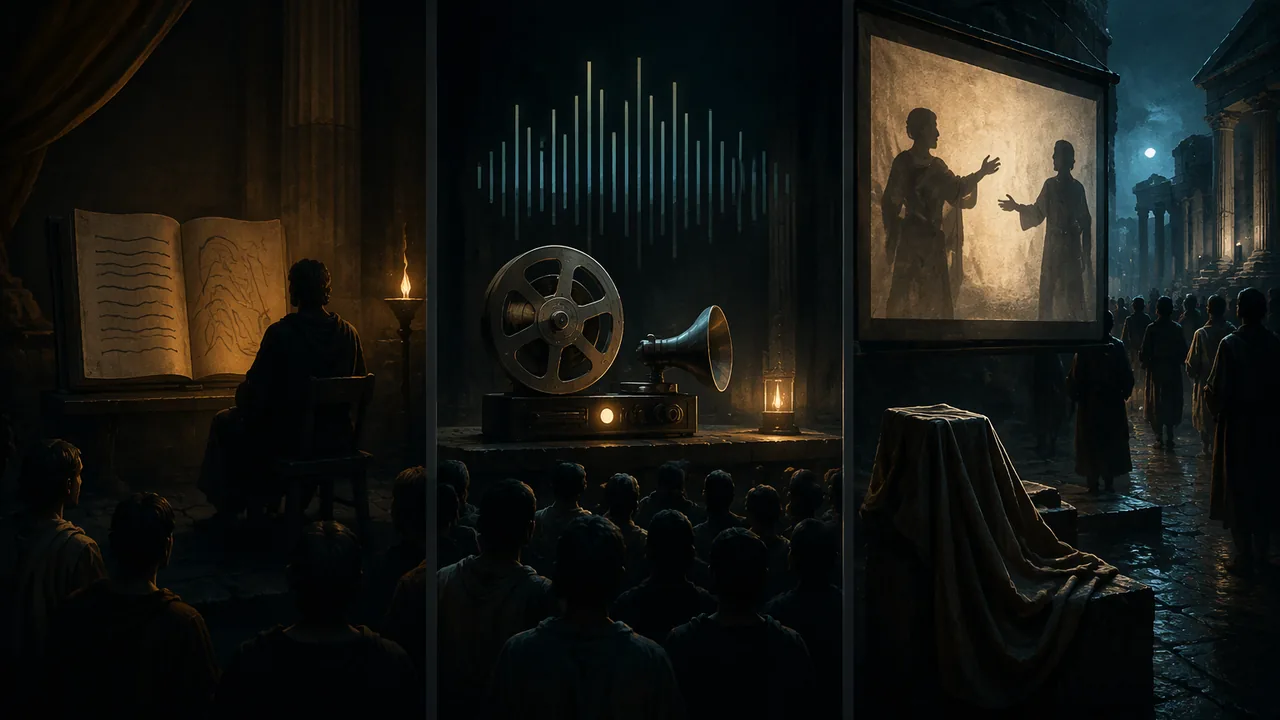
analyze how the funeral scene is represented in the text, an audio performance and a silent film, including what each treatment emphasizes or leaves out, and judge which the text best supports.
Instruction
Act 3, scene 2 is one of the most famous scenes in English drama, and one of the most studied in rhetoric. Brutus speaks first, then leaves Antony alone with the crowd. By the end, the crowd that cheered Brutus is hunting the conspirators through the streets. In the short scene that follows, the mob meets Cinna the poet, who shares a conspirator’s name, and turns on him anyway: “Tear him for his bad verses.” That is what the speech has made.
Brutus’s speech is in prose — careful, balanced and logical. It is built on antithesis: “Not that I loved Caesar less, but that I loved Rome more.” He appeals to the crowd’s reason and to his own reputation, and asks them to judge. It works, briefly: the crowd cheers and wants to make Brutus Caesar.
Antony’s speech is in verse and moves from reason to emotion. He claims he has come “to bury Caesar, not to praise him,” then praises him. He repeats “Brutus is an honourable man” until the phrase is poisoned. He answers the charge of ambition with evidence — Caesar filled Rome’s treasury, wept for the poor, refused the crown three times. He produces Caesar’s will and refuses to read it, which makes the crowd demand it. He descends to stand by the body, shows the torn cloak and names each wound. Only then does he read the will.
Three mediums. 9-10.RL.3.A / 9-10.RL.1.C asks you to analyze the representation of a subject in two different artistic mediums, including what is emphasized or absent in each. You will compare three: the text on the page; a public-domain audio performance, where voice, pace and crowd sound carry the effect; and the Vitagraph silent film of 1908, where the speech itself cannot be heard at all and everything must be carried by gesture, the body and the crowd’s movement.
What to look for. On the page, you see the switch from prose to verse and the patterns of repetition. In audio, you hear whether Antony’s irony is played openly or slyly, and how the crowd’s interruptions shape the rhythm. In silent film, the words are replaced by title cards; Antony’s rhetoric becomes action — the cloak, the body — which may show how much of the speech’s power is theatrical rather than verbal.
Judging treatments. The question is not which version you enjoy but which the text best supports. If a performance plays Antony as sincerely grieving throughout, does the text support that? If it plays him as a cold manipulator from the first line, what does the text’s mixture of grief and calculation lose? Your judgment must rest on specific lines.
Evaluating sources (9-10.SL.1.C). When you use information from different media, note its credibility and accuracy: a performance is an interpretation, not the text.
The lab. Complete a chart for each medium: what it emphasizes, what it adds that the script leaves open, what it omits. Then record a 90-second judgment naming which treatment the text best supports and the line that decides it. Reply to one classmate who chose differently (9-10.SL.1.A).
📖 Before this lesson, read: Julius Caesar, Act 3, Scenes 2-3
The reading opens over the lesson; close it to come back to exactly where you were.
Reading: The funeral scene and the seminar: passages, positions and a protocol
William Shakespeare, The Tragedy of Julius Caesar (c. 1599), public-domain text, Project Gutenberg eBook #1522 (PG Shakespeare Team), https://www.gutenberg.org/ebooks/1522, retrieved 2026-09-26. Line numbers were counted by SLS from this text (verse lines; a line shared between two speakers counts once). Critic: William Hazlitt, Characters of Shakespeare’s Plays (1817), Project Gutenberg eBook #5085, https://www.gutenberg.org/ebooks/5085, retrieved 2026-09-26. · SLS original; quoted passages are public domain (William Shakespeare, Julius Caesar, c. 1599; William Hazlitt, 1817)
Passages copied by script and checked verbatim. The public-domain audio recording (LibriVox) and the 1908 Vitagraph film are not reproduced here; those rows of the chart are left for you to complete.
Act 3, scene 2 is assigned in full in the reading card above. This reading gives you everything the seminar argues from: the funeral scene, the reactions of the crowd, and two attributed judgments by a critic of 1817. It also gives you the seminar protocol, a bank of question stems, a model contribution, and a chart to complete for each medium. Only the passages and Hazlitt’s words are quoted; the rest is SLS original.
Part 1. Brutus speaks (3.2, in prose)
Brutus’s speech is prose. Cite it by act, scene and the words you quote, for example (3.2, “Not that I loved Caesar less”). Notice its shape: balanced pairs, then a run of questions, then a pause for a reply.
[Brutus.] Romans, countrymen, and lovers, hear me for my cause; and be silent, that you may hear. Believe me for mine honour, and have respect to mine honour, that you may believe. Censure me in your wisdom, and awake your senses, that you may the better judge. If there be any in this assembly, any dear friend of Caesar’s, to him I say that Brutus’ love to Caesar was no less than his. If then that friend demand why Brutus rose against Caesar, this is my answer: Not that I loved Caesar less, but that I loved Rome more. Had you rather Caesar were living, and die all slaves, than that Caesar were dead, to live all free men? As Caesar loved me, I weep for him; as he was fortunate, I rejoice at it; as he was valiant, I honour him; but, as he was ambitious, I slew him. There is tears, for his love; joy for his fortune; honour for his valour; and death, for his ambition. Who is here so base, that would be a bondman? If any, speak; for him have I offended. Who is here so rude, that would not be a Roman? If any, speak; for him have I offended. Who is here so vile, that will not love his country? If any, speak; for him have I offended. I pause for a reply.
[Citizens.] None, Brutus, none.
[Brutus.] Then none have I offended. I have done no more to Caesar than you shall do to Brutus. The question of his death is enroll’d in the Capitol, his glory not extenuated, wherein he was worthy; nor his offences enforc’d, for which he suffered death.
[Enter Antony and others, with Caesar’s body.] Here comes his body, mourned by Mark Antony, who, though he had no hand in his death, shall receive the benefit of his dying, a place in the commonwealth; as which of you shall not? With this I depart, that, as I slew my best lover for the good of Rome, I have the same dagger for myself, when it shall please my country to need my death.
[Citizens.] Live, Brutus! live, live!
[First Citizen.] Bring him with triumph home unto his house.
The crowd answers:
[Second Citizen.] Give him a statue with his ancestors.
[Third Citizen.] Let him be Caesar.
[Fourth Citizen.] Caesar’s better parts
Shall be crown’d in Brutus.[First Citizen.] 45 We’ll bring him to his house with shouts and clamours.
[Brutus.] My countrymen,—
[Second Citizen.] Peace! Silence! Brutus speaks.
[First Citizen.] Peace, ho!
[Brutus.] Good countrymen, let me depart alone,
Part 2. Brutus hands over the stage (3.2.49-55)
[Brutus.] Do grace to Caesar’s corpse, and grace his speech
50 Tending to Caesar’s glories, which Mark Antony,
By our permission, is allow’d to make.
I do entreat you, not a man depart,
Save I alone, till Antony have spoke.[First Citizen.] Stay, ho! and let us hear Mark Antony.
[Third Citizen.] 55 Let him go up into the public chair.
Part 3. Antony speaks (3.2, verse)
Opening, with the refrain (lines 66-102):
[Antony.] Friends, Romans, countrymen, lend me your ears;
I come to bury Caesar, not to praise him.
The evil that men do lives after them,
The good is oft interred with their bones;
70 So let it be with Caesar. The noble Brutus
Hath told you Caesar was ambitious.
If it were so, it was a grievous fault,
And grievously hath Caesar answer’d it.
Here, under leave of Brutus and the rest,
75 For Brutus is an honourable man,
So are they all, all honourable men,
Come I to speak in Caesar’s funeral.
He was my friend, faithful and just to me;
But Brutus says he was ambitious,
80 And Brutus is an honourable man.
He hath brought many captives home to Rome,
Whose ransoms did the general coffers fill:
Did this in Caesar seem ambitious?
When that the poor have cried, Caesar hath wept;
85 Ambition should be made of sterner stuff:
Yet Brutus says he was ambitious;
And Brutus is an honourable man.
You all did see that on the Lupercal
I thrice presented him a kingly crown,
90 Which he did thrice refuse. Was this ambition?
Yet Brutus says he was ambitious;
And sure he is an honourable man.
I speak not to disprove what Brutus spoke,
But here I am to speak what I do know.
95 You all did love him once, not without cause;
What cause withholds you then to mourn for him?
O judgement, thou art fled to brutish beasts,
And men have lost their reason. Bear with me.
My heart is in the coffin there with Caesar,
100 And I must pause till it come back to me.[First Citizen.] Methinks there is much reason in his sayings.
[Second Citizen.] If thou consider rightly of the matter,
The will withheld (lines 113-132):
[Antony.] And none so poor to do him reverence.
O masters! If I were dispos’d to stir
115 Your hearts and minds to mutiny and rage,
I should do Brutus wrong and Cassius wrong,
Who, you all know, are honourable men.
I will not do them wrong; I rather choose
To wrong the dead, to wrong myself and you,
120 Than I will wrong such honourable men.
But here’s a parchment with the seal of Caesar,
I found it in his closet; ’tis his will:
Let but the commons hear this testament,
Which, pardon me, I do not mean to read,
125 And they would go and kiss dead Caesar’s wounds,
And dip their napkins in his sacred blood;
Yea, beg a hair of him for memory,
And, dying, mention it within their wills,
Bequeathing it as a rich legacy
130 Unto their issue.[Fourth Citizen.] We’ll hear the will. Read it, Mark Antony.
[Citizens.] The will, the will! We will hear Caesar’s will.
The descent and the mantle (lines 152-188):
[Antony.] Shall I descend? and will you give me leave?
[Citizens.] Come down.
[Second Citizen.] Descend.
[Third Citizen.] You shall have leave.
[Fourth Citizen.] A ring! Stand round.
[First Citizen.] Stand from the hearse, stand from the body.
[Second Citizen.] 155 Room for Antony, most noble Antony!
[Antony.] Nay, press not so upon me; stand far off.
[Citizens.] Stand back; room! bear back.
[Antony.] If you have tears, prepare to shed them now.
You all do know this mantle. I remember
160 The first time ever Caesar put it on;
’Twas on a Summer’s evening, in his tent,
That day he overcame the Nervii.
Look, in this place ran Cassius’ dagger through:
See what a rent the envious Casca made:
165 Through this the well-beloved Brutus stabb’d;
And as he pluck’d his cursed steel away,
Mark how the blood of Caesar follow’d it,
As rushing out of doors, to be resolv’d
If Brutus so unkindly knock’d, or no;
170 For Brutus, as you know, was Caesar’s angel.
Judge, O you gods, how dearly Caesar lov’d him.
This was the most unkindest cut of all;
For when the noble Caesar saw him stab,
Ingratitude, more strong than traitors’ arms,
175 Quite vanquish’d him: then burst his mighty heart;
And in his mantle muffling up his face,
Even at the base of Pompey’s statue
Which all the while ran blood, great Caesar fell.
O, what a fall was there, my countrymen!
180 Then I, and you, and all of us fell down,
Whilst bloody treason flourish’d over us.
O, now you weep; and I perceive you feel
The dint of pity. These are gracious drops.
Kind souls, what weep you when you but behold
185 Our Caesar’s vesture wounded? Look you here,
Here is himself, marr’d, as you see, with traitors.[First Citizen.] O piteous spectacle!
[Second Citizen.] O noble Caesar!
[Third Citizen.] O woeful day!
[Fourth Citizen.] O traitors, villains!
[First Citizen.] O most bloody sight!
[Second Citizen.] We will be revenged.
[Citizens.] Revenge,—about,—seek,—burn,—fire,—kill,—slay,—let not a traitor live!
The close: the plain man, and the will read (lines 194-214 and 224-234):
[Antony.] They that have done this deed are honourable.
195 What private griefs they have, alas, I know not,
That made them do it. They’re wise and honourable,
And will, no doubt, with reasons answer you.
I come not, friends, to steal away your hearts.
I am no orator, as Brutus is;
200 But, as you know me all, a plain blunt man,
That love my friend; and that they know full well
That gave me public leave to speak of him.
For I have neither wit, nor words, nor worth,
Action, nor utterance, nor the power of speech,
205 To stir men’s blood. I only speak right on.
I tell you that which you yourselves do know,
Show you sweet Caesar’s wounds, poor poor dumb mouths,
And bid them speak for me. But were I Brutus,
And Brutus Antony, there were an Antony
210 Would ruffle up your spirits, and put a tongue
In every wound of Caesar, that should move
The stones of Rome to rise and mutiny.[Citizens.] We’ll mutiny.
[First Citizen.] We’ll burn the house of Brutus.
[Third Citizen.] Away, then! come, seek the conspirators.
[Antony.] To every several man, seventy-five drachmas.
[Second Citizen.] 225 Most noble Caesar! We’ll revenge his death.
[Third Citizen.] O, royal Caesar!
[Antony.] Hear me with patience.
[Citizens.] Peace, ho!
[Antony.] Moreover, he hath left you all his walks,
His private arbors, and new-planted orchards,
On this side Tiber; he hath left them you,
230 And to your heirs forever; common pleasures,
To walk abroad, and recreate yourselves.
Here was a Caesar! when comes such another?[First Citizen.] Never, never. Come, away, away!
We’ll burn his body in the holy place,
About the numbers. The small numbers in the passages are line numbers counted in this hosted text, marked every fifth line. Printed editions differ from one another by a few lines, so a citation in another edition may be a line or several off from the numbers here. Cite from the numbers printed in these readings, and name this text in your Works Cited. Passages printed without line numbers are cited by act and scene. Brutus’s funeral speech is prose, so it is cited by act, scene and the words you quote rather than by line.
Part 4. Two positions on the scene, attributed
These are the words of William Hazlitt, an English critic, in 1817. Read them as arguments, not as answers.
Mark Antony’s speech over the dead body of Caesar has been justly admired for the mixture of pathos and artifice in it: that of Brutus certainly is not so good.
On why the conspirators lose:
For instance, the whole design to liberate their country fails from the generous temper and overweening confidence of Brutus in the goodness of their cause and the assistance of others. Thus it has always been. Those who mean well themselves think well of others, and fall a prey to their security. That humanity and sincerity which dispose men to resist injustice and tyranny render them unfit to cope with the cunning and power of those who are opposed to them. The friends of liberty trust to the professions of others because they are themselves sincere, and endeavour to secure the public good with the least possible hurt to its enemies, who have no regard to anything but their own unprincipled ends, and stick at nothing to accomplish them.
Hazlitt is writing about the whole play; you have read to the end of Act 3, so test his claim about why the conspirators fail against what you have seen so far. He cites the speech and its effect, but he does not say which line decides the matter; that is for you to find. He praises Antony’s mixture of two things, and claims Brutus’s speech is weaker. Use his sentence as a position to test: does the text support “pathos and artifice”? Which lines show pathos, and which show artifice? Is a speech that is not “so good” the same as one that fails?
The characters in the scene hold positions too. After Brutus, the crowd wants to “Let him be Caesar”. After Antony, it turns to “Revenge”. Their shift in a few minutes is evidence for both critics.
The protocol for the seminar (SLS original)
- Everyone reads the parts above at least twice before the seminar and brings one marked quotation.
- The opening question is asked once and belongs to the group, not to a leader: “Which speech does the text support as the more honest, and which line decides it for you?”
- Speak from the text: give the line before you give the opinion.
- After you speak, name a classmate who has not yet spoken and pass the question.
- In the last five minutes, each person states one position changed or complicated by someone else, naming who did it.
A bank of question stems (SLS original)
- What line in the passage supports that reading, and what line seems to work against it?
- What is the crowd hearing that we, the audience, hear differently?
- Is Antony’s grief here proof of sincerity, or a means to an end? What would each reading need to be true?
- What does the text lose if the speech is played straight? What does it lose if it is played cold?
- You said “…”; where in the speech does that turn occur?
- Whose reason is being asked to do the work here, and whose feeling?
A model contribution (SLS original)
“I think Antony’s grief is real and also useful, and the text lets both be true. When he says “My heart is in the coffin there with Caesar”, he stops speaking and asks for a pause, and the crowd fills it with sympathy for him. That pause is a tactic and also an honest cost. I would like to hear from someone who reads it as pure strategy: what line would you point to that shows he feels nothing?”
Chart for the three media (SLS original)
| Medium | What it emphasizes | What it adds that the script leaves open | What it omits |
|---|---|---|---|
| Page (worked row) | The switch from Brutus’s prose to Antony’s verse; the repetition of the refrain. | Nothing: the page leaves the pace, the tone and the crowd’s noise for the reader to imagine. | All sound and all action; the reader must supply the pause after “come back to me.” |
| Audio recording | Yours to complete: listen to the same lines and note where the voice stresses “honourable” and how the crowd interrupts. | Yours. | Yours. |
| 1908 silent film | Yours to complete: note how gesture and the crowd’s movement replace the words. | Yours. | Yours. |
Find the audio recording and the film by searching for their titles in a free public-domain library such as LibriVox or the Internet Archive. If you cannot find a copy of the 1908 film, complete its row by describing how a silent staging would have to carry Antony’s refrain, the withheld will and the cloak with gesture, the crowd’s movement and title cards alone, using the stage directions and the crowd’s lines in the scene.
Your 90-second judgment must name which treatment the text best supports and the single line that decides it. Reply to one classmate who chose differently: name their choice, say what reading it implies, and extend it or name a line that complicates it.
Formative check
Work through these before moving on. They are not graded — they tell you whether the standard below has landed yet.
What does the silent film inevitably omit from Antony’s speech?
Brutus’s funeral speech is written in blank verse, like Antony’s.
Complete the three-medium chart for the funeral scene. Then draft your 90-second judgment: which treatment does the text best support, and which single line decides it for you?
How confident are you that you can compare how different mediums represent a scene and judge treatments against the text?
Julius Caesar, Act 3, Scenes 2-3
Julius Caesar, Act 3, Scene 2: The same. The Forum.
Source: William Shakespeare, The Tragedy of Julius Caesar (c. 1599), Project Gutenberg eBook #1522 (gutenberg.org) · Public domain
Enter Brutus and goes into the pulpit, and Cassius, with a throng of Citizens.
CITIZENS.
We will be satisfied; let us be satisfied.
BRUTUS.
Then follow me, and give me audience, friends.
Cassius, go you into the other street
And part the numbers.
Those that will hear me speak, let ’em stay here;
Those that will follow Cassius, go with him;
And public reasons shall be rendered
Of Caesar’s death.
FIRST CITIZEN.
I will hear Brutus speak.
SECOND CITIZEN.
I will hear Cassius; and compare their reasons,
When severally we hear them rendered.
[_Exit Cassius, with some of the Citizens. Brutus goes into the rostrum._]
THIRD CITIZEN.
The noble Brutus is ascended: silence!
BRUTUS.
Be patient till the last.
Romans, countrymen, and lovers, hear me for my cause; and be silent,
that you may hear. Believe me for mine honour, and have respect to mine
honour, that you may believe. Censure me in your wisdom, and awake your
senses, that you may the better judge. If there be any in this
assembly, any dear friend of Caesar’s, to him I say that Brutus’ love
to Caesar was no less than his. If then that friend demand why Brutus
rose against Caesar, this is my answer: Not that I loved Caesar less,
but that I loved Rome more. Had you rather Caesar were living, and die
all slaves, than that Caesar were dead, to live all free men? As Caesar
loved me, I weep for him; as he was fortunate, I rejoice at it; as he
was valiant, I honour him; but, as he was ambitious, I slew him. There
is tears, for his love; joy for his fortune; honour for his valour; and
death, for his ambition. Who is here so base, that would be a bondman?
If any, speak; for him have I offended. Who is here so rude, that would
not be a Roman? If any, speak; for him have I offended. Who is here so
vile, that will not love his country? If any, speak; for him have I
offended. I pause for a reply.
CITIZENS.
None, Brutus, none.
BRUTUS.
Then none have I offended. I have done no more to Caesar than you shall
do to Brutus. The question of his death is enroll’d in the Capitol, his
glory not extenuated, wherein he was worthy; nor his offences enforc’d,
for which he suffered death.
Enter Antony and others, with Caesar’s body.
Here comes his body, mourned by Mark Antony, who, though he had no hand in his death, shall receive the benefit of his dying, a place in the commonwealth; as which of you shall not? With this I depart, that, as I slew my best lover for the good of Rome, I have the same dagger for myself, when it shall please my country to need my death.
CITIZENS.
Live, Brutus! live, live!
FIRST CITIZEN.
Bring him with triumph home unto his house.
SECOND CITIZEN.
Give him a statue with his ancestors.
THIRD CITIZEN.
Let him be Caesar.
FOURTH CITIZEN.
Caesar’s better parts
Shall be crown’d in Brutus.
FIRST CITIZEN.
We’ll bring him to his house with shouts and clamours.
BRUTUS.
My countrymen,—
SECOND CITIZEN.
Peace! Silence! Brutus speaks.
FIRST CITIZEN.
Peace, ho!
BRUTUS.
Good countrymen, let me depart alone,
And, for my sake, stay here with Antony.
Do grace to Caesar’s corpse, and grace his speech
Tending to Caesar’s glories, which Mark Antony,
By our permission, is allow’d to make.
I do entreat you, not a man depart,
Save I alone, till Antony have spoke.
[Exit.]
FIRST CITIZEN.
Stay, ho! and let us hear Mark Antony.
THIRD CITIZEN.
Let him go up into the public chair.
We’ll hear him. Noble Antony, go up.
ANTONY.
For Brutus’ sake, I am beholding to you.
[Goes up.]
FOURTH CITIZEN.
What does he say of Brutus?
THIRD CITIZEN.
He says, for Brutus’ sake
He finds himself beholding to us all.
FOURTH CITIZEN.
’Twere best he speak no harm of Brutus here!
FIRST CITIZEN.
This Caesar was a tyrant.
THIRD CITIZEN.
Nay, that’s certain.
We are blest that Rome is rid of him.
SECOND CITIZEN.
Peace! let us hear what Antony can say.
ANTONY.
You gentle Romans,—
CITIZENS.
Peace, ho! let us hear him.
ANTONY.
Friends, Romans, countrymen, lend me your ears;
I come to bury Caesar, not to praise him.
The evil that men do lives after them,
The good is oft interred with their bones;
So let it be with Caesar. The noble Brutus
Hath told you Caesar was ambitious.
If it were so, it was a grievous fault,
And grievously hath Caesar answer’d it.
Here, under leave of Brutus and the rest,
For Brutus is an honourable man,
So are they all, all honourable men,
Come I to speak in Caesar’s funeral.
He was my friend, faithful and just to me;
But Brutus says he was ambitious,
And Brutus is an honourable man.
He hath brought many captives home to Rome,
Whose ransoms did the general coffers fill:
Did this in Caesar seem ambitious?
When that the poor have cried, Caesar hath wept;
Ambition should be made of sterner stuff:
Yet Brutus says he was ambitious;
And Brutus is an honourable man.
You all did see that on the Lupercal
I thrice presented him a kingly crown,
Which he did thrice refuse. Was this ambition?
Yet Brutus says he was ambitious;
And sure he is an honourable man.
I speak not to disprove what Brutus spoke,
But here I am to speak what I do know.
You all did love him once, not without cause;
What cause withholds you then to mourn for him?
O judgement, thou art fled to brutish beasts,
And men have lost their reason. Bear with me.
My heart is in the coffin there with Caesar,
And I must pause till it come back to me.
FIRST CITIZEN.
Methinks there is much reason in his sayings.
SECOND CITIZEN.
If thou consider rightly of the matter,
Caesar has had great wrong.
THIRD CITIZEN.
Has he, masters?
I fear there will a worse come in his place.
FOURTH CITIZEN.
Mark’d ye his words? He would not take the crown;
Therefore ’tis certain he was not ambitious.
FIRST CITIZEN.
If it be found so, some will dear abide it.
SECOND CITIZEN.
Poor soul, his eyes are red as fire with weeping.
THIRD CITIZEN.
There’s not a nobler man in Rome than Antony.
FOURTH CITIZEN.
Now mark him; he begins again to speak.
ANTONY.
But yesterday the word of Caesar might
Have stood against the world; now lies he there,
And none so poor to do him reverence.
O masters! If I were dispos’d to stir
Your hearts and minds to mutiny and rage,
I should do Brutus wrong and Cassius wrong,
Who, you all know, are honourable men.
I will not do them wrong; I rather choose
To wrong the dead, to wrong myself and you,
Than I will wrong such honourable men.
But here’s a parchment with the seal of Caesar,
I found it in his closet; ’tis his will:
Let but the commons hear this testament,
Which, pardon me, I do not mean to read,
And they would go and kiss dead Caesar’s wounds,
And dip their napkins in his sacred blood;
Yea, beg a hair of him for memory,
And, dying, mention it within their wills,
Bequeathing it as a rich legacy
Unto their issue.
FOURTH CITIZEN.
We’ll hear the will. Read it, Mark Antony.
CITIZENS.
The will, the will! We will hear Caesar’s will.
ANTONY.
Have patience, gentle friends, I must not read it.
It is not meet you know how Caesar loved you.
You are not wood, you are not stones, but men;
And being men, hearing the will of Caesar,
It will inflame you, it will make you mad.
’Tis good you know not that you are his heirs;
For if you should, O, what would come of it?
FOURTH CITIZEN.
Read the will! We’ll hear it, Antony;
You shall read us the will, Caesar’s will!
ANTONY.
Will you be patient? Will you stay awhile?
I have o’ershot myself to tell you of it.
I fear I wrong the honourable men
Whose daggers have stabb’d Caesar; I do fear it.
FOURTH CITIZEN.
They were traitors. Honourable men!
CITIZENS.
The will! The testament!
SECOND CITIZEN.
They were villains, murderers. The will! Read the will!
ANTONY.
You will compel me then to read the will?
Then make a ring about the corpse of Caesar,
And let me show you him that made the will.
Shall I descend? and will you give me leave?
CITIZENS.
Come down.
SECOND CITIZEN.
Descend.
[He comes down.]
THIRD CITIZEN.
You shall have leave.
FOURTH CITIZEN.
A ring! Stand round.
FIRST CITIZEN.
Stand from the hearse, stand from the body.
SECOND CITIZEN.
Room for Antony, most noble Antony!
ANTONY.
Nay, press not so upon me; stand far off.
CITIZENS.
Stand back; room! bear back.
ANTONY.
If you have tears, prepare to shed them now.
You all do know this mantle. I remember
The first time ever Caesar put it on;
’Twas on a Summer’s evening, in his tent,
That day he overcame the Nervii.
Look, in this place ran Cassius’ dagger through:
See what a rent the envious Casca made:
Through this the well-beloved Brutus stabb’d;
And as he pluck’d his cursed steel away,
Mark how the blood of Caesar follow’d it,
As rushing out of doors, to be resolv’d
If Brutus so unkindly knock’d, or no;
For Brutus, as you know, was Caesar’s angel.
Judge, O you gods, how dearly Caesar lov’d him.
This was the most unkindest cut of all;
For when the noble Caesar saw him stab,
Ingratitude, more strong than traitors’ arms,
Quite vanquish’d him: then burst his mighty heart;
And in his mantle muffling up his face,
Even at the base of Pompey’s statue
Which all the while ran blood, great Caesar fell.
O, what a fall was there, my countrymen!
Then I, and you, and all of us fell down,
Whilst bloody treason flourish’d over us.
O, now you weep; and I perceive you feel
The dint of pity. These are gracious drops.
Kind souls, what weep you when you but behold
Our Caesar’s vesture wounded? Look you here,
Here is himself, marr’d, as you see, with traitors.
FIRST CITIZEN.
O piteous spectacle!
SECOND CITIZEN.
O noble Caesar!
THIRD CITIZEN.
O woeful day!
FOURTH CITIZEN.
O traitors, villains!
FIRST CITIZEN.
O most bloody sight!
SECOND CITIZEN.
We will be revenged.
CITIZENS.
Revenge,—about,—seek,—burn,—fire,—kill,—slay,—let not a traitor live!
ANTONY.
Stay, countrymen.
FIRST CITIZEN.
Peace there! Hear the noble Antony.
SECOND CITIZEN.
We’ll hear him, we’ll follow him, we’ll die with him.
ANTONY.
Good friends, sweet friends, let me not stir you up
To such a sudden flood of mutiny.
They that have done this deed are honourable.
What private griefs they have, alas, I know not,
That made them do it. They’re wise and honourable,
And will, no doubt, with reasons answer you.
I come not, friends, to steal away your hearts.
I am no orator, as Brutus is;
But, as you know me all, a plain blunt man,
That love my friend; and that they know full well
That gave me public leave to speak of him.
For I have neither wit, nor words, nor worth,
Action, nor utterance, nor the power of speech,
To stir men’s blood. I only speak right on.
I tell you that which you yourselves do know,
Show you sweet Caesar’s wounds, poor poor dumb mouths,
And bid them speak for me. But were I Brutus,
And Brutus Antony, there were an Antony
Would ruffle up your spirits, and put a tongue
In every wound of Caesar, that should move
The stones of Rome to rise and mutiny.
CITIZENS.
We’ll mutiny.
FIRST CITIZEN.
We’ll burn the house of Brutus.
THIRD CITIZEN.
Away, then! come, seek the conspirators.
ANTONY.
Yet hear me, countrymen; yet hear me speak.
CITIZENS.
Peace, ho! Hear Antony; most noble Antony.
ANTONY.
Why, friends, you go to do you know not what.
Wherein hath Caesar thus deserved your loves?
Alas, you know not; I must tell you then.
You have forgot the will I told you of.
CITIZENS.
Most true; the will!—let’s stay, and hear the will.
ANTONY.
Here is the will, and under Caesar’s seal.
To every Roman citizen he gives,
To every several man, seventy-five drachmas.
SECOND CITIZEN.
Most noble Caesar! We’ll revenge his death.
THIRD CITIZEN.
O, royal Caesar!
ANTONY.
Hear me with patience.
CITIZENS.
Peace, ho!
ANTONY.
Moreover, he hath left you all his walks,
His private arbors, and new-planted orchards,
On this side Tiber; he hath left them you,
And to your heirs forever; common pleasures,
To walk abroad, and recreate yourselves.
Here was a Caesar! when comes such another?
FIRST CITIZEN.
Never, never. Come, away, away!
We’ll burn his body in the holy place,
And with the brands fire the traitors’ houses.
Take up the body.
SECOND CITIZEN.
Go, fetch fire.
THIRD CITIZEN.
Pluck down benches.
FOURTH CITIZEN.
Pluck down forms, windows, anything.
[Exeunt Citizens, with the body.]
ANTONY.
Now let it work. Mischief, thou art afoot,
Take thou what course thou wilt!
Enter a Servant.
How now, fellow?
SERVANT.
Sir, Octavius is already come to Rome.
ANTONY.
Where is he?
SERVANT.
He and Lepidus are at Caesar’s house.
ANTONY.
And thither will I straight to visit him.
He comes upon a wish. Fortune is merry,
And in this mood will give us anything.
SERVANT.
I heard him say Brutus and Cassius
Are rid like madmen through the gates of Rome.
ANTONY.
Belike they had some notice of the people,
How I had moved them. Bring me to Octavius.
[Exeunt.]
Julius Caesar, Act 3, Scene 3: The same. A street. Bridge summary — not the primary text
This is a short recap written for this course, not William Shakespeare’s own words, so you can follow the story between close-reading lessons.
{summary}