analyze how Keller develops and refines her ideas about learning in Chapters 5-10, especially through the lists, analogies and closing paragraphs of Chapter 7, and explain what she claims about her teacher’s part in her education.
Instruction
Chapter 4 ended with a single word at the well-house. Chapters 5 through 10 answer the question that day raises: once a child has “the key to all language,” how does she learn everything else? These six chapters cover little more than a year, from the summer of 1887 to Keller’s first visit to Boston and the seashore in 1888. Chapter 7, the longest of them, is where Keller states most fully what she believes about learning, and it repays close reading paragraph by paragraph.
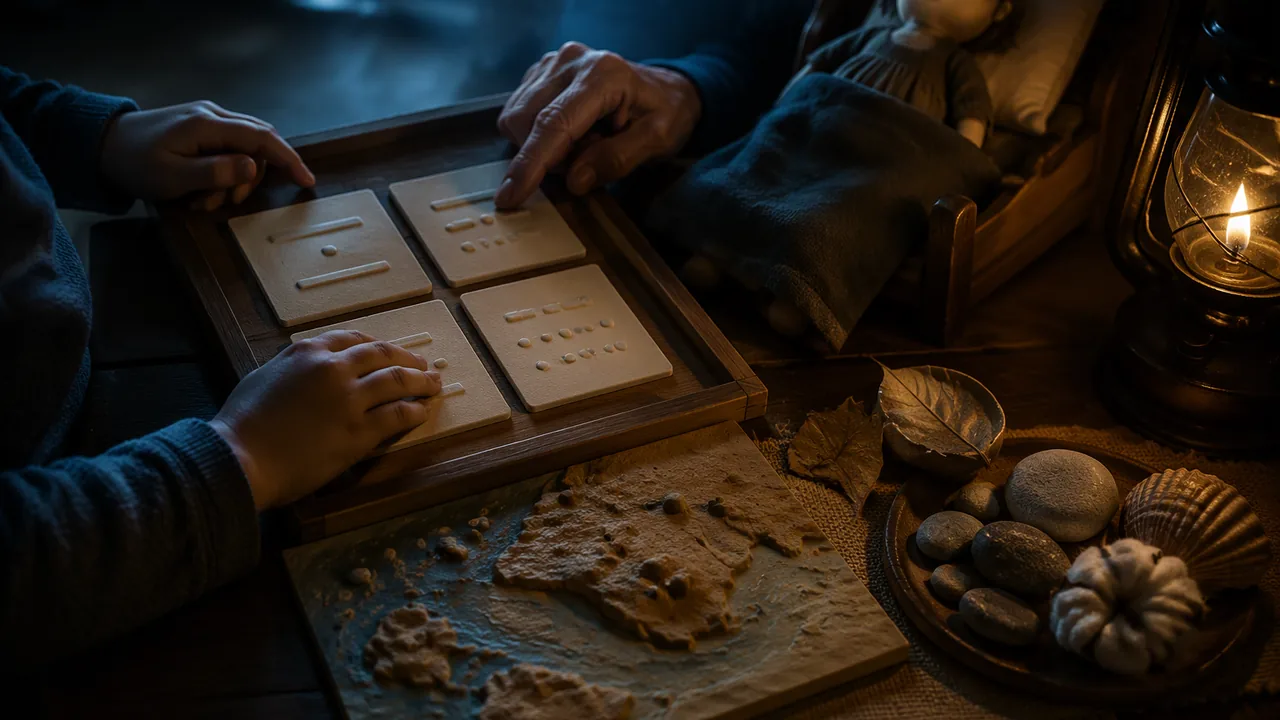
1. A signpost, then a method. Chapter 7 opens with a paragraph only one sentence long: “The next important step in my education was learning to read.” A short paragraph like this works as a signpost; it tells you a new stage begins. Keller then describes the method. Sullivan gave her slips of cardboard printed with raised words, and before Keller arranged sentences in a frame she made them out of things, laying the slips for “doll,” “is,” “on” and “bed” beside her doll on the bed. Notice what this paragraph claims without stating it: a sentence was, for her, first an arrangement of real objects and only later an arrangement of words.
2. Lists as evidence. Keller insists, “For a long time I had no regular lessons.” She learned in the woods, in the orchard and on the riverbank at Keller’s Landing, where she built dams and islands of pebbles, and she felt raised maps that Sullivan made in clay. The long catalog of sensations in this chapter, from the “bursting cotton-bolls” to “the spicy, clovery smell” of her pony’s breath, is not decoration. It is evidence for a claim: that she learned through every sense she had, and that study seemed “more like play than work.” When a writer develops a claim through a list, ask what the items have in common and why there are so many.
3. Analogy as argument. Twice in this chapter Keller builds a paragraph on an extended comparison. Sullivan reads her “The Chambered Nautilus” and shows her that the mollusk’s shell-building is “symbolical of the development of the mind”: as the nautilus turns what it absorbs into its shell, “the bits of knowledge one gathers undergo a similar change and become pearls of thought.” Later Keller compares a child’s mind to “a shallow brook” that must be fed by mountain streams and hidden springs until it becomes “a deep river.” An analogy explains something unfamiliar through something familiar, and when a whole paragraph rests on one, the analogy carries the claim. Ask what each analogy says about where knowledge comes from and who supplies it.
4. Whose achievement is it? The chapter ends by refining its central claim in a direction that may surprise you. “At the beginning I was only a little mass of possibilities,” Keller writes. “It was my teacher who unfolded and developed them.” The final paragraph goes further still: “All the best of me belongs to her.” Read these sentences carefully. Keller, a college student when she wrote them, gives nearly all the credit for her education to Sullivan. Is that gratitude, modesty, an accurate account, or all three? The editor’s account at the back of the book, which you will meet in Lesson 4.7, offers another view of the same partnership.
5. The chapters around it. The shorter chapters test the same idea in new settings. In Chapter 5 a storm catches Keller alone in a tree, and she learns that nature can frighten as well as delight. In Chapter 6 she grasps her first abstract word, “think,” and uses it to puzzle out “love.” In Chapter 9, at the Perkins Institution, she meets children who can spell into her hand and says that until then she had been “like a foreigner speaking through an interpreter.” Each chapter adds a new kind of learning: about danger, about ideas, and about belonging to a community that shares her language.
As you read, mark one paragraph in Chapter 7 that develops a claim through a list of concrete details, one that develops a claim through an analogy, and one sentence in which Keller credits her teacher. You will use them in the final task.
📖 Before this lesson, read: The Story of My Life, Chapters 5-10
The reading opens over the lesson; close it to come back to exactly where you were.
Formative check
Work through these before moving on. They are not graded — they tell you whether the standard below has landed yet.
Chapter 7 begins with a one-sentence paragraph: “The next important step in my education was learning to read.” Before reading on, what kind of chapter does it prepare you for?
What claim does Keller make through the chambered nautilus?
At the end of Chapter 7, Keller claims most of the credit for her own education and says her teacher played a small part.
An extended comparison that carries a claim, like Keller’s brook that becomes a river, is an ; a one-sentence paragraph that announces a new stage, like the opening of Chapter 7, works as a .
Choose one paragraph from Chapter 7: the object sentences, the outdoor lessons, the nautilus, or the brook. Quote one sentence from it, and explain in four or five sentences how that paragraph develops or refines Keller’s claim about how she learned. End with one sentence on whether the chapter’s last paragraph, which gives her teacher “All the best of me,” changes how you read the paragraph you chose.
The Story of My Life, Chapters 5-10
The Story of My Life, Part I, Chapter 5 Bridge summary — not the primary text
This is a short recap written for this course, not Helen Keller’s own words, so you can follow the story between close-reading lessons.
{summary}The Story of My Life, Part I, Chapter 6 Bridge summary — not the primary text
This is a short recap written for this course, not Helen Keller’s own words, so you can follow the story between close-reading lessons.
{summary}The Story of My Life, Part I, Chapter 7
Source: Helen Keller, The Story of My Life (New York: Doubleday, Page, 1903), Project Gutenberg eBook #2397 (gutenberg.org) · Public domain
The next important step in my education was learning to read.
As soon as I could spell a few words my teacher gave me slips of cardboard on which were printed words in raised letters. I quickly learned that each printed word stood for an object, an act, or a quality. I had a frame in which I could arrange the words in little sentences; but before I ever put sentences in the frame I used to make them in objects. I found the slips of paper which represented, for example, “doll,” “is,” “on,” “bed” and placed each name on its object; then I put my doll on the bed with the words is, on, bed arranged beside the doll, thus making a sentence of the words, and at the same time carrying out the idea of the sentence with the things themselves.
One day, Miss Sullivan tells me, I pinned the word girl on my pinafore and stood in the wardrobe. On the shelf I arranged the words, is, in, wardrobe. Nothing delighted me so much as this game. My teacher and I played it for hours at a time. Often everything in the room was arranged in object sentences.
From the printed slip it was but a step to the printed book. I took my “Reader for Beginners” and hunted for the words I knew; when I found them my joy was like that of a game of hide-and-seek. Thus I began to read. Of the time when I began to read connected stories I shall speak later.
For a long time I had no regular lessons. Even when I studied most earnestly it seemed more like play than work. Everything Miss Sullivan taught me she illustrated by a beautiful story or a poem. Whenever anything delighted or interested me she talked it over with me just as if she were a little girl herself. What many children think of with dread, as a painful plodding through grammar, hard sums and harder definitions, is to-day one of my most precious memories.
I cannot explain the peculiar sympathy Miss Sullivan had with my pleasures and desires. Perhaps it was the result of long association with the blind. Added to this she had a wonderful faculty for description. She went quickly over uninteresting details, and never nagged me with questions to see if I remembered the day-before-yesterday’s lesson. She introduced dry technicalities of science little by little, making every subject so real that I could not help remembering what she taught.
We read and studied out of doors, preferring the sunlit woods to the house. All my early lessons have in them the breath of the woods–the fine, resinous odour of pine needles, blended with the perfume of wild grapes. Seated in the gracious shade of a wild tulip tree, I learned to think that everything has a lesson and a suggestion. “The loveliness of things taught me all their use.” Indeed, everything that could hum, or buzz, or sing, or bloom had a part in my education–noisy-throated frogs, katydids and crickets held in my hand until forgetting their embarrassment, they trilled their reedy note, little downy chickens and wildflowers, the dogwood blossoms, meadow-violets and budding fruit trees. I felt the bursting cotton-bolls and fingered their soft fiber and fuzzy seeds; I felt the low soughing of the wind through the cornstalks, the silky rustling of the long leaves, and the indignant snort of my pony, as we caught him in the pasture and put the bit in his mouth–ah me! how well I remember the spicy, clovery smell of his breath!
Sometimes I rose at dawn and stole into the garden while the heavy dew lay on the grass and flowers. Few know what joy it is to feel the roses pressing softly into the hand, or the beautiful motion of the lilies as they sway in the morning breeze. Sometimes I caught an insect in the flower I was plucking, and I felt the faint noise of a pair of wings rubbed together in a sudden terror, as the little creature became aware of a pressure from without.
Another favourite haunt of mine was the orchard, where the fruit ripened early in July. The large, downy peaches would reach themselves into my hand, and as the joyous breezes flew about the trees the apples tumbled at my feet. Oh, the delight with which I gathered up the fruit in my pinafore, pressed my face against the smooth cheeks of the apples, still warm from the sun, and skipped back to the house!
Our favourite walk was to Keller’s Landing, an old tumbledown lumber-wharf on the Tennessee River, used during the Civil War to land soldiers. There we spent many happy hours and played at learning geography. I built dams of pebbles, made islands and lakes, and dug river-beds, all for fun, and never dreamed that I was learning a lesson. I listened with increasing wonder to Miss Sullivan’s descriptions of the great round world with its burning mountains, buried cities, moving rivers of ice, and many other things as strange. She made raised maps in clay, so that I could feel the mountain ridges and valleys, and follow with my fingers the devious course of rivers. I liked this, too; but the division of the earth into zones and poles confused and teased my mind. The illustrative strings and the orange stick representing the poles seemed so real that even to this day the mere mention of temperate zone suggests a series of twine circles; and I believe that if any one should set about it he could convince me that white bears actually climb the North Pole.
Arithmetic seems to have been the only study I did not like. From the first I was not interested in the science of numbers. Miss Sullivan tried to teach me to count by stringing beads in groups, and by arranging kintergarten straws I learned to add and subtract. I never had patience to arrange more than five or six groups at a time. When I had accomplished this my conscience was at rest for the day, and I went out quickly to find my playmates.
In this same leisurely manner I studied zoology and botany.
Once a gentleman, whose name I have forgotten, sent me a collection of fossils–tiny mollusk shells beautifully marked, and bits of sandstone with the print of birds’ claws, and a lovely fern in bas-relief. These were the keys which unlocked the treasures of the antediluvian world for me. With trembling fingers I listened to Miss Sullivan’s descriptions of the terrible beasts, with uncouth, unpronounceable names, which once went tramping through the primeval forests, tearing down the branches of gigantic trees for food, and died in the dismal swamps of an unknown age. For a long time these strange creatures haunted my dreams, and this gloomy period formed a somber background to the joyous Now, filled with sunshine and roses and echoing with the gentle beat of my pony’s hoof.
Another time a beautiful shell was given me, and with a child’s surprise and delight I learned how a tiny mollusk had built the lustrous coil for his dwelling place, and how on still nights, when there is no breeze stirring the waves, the Nautilus sails on the blue waters of the Indian Ocean in his “ship of pearl.” After I had learned a great many interesting things about the life and habits of the children of the sea–how in the midst of dashing waves the little polyps build the beautiful coral isles of the Pacific, and the foraminifera have made the chalk-hills of many a land–my teacher read me “The Chambered Nautilus,” and showed me that the shell-building process of the mollusks is symbolical of the development of the mind. Just as the wonder-working mantle of the Nautilus changes the material it absorbs from the water and makes it a part of itself, so the bits of knowledge one gathers undergo a similar change and become pearls of thought.
Again, it was the growth of a plant that furnished the text for a lesson. We bought a lily and set it in a sunny window. Very soon the green, pointed buds showed signs of opening. The slender, fingerlike leaves on the outside opened slowly, reluctant, I thought, to reveal the loveliness they hid; once having made a start, however, the opening process went on rapidly, but in order and systematically. There was always one bud larger and more beautiful than the rest, which pushed her outer covering back with more pomp, as if the beauty in soft, silky robes knew that she was the lily-queen by right divine, while her more timid sisters doffed their green hoods shyly, until the whole plant was one nodding bough of loveliness and fragrance.
Once there were eleven tadpoles in a glass globe set in a window full of plants. I remember the eagerness with which I made discoveries about them. It was great fun to plunge my hand into the bowl and feel the tadpoles frisk about, and to let them slip and slide between my fingers. One day a more ambitious fellow leaped beyond the edge of the bowl and fell on the floor, where I found him to all appearance more dead than alive. The only sign of life was a slight wriggling of his tail. But no sooner had he returned to his element than he darted to the bottom, swimming round and round in joyous activity. He had made his leap, he had seen the great world, and was content to stay in his pretty glass house under the big fuchsia tree until he attained the dignity of froghood. Then he went to live in the leafy pool at the end of the garden, where he made the summer nights musical with his quaint love-song.
Thus I learned from life itself. At the beginning I was only a little mass of possibilities. It was my teacher who unfolded and developed them. When she came, everything about me breathed of love and joy and was full of meaning. She has never since let pass an opportunity to point out the beauty that is in everything, nor has she ceased trying in thought and action and example to make my life sweet and useful.
It was my teacher’s genius, her quick sympathy, her loving tact which made the first years of my education so beautiful. It was because she seized the right moment to impart knowledge that made it so pleasant and acceptable to me. She realized that a child’s mind is like a shallow brook which ripples and dances merrily over the stony course of its education and reflects here a flower, there a bush, yonder a fleecy cloud; and she attempted to guide my mind on its way, knowing that like a brook it should be fed by mountain streams and hidden springs, until it broadened out into a deep river, capable of reflecting in its placid surface, billowy hills, the luminous shadows of trees and the blue heavens, as well as the sweet face of a little flower.
Any teacher can take a child to the classroom, but not every teacher can make him learn. He will not work joyously unless he feels that liberty is his, whether he is busy or at rest; he must feel the flush of victory and the heart-sinking of disappointment before he takes with a will the tasks distasteful to him and resolves to dance his way bravely through a dull routine of textbooks.
My teacher is so near to me that I scarcely think of myself apart from her. How much of my delight in all beautiful things is innate, and how much is due to her influence, I can never tell. I feel that her being is inseparable from my own, and that the footsteps of my life are in hers. All the best of me belongs to her–there is not a talent, or an aspiration or a joy in me that has not been awakened by her loving touch.
The Story of My Life, Part I, Chapter 8 Bridge summary — not the primary text
This is a short recap written for this course, not Helen Keller’s own words, so you can follow the story between close-reading lessons.
{summary}The Story of My Life, Part I, Chapter 9 Bridge summary — not the primary text
This is a short recap written for this course, not Helen Keller’s own words, so you can follow the story between close-reading lessons.
{summary}The Story of My Life, Part I, Chapter 10 Bridge summary — not the primary text
This is a short recap written for this course, not Helen Keller’s own words, so you can follow the story between close-reading lessons.
{summary}