interpret figures of speech in context and analyze their role in the play, and distinguish nuances in the meaning of words with similar denotations.
Instruction
Julius Caesar is a play about persuasion, and its figures of speech are weapons. This lab teaches you to interpret figures in context and analyze what they do (9-10.RL.1.B / 9-10.RL.2.C).
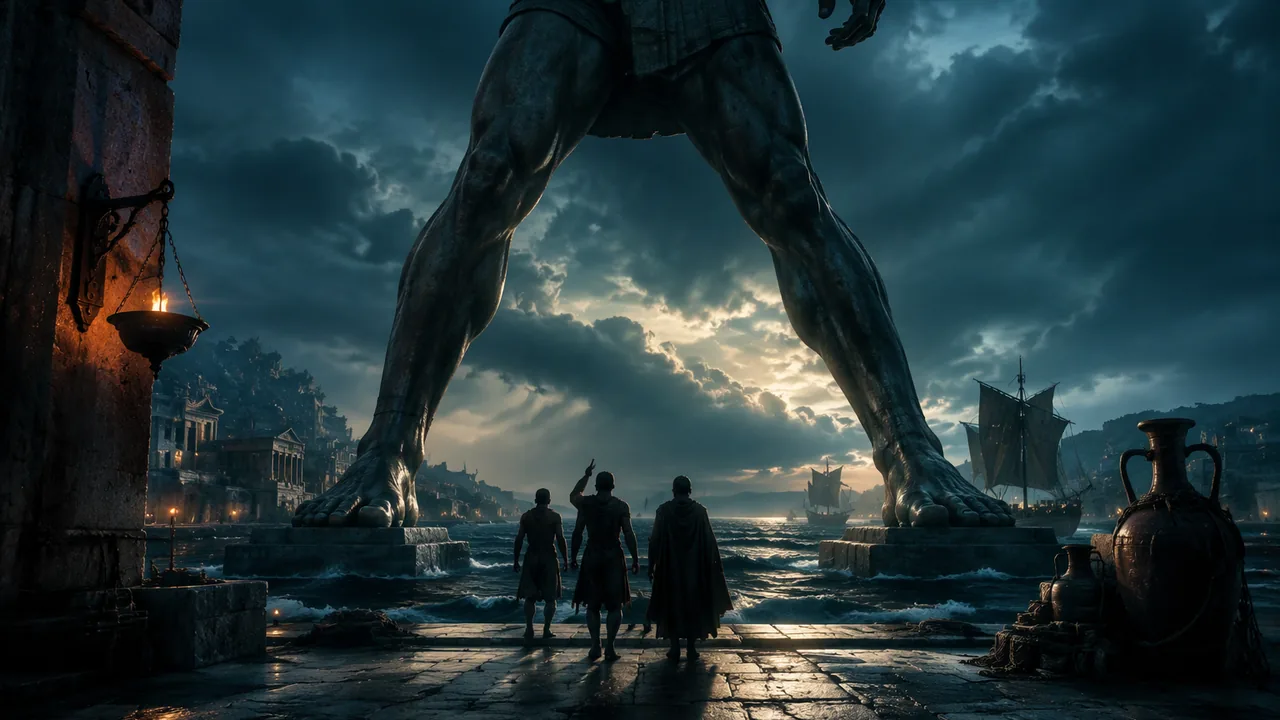
Metaphor and hyperbole: the Colossus. Cassius tells Brutus that Caesar “doth bestride the narrow world / Like a Colossus, and we petty men / Walk under his huge legs.” The Colossus of Rhodes was a giant bronze statue said to stand astride a harbor. The simile shrinks the world (“narrow”) and the Romans (“petty men”), and enlarges Caesar to a monster. Its purpose is not description but provocation: it is designed to make Brutus feel small. Notice what Cassius does not say — that Caesar has done anything wrong.
Symbol and pathetic fallacy: the storm. On the night before the ides, a storm rages; Casca reports a lion in the Capitol and men walking in fire. Nature seems to reflect the disorder in the state. Different characters read the storm differently: Casca sees a warning from the gods; Cassius claims it points to Caesar’s tyranny. The same sign is interpreted to fit each speaker’s argument, and Cicero names the danger: “men may construe things after their fashion, / Clean from the purpose of the things themselves.” Act 2 does the same with Calphurnia’s dream, which she reads as a warning and Decius reads as a promise.
Irony: words that mean more than the speaker knows. Verbal irony is saying one thing to mean another. Decius explains how he will manage Caesar: “when I tell him he hates flatterers, / He says he does, being then most flattered.” The compliment that Caesar hates flattery is itself the flattery. Dramatic irony is different: the speaker means exactly what he says, and the audience hears more. On the morning of the Ides, Caesar welcomes the men who have come to kill him: “Good friends, go in, and taste some wine with me; / And we, like friends, will straightway go together.” Caesar is sincere; the irony belongs to the situation. Brutus’s aside confirms it: “That every like is not the same, O Caesar, / The heart of Brutus yearns to think upon.” To be like friends is not to be friends.
Nuance in word meaning (9-10.RL.1.B / 9-10.RL.2.C). Words with similar denotations carry different connotations, and Brutus knows it. Arguing to spare Antony, he sets near-synonyms against each other: “Let us be sacrificers, but not butchers, Caius”; “Let’s carve him as a dish fit for the gods, / Not hew him as a carcass fit for hounds”; “We shall be call’d purgers, not murderers.” In each pair the act is the same, killing with a blade, and the word decides its meaning. Brutus is choosing the vocabulary in which Rome will remember the deed. Other words to watch: ambition (a flaw or a virtue?), honor, bondman, liberty.
Why this matters. 9-10.RL.1.B / 9-10.RL.2.C asks for the cumulative impact of word choices on meaning and tone. In this play, the fight over words is the fight over power. Whoever makes Rome accept their word for an act controls what the act means.
Building vocabulary (9-10.RI.1.B). Add to your academic vocabulary: simile, metaphor, hyperbole, symbol, verbal irony, dramatic irony, connotation, denotation. In your log, use each term precisely at least once.
📖 Before this lesson, read: Julius Caesar, Acts 1-2
The reading opens over the lesson; close it to come back to exactly where you were.
Reading: Figures of speech in Julius Caesar, Acts 1-2: eight passages and a worked key
William Shakespeare, The Tragedy of Julius Caesar (c. 1599), public-domain text, Project Gutenberg eBook #1522 (PG Shakespeare Team), https://www.gutenberg.org/ebooks/1522, retrieved 2026-09-26. Line numbers were counted by SLS from this text (verse lines; a line shared between two speakers counts once). · SLS original; quoted passages are public domain (William Shakespeare, Julius Caesar, c. 1599)
Passages copied by script and checked verbatim against the Gutenberg text. Definitions, key and practice are SLS original.
This lab works from eight real passages, lettered A to H, drawn from Acts 1 and 2, the part of the play you have read. Four entries are worked for you in the key so you can see the reasoning; you will log six figures from at least three different scenes, and the unworked passages are yours to use. Everything under “SLS original” is written for this course.
The bank of passages
A. Cassius to Brutus (1.2.133-139).
[Cassius.] Why, man, he doth bestride the narrow world
Like a Colossus, and we petty men
135 Walk under his huge legs, and peep about
To find ourselves dishonourable graves.
Men at some time are masters of their fates:
The fault, dear Brutus, is not in our stars,
But in ourselves, that we are underlings.
B. Casca describes the night of the storm (1.3.5-13).
[Casca.] 5 I have seen tempests, when the scolding winds
Have riv’d the knotty oaks; and I have seen
Th’ ambitious ocean swell and rage and foam,
To be exalted with the threatening clouds:
But never till tonight, never till now,
10 Did I go through a tempest dropping fire.
Either there is a civil strife in heaven,
Or else the world too saucy with the gods,
Incenses them to send destruction.
C. Brutus on ambition (2.1.22-27).
[Brutus.] That lowliness is young ambition’s ladder,
Whereto the climber-upward turns his face;
But when he once attains the upmost round,
25 He then unto the ladder turns his back,
Looks in the clouds, scorning the base degrees
By which he did ascend. So Caesar may;
D. Brutus on the sacrifice (2.1.163-171).
[Brutus.] Let us be sacrificers, but not butchers, Caius.
We all stand up against the spirit of Caesar,
165 And in the spirit of men there is no blood.
O, that we then could come by Caesar’s spirit,
And not dismember Caesar! But, alas,
Caesar must bleed for it! And, gentle friends,
Let’s kill him boldly, but not wrathfully;
170 Let’s carve him as a dish fit for the gods,
Not hew him as a carcass fit for hounds.
E. Flavius, after the crowd leaves (1.1).
[Flavius.] These growing feathers pluck’d from Caesar’s wing
Will make him fly an ordinary pitch,
Who else would soar above the view of men,
And keep us all in servile fearfulness.
F. Caesar to Antony (1.2).
[Caesar.] Let me have men about me that are fat,
Sleek-headed men, and such as sleep a-nights:
Yond Cassius has a lean and hungry look;
He thinks too much: such men are dangerous.
G. Calphurnia and Caesar on the omens (2.2).
[Calphurnia.] When beggars die, there are no comets seen;
The heavens themselves blaze forth the death of princes.[Caesar.] Cowards die many times before their deaths;
The valiant never taste of death but once.
H. Caesar greets the conspirators, and Brutus answers aside (2.2).
[Caesar.] Good friends, go in, and taste some wine with me;
And we, like friends, will straightway go together.[Brutus.] [Aside.] That every like is not the same, O Caesar,
The heart of Brutus yearns to think upon.
About the numbers. The small numbers in the passages are line numbers counted in this hosted text, marked every fifth line. Printed editions differ from one another by a few lines, so a citation in another edition may be a line or several off from the numbers here. Cite from the numbers printed in these readings, and name this text in your Works Cited. Passages printed without line numbers are cited by act and scene.
The five figures to recognize (SLS original definitions)
- Simile and metaphor: a simile compares with “like” or “as”; a metaphor says one thing is another.
- Hyperbole: deliberate exaggeration for effect.
- Pathetic fallacy: giving weather or nature a feeling or a purpose that matches the human events.
- Verbal irony: saying one thing while meaning something different, so that the surface praise carries an attack.
- Dramatic irony: the speaker means what he says, but the audience knows something that gives the words a second meaning.
Worked key (SLS original)
Entry for A: the Colossus. Quotation: “he doth bestride the narrow world” and “Like a Colossus”. Figure: simile, with hyperbole in “narrow world.” Interpretation in context: Cassius is speaking to Brutus, whom he wants to move. Caesar is not literally a statue, and the world is not literally narrow; the exaggeration makes every other Roman look small. Role: the figure does not report anything Caesar has done. It works on Brutus’s pride, and that is why the speech goes on at once to the name: “Brutus” and “Caesar” weigh the same.
Entry for B: the storm. Quotation: “tempest dropping fire”. Figure: pathetic fallacy, with a metaphor of civil war among the gods: “a civil strife in heaven”. Interpretation in context: Casca is frightened, and he reads the weather as a message about Rome. Role: it makes the political danger feel cosmic before anything has happened. Note that the storm is only a sign; other characters in the play read it differently, so the figure shows the speaker as much as the sky.
Entry for H: the morning wine. Quotation: “we, like friends, will straightway go together”. Figure: dramatic irony, sharpened by Brutus’s aside on the word “like”. Interpretation in context: Caesar means every word; he is being a gracious host to men he trusts. The audience knows that the men around him are going to the Capitol to kill him. Role: the irony does not belong to Caesar, it belongs to the situation, and Brutus’s aside turns it into a confession: to be like friends is not the same as being friends, and Brutus feels the difference.
Entry for D: the nuance of three pairs. Brutus asks for “sacrificers” and not “butchers”, for men who “carve” and do not “hew”, for “purgers” and not “murderers”. The denotation of each pair is nearly the same: people who kill with a blade. The connotation is opposite. Sacrificer suggests a solemn, permitted act done for a good outcome; butcher suggests bloody carelessness and a victim who is only meat. Role: Brutus is choosing in advance the words in which Rome will remember the killing, because he knows the same act can be named either way.
Practice with a key (SLS original)
Try each on your own, then read the key.
- In passage C, Brutus says “lowliness is young ambition’s ladder”. Name the figure and say what it claims about ambition.
- Replace butchers in D with killers. What is lost?
- Is “These growing feathers pluck’d from Caesar’s wing” (E) a literal statement? Name the figure.
Key. (1) Metaphor: ambition is a ladder that a climber uses, then turns his back on once he reaches the top. It claims that ambition hides itself while rising. (2) Killers is neutral and drops the blood and the contempt. Brutus’s contrast only works if the word he rejects is ugly, because he wants his friends to fear looking like butchers more than they fear being called killers. (3) No: it is a metaphor. Caesar is a bird of prey, and the honors and supporters around him are the feathers that let him fly high; pull them out and he will “fly an ordinary pitch”. It claims that Caesar’s height depends on what others give him.
Your log: a model row (SLS original)
Use these columns for each of your six entries: act, scene and lines; quotation; figure; meaning in context; role for this speaker. Then write one paragraph on a near-synonym pair, using the D entry above as your pattern. Use each of these terms precisely at least once: simile, metaphor, hyperbole, symbol, verbal irony, dramatic irony, connotation, denotation.
Formative check
Work through these before moving on. They are not graded — they tell you whether the standard below has landed yet.
What is the main purpose of Cassius’s Colossus simile?
When Caesar tells the conspirators, “we, like friends, will straightway go together,” he is being deliberately ironic.
Brutus asks the conspirators to be , not butchers, and hopes they will be called , not murderers; when the audience knows more than the speaker, the irony is .
Log six figures of speech from Acts 1 and 2, drawn from at least three different scenes. For each: quote it, name the figure, interpret it in context, and state its role, meaning what it does for the speaker’s purpose. Then choose one pair of near-synonyms (sacrificers/butchers, carve/hew or purgers/murderers) and explain how the play uses the difference.
How confident are you that you can interpret a figure of speech in context and explain what it does for the speaker?
Julius Caesar, Acts 1-2
Julius Caesar, Acts 1-2 so far Bridge summary — not the primary text
A recap of what you have already read, written for this course, so the reading check below does not require re-opening every earlier popover.
In Act 1, the tribunes scold Rome’s commoners for celebrating Caesar’s triumph over Pompey; a soothsayer warns Caesar to beware the Ides of March; and while offstage shouts greet the crown Caesar refuses three times, Cassius works on Brutus’s pride and his fear of a king. On a night of storms and omens, Cassius recruits Casca and arranges for papers to reach Brutus. In Act 2, Brutus decides alone in his orchard that Caesar must die, takes charge of the conspirators, refuses to kill Antony with Caesar, and promises to tell Portia his secret. Decius talks Caesar out of Calphurnia’s warning dream, and Caesar sets out for the Capitol among the men who plan to kill him, while Artemidorus waits with a written warning and Portia struggles to keep the secret.