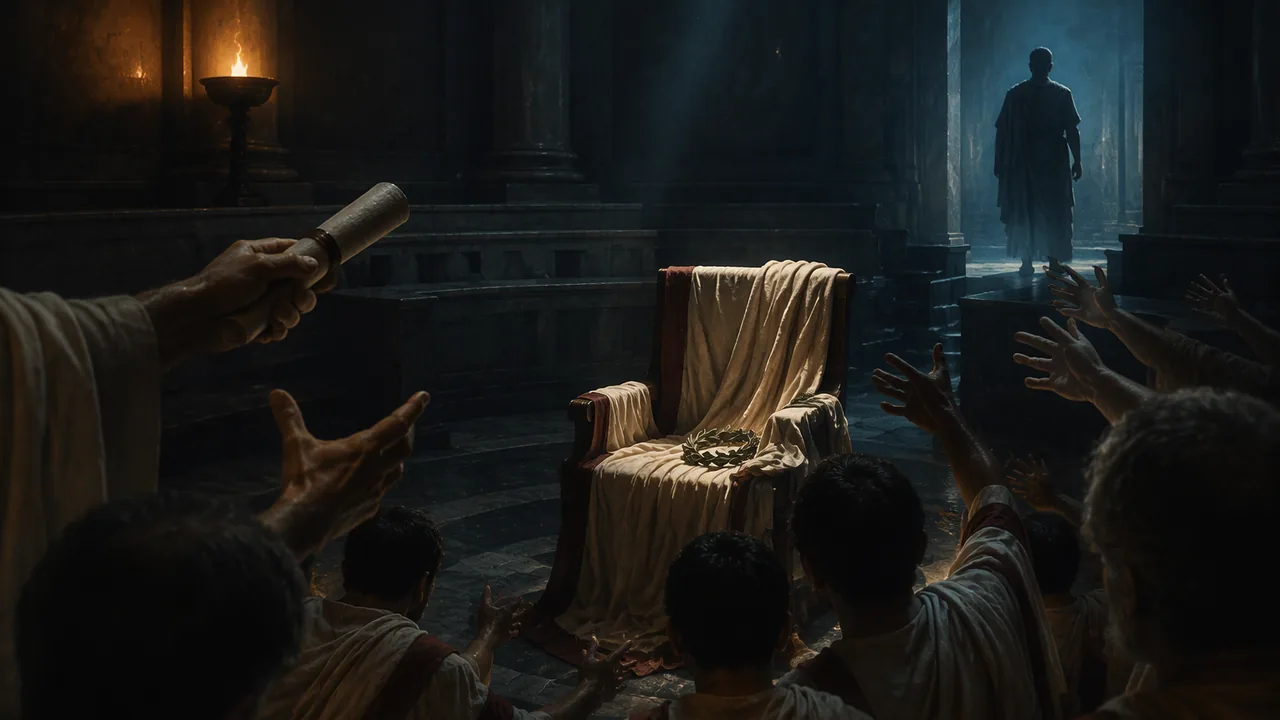
explain how Shakespeare builds the assassination scene as the play’s hinge, from the near misses before the killing to Antony’s soliloquy after it, and judge how two different stagings of the killing would change its meaning.
Instruction
Act 3, scene 1 is the hinge of the play. In one scene Caesar is warned, killed and mourned, the conspirators declare Rome free, and Brutus makes the decision that will undo what they have done. Read it as two movements: the killing, and what the killers do with it.
Near misses. The scene opens with Caesar’s jibe at the soothsayer, “The Ides of March are come,” and the reply, “Ay, Caesar; but not gone.” Artemidorus presses his warning on Caesar, and Caesar refuses to read it first because it concerns himself: “What touches us ourself shall be last serv’d.” Then Popilius wishes Cassius well in his “enterprise” and walks over to Caesar, and Cassius panics, ready to kill himself if the plot is discovered. Shakespeare stretches these moments because the audience knows what is coming. The suspense is not about what will happen but about whether something will stop it.
The last speech. Metellus Cimber kneels to beg for his banished brother, and the others join him one by one, Brutus kissing Caesar’s hand “but not in flattery.” Caesar refuses them all in his grandest verse: “I am constant as the northern star, / Of whose true-fix’d and resting quality / There is no fellow in the firmament.” He claims to be the one man “Unshak’d of motion.” The placement is the point. Shakespeare gives Caesar his most godlike claim moments before he is stabbed, so that the boast and the fall arrive together. Casca strikes first, with words that hand speech over to violence: “Speak, hands, for me!” Caesar’s last words, “Et tu, Brute?—Then fall, Caesar!”, suggest that it is the sight of Brutus, more than the wounds, that ends him.
The ritual. The conspirators do not run. Brutus tells the senators that “ambition’s debt is paid,” then asks the others to “bathe our hands in Caesar’s blood / Up to the elbows” and walk to the marketplace crying “Peace, freedom, and liberty!” Remember Calphurnia’s dream as Caesar told it: his statue ran blood, and “many lusty Romans / Came smiling, and did bathe their hands in it.” Decius called the dream lucky; now it has come true in the plainest way. Cassius even imagines the scene performed in the future: “How many ages hence / Shall this our lofty scene be acted over / In States unborn, and accents yet unknown!” The line is spoken by an actor on a stage, which makes every audience part of the prophecy.
Antony. Antony sends a servant ahead to promise loyalty if Brutus will give him reasons, then arrives, sees the body, and offers his own life. He shakes each bloody hand by name and admits that the conspirators must now think him “Either a coward or a flatterer.” When he asks to speak at the funeral, Brutus answers at once, “You shall, Mark Antony,” and Cassius warns him aside, “You know not what you do.” Brutus believes that speaking first, and setting conditions, will be enough.
Alone with the body. As soon as the conspirators leave, Antony’s language changes completely: “O, pardon me, thou bleeding piece of earth, / That I am meek and gentle with these butchers.” Brutus wanted the killers to be “sacrificers, but not butchers”; Antony gives them the other word. He prophesies civil war, ending with Caesar’s spirit crying “havoc” to “let slip the dogs of war.” Then, practical again, he tells a servant of young Octavius that Rome is not yet safe for his master, and that he will test the people in his funeral speech.
Staging the killing. The script says only that Casca stabs Caesar in the neck, that the others stab him, and that Brutus strikes last. Everything else is a production’s decision. A fast, chaotic killing makes the conspirators look like a mob, the thing Brutus feared. A slow, almost ceremonial one, with Brutus’s blow held apart from the rest, makes it the sacrifice he wanted. Neither choice is neutral, and each changes how an audience hears Antony’s word “butchers” a few minutes later.
📖 Before this lesson, read: Julius Caesar, Act 3, Scene 1
The reading opens over the lesson; close it to come back to exactly where you were.
Formative check
Work through these before moving on. They are not graded — they tell you whether the standard below has landed yet.
Why does Shakespeare give Caesar the “northern star” speech immediately before the stabbing?
Cassius urges Brutus to let Antony speak at Caesar’s funeral.
Brutus wanted to be a sacrificer; alone with the body, Antony calls the conspirators , and prophesies that Caesar’s spirit will “let slip the of war.”
Describe two contrasting stagings of the killing and the blood ritual, from “Speak, hands, for me!” to “Peace, freedom, and liberty!” For each, say how fast the stabbing is, how Brutus’s blow is staged, and how the conspirators wash in the blood, and say what each staging emphasizes and what it leaves out. Then argue which staging the text supports better, quoting at least two lines, and explain how your choice changes the effect of Antony’s word “butchers” at the end of the scene. Finish with one sentence naming the moment in the scene that you think cannot be undone.
How confident are you that you can explain how a scene’s structure makes it the turning point of a play, and how staging choices change its meaning?
Julius Caesar, Act 3, Scene 1
Julius Caesar, Act 3, Scene 1: Rome. Before the Capitol; the Senate sitting.
Source: William Shakespeare, The Tragedy of Julius Caesar (c. 1599), Project Gutenberg eBook #1522 (gutenberg.org) · Public domain
A crowd of people in the street leading to the Capitol. Flourish. Enter Caesar, Brutus, Cassius, Casca, Decius, Metellus, Trebonius, Cinna, Antony, Lepidus, Artemidorus, Publius, Popilius and the Soothsayer.
CAESAR.
The Ides of March are come.
SOOTHSAYER.
Ay, Caesar; but not gone.
ARTEMIDORUS.
Hail, Caesar! Read this schedule.
DECIUS.
Trebonius doth desire you to o’er-read,
At your best leisure, this his humble suit.
ARTEMIDORUS.
O Caesar, read mine first; for mine’s a suit
That touches Caesar nearer. Read it, great Caesar.
CAESAR.
What touches us ourself shall be last serv’d.
ARTEMIDORUS.
Delay not, Caesar. Read it instantly.
CAESAR.
What, is the fellow mad?
PUBLIUS.
Sirrah, give place.
CASSIUS.
What, urge you your petitions in the street?
Come to the Capitol.
Caesar enters the Capitol, the rest following. All the Senators rise.
POPILIUS.
I wish your enterprise today may thrive.
CASSIUS.
What enterprise, Popilius?
POPILIUS.
Fare you well.
[Advances to Caesar.]
BRUTUS.
What said Popilius Lena?
CASSIUS.
He wish’d today our enterprise might thrive.
I fear our purpose is discovered.
BRUTUS.
Look how he makes to Caesar: mark him.
CASSIUS.
Casca, be sudden, for we fear prevention.
Brutus, what shall be done? If this be known,
Cassius or Caesar never shall turn back,
For I will slay myself.
BRUTUS.
Cassius, be constant:
Popilius Lena speaks not of our purposes;
For look, he smiles, and Caesar doth not change.
CASSIUS.
Trebonius knows his time, for look you, Brutus,
He draws Mark Antony out of the way.
[_Exeunt Antony and Trebonius. Caesar and the Senators take their seats._]
DECIUS.
Where is Metellus Cimber? Let him go,
And presently prefer his suit to Caesar.
BRUTUS.
He is address’d; press near and second him.
CINNA.
Casca, you are the first that rears your hand.
CAESAR.
Are we all ready? What is now amiss
That Caesar and his Senate must redress?
METELLUS.
Most high, most mighty, and most puissant Caesar,
Metellus Cimber throws before thy seat
An humble heart.
[Kneeling.]
CAESAR.
I must prevent thee, Cimber.
These couchings and these lowly courtesies
Might fire the blood of ordinary men,
And turn pre-ordinance and first decree
Into the law of children. Be not fond,
To think that Caesar bears such rebel blood
That will be thaw’d from the true quality
With that which melteth fools; I mean sweet words,
Low-crooked curtsies, and base spaniel fawning.
Thy brother by decree is banished:
If thou dost bend, and pray, and fawn for him,
I spurn thee like a cur out of my way.
Know, Caesar dost not wrong, nor without cause
Will he be satisfied.
METELLUS.
Is there no voice more worthy than my own,
To sound more sweetly in great Caesar’s ear
For the repealing of my banish’d brother?
BRUTUS.
I kiss thy hand, but not in flattery, Caesar;
Desiring thee that Publius Cimber may
Have an immediate freedom of repeal.
CAESAR.
What, Brutus?
CASSIUS.
Pardon, Caesar; Caesar, pardon:
As low as to thy foot doth Cassius fall,
To beg enfranchisement for Publius Cimber.
CAESAR.
I could be well mov’d, if I were as you;
If I could pray to move, prayers would move me:
But I am constant as the northern star,
Of whose true-fix’d and resting quality
There is no fellow in the firmament.
The skies are painted with unnumber’d sparks,
They are all fire, and every one doth shine;
But there’s but one in all doth hold his place.
So in the world; ’tis furnish’d well with men,
And men are flesh and blood, and apprehensive;
Yet in the number I do know but one
That unassailable holds on his rank,
Unshak’d of motion: and that I am he,
Let me a little show it, even in this,
That I was constant Cimber should be banish’d,
And constant do remain to keep him so.
CINNA.
O Caesar,—
CAESAR.
Hence! wilt thou lift up Olympus?
DECIUS.
Great Caesar,—
CAESAR.
Doth not Brutus bootless kneel?
CASCA.
Speak, hands, for me!
[_Casca stabs Caesar in the neck. Caesar catches hold of his arm. He is then stabbed by several other Conspirators, and at last by Marcus Brutus._]
CAESAR.
Et tu, Brute?—Then fall, Caesar!
[Dies. The Senators and People retire in confusion.]
CINNA.
Liberty! Freedom! Tyranny is dead!
Run hence, proclaim, cry it about the streets.
CASSIUS.
Some to the common pulpits and cry out,
“Liberty, freedom, and enfranchisement!”
BRUTUS.
People and Senators, be not affrighted.
Fly not; stand still; ambition’s debt is paid.
CASCA.
Go to the pulpit, Brutus.
DECIUS.
And Cassius too.
BRUTUS.
Where’s Publius?
CINNA.
Here, quite confounded with this mutiny.
METELLUS.
Stand fast together, lest some friend of Caesar’s
Should chance—
BRUTUS.
Talk not of standing. Publius, good cheer!
There is no harm intended to your person,
Nor to no Roman else. So tell them, Publius.
CASSIUS.
And leave us, Publius; lest that the people
Rushing on us, should do your age some mischief.
BRUTUS.
Do so; and let no man abide this deed
But we the doers.
Enter Trebonius.
CASSIUS.
Where’s Antony?
TREBONIUS.
Fled to his house amaz’d.
Men, wives, and children stare, cry out, and run,
As it were doomsday.
BRUTUS.
Fates, we will know your pleasures.
That we shall die, we know; ’tis but the time
And drawing days out, that men stand upon.
CASCA.
Why, he that cuts off twenty years of life
Cuts off so many years of fearing death.
BRUTUS.
Grant that, and then is death a benefit:
So are we Caesar’s friends, that have abridg’d
His time of fearing death. Stoop, Romans, stoop,
And let us bathe our hands in Caesar’s blood
Up to the elbows, and besmear our swords:
Then walk we forth, even to the market-place,
And waving our red weapons o’er our heads,
Let’s all cry, “Peace, freedom, and liberty!”
CASSIUS.
Stoop then, and wash. How many ages hence
Shall this our lofty scene be acted over
In States unborn, and accents yet unknown!
BRUTUS.
How many times shall Caesar bleed in sport,
That now on Pompey’s basis lies along,
No worthier than the dust!
CASSIUS.
So oft as that shall be,
So often shall the knot of us be call’d
The men that gave their country liberty.
DECIUS.
What, shall we forth?
CASSIUS.
Ay, every man away.
Brutus shall lead; and we will grace his heels
With the most boldest and best hearts of Rome.
Enter a Servant.
BRUTUS.
Soft, who comes here? A friend of Antony’s.
SERVANT.
Thus, Brutus, did my master bid me kneel;
Thus did Mark Antony bid me fall down;
And, being prostrate, thus he bade me say:
Brutus is noble, wise, valiant, and honest;
Caesar was mighty, bold, royal, and loving;
Say I love Brutus and I honour him;
Say I fear’d Caesar, honour’d him, and lov’d him.
If Brutus will vouchsafe that Antony
May safely come to him, and be resolv’d
How Caesar hath deserv’d to lie in death,
Mark Antony shall not love Caesar dead
So well as Brutus living; but will follow
The fortunes and affairs of noble Brutus
Thorough the hazards of this untrod state,
With all true faith. So says my master Antony.
BRUTUS.
Thy master is a wise and valiant Roman;
I never thought him worse.
Tell him, so please him come unto this place,
He shall be satisfied and, by my honour,
Depart untouch’d.
SERVANT.
I’ll fetch him presently.
[Exit.]
BRUTUS.
I know that we shall have him well to friend.
CASSIUS.
I wish we may: but yet have I a mind
That fears him much; and my misgiving still
Falls shrewdly to the purpose.
Enter Antony.
BRUTUS.
But here comes Antony. Welcome, Mark Antony.
ANTONY.
O mighty Caesar! Dost thou lie so low?
Are all thy conquests, glories, triumphs, spoils,
Shrunk to this little measure? Fare thee well.
I know not, gentlemen, what you intend,
Who else must be let blood, who else is rank:
If I myself, there is no hour so fit
As Caesar’s death’s hour; nor no instrument
Of half that worth as those your swords, made rich
With the most noble blood of all this world.
I do beseech ye, if you bear me hard,
Now, whilst your purpled hands do reek and smoke,
Fulfill your pleasure. Live a thousand years,
I shall not find myself so apt to die.
No place will please me so, no means of death,
As here by Caesar, and by you cut off,
The choice and master spirits of this age.
BRUTUS.
O Antony, beg not your death of us.
Though now we must appear bloody and cruel,
As by our hands and this our present act
You see we do; yet see you but our hands
And this the bleeding business they have done.
Our hearts you see not; they are pitiful;
And pity to the general wrong of Rome—
As fire drives out fire, so pity pity—
Hath done this deed on Caesar. For your part,
To you our swords have leaden points, Mark Antony;
Our arms in strength of malice, and our hearts
Of brothers’ temper, do receive you in
With all kind love, good thoughts, and reverence.
CASSIUS.
Your voice shall be as strong as any man’s
In the disposing of new dignities.
BRUTUS.
Only be patient till we have appeas’d
The multitude, beside themselves with fear,
And then we will deliver you the cause
Why I, that did love Caesar when I struck him,
Have thus proceeded.
ANTONY.
I doubt not of your wisdom.
Let each man render me his bloody hand.
First, Marcus Brutus, will I shake with you;
Next, Caius Cassius, do I take your hand.
Now, Decius Brutus, yours; now yours, Metellus;
Yours, Cinna; and, my valiant Casca, yours;
Though last, not least in love, yours, good Trebonius.
Gentlemen all—alas, what shall I say?
My credit now stands on such slippery ground,
That one of two bad ways you must conceit me,
Either a coward or a flatterer.
That I did love thee, Caesar, O, ’tis true:
If then thy spirit look upon us now,
Shall it not grieve thee dearer than thy death,
To see thy Antony making his peace,
Shaking the bloody fingers of thy foes,
Most noble, in the presence of thy corse?
Had I as many eyes as thou hast wounds,
Weeping as fast as they stream forth thy blood,
It would become me better than to close
In terms of friendship with thine enemies.
Pardon me, Julius! Here wast thou bay’d, brave hart;
Here didst thou fall; and here thy hunters stand,
Sign’d in thy spoil, and crimson’d in thy lethe.
O world, thou wast the forest to this hart;
And this indeed, O world, the heart of thee.
How like a deer strucken by many princes,
Dost thou here lie!
CASSIUS.
Mark Antony,—
ANTONY.
Pardon me, Caius Cassius:
The enemies of Caesar shall say this;
Then, in a friend, it is cold modesty.
CASSIUS.
I blame you not for praising Caesar so;
But what compact mean you to have with us?
Will you be prick’d in number of our friends,
Or shall we on, and not depend on you?
ANTONY.
Therefore I took your hands; but was indeed
Sway’d from the point, by looking down on Caesar.
Friends am I with you all, and love you all,
Upon this hope, that you shall give me reasons
Why, and wherein, Caesar was dangerous.
BRUTUS.
Or else were this a savage spectacle.
Our reasons are so full of good regard
That were you, Antony, the son of Caesar,
You should be satisfied.
ANTONY.
That’s all I seek,
And am moreover suitor that I may
Produce his body to the market-place;
And in the pulpit, as becomes a friend,
Speak in the order of his funeral.
BRUTUS.
You shall, Mark Antony.
CASSIUS.
Brutus, a word with you.
[Aside to Brutus.] You know not what you do. Do not consent
That Antony speak in his funeral.
Know you how much the people may be mov’d
By that which he will utter?
BRUTUS.
[Aside to Cassius.] By your pardon:
I will myself into the pulpit first,
And show the reason of our Caesar’s death.
What Antony shall speak, I will protest
He speaks by leave and by permission;
And that we are contented Caesar shall
Have all true rights and lawful ceremonies.
It shall advantage more than do us wrong.
CASSIUS.
[Aside to Brutus.] I know not what may fall; I like it not.
BRUTUS.
Mark Antony, here, take you Caesar’s body.
You shall not in your funeral speech blame us,
But speak all good you can devise of Caesar,
And say you do’t by our permission;
Else shall you not have any hand at all
About his funeral. And you shall speak
In the same pulpit whereto I am going,
After my speech is ended.
ANTONY.
Be it so;
I do desire no more.
BRUTUS.
Prepare the body, then, and follow us.
[Exeunt all but Antony.]
ANTONY.
O, pardon me, thou bleeding piece of earth,
That I am meek and gentle with these butchers.
Thou art the ruins of the noblest man
That ever lived in the tide of times.
Woe to the hand that shed this costly blood!
Over thy wounds now do I prophesy,
Which, like dumb mouths do ope their ruby lips
To beg the voice and utterance of my tongue,
A curse shall light upon the limbs of men;
Domestic fury and fierce civil strife
Shall cumber all the parts of Italy;
Blood and destruction shall be so in use,
And dreadful objects so familiar,
That mothers shall but smile when they behold
Their infants quartered with the hands of war;
All pity chok’d with custom of fell deeds:
And Caesar’s spirit, ranging for revenge,
With Ate by his side come hot from Hell,
Shall in these confines with a monarch’s voice
Cry havoc and let slip the dogs of war,
That this foul deed shall smell above the earth
With carrion men, groaning for burial.
Enter a Servant.
You serve Octavius Caesar, do you not?
SERVANT.
I do, Mark Antony.
ANTONY.
Caesar did write for him to come to Rome.
SERVANT.
He did receive his letters, and is coming,
And bid me say to you by word of mouth,—
[Seeing the body.] O Caesar!
ANTONY.
Thy heart is big, get thee apart and weep.
Passion, I see, is catching; for mine eyes,
Seeing those beads of sorrow stand in thine,
Began to water. Is thy master coming?
SERVANT.
He lies tonight within seven leagues of Rome.
ANTONY.
Post back with speed, and tell him what hath chanc’d.
Here is a mourning Rome, a dangerous Rome,
No Rome of safety for Octavius yet.
Hie hence, and tell him so. Yet stay awhile;
Thou shalt not back till I have borne this corse
Into the market-place: there shall I try,
In my oration, how the people take
The cruel issue of these bloody men;
According to the which thou shalt discourse
To young Octavius of the state of things.
Lend me your hand.
[Exeunt with Caesar’s body.]