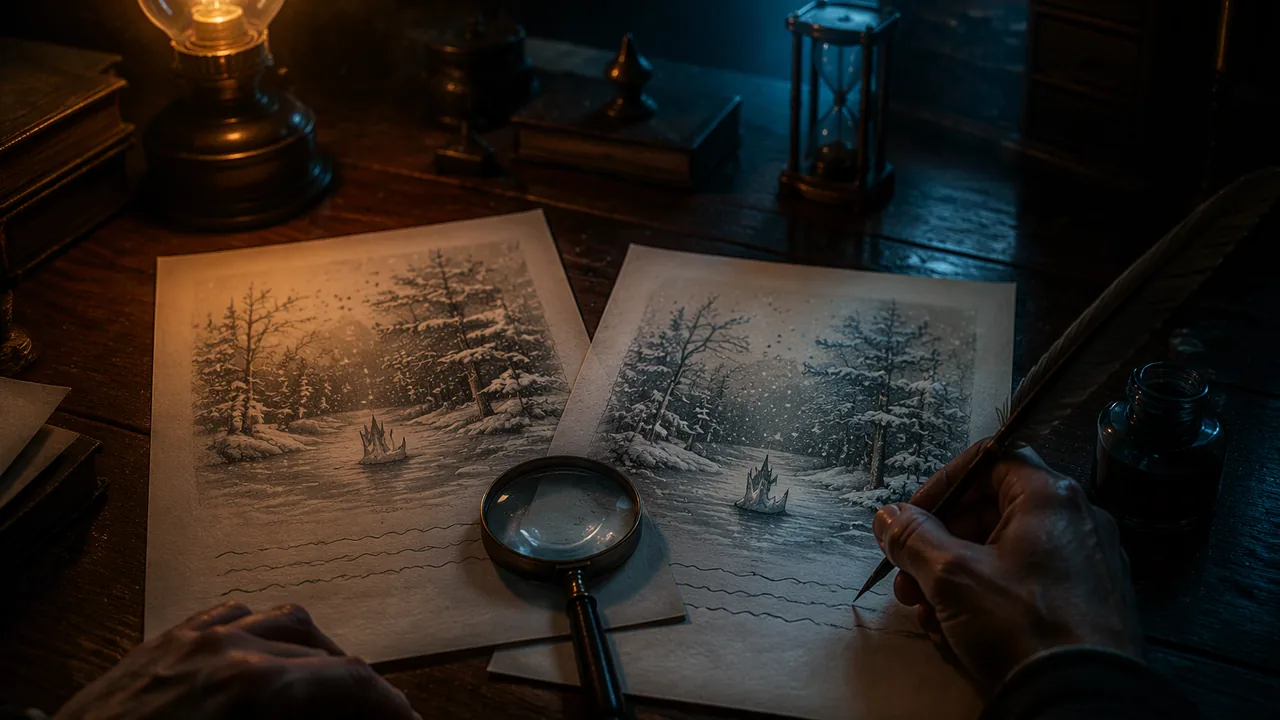
analyze how Keller presents her point of view and purpose in the “Frost King” chapter, evaluate the evidence she offers, and explain what the episode shows about the line between learning from other writers and copying them.
Instruction
Chapters 11 through 16 cover about five years, from the autumn of 1888 to the autumn of 1893. They hold some of the book’s happiest pages: the woods at Fern Quarry, a winter of deep snow, the spring of 1890 when Keller spoke her first connected sentence, “It is warm,” and a visit to the World’s Fair, where she was allowed to touch the exhibits. In the middle sits Chapter 14, which opens: “The winter of 1892 was darkened by the one cloud in my childhood’s bright sky.” It is by far the longest chapter in this stretch, and the most carefully argued.
1. What happened. At eleven, Keller wrote a story she first called “Autumn Leaves,” retitled it “The Frost King,” and sent it to Mr. Anagnos, director of the Perkins Institution, as a birthday gift. He published it. Soon it was discovered that the story closely resembled “The Frost Fairies” by Margaret T. Canby, published before Keller was born. Keller had no memory of ever hearing it. She was questioned by what she calls a “court of investigation” of teachers and officers of the Institution, with Sullivan sent from the room. Later inquiry suggested that a family friend, Mrs. Hopkins, had probably read Canby’s story to her in 1888, while Sullivan was away.
2. Point of view and purpose. Keller tells you her purpose in the first paragraph: she must “set forth the facts connected with this episode, which justice to my teacher and to myself compels me to relate.” In the last paragraph she says she has written “without a thought of defending myself or of laying blame on any one.” Hold both statements up against the chapter between them. She describes the questioning as an effort “to force me to acknowledge” a memory she did not have. She reports that Mr. Anagnos later said he had voted in her favor, and then adds that he “evidently retracted his favourable judgment, why I do not know.” A writer can present facts and still shape how a reader judges them, through what she selects, the order she gives it, and the feelings she describes. 9-10.RI.2.B asks you to name that point of view precisely.
3. Evaluating the evidence. 9-10.RI.2.D asks whether reasoning is valid and evidence sufficient. Keller’s case rests on several kinds of support: her sincere lack of memory; the inquiry Sullivan made with the help of Alexander Graham Bell; Mrs. Hopkins’s belief that Canby’s book was among those she read aloud that summer; and Keller’s own later discovery, in a letter she wrote in September 1891, of an idea “direct from Miss Canby’s story.” That last piece of evidence is striking, because Keller offers proof against her own memory. Notice, too, what she never claims: that the story was original. Her claim is narrower. She did not know she was copying.
4. Learning by imitation. The chapter then widens into an essay on how writers learn. Keller calls her early compositions “mental gymnastics” and says she learned, “as all young and inexperienced persons learn, by assimilation and imitation.” She compares her writing to “crazy patchwork” made of her own “crude notions” inlaid with “the brighter thoughts and riper opinions of the authors I have read.” Her question belongs to every writer, including you: when does reading other writers become copying them? Today the line is drawn with quotation marks and citation. Using another writer’s words or ideas without credit is plagiarism whether or not it is intended, and the safeguard is the habit Keller could not have had as a child: noting where each idea came from.
5. After the storm. The episode does not end with Chapter 14. In Chapter 15 Keller writes that she would still spell to Sullivan, “I am not sure it is mine,” and that she wrote her next piece “timidly, fearfully, but resolutely.” Chapter 14 itself closes on a hope “to outgrow my artificial, periwigged compositions.” As you read, mark the sentence where Keller’s account is most persuasive and the sentence where you would most like to hear another witness. You will hear one, Sullivan’s own account as Macy prints it in Part III, when you reach Lesson 4.7.
📖 Before this lesson, read: The Story of My Life, Chapters 11-16
The reading opens over the lesson; close it to come back to exactly where you were.
Formative check
Work through these before moving on. They are not graded — they tell you whether the standard below has landed yet.
Keller says she tells the story because “justice to my teacher and to myself compels me.” What does this reveal about her purpose?
Keller argues that “The Frost King” was entirely her own original story.
Which piece of evidence in Chapter 14 cuts against Keller’s own memory, and so makes her account more credible?
Using another writer’s words or ideas without credit is ; Keller says young writers learn by assimilation and .
Quote the sentence where you find Keller’s account most persuasive and the sentence where you would most want another witness. In five or six sentences, evaluate her account: what is her purpose, what evidence does she offer, and is it sufficient for her narrower claim that she did not knowingly copy? Close with one sentence on what the episode suggests about how any writer should handle borrowed words.
The Story of My Life, Chapters 11-16
The Story of My Life, Part I, Chapter 11 Bridge summary — not the primary text
This is a short recap written for this course, not Helen Keller’s own words, so you can follow the story between close-reading lessons.
{summary}The Story of My Life, Part I, Chapter 12 Bridge summary — not the primary text
This is a short recap written for this course, not Helen Keller’s own words, so you can follow the story between close-reading lessons.
{summary}The Story of My Life, Part I, Chapter 13 Bridge summary — not the primary text
This is a short recap written for this course, not Helen Keller’s own words, so you can follow the story between close-reading lessons.
{summary}The Story of My Life, Part I, Chapter 14
Source: Helen Keller, The Story of My Life (New York: Doubleday, Page, 1903), Project Gutenberg eBook #2397 (gutenberg.org) · Public domain
The winter of 1892 was darkened by the one cloud in my childhood’s bright sky. Joy deserted my heart, and for a long, long time I lived in doubt, anxiety and fear. Books lost their charm for me, and even now the thought of those dreadful days chills my heart. A little story called “The Frost King,” which I wrote and sent to Mr. Anagnos, of the Perkins Institution for the Blind, was at the root of the trouble. In order to make the matter clear, I must set forth the facts connected with this episode, which justice to my teacher and to myself compels me to relate.
I wrote the story when I was at home, the autumn after I had learned to speak. We had stayed up at Fern Quarry later than usual. While we were there, Miss Sullivan had described to me the beauties of the late foliage, and it seems that her descriptions revived the memory of a story, which must have been read to me, and which I must have unconsciously retained. I thought then that I was “making up a story,” as children say, and I eagerly sat down to write it before the ideas should slip from me. My thoughts flowed easily; I felt a sense of joy in the composition. Words and images came tripping to my finger ends, and as I thought out sentence after sentence, I wrote them on my braille slate. Now, if words and images come to me without effort, it is a pretty sure sign that they are not the offspring of my own mind, but stray waifs that I regretfully dismiss. At that time I eagerly absorbed everything I read without a thought of authorship, and even now I cannot be quite sure of the boundary line between my ideas and those I find in books. I suppose that is because so many of my impressions come to me through the medium of others’ eyes and ears.
When the story was finished, I read it to my teacher, and I recall now vividly the pleasure I felt in the more beautiful passages, and my annoyance at being interrupted to have the pronunciation of a word corrected. At dinner it was read to the assembled family, who were surprised that I could write so well. Some one asked me if I had read it in a book.
This question surprised me very much; for I had not the faintest recollection of having had it read to me. I spoke up and said, “Oh, no, it is my story, and I have written it for Mr. Anagnos.”
Accordingly I copied the story and sent it to him for his birthday. It was suggested that I should change the title from “Autumn Leaves” to “The Frost King,” which I did. I carried the little story to the post-office myself, feeling as if I were walking on air. I little dreamed how cruelly I should pay for that birthday gift.
Mr. Anagnos was delighted with “The Frost King,” and published it in one of the Perkins Institution reports. This was the pinnacle of my happiness, from which I was in a little while dashed to earth. I had been in Boston only a short time when it was discovered that a story similar to “The Frost King,” called “The Frost Fairies” by Miss Margaret T. Canby, had appeared before I was born in a book called “Birdie and His Friends.” The two stories were so much alike in thought and language that it was evident Miss Canby’s story had been read to me, and that mine was–a plagiarism. It was difficult to make me understand this; but when I did understand I was astonished and grieved. No child ever drank deeper of the cup of bitterness than I did. I had disgraced myself; I had brought suspicion upon those I loved best. And yet how could it possibly have happened? I racked my brain until I was weary to recall anything about the frost that I had read before I wrote “The Frost King”; but I could remember nothing, except the common reference to Jack Frost, and a poem for children, “The Freaks of the Frost,” and I knew I had not used that in my composition.
At first Mr. Anagnos, though deeply troubled, seemed to believe me. He was unusually tender and kind to me, and for a brief space the shadow lifted. To please him I tried not to be unhappy, and to make myself as pretty as possible for the celebration of Washington’s birthday, which took place very soon after I received the sad news.
I was to be Ceres in a kind of masque given by the blind girls. How well I remember the graceful draperies that enfolded me, the bright autumn leaves that wreathed my head, and the fruit and grain at my feet and in my hands, and beneath all the piety of the masque the oppressive sense of coming ill that made my heart heavy.
The night before the celebration, one of the teachers of the Institution had asked me a question connected with “The Frost King,” and I was telling her that Miss Sullivan had talked to me about Jack Frost and his wonderful works. Something I said made her think she detected in my words a confession that I did remember Miss Canby’s story of “The Frost Fairies,” and she laid her conclusions before Mr. Anagnos, although I had told her most emphatically that she was mistaken.
Mr. Anagnos, who loved me tenderly, thinking that he had been deceived, turned a deaf ear to the pleadings of love and innocence. He believed, or at least suspected, that Miss Sullivan and I had deliberately stolen the bright thoughts of another and imposed them on him to win his admiration. I was brought before a court of investigation composed of the teachers and officers of the Institution, and Miss Sullivan was asked to leave me. Then I was questioned and cross-questioned with what seemed to me a determination on the part of my judges to force me to acknowledge that I remembered having had “The Frost Fairies” read to me. I felt in every question the doubt and suspicion that was in their minds, and I felt, too, that a loved friend was looking at me reproachfully, although I could not have put all this into words. The blood pressed about my thumping heart, and I could scarcely speak, except in monosyllables. Even the consciousness that it was only a dreadful mistake did not lessen my suffering, and when at last I was allowed to leave the room, I was dazed and did not notice my teacher’s caresses, or the tender words of my friends, who said I was a brave little girl and they were proud of me.
As I lay in my bed that night, I wept as I hope few children have wept. I felt so cold, I imagined I should die before morning, and the thought comforted me. I think if this sorrow had come to me when I was older, it would have broken my spirit beyond repairing. But the angel of forgetfulness has gathered up and carried away much of the misery and all the bitterness of those sad days.
Miss Sullivan had never heard of “The Frost Fairies” or of the book in which it was published. With the assistance of Dr. Alexander Graham Bell, she investigated the matter carefully, and at last it came out that Mrs. Sophia C. Hopkins had a copy of Miss Canby’s “Birdie and His Friends” in 1888, the year that we spent the summer with her at Brewster. Mrs. Hopkins was unable to find her copy; but she has told me that at that time, while Miss Sullivan was away on a vacation, she tried to amuse me by reading from various books, and although she could not remember reading “The Frost Fairies” any more than I, yet she felt sure that “Birdie and His Friends” was one of them. She explained the disappearance of the book by the fact that she had a short time before sold her house and disposed of many juvenile books, such as old schoolbooks and fairy tales, and that “Birdie and His Friends” was probably among them.
The stories had little or no meaning for me then; but the mere spelling of the strange words was sufficient to amuse a little child who could do almost nothing to amuse herself; and although I do not recall a single circumstance connected with the reading of the stories, yet I cannot help thinking that I made a great effort to remember the words, with the intention of having my teacher explain them when she returned. One thing is certain, the language was ineffaceably stamped upon my brain, though for a long time no one knew it, least of all myself.
When Miss Sullivan came back, I did not speak to her about “The Frost Fairies,” probably because she began at once to read “Little Lord Fauntleroy,” which filled my mind to the exclusion of everything else. But the fact remains that Miss Canby’s story was read to me once, and that long after I had forgotten it, it came back to me so naturally that I never suspected that it was the child of another mind.
In my trouble I received many messages of love and sympathy. All the friends I loved best, except one, have remained my own to the present time.
Miss Canby herself wrote kindly, “Some day you will write a great story out of your own head, that will be a comfort and help to many.” But this kind prophecy has never been fulfilled. I have never played with words again for the mere pleasure of the game. Indeed, I have ever since been tortured by the fear that what I write is not my own. For a long time, when I wrote a letter, even to my mother, I was seized with a sudden feeling of terror, and I would spell the sentences over and over, to make sure that I had not read them in a book. Had it not been for the persistent encouragement of Miss Sullivan, I think I should have given up trying to write altogether.
I have read “The Frost Fairies” since, also the letters I wrote in which I used other ideas of Miss Canby’s. I find in one of them, a letter to Mr. Anagnos, dated September 29, 1891, words and sentiments exactly like those of the book. At the time I was writing “The Frost King,” and this letter, like many others, contains phrases which show that my mind was saturated with the story. I represent my teacher as saying to me of the golden autumn leaves, “Yes, they are beautiful enough to comfort us for the flight of summer”–an idea direct from Miss Canby’s story.
This habit of assimilating what pleased me and giving it out again as my own appears in much of my early correspondence and my first attempts at writing. In a composition which I wrote about the old cities of Greece and Italy, I borrowed my glowing descriptions, with variations, from sources I have forgotten. I knew Mr. Anagnos’s great love of antiquity and his enthusiastic appreciation of all beautiful sentiments about Italy and Greece. I therefore gathered from all the books I read every bit of poetry or of history that I thought would give him pleasure. Mr. Anagnos, in speaking of my composition on the cities, has said, “These ideas are poetic in their essence.” But I do not understand how he ever thought a blind and deaf child of eleven could have invented them. Yet I cannot think that because I did not originate the ideas, my little composition is therefore quite devoid of interest. It shows me that I could express my appreciation of beautiful and poetic ideas in clear and animated language.
Those early compositions were mental gymnastics. I was learning, as all young and inexperienced persons learn, by assimilation and imitation, to put ideas into words. Everything I found in books that pleased me I retained in my memory, consciously or unconsciously, and adapted it. The young writer, as Stevenson has said, instinctively tries to copy whatever seems most admirable, and he shifts his admiration with astonishing versatility. It is only after years of this sort of practice that even great men have learned to marshal the legion of words which come thronging through every byway of the mind.
I am afraid I have not yet completed this process. It is certain that I cannot always distinguish my own thoughts from those I read, because what I read becomes the very substance and texture of my mind. Consequently, in nearly all that I write, I produce something which very much resembles the crazy patchwork I used to make when I first learned to sew. This patchwork was made of all sorts of odds and ends–pretty bits of silk and velvet; but the coarse pieces that were not pleasant to touch always predominated. Likewise my compositions are made up of crude notions of my own, inlaid with the brighter thoughts and riper opinions of the authors I have read. It seems to me that the great difficulty of writing is to make the language of the educated mind express our confused ideas, half feelings, half thoughts, when we are little more than bundles of instinctive tendencies. Trying to write is very much like trying to put a Chinese puzzle together. We have a pattern in mind which we wish to work out in words; but the words will not fit the spaces, or, if they do, they will not match the design. But we keep on trying because we know that others have succeeded, and we are not willing to acknowledge defeat.
“There is no way to become original, except to be born so,” says Stevenson, and although I may not be original, I hope sometime to outgrow my artificial, periwigged compositions. Then, perhaps, my own thoughts and experiences will come to the surface. Meanwhile I trust and hope and persevere, and try not to let the bitter memory of “The Frost King” trammel my efforts.
So this sad experience may have done me good and set me thinking on some of the problems of composition. My only regret is that it resulted in the loss of one of my dearest friends, Mr. Anagnos.
Since the publication of “The Story of My Life” in the Ladies’ Home Journal, Mr. Anagnos has made a statement, in a letter to Mr. Macy, that at the time of the “Frost King” matter, he believed I was innocent. He says, the court of investigation before which I was brought consisted of eight people: four blind, four seeing persons. Four of them, he says, thought I knew that Miss Canby’s story had been read to me, and the others did not hold this view. Mr. Anagnos states that he cast his vote with those who were favourable to me.
But, however the case may have been, with whichever side he may have cast his vote, when I went into the room where Mr. Anagnos had so often held me on his knee and, forgetting his many cares, had shared in my frolics, and found there persons who seemed to doubt me, I felt that there was something hostile and menacing in the very atmosphere, and subsequent events have borne out this impression. For two years he seems to have held the belief that Miss Sullivan and I were innocent. Then he evidently retracted his favourable judgment, why I do not know. Nor did I know the details of the investigation. I never knew even the names of the members of the “court” who did not speak to me. I was too excited to notice anything, too frightened to ask questions. Indeed, I could scarcely think what I was saying, or what was being said to me.
I have given this account of the “Frost King” affair because it was important in my life and education; and, in order that there might be no misunderstanding, I have set forth all the facts as they appear to me, without a thought of defending myself or of laying blame on any one.
The Story of My Life, Part I, Chapter 15 Bridge summary — not the primary text
This is a short recap written for this course, not Helen Keller’s own words, so you can follow the story between close-reading lessons.
{summary}The Story of My Life, Part I, Chapter 16 Bridge summary — not the primary text
This is a short recap written for this course, not Helen Keller’s own words, so you can follow the story between close-reading lessons.
{summary}