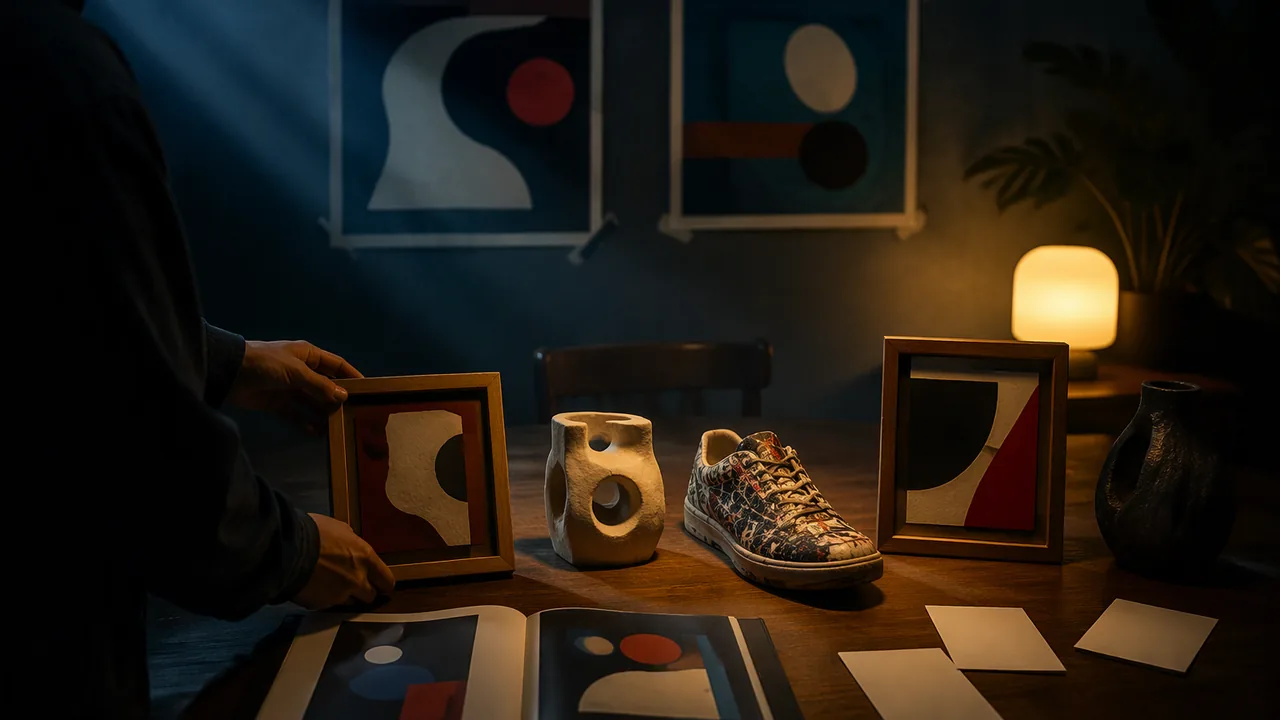
select, curate and preserve my semester’s work as a home or online exhibition, explain it in a statement and a recorded gallery talk, and propose a sustained investigation for semester B.
Instruction
Artists exhibit their work at the middle and end of the year, and this task is your midyear show. Because you study online, you are the curator: you choose the works, decide how they are presented, and decide how they will be kept. The task also launches the sustained investigation that defines semester B.
Selecting and curating. Choose four or five works from the semester, including the altered hat or shoe. Selection is critique applied to yourself: which works are strongest, and which together say something about you as an artist? Analyze each candidate before you choose: its strongest quality, what it says about you, and what it connects to. A show of your four best pieces may be less coherent than a show of three strong pieces and one weaker piece that connects them. Write a sentence for each choice. Curating also means deciding the order: which work opens the show, which closes it, and which two sit side by side so that each makes the other easier to read.
Two venues. Your exhibition has two forms. The first is a catalog: a PDF or slide deck with a cover (your show’s title), your artist statement, then one page per work with a good photograph and its label, in the order you chose. The second is a showing at home for family or other adults: the works set out on a table, a shelf or a stretch of wall. Hang work on a wall only with a parent’s permission and only with removable hooks or painter’s tape. You may also share the catalog online, but only with a parent’s or guardian’s permission, and without your full name, address or school in the captions.
Installing. Standard VA:Pr5A.II asks you to evaluate and apply methods to display work in a specific place. At home, decide: hang or prop at eye level (center of the work about 57-60 inches from the floor is a common gallery convention); keep consistent spacing; group related works; give three-dimensional work a stand, a box or a clear table where viewers can walk around it; light work from the front and above without glare, using a window or a lamp. Two-dimensional work should be mounted flat on card. In the catalog, the same decisions become image quality, order, captions and spacing on the page. Photograph your work well: daylight, a plain background, the camera square to the work. Unit 4 of semester B returns to this.
Preserving. Curators plan for presentation and for preservation. For each work, write one line on how you will keep it safe until the end of the year: flat works stored flat between sheets of clean paper in a folder or a large flattened box, away from sunlight, damp and heat; collages pressed under weight if edges lift; the altered hat or shoe stuffed with paper and kept in a box; the sculpture photographed and its fragile joints noted. Your photographs are also a preservation record: name each file with your initials, the title and the year, and keep a copy in a second place.
Labels. Each work gets a label: your name (or initials, online), title, year, medium and dimensions, and one or two sentences that help a viewer look. Museum labels give you a model: the object pages you have used all year state artist, title, date, medium and collection.
The artist statement (150-250 words). A statement tells viewers what connects your work and how you make it. Write in the first person and the present tense. Say what you are interested in, how you work, and what you hope a viewer notices. Avoid claims you cannot show (“my work challenges everything”) and avoid generalities (“art is my passion”). You will expand it into a full 300-500-word statement at the end of the year.
The gallery talk. Record three minutes on one work: how it began, one problem you solved, one decision you changed after your self-critique. Play it at your home showing or include it with the catalog. Record at least two viewers’ responses on the visitor card (family members or other adults at your showing, or, with a parent’s permission, comments on the shared catalog). Standard VA:Pr6A.I asks how an exhibition affects viewers; note whether viewers saw what you intended.
The investigation proposal. A portfolio at this level includes a sustained investigation: a body of related work exploring a question over time. Look at your semester’s work and ask what you keep returning to. Maybe it is a material (paper, found objects), a subject (a place, a person, hands, food), a process (layering, faceting), or an idea (memory, waste, home). Write a question, not a topic: not “my neighborhood” but “How can collage show what a neighborhood remembers that its buildings do not?” In 400-600 words, state the question and where it came from in your work; name at least two artists or works you will study; describe at least six works you plan to make in semester B, and how each will push the question further; and describe how you will document experiments and revisions. Put the draft away for a day, check it against the proposal checklist in the brief, and revise it before winter break.
📖 Read for this lesson
The reading opens over the lesson; close it to come back to exactly where you were. The checks below draw on it.
Formative check
Work through these before moving on. They are not graded — they tell you whether the standard below has landed yet.
Which is the strongest sustained-investigation question?
In a PDF or slide catalog, the order of images, captions and image quality play the role that hanging, spacing and lighting play in a room.
Missouri standard: VA:Pr4A.I
Name the four or five works you will exhibit, in order. For one of them, explain why it belongs in the show even if it is not your technically strongest piece. Then say how you will preserve that work until the end of the year (storage and an archival photograph).
How confident are you that you can select and install my work, write a statement and propose a sustained investigation?
Unit 4 checkpoint
Do this before you start the task. It covers the whole unit and tells you what to review first.
When did a carved Kongo figure become a nkisi?
The interpretation of minkisi minkondi as “fetishes” is the more plausible one because it came first.
Which Missouri connection does the lesson give for Nick Cave?
Duchamp’s term for a manufactured object chosen and presented as art is a .
Which joint is the best match for a heavy, smooth metal object?
A consistent coat of one paint color unifies diverse found objects but erases their histories.
By the kit’s rule of thumb, what is the minimum base width for an 18-inch-tall sculpture?
Which is the strongest description of a style?
A skeleton figure dressed and acting like the living, in Mexican popular art, is a .
Which is a subtractive method on an altered shoe?
Working in another artist’s style is acceptable when you credit the artist, transform rather than copy, and avoid the sacred or culturally owned designs of living communities.
Submit: Midyear exhibition (catalog, home showing, labels, statement, preservation plan, recorded gallery talk) and sustained-investigation proposal
Task: Select, critique, curate and preserve four or five semester works as a home or online exhibition (a PDF or slide catalog and a showing at home) with labels and a 150-250-word artist statement; record a three-minute gallery talk; and write and revise a 400-600-word sustained-investigation proposal.
Submission workflow
- Stage 1 — Plan. Selection with a written reason for each work, the order of the show, a layout plan for the home showing and the catalog, and a first draft of the statement and proposal question.
- Stage 2 — Self-critiqued draft. After a day away, check the selection, statement and proposal question against the rubric and the proposal checklist; optionally preview the catalog with a family member. Record what you will change.
- Stage 3 — Revised final. Finished catalog with labels, the home showing set up, a preservation line for each work, revised statement, and revised investigation proposal.
- Stage 4 — Gallery talk. Three-minute recorded talk on one work, shared at the showing or with the catalog, with notes on two viewers’ responses.
How it is scored
| Criterion | What proficient looks like |
|---|---|
| Selection, curation and preservation (VA:Pr4A.III) | Choices and order justified in writing; the group of works is coherent and represents the student’s development; each work has a storage and documentation plan. |
| Installation and presentation (VA:Pr5A.II) | Display methods suit the works, the home space and the catalog page; labels complete and helpful. |
| Artist statement (VA:Pr6A.I) | First person, specific and supported by the work shown; no unsupported claims. |
| Investigation proposal (VA:Cr1A.II) | A real question grown from the student’s own work, with sources, six planned works and a documentation plan. |
| Gallery talk and reflection (VA:Re7A.III) | Explains process and revision; records and reflects on viewers’ responses. |
Portfolio Task 4 in Full: The Midyear Exhibition at Home and Online, Catalog, Labels, Preservation, Statement, Recorded Talk and Investigation Proposal
Cleveland Museum of Art Open Access records 1983.10 and 1963.1; Art Institute of Chicago record 93903 (retrieved 26 September 2026); exemplars are SLS original and invented as models · SLS original (assignment, rubric, display arithmetic and exemplars); CC0 (museum data)
Why this reading. This is the whole assignment for Portfolio Task 4: what you submit, the rubric that scores it, the selection method, the catalog layout, display arithmetic with a worked plan for a home wall, a preservation plan, the label format (modeled on a real museum label), a complete exemplar artist statement, gallery-talk outline and investigation proposal, and the visitor-response card. You curate, install and review the show yourself. The exemplars are SLS original, invented as models; they describe works that do not exist. The museum facts are from Cleveland Museum of Art Open Access records 1983.10 and 1963.1 and Art Institute of Chicago record 93903 (retrieved 26 September 2026).
The assignment
| Part | What you hand in | Numbers to meet |
|---|---|---|
| 1. The exhibited selection | Four or five works from the semester, including the altered hat or shoe, critiqued, sequenced and curated | 4 to 5 works; a sentence for each choice |
| 2. Labels | One label per work | Name, title, year, medium, dimensions and one or two sentences |
| 3. Installation | A catalog (PDF or slides) and a plan for a showing at home: order, spacing, lighting | Cover, statement page and one page per work; center height, spacing rule and light direction stated for the home showing |
| 3b. Preservation plan | How each work is stored and documented until the end of the year | One line per work; photographs named and backed up |
| 4. Artist statement | First person, present tense; what you are interested in, how you work, what you hope a viewer notices | 150 to 250 words |
| 5. Gallery talk | Recorded: how one work began, one problem you solved, one decision changed after your self-critique; record viewers’ responses | 3 minutes; at least 2 viewer responses (family or other adults, or online comments shared with a parent’s permission) |
| 6. Investigation proposal | A question from your semester’s work; artists and sources; planned works; documentation | 400 to 600 words; at least 2 artists or works; at least 6 planned works; checked against the checklist after a day away and revised before winter break |
The rubric
Score each row 1 to 4; total out of 20.
| Criterion | 4: strong | 3: solid | 2: developing | 1: beginning |
|---|---|---|---|---|
| Selection, sequence and preservation | Works chosen and ordered to say something about you, with a reason for each; every work has a storage and documentation line | Chosen for quality with reasons | Chosen without reasons | Everything from the semester |
| Display and labels | Order, spacing, height and light decided and stated; labels complete and accurate | Most decisions stated; labels complete | Labels missing parts | No display plan |
| Artist statement | Concrete, first person, present tense; describes how you work and what to notice; no claims you cannot show | Mostly concrete | Generalities (‘art is my passion’) | Missing or a list |
| Gallery talk | Recorded: how it began, a problem solved, a change after self-critique, and two viewer responses compared with your intent | Three parts and two responses | Two parts | Reads the label aloud |
| Investigation proposal | A real question from your work; two studied artists or works; six planned works each pushing the question; a documentation plan | Question and six works; artists named | A topic rather than a question | A list of subjects |
How to select
Make a table of your semester’s works. For each write: strongest quality (one phrase); what it says about you (one phrase); what it connects to. Choose the set whose connections make one line. A show of three strong pieces and one weaker piece that links them can be more coherent than your four best. Write one sentence per choice: “I chose ___ because ___.”
The catalog
A PDF or slide deck in the order of the show. Page 1: the show’s title, your name (initials only if it will be shared online) and the year. Page 2: your artist statement. Then one page per work: a photograph filling most of the page, and the label beneath it. Last page: a short list of the works with their sizes, and one line thanking anyone who helped. Online sharing happens only with a parent’s or guardian’s permission, and captions never give your full name, address or school.
Display arithmetic and a worked plan for a home wall
For the showing at home, ask a parent before using a wall, and use only removable hooks or painter’s tape; a table, a shelf or a row of works propped on a ledge works just as well.
Height. The lesson’s convention: center of each work about 57 to 60 inches from the floor. Top edge = center height + half the work’s height. The hook sits at the top edge minus the distance the taut wire sits below it. Example: a work 16 inches tall, center 58 inches: top edge 58 + 8 = 66 inches; bottom edge 50 inches; if the taut wire sits 2 inches below the top edge, the hook goes at 64 inches.
Spacing. Sum of the widths, plus equal gaps between works; center the group on the wall. Worked example: a 12-foot (144-inch) stretch of wall at home; five works 18, 12, 24, 11 and 14 inches wide (total 79 inches); gaps of 3 inches, four gaps (12 inches). Group width 79 + 12 = 91 inches. Left margin (144 – 91) / 2 = 26.5 inches.
| Work | Width (in) | Left edge from the left wall (in) | Right edge (in) |
|---|---|---|---|
| 1 | 18 | 26.5 | 44.5 |
| 2 | 12 | 47.5 | 59.5 |
| 3 | 24 | 62.5 | 86.5 |
| 4 | 11 | 89.5 | 100.5 |
| 5 | 14 | 103.5 | 117.5 |
Check: the right margin is 144 – 117.5 = 26.5 inches, the same as the left. Light and mounting: light from the front and above, without glare on the surface; matted or mounted flat for two-dimensional work; a stand, an upturned box or a clear table that lets viewers walk around a three-dimensional work (the altered hat or shoe). At home, light can come from a window or a lamp aimed from the front and above. Online: photograph each work in daylight against a plain background, square to the camera, with the whole work in frame; 2000 pixels on the long side; the same order and captions as the wall plan.
Preservation: a plan for each work
| Kind of work | Store | Document |
|---|---|---|
| Drawings and paintings on paper | Flat, between sheets of clean paper, in a folder or a large flattened box; away from sunlight, damp and heat | Photograph square to the camera in daylight |
| Collages | Flat under light weight; re-glue lifting edges with a small brush of PVA before storing | Photograph, plus one close-up of a layered area |
| Altered hat or shoe | Stuffed with paper, in a box, not crushed under other things | Four views (front, back, both sides) and one from above |
| Found-object sculpture | On a shelf away from the edge; note any fragile joint | Four views; one photograph of the weakest joint |
Name every photograph with your initials, the title and the year (for example AD_One-Shadow-Two-Chairs_2026.jpg) and keep a second copy in another place. Those photographs are the archive of your show after the works go back into storage.
Labels: the museum model, and yours
A real label from the object record: “Ogata Kōrin (Japanese, 1658-1716), Plum Tree, c. 1700, hanging scroll; ink on silk; image 94 x 35.4 cm; Cleveland Museum of Art, 1983.10.” Yours follows the same order: your name, title, year, medium, dimensions, and one or two sentences that help a viewer look. Model (SLS original): “Amira Dawson, One Shadow, Two Chairs, 2026. Graphite on paper, 12 x 18 in. The chair is pale and cut off at the edge so that its shadow, the darkest shape on the page, holds your eye. Look for where the shadow touches the chair’s legs.”
The artist statement: an exemplar and what makes it strong
I make pictures out of things that already carry a history. This semester that meant paste paper, old ticket stubs, a fence I photographed, and one white canvas sneaker. I begin every piece with a question, not a subject: can a shadow matter more than the chair that casts it? Can a place be built from what its people throw away? I work in layers, back to front. The quiet ground goes down first, the middle layers second, and the dominant shape last, so that I can place it exactly and surround it with the darkest or lightest values in the picture. I let edges show, because I want a viewer to see that the surface was made by hand, one decision at a time. Across the four works in this show, one idea keeps returning: an ordinary object becomes important when I give it space, contrast and a reason to be there. In the drawing it is a shadow; in the collage it is a set of keys; in the altered shoe it is a walking skeleton. I hope a viewer notices where their eye lands first and then asks why. I also hope they look twice at the small things: a stitched line of marks, a strip of orange at the bottom edge, the cut edge of a printed letter.
(SLS original; 223 words.) Strengths: first person, present tense; names the materials; says how the artist works (layers, order); links the four works; states what a viewer might notice; no claim that cannot be pointed at. Weak lines and rewrites: “My work challenges everything” becomes “I put a small pale object beside a very large dark shape to see which one you look at.” “Art is my passion” becomes “I keep a sketchbook page for every decision I test.”
The recorded gallery talk: outline, timing and the viewer card
| Time | Content |
|---|---|
| 0:00 to 0:30 | How the work began: the brief or the question |
| 0:30 to 1:30 | One problem you solved, with the sketchbook page that shows it |
| 1:30 to 2:30 | One decision you changed after your self-critique, and why |
| 2:30 to 3:00 | What viewers saw compared with what you intended (add this part after the showing, or say what you hope they will see) |
Viewer response card (record at least two, from family members or other adults at your showing, or from comments on a catalog shared with a parent’s permission): Viewer’s first word for the work; where their eye went first; what they think it is about. Then add one line: matches my intent / differs, because ___.
The investigation proposal: an exemplar (SLS original; 446 words)
Question. How can collage show what a neighborhood remembers that its buildings do not? Where it came from. In Portfolio Task 3 my poem collage worked best where the papers carried real traces of a place, ticket stubs and road-map strips, and worst where I drew objects to match the words. In the altered shoe, the scuffs I could not paint away were the most convincing marks on the surface. Both times the material’s own history did work that my drawing could not. I want to test how far that goes. Two family members who saw the collage said the same thing without being asked: the most believable parts of my work were the parts I had not invented. That is the pattern I want to follow. Artists and works I will study. Kurt Schwitters, Little Dance (1920, Cleveland Museum of Art, 1963.1): the museum describes scraps gleaned from daily life whose interaction becomes a kind of dance, with red dancing among subdued tones; I will study how he repeats one accent across a small sheet. Romare Bearden, The Return of Odysseus (Homage to Pinturicchio and Benin) (1977, Art Institute of Chicago, 1977.127): the museum explains that he recast a Renaissance fresco of a scene from Homer with Black figures to link an ancient story to present struggles; I will study how a collage can reinterpret a remembered scene without illustrating it. The six works I plan to make, and how each pushes the question further. (1) A transit-map and ticket collage, 11 x 14 in, asking what routes remember; it sets the baseline. (2) The same subject at 8 x 10 in in a single color, to test whether color is needed for memory to show. (3) Transparent tissue over photographs of storefronts I choose, asking what fades; it moves the question from what stays to what leaves. (4) A large 18 x 24 in piece with cut-away windows that reveal older layers, moving the question into subtraction. (5) A version using only free papers I am given or pick up as handouts on one street in one week, so the material record is literal and I can check whether that makes it stronger. (6) A three-panel work ordering past, present and absence, to test whether sequence changes what the pieces claim. Documentation. Two sketchbook pages per work: a thumbnail plan and a log of what each material carried, plus a photograph at the end of each session from the same position, with a note of what I decided, and one paragraph after each finished work saying whether the answer to my question got clearer or more complicated. After work 2 I will reread this proposal against the checklist and revise it before winter break.
What makes it strong: the question could fail (it asks how far one idea goes); it grows from the artist’s own work; the two artists were chosen for what the artist can learn and each is tied to a checkable record; each of the six works moves the question (a color test, a subtraction, a sequence); and the documentation plan says what will be recorded. A question, not a topic: “my neighborhood” is a topic; “How can collage show what a neighborhood remembers that its buildings do not?” is a question. “My family” is a topic; “How can layered transfers show the way a family story changes as it is retold?” is a question.
Sources: Cleveland Museum of Art, Plum Tree (Ogata Kōrin), 1983.10 (clevelandart.org); Cleveland Museum of Art, Little Dance (Kurt Schwitters), 1963.1 (clevelandart.org); Art Institute of Chicago, The Return of Odysseus (Romare Bearden), 1977.127 (artic.edu)