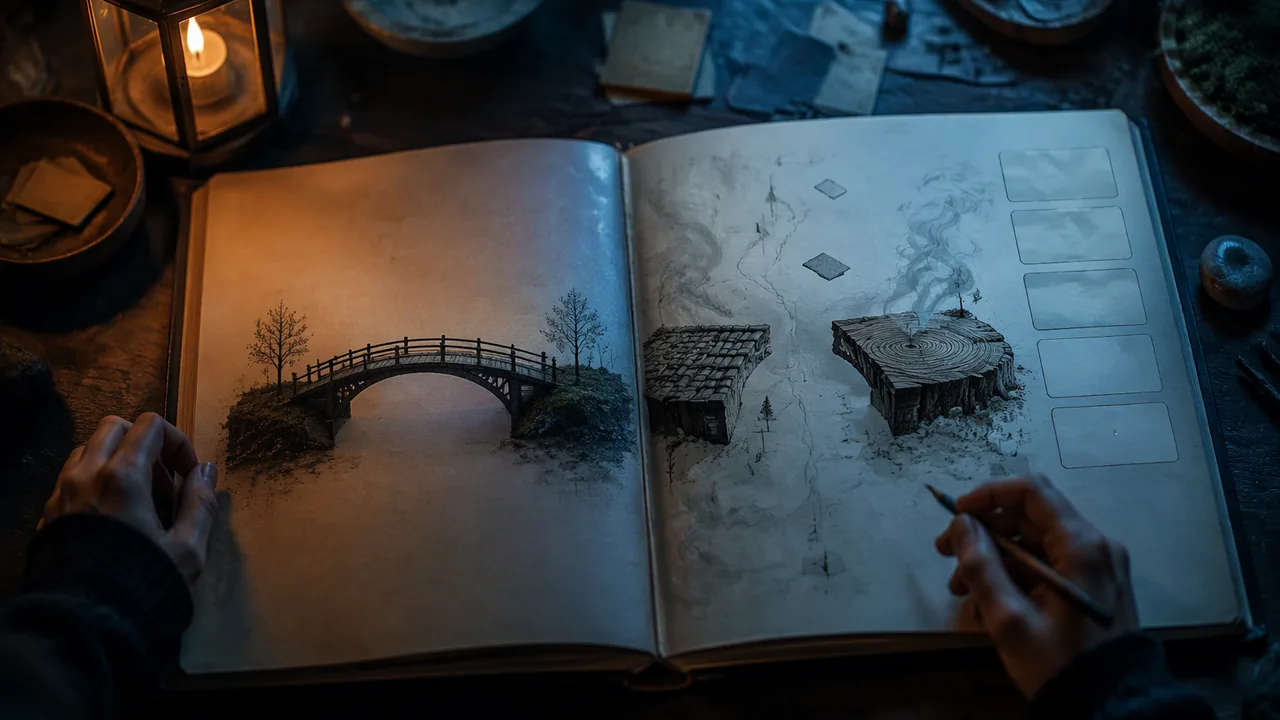
write an acrostic poem about a place that shaped me and discuss how images can interpret a text’s meaning rather than simply illustrate its words.
Instruction
This lab prepares the poem at the center of the unit and asks a question artists have faced for centuries: when an image goes with a text, what should the image do?
Text and image together. A luster wall tile made in Kashan, Iran, in 1266, Luster Wall Tile with a Couple (Cleveland Museum of Art), shows a couple with a wine beaker surrounded by verses of Iranian love poetry, according to the museum. The words circle the image as a border, so text and picture are read together as one design. In illustrated manuscripts of the Shahnama (Book of Kings), the Persian epic written by Firdausi, paintings share the page with the verses. The folio “The Feast of Sada” from the Shahnama made for Shah Tahmasp (c. 1525, The Metropolitan Museum of Art) is one example. In both, the image does not repeat the text; it gives it a setting, a mood and a visual world.
Illustration and interpretation. An illustration shows what the words say: the poem mentions a bridge, so the picture shows a bridge. An interpretation shows what the words mean or feel like: the poem is about leaving home, so the picture might split into two halves that do not quite meet, or use a torn edge where the halves join. Interpretation is harder and stronger, because the image adds something the words could not.
Tools for interpretation. Think in the language of art. Color can carry a mood or a memory (the color of a grandmother’s kitchen, the gray of a morning commute). Scale can carry importance: a small object made huge. Placement and space can carry relationships: crowded or isolated, near or far. Texture and material can carry touch and history: a transferred photograph looks like memory; paste paper looks handmade. Technique can carry meaning: weaving two maps together says two places are part of one life.
The acrostic poem. In an acrostic, the first letters of the lines spell a word. This project uses a word for a place. Choose a place that has shaped you. It may be the country your family comes from, but it does not have to be; you might choose a street, a city, a landscape, a school, or a place you have never visited but carry in your imagination. You are never required to share personal or family history you would rather keep private. Aim for 6-12 lines. Use concrete images (things you can see, hear, smell, touch) rather than general statements. “Mangoes cut on newspaper” gives a collage something to work with; “a wonderful place” does not. If you are writing poetry in your English course, you may develop a draft from that course.
A worked word-image map. One student’s acrostic spelled SEDALIA, the Missouri town where the state fairgrounds stand. The line “Sun-bleached fairground barns in August” became a layer of white tissue, like heat haze, over a monoprint of long low roofs; the line “Dad’s keys on a ring from the hardware store” became a transferred photograph of keys, repeated at different scales along a diagonal; the letters themselves were cut from old ticket stubs. The map lists each line, one visual idea for it, and the technique that would carry it.
Seminar on your own. Look closely at the Kashan tile and the Shahnama folio and write a short seminar response: what does each image add that the text alone would not? Then test your own word-image map with the three tests in the reading (removal, addition, element): which visual ideas interpret and which only illustrate? Put the map away for a day and test it again with fresh eyes. If you like, read one line of your poem aloud to a family member or other adult and ask what picture it puts in their mind; their answer is evidence for your map, not a grade.
📖 Read for this lesson
The reading opens over the lesson; close it to come back to exactly where you were. The checks below draw on it.
Formative check
Work through these before moving on. They are not graded — they tell you whether the standard below has landed yet.
A poem line reads “the silence after my brother left for college.” Which visual idea interprets rather than illustrates?
On the Kashan luster tile, the verses surround the image, so text and picture are designed to be read together.
Post two lines of your poem and, for each, one visual idea and the technique from your sampler that would carry it. Say whether each idea interprets or illustrates.
How confident are you that you can plan images that interpret my poem’s meaning rather than only illustrate its words?
Practice
Work these on paper or in your notebook, then open Check your answer. Aim for all of Fluency and Application; try at least one Challenge.
Printable version: this unit’s practice workbook (PDF)
Fluency
Build speed and accuracy with the core skill.
- Define illustration and interpretation as the lesson uses them.
Check your answer
Answer: Illustration: an image that shows what a text says. Interpretation: an image that conveys what a text means or feels like, adding something the words do not.Interpretation is harder and stronger because the image adds something the words could not. - What is an acrostic, and what does this project’s acrostic spell?
Check your answer
Answer: A poem in which the first letters of the lines spell a word; here the word names a place that has shaped you.Aim for 6-12 lines, with concrete images. You never have to share personal or family history you would rather keep private. - Name the three tests in the reading for checking whether a visual idea interprets or only illustrates.
Check your answer
Answer: Removal test (cover the words: does the image still communicate?); addition test (list what the image contains that the words do not name; if the list is empty, it is an illustration); element test (name the element or principle carrying the meaning).“The bridge is a bridge” fails the element test.
Application
Use the skill in context. Show your reasoning.
- Apply the reading’s concrete test to this line: “My home is a wonderful, special place.” Rewrite it with things you could photograph.
Check your answer
Answer: Model: “Mangoes cut on newspaper, a fan turning by the door.” (Any rewrite that removes the abstract words home, wonderful, special and uses things you can see, hear, smell or touch.)Concrete images give a collage something to work with; general statements do not. - A poem is about leaving home. Give one illustration and one interpretation of it, and name the element carrying the interpretation.
Check your answer
Answer: Illustration: a picture of a suitcase or a house. Interpretation: the picture splits into two halves that do not quite meet, joined by a torn edge; the carrier is placement and technique (the split and the torn edge).This is the lesson’s own example of interpretation; other answers are fine if the meaning is carried by an element, not by depicting the subject. - In the SEDALIA example, the line “Sun-bleached fairground barns in August” became white tissue over a monoprint of long low roofs. Which part illustrates and which interprets? Explain.
Check your answer
Answer: The monoprint of roofs illustrates (it shows the barns the line names). The white tissue layer interprets: like heat haze, it conveys the feeling of a bleaching August sun, which the image adds through material and layering.Run the addition test: the haze is something the image adds beyond the named object. - What does the image add to the text on the Kashan luster tile and in the Shahnama folio “The Feast of Sada”? Answer for both in one or two sentences.
Check your answer
Answer: In both, the image does not repeat the text; it gives it a setting, a mood and a visual world. On the tile the verses circle the image as a border, so word and picture are read as one design; in the folio the painting shares the page with Firdausi’s verses.This is the seminar question the lesson asks you to answer on your own.
Review
Keep earlier skills sharp.
- Review (Lesson 1.3): reading one line of your poem to an adult and asking what picture it makes is “evidence for your map, not a grade.” Which step of criticism is the listener doing, and why is that useful?
Check your answer
Answer: Interpretation: proposing what the words mean or call up. Their answer lets you compare the picture in their mind with your visual idea, to see whether the line and image communicate as you intended.Interpretations are claims that can be tested against evidence, the same idea as in the four-step model.
Text and Image Together: A Tile’s Verses, the Feast of Sada, Bearden’s Odysseus, and a Worked Acrostic and Map
Cleveland Museum of Art Open Access record 1915.524 (inscription and translation fields); Metropolitan Museum of Art object 452111; Art Institute of Chicago record 93903 (retrieved 26 September 2026); The Shahnama of Firdausi, vol. 1, trans. Arthur George Warner and Edmond Warner (London: Kegan Paul, 1905), pp. 123-124, from an archive.org scan; Missouri State Fair site (fairgrounds in Sedalia), retrieved 10 November 2026 · CC0 (museum data); Public domain (Warner translation, 1905); SLS original (recipe, worked poem and map). Bearden work is in copyright and is described, not reproduced
Why this reading. The lab asks you to draft an acrostic poem, make a word-image map, and then write a seminar response on two text-image works: what does each image add that the text alone would not? You cannot do that from the words ‘verses of love poetry’ and ‘a folio from the Book of Kings’. So this reading hosts the two texts (the Kashan tile’s verses in translation, and the Shahnama passage the folio illustrates), describes the two images closely enough to compare with them, adds a third text-image work as a contrast, and gives you a drafting recipe and a full worked poem and map to check yours against. Museum data is CC0 (Cleveland Museum of Art 1915.524, including the translation printed in its record; Metropolitan Museum of Art 1970.301.2; Art Institute of Chicago 93903; retrieved 26 September 2026). The Shahnama verse is from the Warner translation (1905), public domain. The poem, map and recipe are SLS original.
The tile: text and image together
Record. Luster Wall Tile with a Couple, Kashan, Iran, Ilkhanid period (1256-1353), dated 1266; fritware with luster-painted design; 19.5 x 16 cm (7 11/16 x 6 5/16 in.); Cleveland Museum of Art, 1915.524 (CC0). The image. An eight-pointed star. Two haloed figures sit side by side, a bearded man at left and a smooth-faced figure with long dark hair at right, with a slender turquoise tree between them and a small blue bird at each side. The cream ground is filled with tiny spirals, leaving the faces plain. Around the star’s edge runs a band of script. Cleveland says the design is a couple with a wine beaker surrounded by verses of Iranian love poetry, and that it would have alternated with cross-shaped tiles on a wall.
The text. Cleveland’s record gives the transliteration and an English translation (credited there to Dick Davis, Ohio State University, 1996). Two four-line poems (rubā’īs) run around the tile. The second, in translation: “Your hair (tresses), which viper-like is bent on mischief, do you know why it returns behind your back? When it saw that your ruby (lips) has (now) an emerald (down appearing above the lips), it became wild (lost all senses) and wanders on the mountain side.” The first plays on the same theme: the beloved’s curls, numbering more than a thousand, are compared to soldiers bent on a night raid, and the speaker begs that the “thief” be “hanged,” which the museum’s note reads as a request that the beloved wear her hair down. The museum’s remark: two metaphors run together, the lips as a ruby being stolen, and the hair’s beauty as someone waiting in ambush to capture the speaker. A note on that language: the first poem uses period images of dark-skinned soldiers as metaphors for hair, which readers today may find troubling. Part of judging a text-image work is noticing what the text asks you to picture, and deciding whether the image repeats it, softens it or answers it.
What to ask: The poems are about hair, lips and desire. What does the picture show that the poems do not (a shared cup, a tree, birds, a calm pair sitting still)? What do the poems say that the picture cannot show (the ambush, the mischief, the mountain)? Where the picture does echo the poem (the long dark hair of one figure), is it illustrating or interpreting?
The Shahnama folio: the text, then the picture
Record. “The Feast of Sada,” folio 22v from the Shahnama (Book of Kings) of Shah Tahmasp; author of the text Abu’l Qasim Firdausi (Iranian, about 940/41-1020); Iran, about 1525; opaque watercolor, ink, silver and gold on paper; painting 24.1 x 23 cm (9 1/2 x 9 1/16 in.), page 47 x 31.8 cm (18 1/2 x 12 1/2 in.); Metropolitan Museum of Art, 1970.301.2, Gift of Arthur A. Houghton Jr., 1970 (public domain; the Met tags it with animals, men, deer, goats and fire).
The text it goes with. The Warner translation (The Shahnama of Firdausi, vol. 1, 1905, pp. 123-124) tells how King Hushang discovered fire: “One day he reached a mountain with his men / And saw afar a long swift dusky form / With eyes like pools of blood and jaws whose smoke / Bedimmed the world. Hushang the wary seized / A stone, advanced and hurled it royally.” The serpent escaped; the stone struck another stone and sparks flew. “That night he made a mighty blaze, he stood / Around it with his men and held the feast / Called Sada; that bright festival remaineth / As his memorial.” The passage continues: “By Grace and kingly power domesticating / Ox, ass, and sheep he turned them to good use.” (Text from an archive.org scan; punctuation as printed.)
The picture. A framed painting at the top of a page, with four columns of Persian script beneath it and a small text panel in the upper right corner. On a wide, pale green plateau dotted with tiny marks, a king in an orange robe sits on a patterned rug at the center, holding a cup. Directly in front of him, at the bottom center, a bonfire burns in red and orange. Around the fire, on smaller rugs, guests sit in pairs and alone, in green, blue and orange, some holding cups and one with a hand raised to the head; gold vessels and dishes of fruit sit on the ground. At the upper left, attendants carry trays of food. Along the bottom, a herdsman drives goats, sheep and cattle toward the fire, and deer and other animals rest at the lower right. At the top, gazelles leap among pink, purple and blue rocks, with a pink flowering tree at the left and blue sky at the corner. The colors are saturated jewel tones with gold.
| In the text | In the picture | Only in the picture |
|---|---|---|
| A king and his men | A king with guests seated in pairs | Faces, clothing, patterned rugs, who sits where |
| A blaze and a feast | A bonfire and cups, fruit and gold vessels | The mood: a calm gathering, not the fear of the serpent |
| Domesticated ox, ass, sheep | A herdsman with goats, sheep and cattle | The herd is shown walking toward the fire, tying the two discoveries together |
| A mountain, a serpent, a hurled stone | Rocks and leaping gazelles at the top | No serpent and no stone: the picture skips the violence and paints the result |
A contrast: an image that reinterprets a text
The Art Institute of Chicago’s The Return of Odysseus (Homage to Pinturicchio and Benin), 1977, by Romare Bearden (in copyright, so described from the museum’s text): a collage of cut-and-pasted papers with graphite and touches of brush and black and gray wash on a wood panel, 111.8 x 142.2 cm (Art Institute of Chicago, 1977.127). The museum says Bearden based it on Pintoricchio’s Renaissance fresco of the same scene from Homer’s Odyssey, added features from Benin masks and sculpture, made the figures Black where the fresco’s are white, and sought to link Odysseus’s struggles with those of African Americans, using the Greek epic to underscore the commonalities of all humans. Its image: a cool-toned room with a small woman spinning wool at left, a larger woman at an upright loom behind her, a man striding across the frame, three men to one side, a figure with a knife entering by a back door, and a window framing a mountainous island and a ship with white sails. Compare with the Sada folio: both pictures give a text a visible world; Bearden also changes what the text means.
Illustration and interpretation: three tests
- Removal test. Cover the words. Does the image still communicate a place, a mood or an idea? An illustration often does not.
- Addition test. List what the image contains that the words do not name. If the list is empty, it is an illustration.
- Element test. Name the element or principle carrying the meaning (color, scale, placement, texture, technique, repetition). “The bridge is a bridge” is not a carrier; “two halves that do not quite meet, joined by a torn edge” is.
Drafting the acrostic: a recipe
- Choose a place that has shaped you (a family’s place of origin, a street, a Missouri town or landscape, a school, or an imagined place). You never have to share private history.
- Choose the word: the place’s name, 6 to 12 letters, one letter per line.
- List 3 things you can see, 3 you can hear, 3 you can smell, 3 you can touch, 3 you can taste. Fifteen concrete items.
- Write each line beginning with its letter, 3 to 8 words, using at least one item from the list. Use a noun you can picture, and a verb.
- Concrete test: cross out abstract words (wonderful, beautiful, special, amazing, home, love) and replace them with a thing you could photograph.
A full worked poem and map (SLS original; invented as a model)
SEDALIA (7 lines, one per letter; Sedalia is the Missouri town where the state fairgrounds stand): S: Sun-bleached fairground barns in August. E: Evening trains calling across the tracks. D: Dad’s keys on a ring from the hardware store. A: A lemonade jar sweating on the porch rail. L: Laundromat hum, my aunties talking over it. I: Interstate lights strung like lanterns at night. A: All the kitchen windows steamed at dinner.
| Line | Visual idea | Technique | Element carrying the meaning | Interprets or illustrates? |
|---|---|---|---|---|
| S | A veil of white tissue, like heat haze, over a monoprint of long low roof shapes | Tissue layer over monoprint | Color and texture (softness, glare) | Interprets: you feel the heat, no barn drawn in detail |
| E | Parallel dark strips of transparent tissue across a pale yellow ground, tilted so they read as sound moving across the picture | Tissue strips over paste paper | Value and rhythm | Interprets: you sense the whistle passing, no train drawn |
| D | A transferred photograph of keys, repeated at smaller and smaller scales along a diagonal | Photo transfer | Scale, repetition, direction | Interprets: repetition suggests work over years |
| A | First plan: a drawing of a jar on a porch rail. Upgrade: lemon-yellow cut circles pressing against a grid of gray printed lines | First: drawing; upgrade: cut paper against printed lines | Color and pattern | First plan illustrates. Upgrade interprets: summer heat pressing on everything |
| L | Overlapping circles cut from laundry-tag print, so the numbers pile into a hum | Cut printed paper | Overlap and texture | Interprets |
| I | A row of small glowing orange waxed-paper dots in a dark navy field, off-center and receding | Waxed paper against dark paper | Value contrast, scale | Interprets: distance and small sources of warmth |
| A | A row of small window shapes each with a curl of white tissue | Cut paper and tissue curls | Repetition, texture | Interprets: shared warmth, repeated |
Old ticket stubs supply the letters of the word SEDALIA, cut and placed as shapes rather than labels. To check your own map, run the three tests on every line, put the map away for a day, run them again, and rewrite any that only illustrate. If a family member or other adult is willing, read them one line and ask what picture it makes in their mind; compare their answer with your visual idea.
Sources: Cleveland Museum of Art, Luster Wall Tile with a Couple, 1915.524 (clevelandart.org); Metropolitan Museum of Art, The Feast of Sada, 1970.301.2 (metmuseum.org); Art Institute of Chicago, The Return of Odysseus (Bearden), 1977.127 (artic.edu); The Shahnama of Firdausi, vol. 1 (Warner translation, 1905), Internet Archive (archive.org); Missouri State Fair (Missouri Department of Agriculture), fairgrounds address, 2503 W 16th Street, Sedalia, MO (mostatefair.com)