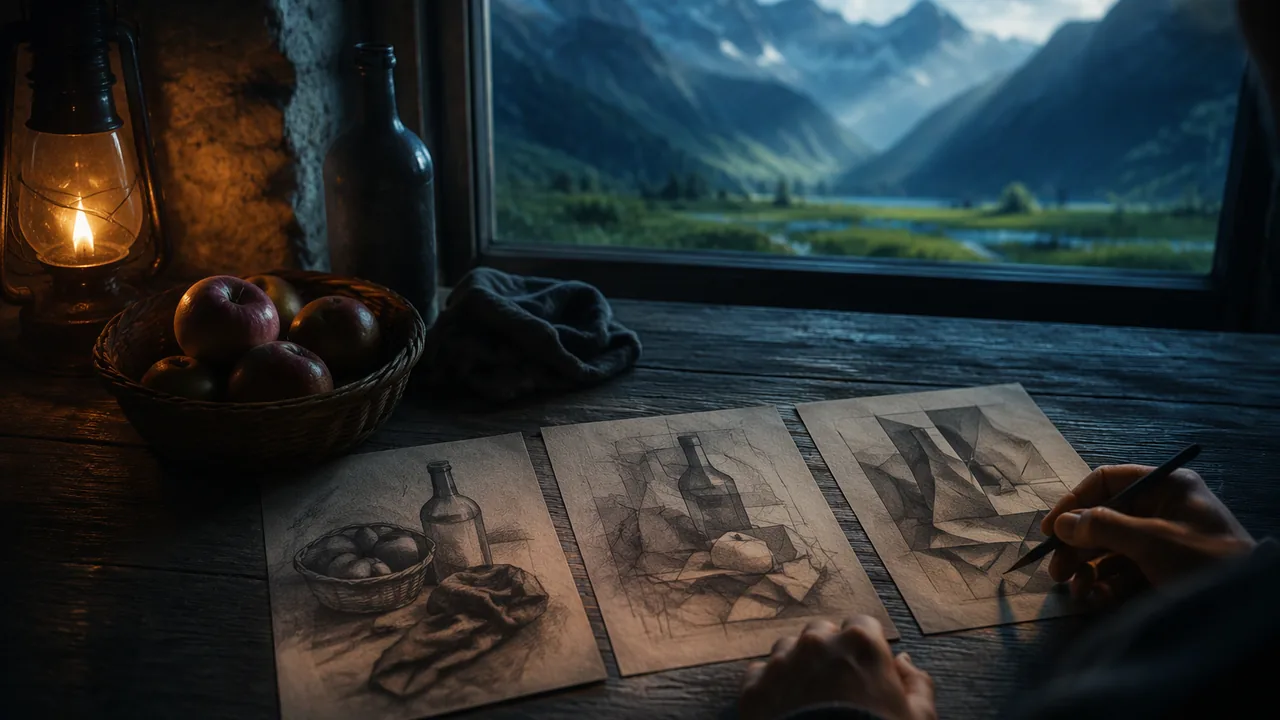
explain how Cezanne and the Cubists moved from observation to abstraction, and compare their route with abstraction in other traditions.
Instruction
Abstract does not mean “random” or “of nothing.” In art it usually means drawn out of something: a form simplified, rearranged or reduced until its structure matters more than its surface appearance. This unit takes you along that road with an object you choose. First, look at how others traveled it.
Cezanne rebuilds the apple. Look closely at Paul Cezanne’s The Basket of Apples (c. 1893, Art Institute of Chicago). The apples are built from separate patches of color laid side by side, so that a change of plane is shown by a change of hue rather than by smooth shading. Now look at the table. Its front edge does not line up on either side of the cloth, and the bottle and basket tilt. Cezanne was not careless. He painted what it is like to look at objects from slightly different positions over a long time, and he placed each form where the composition needed it. That idea, that a painting can combine several views and be built from planes, is the door the Cubists walked through.
Cezanne in Kansas City. You can see the same method in a Missouri collection. The Nelson-Atkins Museum of Art owns Cezanne’s Mont Sainte-Victoire Seen from Les Lauves (1904-1905, oil on canvas): a green meadow in front, a grove of trees in the middle ground and the jagged peak behind. The museum’s label explains that Cezanne painted this mountain near his home in Aix-en-Provence many times, set aside traditional perspective, and built the landscape from simplified geometric shapes in shifting planes of color laid on in small parallel strokes, merging foreground, middle ground and background into one space and “paving the way for Cubism.” Cezanne kept returning to a landscape he knew. You could do the same with a view near you, such as a river bluff, an Ozark ridge or the trees at the end of your street, and ask which planes you would keep.
Cubism. Around 1908-1912 Pablo Picasso (1881-1973) and Georges Braque (1882-1963) developed Cubism in Paris. Their works are still under copyright, so we discuss them by description rather than reproducing images here; you can look them up in museum collection records online. In their early Cubist paintings, a guitar, a bottle or a face is broken into small, angular facets, each shaded as though it were a separate plane, and views from the front, side and above are combined in one image. The palette was often reduced to browns, grays and ochres so that color would not distract from structure. That is exactly the method of this unit’s project: facet a form into planned sections and render them in a limited palette.
From nature to pure color. Vasily Kandinsky’s Improvisation No. 30 (Cannons) (1913, Art Institute of Chicago) shows a different route. Recognizable things, including cannons in the lower right, dissolve into lines and zones of color that Kandinsky compared to music. Here abstraction is driven by expression rather than by structure.
Other roads. Abstraction did not begin in Paris. The Japanese painter Ogata Kōrin, a leader of the Rinpa school, made Plum Tree (c. 1700, ink on silk, Cleveland Museum of Art). The museum explains that Kōrin washed ink over almost the whole silk and left the blossoms as unpainted reserves, so the white flowers are made by what he did not paint. Rinpa artists are known for turning natural forms into bold, simplified shapes. A Diné (Navajo) weaver made this Wearing Blanket (c. 1875-80, Cleveland Museum of Art) with geometric designs; the museum notes that such designs reference the natural environment and carry spiritual meanings, and that patterns were inherited but changed over time. A Hawaiian maker produced this tapa cloth (before 1930, Cleveland Museum of Art), a cloth made by beating the inner bark of the paper mulberry and then decorating the surface. These abstractions come from textile structures, patterns handed down within a community and ideas about what the patterns represent, not from a European argument about perspective. Treat them as their own traditions, not as “early” versions of modern art.
Arthur Wesley Dow, an American painter and art educator, studied Japanese prints closely and wrote Composition (1899), which taught students to design with line, notan (the Japanese term for the arrangement of dark and light) and color. His painting Boats at Rest (c. 1895, Art Institute of Chicago) is a chance to test his method: make a thumbnail of it in three values only and see whether the composition still holds.
The common thread. Each route asks what to keep and what to leave out. Your study today: draw one apple five times, each time leaving more out, and label what you kept.
📖 Read for this lesson
The reading opens over the lesson; close it to come back to exactly where you were. The checks below draw on it.
Formative check
Work through these before moving on. They are not graded — they tell you whether the standard below has landed yet.
In The Basket of Apples, the front edge of the table does not line up on either side of the cloth. What is the best interpretation?
The geometric patterns in a Diné wearing blanket are an early stage of European modern abstraction.
Cezanne
Tap to revealForms built from planes of color; several viewpoints combined.
Analytic Cubism (Picasso, Braque)
Tap to revealFaceted forms, multiple views, reduced palette.
Kandinsky
Tap to revealAbstraction driven by expression; color compared to music.
Rinpa (Kōrin)
Tap to revealNatural forms turned into bold simplified shapes.
Dow
Tap to revealDesign with line, notan and color.
How confident are you that you can explain several different routes from nature to abstraction and what each one keeps?
Practice
Work these on paper or in your notebook, then open Check your answer. Aim for all of Fluency and Application; try at least one Challenge.
Printable version: this unit’s practice workbook (PDF)
Fluency
Build speed and accuracy with the core skill.
- What does abstract usually mean in art, according to the lesson? Why is “random” the wrong definition?
Check your answer
Answer: It usually means drawn out of something: a form simplified, rearranged or reduced until its structure matters more than its surface appearance. It is not random because the abstraction still comes from, and is rooted in, a source.The unit’s road runs from something seen in nature to an image that is abstract but still rooted in it. - Define facet and notan.
Check your answer
Answer: A facet is a small flat plane, like a face of a cut gem, used to break a form into sections. Notan is a Japanese term, used by Arthur Wesley Dow, for the arrangement of dark and light shapes in a design.Both are glossary terms for this lesson. - Match each artist or maker to the route to abstraction the lesson describes: (a) Cezanne, (b) Picasso and Braque, (c) Kandinsky, (d) Ogata Kōrin.
Check your answer
Answer: (a) forms built from planes of color, several viewpoints combined; (b) Cubism: faceted forms, multiple views, reduced palette; (c) abstraction driven by expression, color compared to music; (d) Rinpa: natural forms turned into bold simplified shapes, blossoms left as unpainted reserves.Each route asks what to keep and what to leave out.
Application
Use the skill in context. Show your reasoning.
- In Cezanne’s The Basket of Apples, how is a change of plane on an apple shown? Contrast this with the smooth shading of Unit 1’s value lab.
Check your answer
Answer: By a change of hue: the apples are built from separate patches of color laid side by side. In Unit 1 a turning form was shown by gradual changes of value (smooth shading through halftone to core shadow).This plane-by-plane method is the door the Cubists walked through. - The Nelson-Atkins label for Mont Sainte-Victoire Seen from Les Lauves says Cezanne set aside traditional perspective. List three things the label says he did instead.
Check your answer
Answer: Built the landscape from simplified geometric shapes; laid on shifting planes of color in small parallel strokes; merged foreground, middle ground and background into one space (“paving the way for Cubism”).He also painted this mountain near his home in Aix-en-Provence many times. - Explain why the lesson says the Diné wearing blanket and the Hawaiian tapa cloth should be treated as their own traditions and not as “early” versions of modern art.
Check your answer
Answer: Their abstraction comes from textile structures, patterns handed down within a community and ideas about what the patterns represent (the Diné designs reference the natural environment and carry spiritual meanings), not from a European argument about perspective. Calling them steps toward European modernism misreads their history and meaning.A strong answer names the actual sources of the designs and the error of a single timeline. - Kōrin’s Plum Tree makes white blossoms “by what he did not paint.” Explain the technique and name one way you could use the same idea in a pencil abstraction of an apple.
Check your answer
Answer: He washed ink over almost the whole silk and left the blossoms as unpainted reserves. In pencil, you could shade the background and shadow facets and leave the apple’s highlight shapes as untouched paper.Any plan that creates light shapes by leaving the paper bare, rather than drawing them, applies the idea.
Challenge
Stretch problems. Expect to think before you write.
- The lesson’s study asks you to draw one apple five times, each time leaving more out. Write a plan for the five drawings, saying what you keep in each.
Check your answer
Answer: Model: 1, full observed apple with value and stem; 2, drop the surface detail, keep planes of color or value; 3, keep only the major facets and silhouette; 4, keep the silhouette and one dark plane; 5, keep only the dark-light shape (notan) of apple against ground.A strong plan removes one kind of information at a time and labels what is kept, so the series shows the road from observation to abstraction.
Review
Keep earlier skills sharp.
- Review (Lesson 1.1): the lesson invites you to make a three-value thumbnail of Dow’s Boats at Rest. Which sketchbook purpose is that, and what question does it test?
Check your answer
Answer: Testing: a small study that answers one question, here whether the composition still holds when reduced to three values (its notan).Dow taught that a picture is first an arrangement of dark and light masses.
Roads to Abstraction: Six Records, Cézanne and Kandinsky on the Record, and a Value Map of Dow
Art Institute of Chicago records 111436, 8991, 121377; Cleveland Museum of Art Open Access records 1983.10, 1921.556, 1971.158 (retrieved 26 September 2026); Arthur Jerome Eddy, Cubists and Post-Impressionism (Chicago: A. C. McClurg, 1914), pp. 43, 124-126; Arthur Wesley Dow, Composition (ninth edition, 1914) · CC0 (museum data); Public domain (Eddy 1914; Dow 1914); SLS original (descriptions, value map and models)
Why this reading. The lesson asks for a sketchbook comparison chart of four works, a three-value thumbnail of Dow’s Boats at Rest, and a five-step study of one apple, and it discusses Picasso and Braque without showing them. So here is what you need: six object records, a careful description of each work, what Cézanne and Kandinsky are on record as saying (public-domain sources), a measured value map of the Dow so you can check your thumbnail, and worked models for the chart and the apple study. Museum data is CC0 (Art Institute of Chicago and Cleveland Museum of Art, retrieved 26 September 2026); descriptions were written by looking at museum-released images; models and the value map are SLS original. Quoted passages are from Arthur Jerome Eddy, Cubists and Post-Impressionism (1914) and Arthur Wesley Dow, Composition (9th ed., 1914), both public domain.
The six records
| Work | Date | Medium and size | Museum and accession |
|---|---|---|---|
| Paul Cézanne, The Basket of Apples | c. 1893 | Oil on canvas, 65 x 80 cm (25 7/16 x 31 1/2 in.); signed lower left, P. Cézanne | Art Institute of Chicago, 1926.252 |
| Vasily Kandinsky, Improvisation No. 30 (Cannons) | 1913 | Oil on canvas, 111 x 111.3 cm (43 11/16 x 43 13/16 in.) | Art Institute of Chicago, 1931.511 |
| Arthur Wesley Dow, Boats at Rest | c. 1895 | Oil on canvas, 66 x 91.4 cm (26 x 36 in.); signed lower left | Art Institute of Chicago, 1990.394 |
| Ogata Kōrin, Plum Tree | c. 1700, Japan, Edo period | Hanging scroll; ink on silk; image 94 x 35.4 cm (37 x 13 15/16 in.), with mounting 177.2 x 51.8 cm | Cleveland Museum of Art, 1983.10 |
| Diné (Navajo) woman weaver, Wearing Blanket | c. 1875-80 | Wool (handspun, Germantown and bayeta), tapestry weave; 117.5 x 152.5 cm (46 1/4 x 60 1/16 in.) | Cleveland Museum of Art, 1921.556 |
| Hawaiian maker, Tapa Cloth | Before 1930 | Probably mulberry bark (Broussonetia papyrifera); 147 x 36.2 cm (57 7/8 x 14 1/4 in.) | Cleveland Museum of Art, 1971.158 |
Cézanne, The Basket of Apples, in words
A table-top still life in a landscape-format canvas. At left, a dark woven basket lies tipped on its side, with a heap of green, red and orange apples spilling toward the front. Beside it stands a dark green wine bottle, very slightly tilted, and at right a plate of pale, finger-shaped biscuits (the AIC calls them langues de chat) stacked in a tower. A white cloth, crumpled into sculptural folds, fills the lower center, with loose apples resting on it. Behind everything is a wall of blue-green and gray. Value: the darkest darks are the basket, the bottle and the folds’ shadow edges; the lightest is the cloth. Edges: apples are outlined with a dark blue contour; the outer edge of the cloth and table are left as loose, sketchy strokes. Facts to check for yourself: the front edge of the table at the left of the cloth sits noticeably lower than at the right, so the table does not line up across the cloth; the bottle leans; and the biscuit tower stops just short of falling out of the picture. The AIC describes these as “shifts in reality” and the brushwork as changing from thick strokes that model the fruit to sketch-like marks around the edges of the table and cloth. The apples are built from separate patches of color: a red patch, a yellow patch and a green patch side by side make one round fruit.
In Cézanne’s words, as Eddy reported them in 1914 (Eddy gives no date or source for the passage; treat it as a translation): “Everything in nature is modelled on the lines of the sphere, the cone, and the cylinder, and one must understand how to paint these simple figures, one can then paint anything. Design and color are not distinct; to precisely the extent that one paints, one draws.” Eddy’s own comment is a judgment you can weigh: in these elements “one recognizes the alphabet of cubism.” (Cubists and Post-Impressionism, p. 43.)
Cubism, by description only
The works of Picasso and Braque from these years are not linked because their images are not released for reuse. The lesson’s description is what you have: small angular facets, each shaded as if a separate plane; views from front, side and above combined in one image; a palette narrowed to browns, grays and ochres so that color does not distract from structure. Your visible evidence for where this came from is the Cézanne above: separate patches of color for planes, and several viewpoints in one table.
Kandinsky, Improvisation No. 30 (Cannons), in words and in his own words
A square canvas (about 111 cm each way) crowded with saturated color. Structure: a large irregular blue plane in the center and slightly below it; below that, a ragged mud-gray shape almost as important; heavier, darker forms in each corner. Thin black lines sketch tower-like and building-like shapes at upper left and upper right. At the lower right, two black curved arcs like wheels and a brown barrel-shaped form make the cannons. Color: yellow, pink, red, orange, cobalt blue, teal, green and cream, in patches with soft edges; there is no single viewpoint and no perspective. Edges: the edges of color areas are loose and irregular; the black lines are the only crisp marks.
Kandinsky wrote about this picture in a letter that Eddy printed in 1914 (Eddy, pp. 125-126). “The designation ‘Cannons,’ selected by me for my own use, is not to be conceived as indicating the ‘contents’ of the picture. These contents are indeed what the spectator lives, or feels while under the effect of the form and color combinations of the picture. This picture is nearly in the shape of a cross. The centre – somewhat below the middle – is formed by a large, irregular blue plane… Below this centre there is a muddy-gray, ragged second centre almost equal in importance to the first one. The four corners extending the oblique cross into the corners of the picture are heavier than the two centres.” He adds: “But I did not intend to give a representation of war.” He recalled giving himself the instruction: “But the corners must be heavy!” Two competing readings sit in Eddy’s account. Some workmen who handled the canvas called it the “War Picture,” and casual observers insisted it depicted a battle, pointing to the cannons, blue masses like smoke, a helmet-like shape and a tottering tower. Eddy himself judged it “a very pure example of compositional painting,” though “not absolutely pure” because it holds many suggestions of familiar objects. The Art Institute adds that in Concerning the Spiritual in Art (1912) Kandinsky compared painting to music as two paths of abstraction.
Dow, Boats at Rest, and a value map for your thumbnail test
A landscape-format painting, cropped like a Japanese print. In the lower right, a big dark blue boat lies pulled up on the shore, angled diagonally with a pale cloth draped over its side and a yellow pole. Left of it, a smaller bright green boat and a corner of a third boat. At the far left, a tall gray-green shed wall cuts the picture with a hard vertical edge. A pale blue-green river curls through the upper right; on the far shore, green grass, autumn-colored trees and small houses. The foreground grass is dark olive and red-brown. The AIC says Dow used cropping, elevated perspective and flattened space characteristic of Japanese prints, with a palette of bold colors closer to Post-Impressionists such as Bernard and Gauguin.
Dow’s own definition of your thumbnail task: “The term NOTAN, a Japanese word meaning ‘dark, light’, refers to the quantity of light reflected, or the massing of tones of different values.” Thumbnail size: the painting is 26 x 36 in, a ratio of 1 to 1.385, so draw your test in a frame of 2 x 2.8 inches. Answer key for the three-value test: the map below is measured from a reproduction, sixteen columns across and eleven rows down; D is the darkest third of the picture’s brightness, M the middle, L the lightest. A good three-value thumbnail matches this: light upper right, dark bottom band and boat, the shed as a dark-to-middle bar at upper left. Ask whether your version still “holds” as a composition; Dow’s claim is that it should.
| 1 | 2 | 3 | 4 | 5 | 6 | 7 | 8 | 9 | 10 | 11 | 12 | 13 | 14 | 15 | 16 | |
|---|---|---|---|---|---|---|---|---|---|---|---|---|---|---|---|---|
| 1 | M | M | M | L | L | L | L | L | L | L | L | L | L | L | L | L |
| 2 | M | M | M | L | L | L | L | L | L | L | L | L | L | L | L | L |
| 3 | M | M | M | L | L | L | L | L | L | L | L | L | M | L | M | L |
| 4 | M | M | M | L | L | L | L | M | L | L | L | L | L | L | L | L |
| 5 | D | D | M | M | M | M | M | M | M | L | L | L | L | L | L | L |
| 6 | D | D | D | M | M | M | M | D | M | M | L | L | L | M | L | L |
| 7 | D | D | M | M | M | M | D | D | D | M | L | L | M | M | M | M |
| 8 | D | M | M | M | M | M | M | D | D | D | D | M | M | M | M | M |
| 9 | D | D | D | M | M | M | M | M | D | D | D | D | D | M | D | D |
| 10 | D | D | D | D | D | M | M | M | M | D | D | D | D | D | D | D |
| 11 | D | D | D | D | D | D | D | D | D | D | D | D | D | D | D | D |
Kōrin’s Plum Tree: what he did not paint
A tall, narrow scroll, more than two and a half times as high as wide. A pale gray-brown ground fills the whole surface. A bold black trunk enters from the left edge, broken and angular, and a single thin branch zigzags up to the right; small white five-petaled blossoms cluster along the twigs; at lower left a faint rock and a signature and seal. The Cleveland Museum explains that Kōrin “probably roughed in the tree before applying an ink wash to the entire silk surface, except where he intended to place the flowers,” using the reserve technique, in which selected areas are left unpainted, and that the composition shows the tree “twisting out of view, only to return.” The white blossoms are the color of the silk itself.
The Diné blanket and the Hawaiian tapa
Wearing Blanket. A wider-than-tall rectangle, woven in horizontal bands. Most of the field is fine stripes alternating cream and dark brown; three broader bands of red (top, middle and bottom) each carry pairs of dark blue-black rectangles; a single wide dark brown band crosses the center. Cleveland’s record says Diné artists wove “geometric designs that reference the natural environment as well as embody spiritual insights and meanings,” that specific patterns were inherited but also evolved over time, and that this blanket was made in the late 1800s, when weavers began also to make items for non-Native collectors, so that wearing blankets were purchased as rugs. The museum credits the piece to a woman artist.
Tapa Cloth. The Cleveland record gives only the material (probably mulberry bark), the place (Hawaii, Polynesia) and a date before 1930. Its museum photograph shows a long narrow strip in a nearly uniform red-pink with darker mottled marks and no obvious pattern. The record says nothing about surface decoration, so do not assume any: for this piece the maker’s decisions you can point to are material, color and proportion (about four times as long as wide). Ask what has been kept (the bark’s texture, one color) and what has been left out (pattern).
Worked models (SLS original)
Chart. Four columns: Work | What is kept | What is left out | Route to abstraction. Model row for Cézanne: Kept: the apples’ roundness and weight, the cloth’s folds, the table. Left out: a single fixed viewpoint, smooth blending, a straight table edge. Route: structure (planes of color, several views). Evidence: the table edge is lower at left than at right; the AIC’s “shifts in reality.” Fill in Kandinsky (expression: what did he keep of the cannons?), Kōrin (reserve: what is expressed by unpainted silk?) and one of Dow, the Diné blanket or the tapa.
Apple study. Fold a sheet into five boxes of about 3 x 4 inches; spend six minutes on each. 1: a shaded drawing of one apple. 2: outline and the boundaries of its light, mid and dark planes only. 3: replace curves with straight-edged facets, ten or fewer. 4: keep only the pattern of two values. 5: one abstract mark for the whole apple. Under each box write what you kept. Model labels (invented): box 2 “kept: where the light ends and the shadow begins”; box 4 “kept: the dark crescent”; box 5 “kept: weight, at the bottom.”
Sources: Art Institute of Chicago, The Basket of Apples, 1926.252 (artic.edu); Art Institute of Chicago, Improvisation No. 30 (Cannons), 1931.511 (artic.edu); Art Institute of Chicago, Boats at Rest, 1990.394 (artic.edu); Cleveland Museum of Art, Plum Tree, 1983.10 (clevelandart.org); Cleveland Museum of Art, Wearing Blanket, 1921.556 (clevelandart.org); Cleveland Museum of Art, Tapa Cloth, 1971.158 (clevelandart.org); Arthur Jerome Eddy, Cubists and Post-Impressionism (1914), Internet Archive (archive.org); Arthur Wesley Dow, Composition (Project Gutenberg) (gutenberg.org)