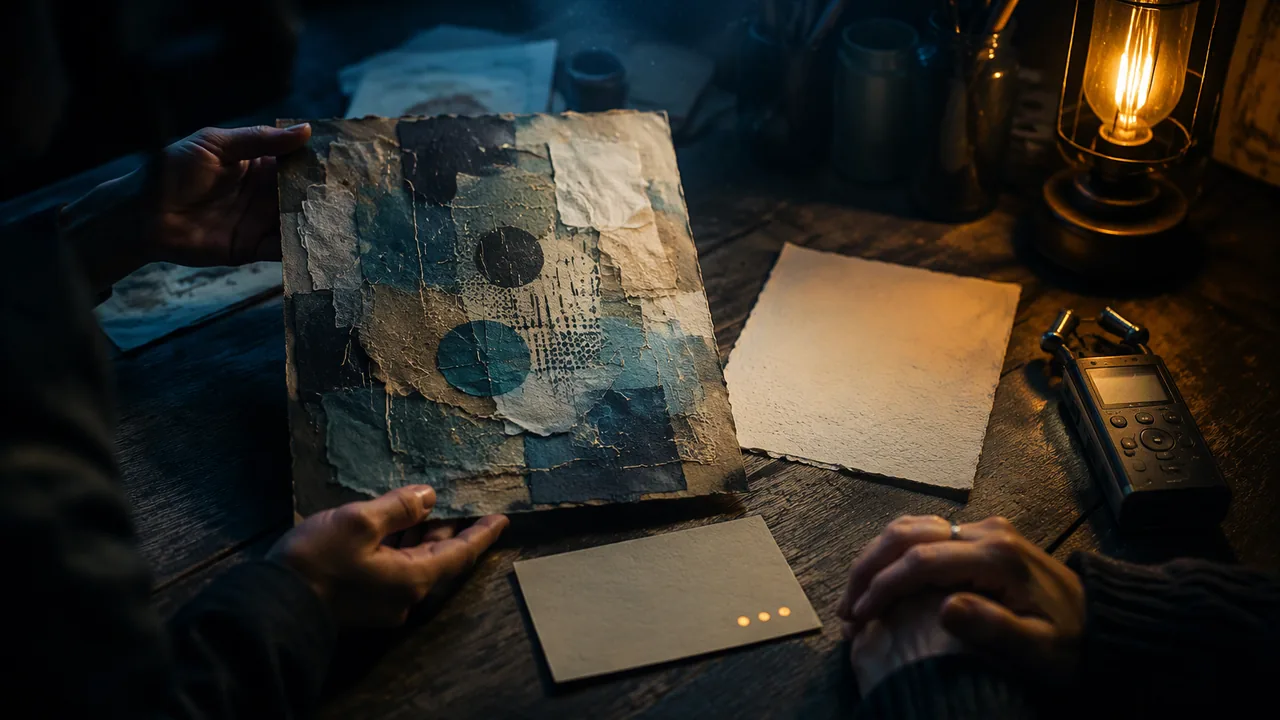
complete and revise a mixed-media collage that interprets my poem, and present the two together, explaining how visual choices carry meaning.
Instruction
Portfolio Task 3 brings your poem and your collage together. It ends the way this kind of project always has, with the work critiqued for visual communication and composition and then presented; here you run the critique yourself and record the presentation.
What you submit. The finished collage (at least 11 x 14 inches) using at least four sampler techniques; the final poem; a materials and credits list; the word-image map from Lesson 3.3; a revision note; and a two- to three-minute recorded presentation.
The critique test. The critique is a blind test you run yourself. Put the collage away for at least a day. Then look at it, or a photograph of it, without the poem beside it, and write the place, mood and idea it communicates as if you had never read the poem. If a family member or other adult is willing, show them the collage first, before they read the poem, and write down their three words too. Then read the poem and note what the collage added that the words did not, and where the image only repeats the text. This tells you whether your collage communicates on its own, which is the standard.
Revising. Common revisions after this critique: strengthening the dominant area so it reads first; removing elements that only illustrate; adding a repeated color or tissue layer to unify; and pressing down lifting edges. Record what you changed and why.
The presentation. Read the poem aloud or have it displayed. Then explain two decisions in which a visual choice (a color, a technique, a scale change, a placement) carries a meaning from the poem. Finish with one thing you would do differently. Record the presentation (video, or audio over a photograph of the collage). You may ask a family member to read your poem in the recording if you prefer.
Care and storage. Collages keep curling and lifting as glue dries. Store yours flat under weight for at least a day before it goes into your portfolio. If edges lift, re-glue with a small brush of PVA and press.
Privacy. Your poem is about a place that matters to you, and it may touch family history. Share only what you are comfortable sharing. A poem about an imagined or chosen place meets the task fully, and no grade depends on personal disclosure.
Looking ahead. Unit 4 ends with the midyear exhibition. Start thinking now about which of your three portfolio pieces best represents you.
📖 Read for this lesson
The reading opens over the lesson; close it to come back to exactly where you were. The checks below draw on it.
Formative check
Work through these before moving on. They are not graded — they tell you whether the standard below has landed yet.
In your blind test, a family member (or you, looking again after a day away) reads your collage as “a busy city,” but your poem is about a quiet village. What should you do?
Write your revision note: what the blind test told you, what you changed, and what you chose to keep.
How confident are you that you can complete a collage that interprets my poem and explain how my visual choices carry its meaning?
Unit 3 checkpoint
Do this before you start the task. It covers the whole unit and tells you what to review first.
What does the lesson say a cut photograph brings into a collage?
Mondrian’s Study for a Composition (1940-41) uses collage mainly as
Bearden’s collages joined fragments of different photographs so that scale shifts and fragments meet, much as memory assembles a place.
A textile technique in which cut fabric shapes are stitched onto a ground cloth is called .
Which copy will work for a packing-tape transfer?
Spray adhesive is the course’s preferred glue for collage because it lays paper flattest.
A poem line names a river. Which visual idea interprets rather than illustrates?
In an poem, the first letters of the lines spell a word.
On the Kashan luster tile, the verses run around the image as a border, so text and picture are read together as one design.
On an 11 x 14 board, what is the largest dominant area allowed by the 15 percent rule?
In what order is the collage built?
Submit: Poem and Collage — final collage, poem, credits, revision note and presentation
Task: Interpret your acrostic poem about a place in a layered mixed-media collage using at least four sampler techniques, revise it after a blind self-test, and present the poem and collage together.
Submission workflow
- Stage 1 — Plan. Drafted poem, word-image map, collected materials with credits, and three structural thumbnails, checked against the Stage 1 list in the brief.
- Stage 2 — Self-critiqued work in progress. Collage with structure and dominant area in place, taken through the blind test after a day away (with an optional family viewer); results recorded.
- Stage 3 — Revised final. Finished collage with revision note and complete credits list.
- Stage 4 — Presentation. Poem and collage presented together in a recording, explaining two visual decisions.
How it is scored
| Criterion | What proficient looks like |
|---|---|
| Visual communication (VA:Cn10A.III) | The collage communicates a place and mood on its own and interprets rather than illustrates the poem. |
| Design and composition (VA:Cr1B.III) | Clear dominant area, unified structure and a planned path for the eye. |
| Technique and craftsmanship (VA:Cr2A.II) | At least four techniques handled with control; flat, secure adhesion; clean edges where intended. |
| Revision (VA:Cr3A.II) | Specific changes made after the blind test, explained. |
| Presentation and credit (VA:Re8A.II) | Two decisions explained with evidence; all borrowed images credited. |
Portfolio Task 3 in Full: Poem and Collage Assignment, Rubric, Blind Self-Test and Exemplar
SLS original assignment, rubric, procedure and exemplar; the exemplar is invented as a model · SLS original
Why this reading. This is the whole assignment for Portfolio Task 3: what you submit, the rubric that scores it, the blind self-test procedure with a worked record, a complete exemplar entry (poem, collage described in words, revision note and presentation script) scored against the rubric, and the presentation timing. You run every step yourself, with an optional family viewer. The exemplar is SLS original, invented as a model; the place in it is imaginary and the collage does not exist. Techniques and layout numbers refer to the sheet for Lesson 3.4.
The assignment
Write an acrostic poem about a place that has shaped you (a place of origin, a neighborhood, a landscape, or an imagined place) and interpret it in a mixed-media collage that interprets the poem rather than illustrating it line by line. Present the poem and collage together.
| Part | What you hand in | Numbers to meet |
|---|---|---|
| 1. Collage | Finished collage using elements and principles and a clear dominant area | At least 11 x 14 inches; at least four sampler techniques; dominant area 15 percent or less of the board; a quiet area of 10 percent or more |
| 2. Poem | The final acrostic | 6 to 12 lines, concrete images |
| 3. Materials and credits list | Every borrowed image credited, with source and rights | Every item listed |
| 4. Word-image map | Each line with its visual idea, technique and element | Each line marked interprets or illustrates |
| 5. Revision note | What the blind test told you, what you changed, what you kept | At least two changes with reasons |
| 6. Presentation | Read or display the poem; explain two decisions where a visual choice carries a meaning from the poem; one thing you would do differently | 2 to 3 minutes; recorded (video, or audio over a photograph of the collage); a family member may read the poem for you |
Privacy. You never have to disclose family history. An imagined or chosen place meets the task fully, and no grade depends on personal disclosure.
The rubric
Score each row 1 to 4; total out of 20.
| Criterion | 4: strong | 3: solid | 2: developing | 1: beginning |
|---|---|---|---|---|
| Communicates without the text | In the blind test, the viewer (you after a day away, or a family viewer) names the place, mood and idea before reading the poem | The viewer names two of the three | The viewer names one | The viewer cannot say what it is about |
| Interpretation, not illustration | Visual choices add meaning the words do not state; at most one line only illustrates | Most lines interpret | Half the lines illustrate | Every line is drawn as written |
| Composition | One clear dominant area, a path for the eye, a rest area, a repeated color three or more times | Dominant area clear; one structural element weak | Competing areas | Scraps with no structure |
| Technique and craft | Four or more sampler techniques used purposefully; edges glued flat; credits complete | Four techniques used; minor lifting | Fewer than four, or credits missing | Techniques unclear |
| Presentation | Two decisions explained with evidence from the work; one honest reflection | Two decisions explained | One decision explained | Description only |
The blind self-test, step by step (about 15 minutes)
- Day away. Put the collage face down or in a folder for at least a day, so you can look at it fresh.
- Silent look (2 min). Look at the collage only, or a photograph of it, with no poem and no title in sight.
- Three words (2 min). Write one word for the place, one for the mood, one for an idea, as if you had never read the poem. Optional: show the collage to a family member or other adult before they know the poem, and write down their three words too.
- Reveal (1 min). Read the poem aloud (to yourself, or to your family viewer).
- Two questions (5 min). “What did the collage add that the words did not?” “Where did the collage only repeat the words?” Write your answers, and your viewer’s if you have one.
- Score (1 min). Match score: how many of the poem’s three key ideas (place, mood, main image) did the three words name, out of 3? If you have two sets of words, score each.
- Decide (3 min). Decide two changes.
The exemplar entry (SLS original; invented as a model)
Poem: ORCHARD (an imagined place). O: Ordered rows of blossom-snow. R: Ripe smell of split plums in a bucket. C: Cousins’ ladders leaning on the sky. H: Heat that hums, then sleeps at noon. A: Ants in a line over a fallen fig. R: Rust on the gate; the latch still works. D: Dusk pours orange into the irrigation ditch.
The collage (11 x 14 in, portrait, 154 square inches), described in words. Ground: pale green paste paper combed in vertical lines. Upper third: a large blue-gray field of tissue over paper (the sky), with thin brown paper strips leaning against it, cropped at the top edge (the ladders). Middle: a monoprint of rows of small white blossom shapes receding on a diagonal. Lower third, the dominant area: a photo transfer of a split plum, 4 x 5 inches (20 square inches, 13 percent of the board), placed on the lower right thirds crossing point on a dark plum-colored halo, the darkest value in the piece. Along the bottom edge: one orange paper strip running the full width. Letters O R C H A R D are cut from fruit-crate labels and run along the left edge, treated as shapes. Rest area: a 4 x 4 inch upper right corner, ground only (10.4 percent). Green appears in the ground, the blossom rows and the ant-line of small stitched marks, three places.
Blind-test record. Three words, from the artist after two days away and from two family viewers: “farm, warm evening, waiting”; “orchard, peaceful, work”; “fruit, sunset, quiet.” The poem’s three key ideas: orchard (place), warm dusk (mood), someone always working up high (idea). Match score: 2 of 3 (place and mood named; the idea of work named by one viewer). “What did it add?” “The ladders leaning off the top of the frame made it feel like the work never ends.” “Where did it only repeat the words?” “The ants: you drew them exactly as written.” Revision note. (1) Removed the drawn ants and replaced them with a line of tiny stitched marks that cross the plum’s edge, so they interpret (a small, steady line crossing something large) instead of illustrate. (2) Enlarged the blue-gray sky field by 1 inch downward so the cropped ladders read as going on past the frame. Kept: the orange strip and the plum transfer.
Presentation (about 270 words; a little over 2 minutes when read aloud):
My poem is about an orchard that I have never visited but carry in my head, from my grandmother’s stories. Here it is: [read the poem]. For the first decision, look at the lower right, where a strip of orange runs along the bottom edge. That orange carries the last line, dusk pouring into the irrigation ditch. I made it the only strip that runs the full width of the collage, and I put it lowest, so the picture ends the way the poem does, with the light sinking away. For the second decision, look at the ladders. In my first version I cut out ladders and glued them beside the words about ladders, and my family said the collage was ‘a picture of a farm.’ That was the illustration problem. I removed the drawn ladders and replaced them with thin brown paper strips leaning against a large blue-gray field, cropped at the top edge, so the ladders lean on the sky and go on past the frame. Now my family said ‘someone is working up high and not coming down.’ The dominant area is the split plum transfer in the lower third, about 4 by 5 inches, on a dark plum-colored halo, because the poem’s smell line is its strongest line. Four techniques from my sampler are in this piece: paste paper for the ground, a monoprint for the blossom rows, tissue glazing over the sky, and a photo transfer for the plum. What I would do differently: I would make the rest area larger. I left about one tenth of the board bare, but the upper right still feels busy.
Scored: Communicates 3 (match score 2 of 3 in the blind test). Interpretation 4 (one line, the ants, illustrated first and was revised). Composition 4 (dominant at the thirds point, path, rest area, green repeated three times). Technique 4 (four sampler techniques, credits complete). Presentation 4. Total 19 of 20. What makes it strong: the artist ran the test, recorded what failed (the ants) and rebuilt it, and can point to two decisions in the work where a visual choice carries a line of the poem.