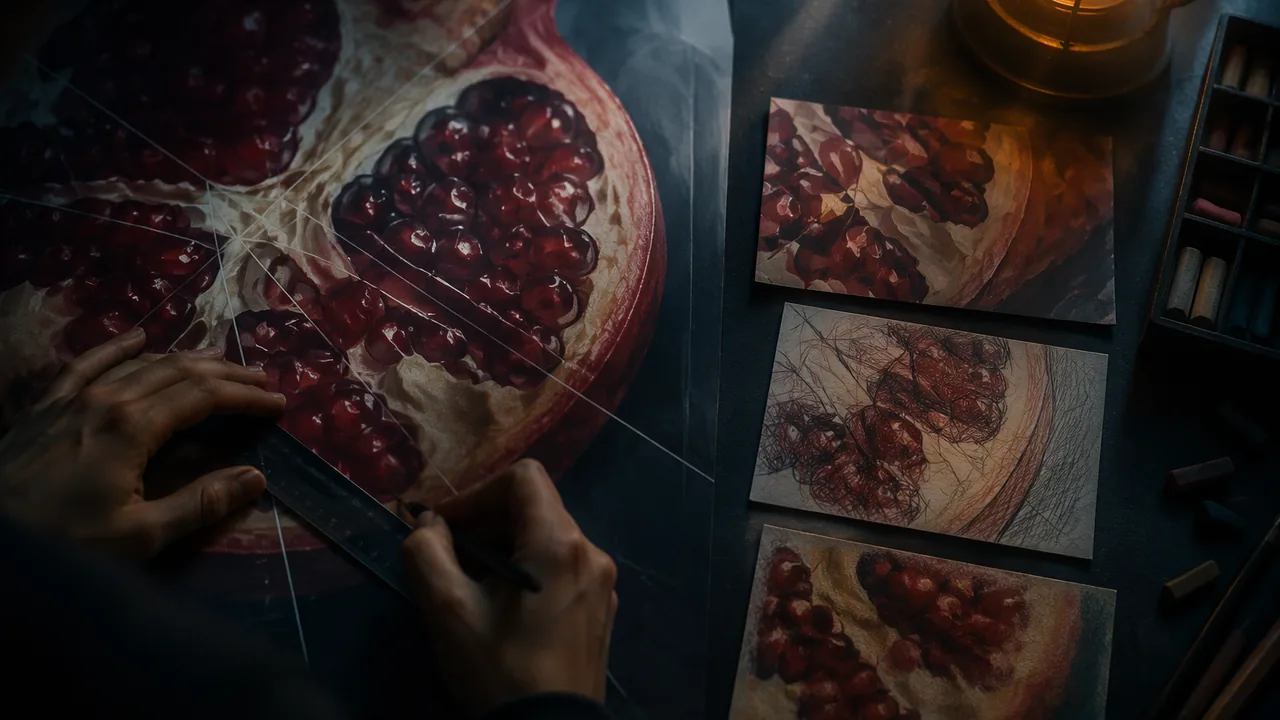
photograph and digitally crop an organic object so it bleeds off three sides, divide it into facets, and test analogous and monochromatic palettes in three media.
Instruction
This lab turns the ideas of Lesson 2.1 into skills you will need for the project. It has three parts: making a strong crop from your own photograph, dividing the form into facets, and choosing a limited palette that holds the facets together.
Choose the object. Pick something organic with interesting structure: a pepper, a shell, a cabbage leaf, a pinecone, a split pomegranate, a succulent. Avoid anything with printed text or a logo. You will look at it for weeks, so choose something you are curious about.
The crop. Photograph the object close up, in side light, against a plain background. Open the photo in GIMP (free) or on a phone. Crop so that the object is enlarged and bleeds off at least three edges of the frame, meaning the form runs out of the picture instead of floating in the middle. A bleed crop changes the relationship between the form and the page: the negative spaces become shapes you must design, and the viewer reads the image as a structure rather than as a portrait of a vegetable. Try at least four crops and keep the one in which the negative spaces are most varied in size.
Using your own photograph. You are working from your own image. That matters. Copying another person’s photograph and presenting the result as your own raises questions of permission and credit. Working from your own photograph makes the source yours.
Faceting. Enlarge the crop to your paper size by printing it or by gridding it. Draw the main contours lightly. Then divide the form into facets using straight lines that follow the object’s own structure: the ridges of a shell, the veins of a leaf, the edges of the highlights and shadows. Let some lines continue past the contour into the background, so that figure and ground interlock, as they do in Cubist paintings. Number the facets. Aim for 20 to 40; fewer looks like a coloring page, more becomes noise.
The limited palette. A monochromatic palette uses one hue in many values and intensities, for example a blue from near-white tint to near-black shade. An analogous palette uses three to five hues that sit next to each other on the color wheel, such as yellow-green, green and blue-green. Both create harmony because every color shares something with its neighbors. Within the palette, you still need a full value range: each facet is a separate value step, so a form turning away from the light gets progressively darker facets.
A worked example. For a green bell pepper lit from the left, an analogous palette of yellow, yellow-green, green and blue-green works well. The lightest facets on the left lobe get a pale yellow-green tint; the halftones get green; the core shadows get a dark blue-green; the background facets use the same hues at lower intensity so they recede. The form still reads as a pepper, but it is now built from planes.
Three media, three behaviors. Colored pencil builds color in thin transparent layers and can be burnished for smooth, saturated areas. Watercolor is transparent and flows; you must plan the lights, because the paper is the white. Oil pastel is opaque, buttery and bold, and resists fine detail. Test each on your palette sheet before you choose.
📖 Read for this lesson
The reading opens over the lesson; close it to come back to exactly where you were. The checks below draw on it.
Studio: Crop, enlarge, facet
Question. How can you crop and facet a natural form so that it bleeds off three sides and reads as a unified abstract structure in a limited palette?
Materials
- An organic object you choose (vegetable, fruit, shell, leaf, pinecone)
- A phone or any digital camera and GIMP (free) or a phone photo editor for cropping
- Ruler, graphite pencil and eraser; tracing paper or a printed grid
- Colored pencils, a watercolor set with a round brush, and oil pastels
- Mixed-media or watercolor paper, 9 x 12 inches for tests
- If a fruit or vegetable must be cut to show its structure, an adult cuts it or supervises, using a cutting board and a knife with the blade directed away from the body.
- Check for food allergies in your household before choosing produce, and do not eat anything used as studio material.
- Oil pastel residue is greasy: wipe hands with a dry paper towel and wash with soap before touching phones or keyboards.
Procedure
- Photograph your object close up in side light against a plain background, from at least three angles.
- In GIMP or a phone editor, make four different crops in which the form bleeds off at least three edges. Save each and choose the one with the most varied negative spaces.
- Transfer the chosen crop to paper at final size by printing and tracing, or with a proportional grid.
- Divide the form and background into 20-40 facets with straight lines that follow the object’s structure; let some lines cross the contour into the background. Number the facets.
- Choose an analogous or monochromatic palette of no more than five colors. Make a nine-step value strip in each medium using only that palette.
- Render the same small section of your faceted drawing three times, once each in colored pencil, watercolor and oil pastel.
- Tape the three tests side by side and annotate which medium best serves your object and why.
Data
| Medium | Value range achieved (1-9) | Edge quality between facets | Time for one section | Best suited to |
|---|---|---|---|---|
| Colored pencil | ||||
| Watercolor | ||||
| Oil pastel |
Analysis
- Which crop did you choose, and how do its negative spaces change the way the form reads? Compare it with one crop you rejected.
- Which medium gave you the clearest separation between facets while keeping the form unified? Use your test sheet as evidence.
- Where did the faceting interfere with the form instead of supporting it? What will you change in the final?
If you cannot do this studio in person: Photograph and crop with any phone’s built-in editor; if no device is available, crop with two L-shaped pieces of card over a direct observational drawing. Test the palette in whichever one or two media you have at home.
Formative check
Work through these before moving on. They are not graded — they tell you whether the standard below has landed yet.
Which palette is analogous?
You divide a pepper into 120 tiny facets. What will most likely happen?
Working from your own photograph avoids the permission and credit problems of copying someone else’s image.
How confident are you that you can crop a form to bleed off three sides, facet it and test a limited palette in three media?
Practice
Work these on paper or in your notebook, then open Check your answer. Aim for all of Fluency and Application; try at least one Challenge.
Printable version: this unit’s practice workbook (PDF)
Fluency
Build speed and accuracy with the core skill.
- Define monochromatic and analogous palettes and give an example of each.
Check your answer
Answer: Monochromatic: one hue in many values and intensities (a blue from near-white tint to near-black shade). Analogous: three to five hues that sit next to each other on the color wheel (yellow-green, green, blue-green).Both create harmony because every color shares something with its neighbors. - What does it mean for a form to bleed, and how many edges must your crop bleed off?
Check your answer
Answer: The form runs off the edges of the picture instead of sitting inside them. The crop must bleed off at least three edges.The negative spaces then become shapes you must design. - Describe how each of the three lab media behaves: colored pencil, watercolor, oil pastel.
Check your answer
Answer: Colored pencil builds color in thin transparent layers and can be burnished for smooth, saturated areas. Watercolor is transparent and flows; you plan the lights because the paper is the white. Oil pastel is opaque, buttery and bold, and resists fine detail.Test each on the palette sheet before choosing.
Application
Use the skill in context. Show your reasoning.
- Using the lab kit’s crop test (biggest negative shape divided by smallest, and at least three bleed edges), decide which crop to keep: Crop P bleeds 3 edges, shapes 8, 4, 2; Crop Q bleeds 4 edges, shapes 6, 6, 5; Crop R bleeds 2 edges, shapes 12, 3, 1.
Check your answer
Answer: Keep Crop P.Ratios: P = 8 / 2 = 4; Q = 6 / 5 = 1.2; R = 12 / 1 = 12. R fails the bleed rule (only 2 edges). Of P and Q, which both bleed off at least three edges, P has the more varied negative shapes (4 vs 1.2). - Your paper is 12 x 16 inches. What is the average facet area if you use 20 facets? 40 facets? 120 facets? Which is too many, and why?
Check your answer
Answer: 20 facets: 9.6 sq in; 40 facets: 4.8 sq in; 120 facets: 1.6 sq in. 120 is too many: the facets become visual noise and the form is hard to read.Area = 12 x 16 = 192 sq in. 192 / 20 = 9.6; 192 / 40 = 4.8; 192 / 120 = 1.6. - Plan an analogous palette for a red-orange pepper (or another warm object) lit from the left, following the lesson’s green-pepper example: name the hues and say which facets get which.
Check your answer
Answer: Model: red, red-orange, orange and yellow-orange. Lightest facets on the lit side get a pale yellow-orange tint; halftones get orange and red-orange; core shadows get a dark red; background facets use the same hues at lower intensity so they recede.The hues must be neighbors on the color wheel, and each facet still needs its own value step so the form turns. - The lesson says to use your own photograph. Explain the reason in terms of permission and credit.
Check your answer
Answer: Copying another person’s photograph and presenting the result as your own raises questions of permission and credit. Working from your own photograph makes the source yours.If you ever use someone else’s photograph, you need their permission and must credit them.
Challenge
Stretch problems. Expect to think before you write.
- Use the kit’s worked palette-test scores (value range, edge control, speed, each 1-5): colored pencil 4, 5, 2; watercolor 3, 3, 4; oil pastel 3, 2, 5. Your object needs crisp facet edges most. Which medium do you choose, and what is each medium’s total if you count edge control double?
Check your answer
Answer: Colored pencil. Totals with edge control doubled: colored pencil 4 + 10 + 2 = 16; watercolor 3 + 6 + 4 = 13; oil pastel 3 + 4 + 5 = 12.Doubling the criterion that matters most to your object makes the choice explicit; taped watercolor is the kit’s other option for crisp edges.
Review
Keep earlier skills sharp.
- Review (Lesson 2.1): which earlier movement’s method is this lab’s faceting closest to, and what palette did that movement often use?
Check your answer
Answer: Cubism (Picasso and Braque, around 1908-1912): forms broken into small angular facets, each shaded as a separate plane, with the palette often reduced to browns, grays and ochres so color would not distract from structure.That is exactly the method of the unit project: facet a form into planned sections and render them in a limited palette.
Crop, Facet and Palette Lab Kit: Measuring a Crop, Sizing Facets and a Palette Test Sheet
SLS original technique kit with worked numbers · SLS original
Why this reading. The lab has three parts (a bleed crop from your own photograph, a faceting plan of 20 to 40 facets, a limited palette tested in three media) and asks you to try at least four crops and keep the one whose negative spaces vary most in size. That instruction needs a way to measure variety, the facet range needs a check against your paper size, and the palette test needs a sheet to fill in. This kit supplies all three, with worked numbers. It is SLS original. Your own photograph is your only image source for this lab, so there are no museum works to credit here; the free image editor GIMP (or a phone editor) is a tool, not a source.
Measuring a crop: negative-space variety
Print each crop at 4 x 6 inches, or draw its frame at that size. Lay a 1-inch grid over it (24 squares). A negative space is any area of background that the object encloses or separates from the frame’s edge. Count the squares in each negative shape (estimate halves). For each crop, divide the biggest by the smallest. Also check the bleed: the object must run off at least three edges.
| Crop | Bleeds off how many edges | Negative shapes (squares) | Biggest / smallest | Keep? |
|---|---|---|---|---|
| A: centered, object floating | 0 | 6, 5, 4, 4 | 1.5 | No: fails the bleed rule and the shapes are alike |
| B: enlarged, cropped at left, bottom and right | 3 | 9, 3, 1 | 9 | Yes: bleeds off three edges and the shapes vary most |
| C: object cropped on all four sides | 4 | 7, 7, 6 | 1.2 | No: bleeds, but the shapes are uniform |
| D: cropped at left and bottom | 2 | 10, 4, 2, 1 | 10 | No: passes the variety test but bleeds off only two edges |
Worked reading of the table: a crop must pass both tests. D has the largest ratio (10) but bleeds off only two edges, so it fails. Among the crops that bleed off at least three edges, B (ratio 9) beats C (ratio 1.2), so B is kept. Record which you kept and why.
How many facets on your paper
The lab asks for 20 to 40 facets. Divide the paper’s area by the count to see how big an average facet is: on a 12 x 16 inch sheet (192 square inches), 20 facets average 9.6 square inches, and 40 average 4.8. A hundred and twenty facets would average 1.6 square inches, which is too small to hold a pencil stroke and makes the form unreadable, as the lab warns. Aim for facets of different sizes, not equal ones (see the tests in the sheet for Lesson 2.4). Number every facet.
The color wheel, and two palettes
Twelve hues in order around the wheel: yellow, yellow-orange, orange, red-orange, red, red-violet, violet, blue-violet, blue, blue-green, green, yellow-green (then back to yellow). Analogous palettes take three to five neighbors, for example yellow-green, green, blue-green; or yellow, yellow-orange, orange. Monochromatic palettes take one hue in tints (with white or paper) and shades (with a dark). Every facet still needs its own value step.
The palette test sheet: layout and a worked row
Rule a table of three columns (colored pencil, watercolor, oil pastel) and seven rows (value steps 1 to 7), each cell 1 x 1 inch, on a sheet of the paper you plan to use. Beside it write, for each medium: layers used, minutes to finish a step, how it blended, and a score from 1 to 5 for value range, edge control, and speed.
| Medium | Layers for step 4 | Minutes for the 7 steps | Value range (1-5) | Edge control (1-5) | Speed (1-5) | Notes |
|---|---|---|---|---|---|---|
| Colored pencil (worked example) | 4 light layers | 35 | 4 | 5 | 2 | Very clean edges; slow; burnished last |
| Watercolor (worked example) | 2 washes | 15 | 3 | 3 | 4 | Bled once between steps; needs planning of lights |
| Oil pastel (worked example) | 1 heavy layer | 10 | 3 | 2 | 5 | Bold but difficult to hold a thin edge |
| Your test |
Choose the medium for your project by the scores that matter to your object. If you need crisp facet edges, colored pencil or taped watercolor wins; if you need speed and boldness, oil pastel wins.
Your own photograph
Working from your own photograph makes the source yours. Photograph close, in side light, against a plain background, with no printed text or logo. If you were ever to use a photograph by another person, you would need their permission and a credit.