analyze how a medium, including digital media, changes the meaning and reception of an image, and judge how relevant other people’s criteria are.
Instruction
This course asks you to analyze the material an artist used and describe how it influences the meaning of the work, and to compare work made in electronic media with work made in traditional materials. This lab does both, using your own palette tests from Lesson 2.2 and works from the museum collections.
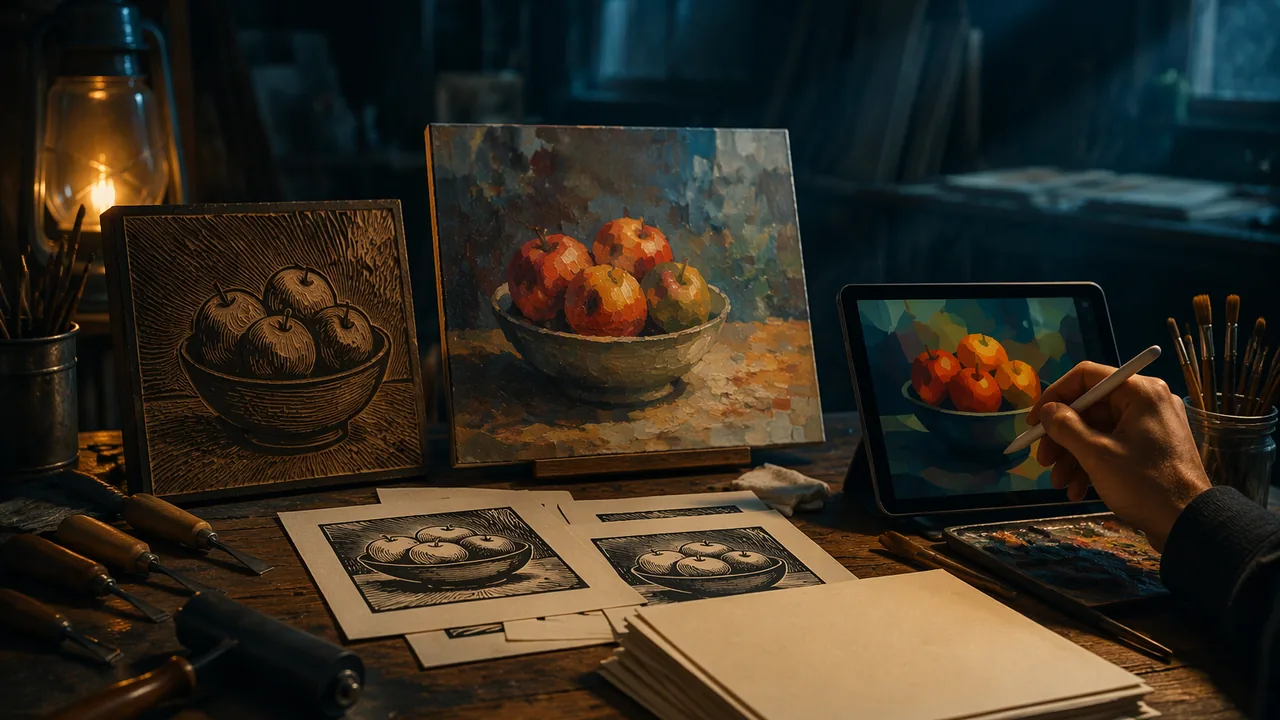
Medium is part of the message. The same subject in different media is not the same work. Compare Hokusai’s Great Wave, a woodblock print (1830/33, Art Institute of Chicago), with Cezanne’s oil painting The Basket of Apples. A woodblock print is made by carving a separate block for each color and printing them in register, so the medium favors flat areas of color and clear contour lines, and it produces many impressions that could be sold cheaply. The Great Wave’s crisp outlines and flat blues are partly a result of that process, and its wide circulation is a result of the print being a multiple. Cezanne’s oil paint, laid on in visible patches, carries the record of looking and adjusting over time. It is a single object. The materials shape not only how each image looks but how it was used and who saw it.
Questions for any material. Is it transparent or opaque? Does it allow correction? Is it fast or slow? Is it a unique object or a multiple? Does it carry cultural associations, such as gold, silk, bark cloth or a spray can? Was it chosen by the artist or dictated by what was available? The Chilkat garment you ranked in Unit 1 is woven from cedar bark and mountain goat hair; those materials tie it to a specific place and to the labor and knowledge of the weaver who made it.
Electronic and traditional media. Digital drawing tools such as Krita imitate pencils, watercolor and oil. What changes? Undo removes the risk of a mistake. Layers let you test changes without committing. Color can be sampled perfectly. The finished image can be copied endlessly without loss, and it can be altered by others. Some artists argue that removing risk removes something important; others argue that the tool frees attention for decisions that matter more. Both views have evidence behind them.
A worked comparison. One student made the same pepper section in oil pastel and in Krita using a pastel brush. The digital version had cleaner facet edges and a perfectly matched palette. The oil pastel version had uneven pressure, visible paper texture and one facet where two colors had mixed. When she showed both to her family, most of them judged the digital version more “correct” but the pastel version more alive. Neither judgment is wrong; they use different criteria. The first is formal precision; the second values the evidence of the hand.
Judging criteria. Standard VA:Re9A.II asks you to determine whether the criteria others use are relevant. In your notes, and whenever you hear or read someone say a digital work is “not real art” or a hand-made one is “sloppy,” ask which criterion they are using and whether it suits the work’s purpose. A poster designed for thousands of copies should not be judged by the criteria for a unique painting.
Responsibility. Digital images are easy to copy and change. If you use someone else’s photograph, even as a starting point, you owe them credit and may need permission. If you alter a photograph, you are responsible for not presenting it as an unaltered record.
📖 Read for this lesson
The reading opens over the lesson; close it to come back to exactly where you were. The checks below draw on it.
Formative check
Work through these before moving on. They are not graded — they tell you whether the standard below has landed yet.
Which fact about the woodblock process best helps explain the flat blue areas and crisp outlines in The Great Wave?
A commenter on an art forum says a digital drawing is “not real art because you can undo.” What is the best response?
Compare two of your palette tests (or one hand-made and one digital version). Write 5-7 sentences on how the medium changed what the image communicates, and which criterion you would use to judge each.
How confident are you that you can explain how a medium shapes meaning and judge whether someone’s criteria fit the work?
Practice
Work these on paper or in your notebook, then open Check your answer. Aim for all of Fluency and Application; try at least one Challenge.
Printable version: this unit’s practice workbook (PDF)
Fluency
Build speed and accuracy with the core skill.
- Define medium, multiple and register.
Check your answer
Answer: Medium: the material or technique an artist uses (oil paint, woodblock, colored pencil, digital drawing). Multiple: a work produced in many equivalent copies, such as a print or a digital file. Register: the exact alignment of separate blocks or layers in printing.Glossary terms for this lesson. - List four of the lesson’s questions you can ask about any material.
Check your answer
Answer: Any four of: Is it transparent or opaque? Does it allow correction? Is it fast or slow? Is it a unique object or a multiple? Does it carry cultural associations (gold, silk, bark cloth, a spray can)? Was it chosen by the artist or dictated by what was available?These questions turn a list of materials into an analysis of meaning. - Name three things that change when a drawing is made in a digital tool like Krita instead of by hand.
Check your answer
Answer: Any three: undo removes the risk of a mistake; layers let you test changes without committing; color can be sampled perfectly; the image can be copied endlessly without loss; it can be altered by others.Some artists argue removing risk removes something important; others that it frees attention for decisions that matter more.
Application
Use the skill in context. Show your reasoning.
- Compare The Great Wave and The Basket of Apples as objects: how did each medium shape how the image looks and how it was used?
Check your answer
Answer: The woodblock print was carved one block per color and printed in register, which favors flat color and clear contour lines; it is a multiple, so many impressions could be sold cheaply and it circulated widely. Cezanne’s oil, laid on in visible patches, records looking and adjusting over time; it is a single, unique object.A strong answer covers both appearance and use (who saw it, how many existed). - In the worked comparison, the family judged the digital pepper more “correct” and the oil-pastel pepper more “alive.” Name the criterion behind each judgment.
Check your answer
Answer: “Correct” uses formal precision (clean facet edges, perfectly matched palette). “Alive” values the evidence of the hand (uneven pressure, paper texture, a facet where colors mixed).Neither judgment is wrong; they use different criteria. - Someone calls a poster designed to be printed in thousands of copies “worse than a painting because it is not unique.” Use Re9.HSII to respond in two or three sentences.
Check your answer
Answer: Model: “Uniqueness is a criterion for a one-of-a-kind painting, not for a poster whose purpose is to reach many people. A fairer criterion is how well it communicates at a distance and in many copies. Judged that way, being a multiple is part of its success.”The strong answer names the critic’s criterion and tests whether it suits the work’s purpose. - You alter a photograph of your object in GIMP (you darken the background and remove a bruise). What responsibility does the lesson say you now have?
Check your answer
Answer: You are responsible for not presenting the altered photograph as an unaltered record. (If the photograph were someone else’s, you would also owe credit and might need permission.)Digital images are easy to copy and change, which is why the responsibility falls on the person who changes them.
Review
Keep earlier skills sharp.
- Review (Lesson 1.3): the Chilkat garment is woven from cedar bark and mountain goat hair. Which family of criteria from Unit 1 does the meaning of those materials most support, and why?
Check your answer
Answer: Functional (and expressive) criteria: the materials tie the garment to a specific place and to the weaver’s labor and knowledge, and it was made to be worn on ceremonial occasions, so judging how it serves that purpose is fairer than imitational criteria.Lesson 2.3 adds that material is part of meaning, which strengthens the Unit 1 point about fair criteria.
Hand, Block, Loom and Screen: How Three Objects Were Made, Two Published Voices, and a Comparison Sheet
Art Institute of Chicago records 24645, 111436; Cleveland Museum of Art Open Access record 1981.69 (retrieved 26 September 2026); Ruskin, The Stones of Venice, vol. 2 (1853), Project Gutenberg #30755; Dow, Composition (1914), Project Gutenberg #45410; Metropolitan Museum of Art, “Woodblock Prints in the Ukiyo-e Style” (Heilbrunn Timeline of Art History); Burke Museum, “Unpacking a phrase: The Chilkat blanket” · CC0 (museum data); Public domain (Ruskin, Dow); SLS original (process notes, comparison sheet and model)
Why this reading. The lesson asks you to explain how a material shapes meaning, to compare a hand-made and a digital version of one subject, and to test other people’s criteria for relevance. That needs three things the lesson mentions but cannot show: the actual facts about how each museum object was made, two published voices on hand and tool that you can argue with, and a way to run the comparison if you skipped a palette test. Museum data is CC0 (Art Institute of Chicago 24645, 111436; Cleveland Museum of Art 1981.69; retrieved 26 September 2026). Ruskin (1853) and Dow (1914) are public domain. The process notes, comparison sheet and worked paragraph are SLS original, with process facts checked against the Metropolitan Museum’s and Burke Museum’s published essays and paraphrased, not copied.
Three objects, three sets of material facts
| Object | What it is made of and how | What the record adds |
|---|---|---|
| Hokusai, Under the Wave off Kanagawa (The Great Wave), 1830/33; color woodblock print, 25.4 x 37.6 cm; Art Institute of Chicago, 1925.3245 | A design drawn by the artist, cut into wood by a carver, and printed by hand by a printer, with a publisher (here Nishimura-ya Yohachi) paying for and selling it. A color print takes a separate carved block for each color, printed one after another on the same sheet; small notches on each block (registration marks, in Japanese kento) keep the paper aligned. The paper is strong and absorbent, made from mulberry bark. Because printing was done by hand, the printer could blend one color into another on the block, and you can see this as the gradation in the sky near Mount Fuji | The AIC notes the series’ heavy use of the newly affordable Berlin blue pigment, and that the museum’s three impressions of the design are all later than the first state. So it was printed many times, and each impression differs slightly |
| Cézanne, The Basket of Apples, c. 1893; oil on canvas, 65 x 80 cm; Art Institute of Chicago, 1926.252 | One canvas, painted by one hand over time in oil paint, which stays workable for days and can be scraped, overpainted or left thin. The paint is laid on in visible strokes | The AIC describes shifts of brushwork from thick strokes that model the fruit to sketch-like marks near the edges of the table and cloth, and notes that he rarely signed, so the signature suggests the painting mattered to him or its first owner |
| Tlingit maker, Ceremonial Garment (Naaxein), late 1800s; weft twining of cedar bark wrapped with mountain goat hair, 137.8 x 175.3 cm; Cleveland Museum of Art, 1981.69 | The Burke Museum explains that the weft is yarn spun from two strands of plucked mountain goat wool, twined by hand across fixed vertical strands of shredded, twisted cedar bark wrapped in goat wool, and that women did the weaving after spring gathering of materials. Every shape in the design, including each curve, is built up by hand, thread by thread | The record names the materials and technique and does not name the weaver. Burke: these garments were worn by noble women and men, particularly chiefs, on extraordinary ceremonial occasions, and the fringe swirls as the wearer dances |
Questions for any material
Transparent or opaque? Can it be corrected? Fast or slow? A unique object or a multiple? Does it carry associations (gold, silk, bark cloth, a spray can)? Was it chosen or forced by what was available? Use them like a checklist: for each object above, write one fact for each question you can answer from the table.
Two published voices on the hand and the tool (public domain; both written before digital tools)
John Ruskin, The Stones of Venice, vol. 2 (1853), chapter “The Nature of Gothic,” section XXV: “The second reason is, that imperfection is in some sort essential to all that we know of life. It is the sign of life in a mortal body, that is to say, of a state of progress and change.” He argues that irregularities in handwork are “not only signs of life, but sources of beauty.” Position card: the visible hand carries life, and removing it removes something.
Arthur Wesley Dow, Composition (9th ed., 1914): “The tool always gives character to work, and the best results are obtained when the possibilities of tools and materials are fully appreciated.” Position card: choose the tool whose nature suits the idea, and judge the work by whether it used its tool’s possibilities.
Third card (SLS original, from the lesson): the purpose decides the criteria. A poster for thousands of copies is not judged as a unique painting.
Neither Ruskin nor Dow wrote about screens. Your job is to say what each would ask of a digital drawing, and whether the answer holds. When someone says “a digital drawing isn’t real art because you can undo,” use the cards: which position is being used, and does the object’s purpose make it relevant?
Run the comparison if you do not have palette tests
Subject: the cut face of a pepper, about 4 x 4 inches. Version A in a traditional medium (oil pastel, colored pencil or watercolor); version B in a free digital painting program with a matching brush. Give each 20 minutes. Fill in the log:
| Measure | Version A (hand-made) | Version B (digital) |
|---|---|---|
| Minutes to a first recognizable image | ||
| Corrections made (erasures, undos, overpaints) | ||
| Layers or passes used | ||
| Marks that show pressure, speed or an accident | ||
| Color: matched exactly, or mixed by eye? | ||
| Can it be copied without loss? | ||
| One phrase for what the image communicates |
A worked comparison paragraph (SLS original; a model of the 5 to 7 sentences asked for)
“Hokusai’s print and Cézanne’s painting show two ways that a medium shapes meaning. The Great Wave was drawn by one person, cut by another and printed by a third, using a separate block for each color, so its crisp outlines and flat blues are results of a process built for repetition; the Art Institute has three impressions, all later than the first state. Cézanne’s canvas is one object made by one hand over time, and its sketch-like edges and thick modeling strokes keep the record of adjusting and looking. I would judge the print by criteria of design and circulation, since it was made to be seen in many copies, and the painting by criteria of process and evidence of decisions, since it exists only once. Judged by the wrong criteria, each would lose: a print called ‘not unique’ or a painting called ‘not repeatable’ would fail for reasons that have nothing to do with what the maker intended.”
Credit and honesty when you use images (a tool, and a rule)
Museums that release images as CC0 or public domain (the Art Institute of Chicago, the Cleveland Museum of Art and the Metropolitan Museum of Art all do for many objects) may be used with a credit. A credit line has creator, title, date, museum and accession number, plus the rights status: “Katsushika Hokusai, Under the Wave off Kanagawa, 1830/33, Art Institute of Chicago, 1925.3245, public domain.” If you use a photograph by another person, credit the person and check the license. If you alter a photograph, label it “digitally altered” so it is not mistaken for an unaltered record.
Sources: Art Institute of Chicago, Under the Wave off Kanagawa, 1925.3245 (artic.edu); Art Institute of Chicago, The Basket of Apples, 1926.252 (artic.edu); Cleveland Museum of Art, Ceremonial Garment (Naaxein), 1981.69 (clevelandart.org); John Ruskin, The Stones of Venice, vol. 2 (Project Gutenberg) (gutenberg.org); Arthur Wesley Dow, Composition (Project Gutenberg) (gutenberg.org); Metropolitan Museum of Art, Woodblock Prints in the Ukiyo-e Style (metmuseum.org); Burke Museum, Unpacking a phrase: The Chilkat blanket (burkemuseum.org)