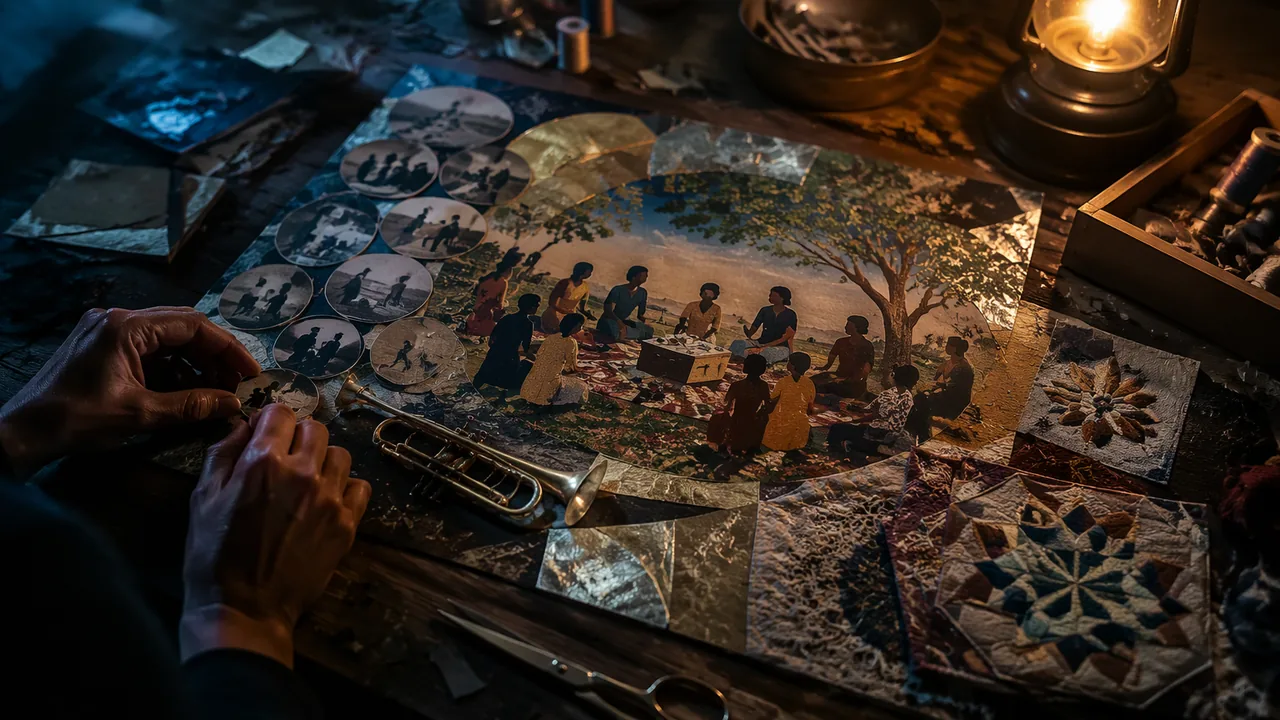
compare how collage has been used for different purposes in several periods and communities, and explain how found materials bring meaning into a work.
Instruction
Collage comes from the French coller, to glue. The word became common in the twentieth century, but people were cutting, pasting and combining images long before. This course asks you to survey collage artists and their methods; this lesson traces several routes and asks one question of each: what do the found materials bring with them?
Collage as record and celebration. In the 1860s the Paris photographer André Adolphe-Eugène Disdéri assembled many small portrait photographs into montages such as Mosaique: The Imperial Court of Napoleon III (c. 1866, Cleveland Museum of Art). The collage turns separate portraits into a single picture of a social world. An unknown maker produced the Civil War Collage (c. 1860/70, Art Institute of Chicago) from albumen photographs. Juan Pedro Chabalgoity combined a photograph with a lithograph in Photo Collage: Musician Playing Trumpet (c. 1875, The Metropolitan Museum of Art). In each, cut photographs keep their authority as records of real people while the arrangement is invented.
Collage with a cause. Susan Torrey Merritt’s Anti-Slavery Picnic at Weymouth Landing, Massachusetts (c. 1845, Art Institute of Chicago) combines watercolor and ink with collage of painted and metallic papers. It records a gathering of the abolitionist movement. Look at which parts are painted and which are cut and applied, and ask why a maker might choose to build figures from cut paper.
Fabric collage. Appliqué, in which cut shapes of cloth are stitched onto a ground, is collage in textile. Sarah Ann Wilson’s Album Quilt (1854, Art Institute of Chicago) is appliquéd, pieced and embroidered. Album quilts gather many blocks into one object, often to mark a relationship or an event. Here the materials are fabrics with their own histories of use.
Modernist collage. Kurt Schwitters made collages he called Merz from tickets, wrappers and scraps he collected in the streets. Little Dance (1920, Cleveland Museum of Art) is one. The scraps bring the everyday world into the picture, and their printed letters become shapes. Piet Mondrian used cut and pasted papers to plan paintings: his Study for a Composition (1940-41, Art Institute of Chicago) lets him move a colored rectangle before committing it in paint. Here collage is a planning tool, like a sketchbook.
Romare Bearden. Romare Bearden (1911-1988), whose collages and photomontages of African American life, made from magazine photographs, painted papers and fabric, are among the most important of the twentieth century. His work is still under copyright, so we study it by description; you can look at his collage The Return of Odysseus (1977) on the Art Institute of Chicago’s own page. Bearden cut faces, hands and buildings from different photographs and joined them so that scale shifts and fragments meet, much as memory assembles a place. The contemporary collage artists Jonathan Talbot and Jeremy Sutton are also worth researching for your sketchbook.
What materials bring. A cut photograph brings its claim to truth. A bus ticket brings a date and a journey. A piece of fabric brings the person who wore it. When you collect materials for your own collage, ask what each one will carry into the work, and whether you want that meaning there.
📖 Read for this lesson
The reading opens over the lesson; close it to come back to exactly where you were. The checks below draw on it.
Formative check
Work through these before moving on. They are not graded — they tell you whether the standard below has landed yet.
Mondrian’s Study for a Composition uses cut and pasted papers. What was collage most likely doing for him in this study?
Disdéri, Mosaique (c. 1866)
Tap to revealPortrait photographs assembled into one image of a social world.
Merritt, Anti-Slavery Picnic (c. 1845)
Tap to revealWatercolor with collaged papers recording an abolitionist gathering.
Wilson, Album Quilt (1854)
Tap to revealAppliqué: collage in textile, gathering many blocks into one object.
Schwitters, Little Dance (1920)
Tap to revealMerz collage from street scraps; printed letters become shapes.
Bearden
Tap to revealPhotomontage of African American life; fragments joined like memory.
Choose two works from this lesson made for different purposes. For each, name one found material and explain what meaning it brings into the work.
How confident are you that you can compare how collage has been used for different purposes and explain what found materials bring?
Practice
Work these on paper or in your notebook, then open Check your answer. Aim for all of Fluency and Application; try at least one Challenge.
Printable version: this unit’s practice workbook (PDF)
Fluency
Build speed and accuracy with the core skill.
- Where does the word collage come from, and how does the lesson define collage, photomontage and assemblage?
Check your answer
Answer: From the French coller, to glue. Collage: a work made by attaching cut, torn or found materials to a surface. Photomontage: a collage made from cut and combined photographs. Assemblage: a three-dimensional collage of found objects.The word became common in the twentieth century, but people cut and pasted images long before. - What is appliqué, and which work in the lesson uses it?
Check your answer
Answer: A textile technique in which cut shapes of fabric are stitched onto a ground cloth; collage in textile. Sarah Ann Wilson’s Album Quilt (1854, Art Institute of Chicago) is appliquéd, pieced and embroidered.Album quilts gather many blocks into one object, often to mark a relationship or event. - Name what each found material brings into a work, according to the lesson: (a) a cut photograph, (b) a bus ticket, (c) a piece of fabric.
Check your answer
Answer: (a) its claim to truth; (b) a date and a journey; (c) the person who wore it.Ask what each material will carry into the work, and whether you want that meaning there.
Application
Use the skill in context. Show your reasoning.
- Compare the purpose of collage in Disdéri’s Mosaique: The Imperial Court of Napoleon III and in Mondrian’s Study for a Composition.
Check your answer
Answer: Disdéri assembled many small portrait photographs into one picture of a social world: collage as record and celebration. Mondrian used cut and pasted papers to move a colored rectangle before committing it in paint: collage as a planning tool, like a sketchbook.A strong answer names a different purpose for each and the evidence for it. - In the photocollages of the 1860s-1870s, cut photographs “keep their authority as records of real people while the arrangement is invented.” Explain what that means and why it can make such a collage persuasive.
Check your answer
Answer: Each photograph is a true record of a real person, so the viewer trusts it; but the maker chose how the pieces sit together, inventing a scene that never happened as a single image. The truth of the parts lends belief to the invented whole.This is the “claim to truth” a cut photograph brings with it. - Schwitters made his Merz collages, such as Little Dance (1920), from tickets, wrappers and scraps. What two things do these scraps do in the picture, according to the lesson?
Check your answer
Answer: They bring the everyday world into the picture, and their printed letters become shapes.The scraps carry meaning and also work formally as shapes in the composition. - Susan Torrey Merritt’s Anti-Slavery Picnic at Weymouth Landing combines watercolor and ink with collaged painted and metallic papers. Suggest one reason a maker might build figures from cut paper rather than paint them, and say what the work records.
Check your answer
Answer: Model: cut paper gives crisp, separate shapes that stand out from the painted setting and can be arranged and rearranged before gluing (metallic papers also add shine). The work records a gathering of the abolitionist movement.The lesson asks you to look at which parts are painted and which cut; any reasoned answer tied to how cut paper looks or works is acceptable.
Review
Keep earlier skills sharp.
- Review (Lesson 2.3): a photomontage is made from photographs, which can be copied. Using Unit 2’s idea that medium shapes meaning, explain why a cut photograph in a collage means something different from a painted portrait of the same person.
Check your answer
Answer: The photograph brings a claim to truth as a record of a real person and is a mechanical image that could be a multiple; a painted portrait carries the record of a painter’s looking and hand and is a single object. The material changes how the viewer trusts and reads the image.Medium is part of the message: the same subject in different media is not the same work.
A Survey of Collage in Nine Records: What Each Is Made Of, What It Was For, How It Is Built
Cleveland Museum of Art Open Access records 2019.69 and 1963.1; Art Institute of Chicago records 204013, 73987, 153633, 142570, 93903, 253744; Metropolitan Museum of Art object 764763 (all retrieved 26 September 2026) · CC0 (museum data, including descriptions from the Cleveland Museum of Art and Art Institute of Chicago open-access records); SLS original (survey sheet, model entry, viewing notes). Works by Romare Bearden are in copyright and are described, not reproduced
Why this reading. The lesson asks you to survey five collage works, and for each to note the source materials, the purpose and the structure, then compare two works made for different purposes. That needs what each work is made of, what the museum says it was for, and how it is put together, all in words. Here are nine records, seven of them free for reuse and two by Romare Bearden, whose work is still in copyright and so is described from the Art Institute’s own text, a sheet to record your survey on, and a filled-in model entry. Museum data is CC0 or public domain as marked (Cleveland Museum of Art, Art Institute of Chicago, Metropolitan Museum of Art; retrieved 26 September 2026). Descriptions come from the museums’ own texts plus looking at museum-released images; where I could not view an image, the description is the museum’s alone and is marked. The survey sheet and model entry are SLS original.
The nine records
| Work | Date | Medium and size | Museum and accession |
|---|---|---|---|
| André Adolphe-Eugène Disdéri, Mosaique: The Imperial Court of Napoleon III | c. 1866, France | Albumen print, montage carte-de-visite; image 9.1 x 5.6 cm (3 9/16 x 2 3/16 in.), mounted 10.5 x 6.1 cm | Cleveland Museum of Art, 2019.69 (CC0) |
| Maker unknown, Civil War Collage | c. 1860/70, United States | Photocollage (albumen prints), 33.4 x 30.7 cm (13 3/16 x 12 1/8 in.) | Art Institute of Chicago, 2010.318 (public domain) |
| Juan Pedro Chabalgoity, [Photo Collage: Musician Playing Trumpet] | c. 1875, Montevideo | Albumen silver print and lithograph, mount 10.5 x 6.3 cm | Metropolitan Museum of Art, 2017.68.14 (public domain) |
| Susan Torrey Merritt, Anti-Slavery Picnic at Weymouth Landing, Massachusetts | c. 1845 | Watercolor and opaque watercolor, pen and black ink, graphite, and collage of painted and metallic papers on tan wove paper, 66 x 92 cm (26 x 36 1/4 in.) | Art Institute of Chicago, 1950.1846 (public domain) |
| Sarah Ann Wilson, Album Quilt | 1854, New York or New Jersey | Appliquéd, pieced and embroidered quilt: dyed, undyed and printed cotton, cotton and silk velvet, cotton embroidery thread; 217.1 x 255.8 cm (85 1/2 x 100 3/4 in.) | Art Institute of Chicago, 1999.509 (public domain) |
| Kurt Schwitters, Little Dance (Kleiner Tanz) | 1920, Germany | Collage; sheet 13.1 x 10.4 cm (5 3/16 x 4 1/8 in.), mounted 23 x 17 cm (9 1/16 x 6 11/16 in.) | Cleveland Museum of Art, 1963.1 (CC0) |
| Piet Mondrian, Study for a Composition | 1940-41 | Collage of cut and pasted papers prepared with gouache and charcoal on pieced cream wove newsprint in three parts, charcoal on verso; maximum 33 x 27 cm (13 x 10 11/16 in.) | Art Institute of Chicago, 2013.984 (public domain) |
| Romare Bearden, The Return of Odysseus (Homage to Pinturicchio and Benin) | 1977 | Collage of cut-and-pasted papers with graphite and touches of brush and black and gray wash on wood panel, 111.8 x 142.2 cm (44 1/16 x 56 in.) | Art Institute of Chicago, 1977.127 (in copyright: Romare Bearden Foundation / VAGA) |
| Romare Bearden, Gray Interior (aka Gray Morning) | 1969 | Collage of cut and pasted printed papers, with graphite and touches of incising, on paperboard laid down on wood panel, 52.5 x 67.9 cm (20 11/16 x 26 3/4 in.); signed lower left in graphite | Art Institute of Chicago, 2020.29 (in copyright) |
Each work: materials, purpose, structure
Disdéri, Mosaique. The Cleveland Museum explains how it was made: hundreds of figures photographed by Disdéri were cut away from their backgrounds and mounted on a single sheet; that collage was photographed and printed on cards about 6 x 9 cm. So the finished object is a photograph of a collage. Structure (from the museum text and the image): a pyramid, with the emperor, the empress and their son at the top, and below them rows of statesmen, soldiers, artists and writers linked to the court, so heads fill the card from edge to edge, with the three at the top the largest. Purpose: the museum says the mosaic cards offered visual catalogs of the luminaries of a profession or social group in a single photograph. Printed on the mount: “Disdéri Phot” and “Mosaïque.” Materials bring: each cut portrait keeps its authority as a likeness of a real person.
Civil War Collage. Around the Civil War, small studio portraits called cartes de visite were traded, kept in albums and sometimes cut and pasted into personal collages (Art Institute of Chicago). This one is unusual because it implies a family tree, with layers of photographs clustered at the bottom and hierarchical rows at the top; the museum suggests it may center on a Union soldier, his commanding officers and his family. It sees in the collage a shift from written lists of births and deaths to a visual narrative of family history, kept in an album or framed on the wall. Materials bring: real faces and a record of relationships.
Chabalgoity. A photographic head, cut out and enlarged, is pasted onto a small lithographed body: a man in a blue cap and dark jacket blows a brass horn beside a music stand, on a peach-colored card printed at the foot with the maker’s name and “Montevideo.” The result looks like a comic portrait: a real face on an invented body. Materials bring: the photograph keeps its claim to be a record of a person, while the lithograph is drawn and free to exaggerate.
Merritt, Anti-Slavery Picnic. The Art Institute’s description of the image: a watercolor of a picnic in rolling fields surrounded by trees, into which small figures of men, women, children, horses and dogs are collaged; a few dozen people, mostly white, crowd around two long white tables, and the few African American people depicted congregate together. So the landscape and tables are painted, and the people and animals are cut and applied, in painted and metallic papers. The title records an abolitionist gathering. Materials bring: cut figures can be placed one at a time and each given a separate outline, so the maker can count and arrange a crowd.
Wilson, Album Quilt. An album quilt is many blocks joined into one object; here squares on a beige ground each hold a single flower or small scene with animals and dark-skinned figures. The museum notes the date, Aug. 1854, is inscribed in a square in the bottom row; faces and hands are appliquéd and embroidered in brown fabric; a hand-and-heart motif sits in the bottom right corner. It says the figures seem to be a family, perhaps the maker’s own, and that historians know little of Wilson, who may have been a free Black woman living in New York. Materials bring: fabrics with their own histories of use; a quilt is also a bed cover, so the family is present in the home.
Schwitters, Little Dance. The Cleveland Museum calls it densely interwoven scraps of paper gleaned from daily life, in which the interaction of the materials becomes a kind of dance, and notes how the color red dances among subdued tones of white, gray and ochre. On viewing: brown wrapping-paper scraps and gray newsprint overlap at angles; a printed ticket with the number 21.00 sits near the center; large red printed letters fill the upper left; and I count four separate red areas in the small sheet (upper left, center, middle left and lower left). The mount carries a handwritten number and the German title. Materials bring: printed letters and numbers, used as shapes.
Mondrian, Study for a Composition. The Art Institute says that Mondrian labored over the location, spacing and thickness of every line, and that here he collaged red and blue papers onto the sheet to examine their weight and position relative to other elements; although not immediately related to any finished painting, it shows his concern with the number, size and location of color fields, and it is the only known surviving study by Mondrian with colored collage elements. (I could not view this image; the description is the museum’s.) Materials bring: movable pieces, so a decision can be tried and changed before it is made permanent.
Bearden, the Art Institute’s two collages. Bearden’s work is under copyright, so it is described here from the museum’s own text and not reproduced. The Return of Odysseus: the Art Institute writes that Bearden based the work on the Italian Renaissance painter Pintoricchio’s fresco of the same subject, using collage to bring in features inspired by Benin masks and sculpture; the scene is from Homer’s Odyssey, where the disguised Odysseus returns home and regains Penelope through the contest of the bow; by making the figures Black, Bearden sought to link Odysseus’s struggles with those of African Americans. The museum’s image description: cool-toned collage of Black figures in a room; a small woman spinning wool in the left foreground, a larger woman at an upright loom behind her, a man striding across the frame, three men to the side, a figure with a knife entering by a back door, and a large window framing a mountainous island and a ship with white sails. Gray Interior: cut and pasted printed papers with graphite and incising, on paperboard laid on a wood panel. Materials bring: printed paper cut from the world of published images, reassembled to say something the source did not.
The survey sheet
| Work | Source materials | Purpose | Structure | What the found materials bring |
|---|---|---|---|---|
A filled-in model entry (SLS original):
| Work | Source materials | Purpose | Structure | What the found materials bring |
|---|---|---|---|---|
| Disdéri, Mosaique, c. 1866 | Hundreds of cut-out studio portrait photographs, mounted on one sheet, then rephotographed | A visual catalog of the court’s luminaries on a small, cheap card | Pyramid: three figures at the top, rows of smaller heads below, filling the card edge to edge | Each portrait keeps its authority as a record of a real person, while the arrangement is Disdéri’s invention |
For the comparison the lesson asks (two works made for different purposes), pairs that differ clearly include Disdéri (a commercial catalog) with Merritt (a record of a cause), or Mondrian (a private working tool) with Wilson (a family object in a home).
Sources: Cleveland Museum of Art, Mosaique: The Imperial Court of Napoleon III, 2019.69 (clevelandart.org); Art Institute of Chicago, Civil War Collage, 2010.318 (artic.edu); Metropolitan Museum of Art, Photo Collage: Musician Playing Trumpet, 2017.68.14 (metmuseum.org); Art Institute of Chicago, Anti-Slavery Picnic at Weymouth Landing, 1950.1846 (artic.edu); Art Institute of Chicago, Album Quilt, 1999.509 (artic.edu); Cleveland Museum of Art, Little Dance, 1963.1 (clevelandart.org); Art Institute of Chicago, Study for a Composition (Mondrian), 2013.984 (artic.edu); Art Institute of Chicago, The Return of Odysseus (Bearden), 1977.127 (artic.edu)