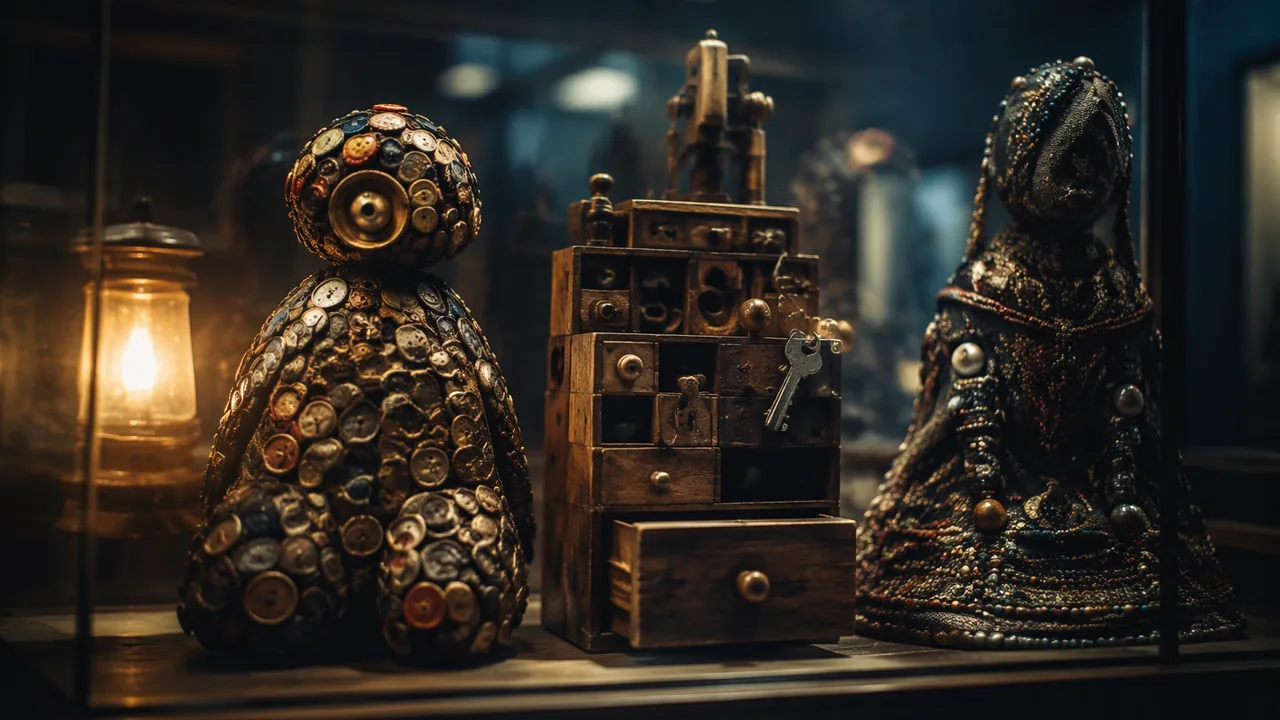
explain how objects gain meaning through what is added to them, and evaluate differing interpretations of objects taken from their original contexts.
Instruction
Most of this semester’s work has been flat. This unit asks how an object, rather than a picture, carries meaning, and especially how an object is transformed by what is added to it or done to it. That is the shared idea behind the unit’s two studio projects: the found-object sculpture and the altered hat or shoe.
An object that accumulates. Look at this male figure (nkisi nkondi) (late 1800s-early 1900s, Cleveland Museum of Art), made in the Kongo region of today’s Democratic Republic of Congo or Cabinda, Angola. The museum credits it to a Kongo artist and an nganga, a ritual specialist. Sculptors carved such figures, but a figure became a nkisi, able to host a spirit, only when an nganga placed empowering substances in and on it. The museum points out that this figure’s mirrored eyes, resin cap and stomach chamber once held such materials, and that most of them are now gone. Many minkisi minkondi were also studded over time with nails and blades, each one driven in to mark an oath, an agreement or an appeal to the figure’s power. In other words, the meaning of these objects was in what was added, and it could be taken away: the museum explains that an nganga removed the materials when a nkisi had served its purpose, and that Kongo people sometimes removed them as an act of anti-colonial resistance before Europeans could seize the figures. We do not know why this one was disempowered, but the sculpture you see is no longer spiritually active.
Two interpretations. European collectors in the colonial period often called such figures “fetishes” and displayed them as curiosities or as evidence of what they considered superstition. Scholars working with Kongo sources describe them instead as instruments of law and healing within a coherent system of belief. Standard VA:Re8A.III asks you to analyze differing interpretations and defend the most plausible. Here the evidence favors the second: it comes from the people who made and used the objects, and it explains features (the chambers for added materials, the nails on many figures) that the first ignores. The museum setting, where the figure stands still behind glass, is itself a third context that neither maker intended.
Adornment as transformation. A beaded crown (adéńlá) by a Yorùbá-style maker in Nigeria (1900s, Cleveland Museum of Art) is built from cloth, glass beads and other materials. The museum describes it as the most important of a Yorùbá king’s regalia: it is topped by a royal bird, and its veil of beaded strings masks the wearer’s identity and, in Yorùbá belief, protects his subjects from the power that radiates from his face. A Kuba hat (Kalyeem) from the Democratic Republic of the Congo (possibly early 1900s, Cleveland Museum of Art) combines raffia, glass beads and cowrie shells. In both, a head covering becomes a statement of status and identity through what is added to its surface.
Footwear as art. A pair of boots from northern China’s Liao dynasty (907-1125, Cleveland Museum of Art) is made of silk tapestry woven with metal threads. A pair of shoes from the Philippines (1850-1932, Cleveland Museum of Art) is knotted from abacá fiber in macramé lace. A Lakota maker covered a boy’s vest (c. 1880, Cleveland Museum of Art) in beadwork. Each takes a practical garment and makes it carry skill, wealth, belonging or care.
Found objects in modern art. In 1917 Marcel Duchamp submitted a manufactured urinal, signed “R. Mutt” and titled Fountain, to an exhibition, arguing in effect that choosing an object can be an artistic act. Many later artists took the idea in other directions. The Ghanaian-born artist El Anatsui, who works in Nigeria, joins thousands of flattened aluminum tops and seals from liquor bottles with copper wire into huge hangings that fold like cloth. The American artist Nick Cave, who was born in Fulton, Missouri, in 1959 and earned his degree at the Kansas City Art Institute in 1982, makes wearable sculptures he calls Soundsuits from found materials such as buttons, twigs and toys. Their work is under copyright; we study it by description.
Assemblage in Missouri. The Nelson-Atkins Museum of Art in Kansas City owns a large assemblage by Cave, Property (2014). The museum lists its materials as found and fabricated objects, including an iron shoeshine chair, vintage molds, thistle seed, a concrete figure, ceramic and perfume-bottle birds, metal flowers and strung beads. A molded figure of a Black man stands on a platform set on the shoeshine chair; a “tree” of found objects full of brightly colored birds rises above it; and on the floor a large rectangle of box-like molds each holds one found object that Cave did not alter. The museum’s label says the work raises questions about race, oppression, identity and memory, and that Cave hopes reusing objects in new ways will make viewers ask themselves, “Have you moved forward? How have you changed? What work have you done?” On a much larger scale, City Museum in St. Louis is a whole building treated as assemblage. It is housed in an old shoe factory downtown, and it was created by the sculptors Bob and Gail Cassilly and their crew, who, in the museum’s words, built it from “all the weird and wonderful things that cities leave behind”: rebar, concrete, iron, limestone and plaster turned into tunnels, slides and climbing spaces.
How looking changes what you understand. Experiencing an image or an object can change how you see the world outside the museum. After you have looked closely at Property, an ordinary shoeshine chair or a box of thrift-store trinkets may never look neutral again: you start to ask who used it, who served whom, and what history it carries. After a visit to City Museum, or after studying it, a pile of salvaged pipe or a demolished building can look like raw material rather than trash. To analyze this in your sketchbook, write three short notes: what you thought about a kind of object before you looked; what in the work (a material, a placement, a contrast) changed your view; and what you now notice in your own home or town that you did not notice before. If a work did not change your view, say so and explain why; that is an honest analysis too.
Your question for the unit. When you add to an object or join objects together, what happens to their original identities? Do they disappear into the new form, or stay visible and bring their meanings with them?
📖 Read for this lesson
The reading opens over the lesson; close it to come back to exactly where you were. The checks below draw on it.
Formative check
Work through these before moving on. They are not graded — they tell you whether the standard below has landed yet.
Why is the interpretation of the nkisi nkondi as an instrument of law and healing more plausible than the colonial label “fetish”?
A carved Kongo figure became a nkisi as soon as the sculptor finished carving it.
Missouri standard: VA:Re7B.I
Choose the crown, the Kuba hat or one piece of footwear. What was added to the basic object, and what does the addition communicate about the wearer? Then choose Nick Cave’s Property or City Museum and analyze how experiencing it affects your understanding of the world: what you thought about discarded or everyday objects before, what in the work changed that, and one thing in your own surroundings you now see differently.
How confident are you that you can explain how added materials transform an object’s meaning and compare interpretations of objects in museums?
Practice
Work these on paper or in your notebook, then open Check your answer. Aim for all of Fluency and Application; try at least one Challenge.
Printable version: this unit’s practice workbook (PDF)
Fluency
Build speed and accuracy with the core skill.
- Define nkisi, nganga and readymade.
Check your answer
Answer: Nkisi (plural minkisi): a Kongo object containing spiritual and medicinal materials, activated by a ritual specialist. Nganga: the Kongo ritual specialist who activates and works with minkisi. Readymade: Duchamp’s term for a manufactured object chosen and presented as art.Glossary terms from the lesson. - What was added to the basic object in each case: (a) the Yorùbá beaded crown (adéńlá), (b) the Kuba hat (Kalyeem), (c) the Liao dynasty boots?
Check your answer
Answer: (a) glass beads and other materials on cloth, a royal bird on top, and a veil of beaded strings; (b) glass beads and cowrie shells on raffia; (c) silk tapestry woven with metal threads.In each, a practical object carries status, identity, skill or wealth through what is added. - What did Marcel Duchamp submit to an exhibition in 1917, and what idea did it argue for?
Check your answer
Answer: A manufactured urinal, signed “R. Mutt” and titled Fountain. It argued, in effect, that choosing an object can be an artistic act.Later artists such as El Anatsui and Nick Cave took the found-object idea in other directions.
Application
Use the skill in context. Show your reasoning.
- Two interpretations of the nkisi nkondi: colonial collectors called such figures “fetishes”; scholars working with Kongo sources call them instruments of law and healing. Defend the more plausible one with two reasons from the lesson.
Check your answer
Answer: The second is more plausible: (1) its evidence comes from the people who made and used the objects; (2) it explains visible features the first ignores, such as the chambers for added materials and the nails and blades, each driven in to mark an oath, agreement or appeal.Standard VA:Re8A.III asks you to analyze differing interpretations and defend the most plausible. - The figure in the Cleveland Museum is “no longer spiritually active.” Explain why, and name the third context the lesson says neither maker intended.
Check your answer
Answer: Its empowering materials (once held in the mirrored eyes, resin cap and stomach chamber) are mostly gone; an nganga removed materials when a nkisi had served its purpose, and Kongo people sometimes removed them in anti-colonial resistance. The third context is the museum setting, where the figure stands still behind glass.The meaning of the object was in what was added, and it could be taken away. - The beaded veil of the Yorùbá crown hides the king’s face. According to the museum, what does that do in Yorùbá belief?
Check your answer
Answer: It masks the wearer’s identity and protects his subjects from the power that radiates from his face.The museum calls the crown the most important of a Yorùbá king’s regalia. - Nick Cave’s Property (2014, Nelson-Atkins) includes an iron shoeshine chair. Using the lesson’s three-note method, write a short model analysis of how studying the work could change how you see an everyday object.
Check your answer
Answer: Model: (1) Before: I thought of a shoeshine chair as just furniture. (2) What changed it: in Property a molded figure of a Black man stands on a platform on the chair, and the label raises questions of race, oppression, identity and memory. (3) Now: I notice old service objects in my town and ask who used them and who served whom.A strong analysis names a prior view, a specific feature of the work, and a new observation; saying honestly that a work did not change your view, with a reason, is also acceptable.
Challenge
Stretch problems. Expect to think before you write.
- The unit’s question asks whether joined objects keep their original identities. Compare City Museum in St. Louis with El Anatsui’s hangings on this question.
Check your answer
Answer: City Museum, built by Bob and Gail Cassilly and their crew in an old shoe factory from things cities leave behind (rebar, concrete, iron, limestone, plaster), turns salvage into tunnels, slides and climbing spaces, so materials stay partly recognizable but take new roles. Anatsui joins thousands of flattened aluminum bottle tops and seals with copper wire into hangings that fold like cloth, so individual tops become units of a new surface while still readable up close.Both recontextualize; a strong answer says how much of the original identity each keeps.
Review
Keep earlier skills sharp.
- Review (Lesson 3.1): what does the lesson say a found material brings into a collage, and how does Cave’s choice to leave the objects in the floor molds unaltered use the same idea in three dimensions?
Check your answer
Answer: A found material brings its own history and associations (a ticket brings a date and journey; fabric brings the person who wore it). Leaving each object unaltered keeps it recognizable, so its history stays visible and comes into the work with it.This connects to the unit question: do original identities disappear into the new form, or stay visible?
Objects With Power: Six Records, Two Interpretations of a Kongo Figure, and Found-Object Records
Cleveland Museum of Art Open Access records 2010.432, 1995.22, 1998.29, 1993.158, 1932.650, 1982.62; Metropolitan Museum of Art objects 319872 and 495553; Smithsonian American Art Museum 2012.34A-B (retrieved 26 September 2026); W. Holman Bentley, Pioneering on the Congo, vol. 1 (London, 1900), p. 261; The Blind Man, no. 2 (New York, May 1917); Wikipedia, “Nkondi” · CC0 (museum data); Public domain (Bentley 1900; The Blind Man 1917); SLS original (analysis sheet, criteria table and model paragraph). Works by El Anatsui and Nick Cave are in copyright and are described, not reproduced
Why this reading. The lesson asks you to analyze three objects in your sketchbook and to write a paragraph comparing two interpretations of one of them. The second task needs the two interpretations themselves, in the words of the people who held them, and the evidence each rests on. So this reading hosts a colonial-era description of a Kongo nail figure (public domain), the museum’s own account (CC0), and a summary of what recent sources say; it describes each of the six objects in the lesson closely enough to analyze; and it adds verified records for the modern found-object artists the lesson names. Museum records are from the Cleveland Museum of Art (CC0), the Metropolitan Museum of Art (public domain metadata) and the Smithsonian American Art Museum, retrieved 26 September 2026. The two historical quotations are public domain. Everything else (the analysis sheet, criteria table and model paragraph) is SLS original.
The six objects: records and descriptions
| Object | Record | What you can see |
|---|---|---|
| Male figure (nkisi nkondi) | Late 1800s-early 1900s; Democratic Republic of Congo or Cabinda (Angola); Kongo artist and nganga (priest); wood, metalized glass, iron, organic material, ivory or plastic, natural fiber; 46 x 25.7 x 19.2 cm (18 1/8 x 10 1/8 x 7 9/16 in.); Cleveland Museum of Art, 2010.432 | A standing male figure on a rectangular base, one arm raised, the other at his side. A cap of dark resinous material covers the head; the eyes are inset with mirror-like glass; the mouth is open with dark lips. A rectangular open chamber cuts into the belly. The surface is cracked and brown, and dozens of iron nails and blades stick out of the chest, shoulders and arms in a radiating pattern |
| Crown (adéńlá) | 1900s; Nigeria; Yorùbá-style maker; cloth (probably cotton and wool), glass beads, reeds, cardboard, wood, plant fiber, cotton and quills; overall height 105.9 cm (41 11/16 in.), cone 35.1 cm high, diameter 26.8 cm, fringe 55.3 cm long; Cleveland, 1995.22 | A tall cone covered in beadwork in diamonds, triangles and rectangles in red, blue, white and purple, with faces worked into the front. A small bird with spread wings tops it, and a curtain of long single strands of beads hangs from the rim |
| Hat (Kalyeem) | Possibly early 1900s; Democratic Republic of the Congo; Kuba-style maker; raffia, glass beads, cowrie shells, cloth (including wool), thread, copper alloy; 29 x 23 x 23 cm (11 7/16 x 9 1/16 x 9 1/16 in.); Cleveland, 1998.29 | Two tall panels of zigzag blue-and-white beadwork flank a central panel of red-and-white checks with cowrie shells set in rosettes; cowries edge the panels; white bead strands hang like a skirt from a wide brim |
| Pair of Boots | 907-1125; Northern China, Liao dynasty; silk tapestry weave with two kinds of metal threads; 47.5 x 30.8 cm (18 11/16 x 12 1/8 in.); Cleveland, 1993.158 | Two soft, calf-high golden-brown boots with a faint pattern of phoenixes and scrolling clouds in muted greens and browns; the colors and gold have faded |
| Pair of Shoes | 1850-1932; Philippines; abacá fiber, macramé knotted lace; 8.6 x 22.9 x 7 cm (3 3/8 x 9 x 2 3/4 in.); Cleveland, 1932.650 | Small pointed shoes of pale fiber knotted into open geometric lace, with stripes, diamonds and bands of a few dyed threads in green and purple |
| Boy’s Vest | c. 1880; Plains, Lakota (Sioux); beadwork; about 45.7 x 38.8 cm (18 x 15 1/4 in.); Cleveland, 1982.62 | A short vest whose front panels are covered in white glass beads bordered in dark blue, with a beaded American flag on each front panel, green and red geometric shapes on tall stands, small crosses, and buckskin fringe at the sides and lower edge |
What the museum says about each (Cleveland Museum of Art, CC0)
The nkisi: “This nkisi nkondi (power figure) lacks most of the materials that transformed it into a vessel for a spirit. Carved by sculptors, minkisi hosted spirits after banganga (priests) placed substances inside to empower them. The mirrored eyes, resin cap, and stomach chamber once contained empowering materials. After the nkisi had served its purpose the nganga removed the materials, stripping it of its spiritual power; the remaining sculpture was discarded. Sometimes, Kongo people removed materials as acts of anti-colonial resistance, disempowering minkisi before Europeans seized them. While we don’t know why it was disempowered, this sculpture is no longer spiritually active.” The crown: it is the most important of all regalia, topped with the royal bird Okin; it connects the king to Oduduwa, the mythical founder of the Yoruba; the veil of beaded strings masks the identity of the wearer and protects his subjects from the supernatural powers that radiate from his face; it also signifies the “inner head” of the king, the locus of a life force called ase. The Kuba hat: Kuba men and some women show title and status with hats; the owner of this one held a senior title; a simple coiled basketry hat forms its foundation; beaded hats and masks share technique and aesthetics, and artists specializing in beading could make both, using imported beads and shells. The Liao boots: made of silk tapestry (kesi), with two phoenixes chasing a flaming pearl; buried in a tomb, so colors and gold have faded; the gold and phoenix suggest they were made for a member of the Liao imperial family, probably a woman; the Khitan people valued boots highly because of a mobile, seminomadic way of life. The shoes: finely knotted abacá forms geometric patterns; likely made for display rather than wear; macramé with local abacá suggests a colonial-era or early twentieth-century hybrid craft, likely taught in a convent or school. The vest: for centuries beautiful garments and objects have held great meaning for Great Plains peoples; the Lakota ceremonially say that something sacred wears me, that is, humans put on powerful garments but are worn, animated and protected by the sacred forces in materials and imagery; by 1870 most Plains people were forced onto reservations, and the garments in this gallery were made after that date. The record does not explain the flags; do not assume their meaning.
Two interpretations of the nkisi nkondi, in their own words
Interpretation A: a colonial-era missionary’s description. William Holman Bentley, a Baptist missionary on the Congo, published in 1900: “On the lower river, a common form of fetish is a little image stuck all over with nails and old knives, each of which is a memorial of services rendered. It may often be seen in a little house of its own.” (Pioneering on the Congo, vol. 1, London, 1900, p. 261.) Bentley uses the word “fetish” throughout his chapter on the subject and calls belief in fetishes “unquestioning and very strong.” Note the evidence in his own sentence: each nail or knife is “a memorial of services rendered,” which says the additions were records of specific events.
Interpretation B: what the museum and current scholarship say. Cleveland describes the figure as a vessel that hosted a spirit once a priest (nganga) placed substances inside it, with the added materials removed when it had served its purpose. A recent summary of the scholarship (the Wikipedia article “Nkondi,” retrieved 26 September 2026, which draws on the work of the anthropologist Wyatt MacGaffey) says that nkondi were used to affirm oaths, to witness contracts and pledges, and to seek help and healing, and that nails were driven in as part of a petition, to awaken the figure to its task. Two things these sources supply that Bentley’s sentence leaves unexplained: that priests (nganga) made the figures work, and what a nail meant (a petition or a witnessed pledge, not only a memory).
A third context. The figure stands behind museum glass, where it is no longer spiritually active; neither the makers nor Bentley intended that.
A criteria table for judging an interpretation (SLS original)
| Question | Bentley (1900) | Cleveland and a recent scholarly summary |
|---|---|---|
| Who is the source, and what was their position? | An outside missionary writing for a European audience | A museum curatorial account; scholarship drawing on Kongo sources and archives |
| What evidence does it use? | His own observation of a nailed figure and its housing | The figure’s chambers, mirror eyes and cap; the practice of removing materials; documented use in oaths |
| Which visible features does it explain? | The nails and knives (as memorials) | The nails, the stomach chamber, the resin cap, the mirror eyes, the empty state |
| What does it leave out? | Who acted, and the legal or healing purpose | The individual history of this figure, which the museum admits it does not know |
A model paragraph (SLS original) for the lesson’s comparison: “Two accounts explain the nails on a Kongo power figure. Bentley, a missionary, called them ‘a memorial of services rendered’ and the figure a ‘fetish.’ The Cleveland Museum and a recent scholarly summary describe a figure empowered by a priest, used in oaths and healing, with nails driven in as part of a petition. The second is more plausible because it explains more of the object: the belly chamber and mirror eyes, which once held the empowering substances, and the museum’s note that the materials were later removed. Bentley’s own evidence, that each nail records a service, actually fits the second account, since a nail as record is a nail as agreement. Neither account tells us why this figure was emptied, and the museum says so.”
Found objects in modern art: three verified records
Marcel Duchamp (public domain text): the unsigned editorial “The Richard Mutt Case,” The Blind Man, no. 2, New York, May 1917, defended the urinal signed R. Mutt and titled Fountain: “Whether Mr. Mutt with his own hands made the fountain or not has no importance. He CHOSE it.” (Duchamp is credited with the text; it was published without a signature.) El Anatsui (Ghanaian, working in Nigeria): the Metropolitan Museum of Art holds Between Earth and Heaven, 2006, aluminum and copper wire, 220.3 x 325.1 x 20.3 cm (2007.96), and Dusasa II, 2007, found aluminum, copper wire and plastic disks, 599.4 x 731.5 x 5.1 cm (2008.121). The sizes (the second is over 7 meters wide and only 5 centimeters deep) confirm that these are hangings, not sculptures in the round. Nick Cave: Smithsonian American Art Museum, Soundsuit, 2009, mixed media, 96 x 26 x 20 in. (243.8 x 66 x 50.8 cm), accession 2012.34A-B. The museum says Cave, trained as a fiber artist and dancer, made his first suit in response to the 1991 beating of Rodney King, conceived the suits as coverings that obscure identity, and sources materials from thrift stores and discarded items (this suit uses doilies); the series is named for the rustling sound he heard as he moved in them. Their work is in copyright and is described here from museum records.
Your sketchbook analysis, worked out for you to copy
For each of your three objects write five lines. Base object: what was it before anything was added? What was added, and by whom? What does the addition communicate about the wearer or user? Does the original identity disappear or stay visible? Evidence: one museum fact and one thing you can see. Model for the Kuba hat: Base: a simple coiled basketry hat (Cleveland). Added: raffia panels, glass beads and cowrie shells, by a beading specialist. Communicates: a senior title (Cleveland). Identity: the basketry disappears under the beads, but the hat’s form (a hat) stays. Evidence: Cleveland’s note on the basketry foundation; I can see zigzag panels and cowrie rosettes.
Sources: Cleveland Museum of Art, Male figure (nkisi nkondi), 2010.432 (clevelandart.org); Cleveland Museum of Art, Crown (adéńlá), 1995.22 (clevelandart.org); Cleveland Museum of Art, Hat (Kalyeem), 1998.29 (clevelandart.org); Cleveland Museum of Art, Pair of Boots, 1993.158 (clevelandart.org); Cleveland Museum of Art, Pair of Shoes, 1932.650 (clevelandart.org); Cleveland Museum of Art, Boy’s Vest, 1982.62 (clevelandart.org); W. Holman Bentley, Pioneering on the Congo, vol. 1 (Internet Archive) (archive.org); Smithsonian American Art Museum, Soundsuit (Nick Cave), 2012.34A-B (americanart.si.edu); Metropolitan Museum of Art, El Anatsui, Between Earth and Heaven, 2007.96 (metmuseum.org)