complete, revise and defend a series of three related abstractions of one natural form.
Instruction
Portfolio Task 2 asks you to show that you can take one form through a sustained process, not just make one successful image. Series thinking is at the heart of advanced studio work: artists such as Monet, whose stacks of wheat you will study in semester B, repeat a subject so that each version tests a new decision.
What you submit. The main abstraction from Lesson 2.4, revised after critique; two smaller variations (at least 6 x 8 inches each) that change one decision each; the sketchbook pages showing your crop choices, faceting plan and palette tests; a revision note; and a critique statement.
The self-critique. Put the main work away for at least a day. The self-critique for this task focuses on one question: do the facets enhance the form or interfere with it? On a light photocopy or a printed phone photo, number the facets and mark each one E if it helps a viewer understand the object’s structure or I if it confuses it. Then judge the palette: does it hold the composition together, and is there enough value range? If a family member or other adult is willing, give them an unmarked copy and the same instructions, and compare their marks with yours.
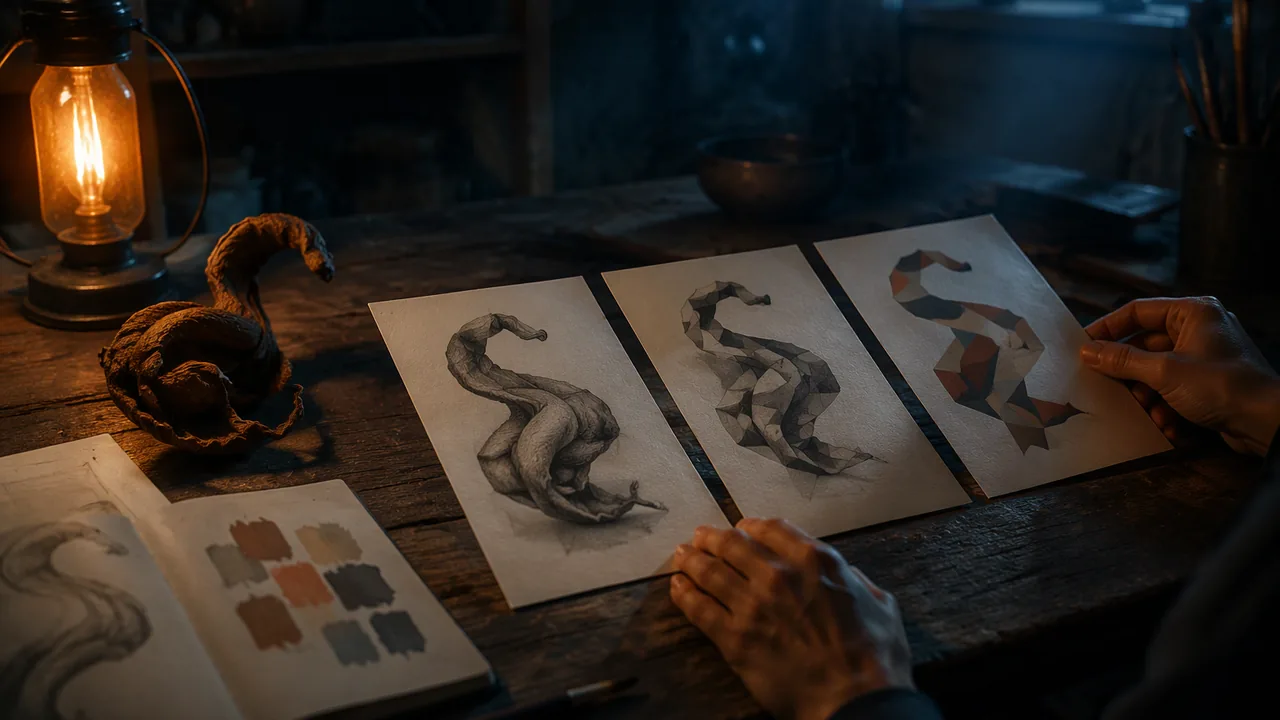
Making the variations. Choose variations that teach you something. Good choices include pushing the same crop to extreme abstraction, going back toward observation, swapping monochromatic for analogous or the reverse, or changing medium. Keep the object the same so the series is coherent. Arrange the three works in the order that makes the strongest sequence, and be ready to explain the order.
The critique statement. In 250-350 words, explain your palette and why it suits the object; how you decided on the facets; how far from nature you chose to go and why; and what you changed after critique. Refer to at least one artist or work from Lesson 2.1 whose approach you adapted or rejected. Record the statement as audio or video, with the series on screen.
Hanging the series. Before the self-critique, pin the three works in a row and look from across the room. A series should read as a family at a distance and reward close looking up close. If one work jumps out for the wrong reason, such as a palette much brighter than the others, decide whether that is a deliberate accent or a problem to fix.
Scoring. The rubric follows the course’s project criteria and adds series coherence.
📖 Read for this lesson
The reading opens over the lesson; close it to come back to exactly where you were. The checks below draw on it.
Formative check
Work through these before moving on. They are not graded — they tell you whether the standard below has landed yet.
Which set of variations makes the most coherent series?
Draft the first two sentences of your critique statement: what your palette is and why it suits your object.
How confident are you that you can complete and defend a coherent series of abstractions of one natural form?
Unit 2 checkpoint
Do this before you start the task. It covers the whole unit and tells you what to review first.
Why does the front edge of the table in Cezanne’s The Basket of Apples not line up on either side of the cloth?
Picasso and Braque’s early Cubist palettes were often reduced to browns, grays and ochres so that color would not distract from structure.
Which work does the lesson describe as abstraction driven by expression, with color compared to music?
A Hawaiian tapa cloth is made by weaving cotton thread on a loom.
A palette of three to five hues that sit next to each other on the color wheel is called .
On a 12 x 16 inch sheet, what is the average facet area with 32 facets?
A crop bleeds off four edges but its negative shapes measure 7, 7 and 6 squares. What does the lab kit decide?
Which feature of woodblock printing best explains why The Great Wave circulated widely?
Standard Re9.HSII asks you to determine whether the others use are relevant to the work.
In colored pencil, you should burnish early so later layers blend smoothly.
A faceted abstraction in which every facet is the same size and value most likely looks like
Submit: Natural Form to Abstraction series (main work + two variations), development pages and critique statement
Task: Complete a faceted, limited-palette abstraction of an organic object that bleeds off at least three sides, plus two variations that each change one decision, and defend the series.
Submission workflow
- Stage 1 — Plan. Chosen crop with rejected alternatives, faceting plan, palette key and medium test, checked off against this list before you begin the main work.
- Stage 2 — Self-critiqued work in progress. Main work at about two-thirds complete, marked facet by facet after a day away on whether the facets enhance or interfere with the form (with a second viewer’s marks if you have one); record the marks.
- Stage 3 — Revised series. Revised main work and two variations, with a revision note naming what changed.
- Stage 4 — Defense. A 250-350-word critique statement recorded as audio or video.
How it is scored
| Criterion | What proficient looks like |
|---|---|
| Design and composition (VA:Cr1B.III) | Bleed on at least three sides; facets and negative spaces varied; the abstraction enhances the form. |
| Technique and workmanship (VA:Cr2A.II) | Controlled handling of the chosen medium; clean facet edges; full value range within a limited palette. |
| Series and development (VA:Cr2A.III) | Three works clearly related; each variation changes a stated decision; sequence explained. |
| Revision (VA:Cr3A.III) | Specific changes made after critique, explained against the student’s own aims. |
| Critique statement (VA:Re8A.III) | Explains choices with reference to a studied artist and defends the degree of abstraction. |
Portfolio Task 2 in Full: Series Assignment, Rubric, Critique Sheet, Exemplar and Citable Works
Art Institute of Chicago records 111436, 8991, 121377; Cleveland Museum of Art Open Access records 1983.10, 1921.556 (retrieved 26 September 2026) · SLS original (assignment, rubric, exemplar and statement); CC0 (museum data)
Why this reading. This is the whole assignment for Portfolio Task 2: what you submit, the rubric that scores it, a complete exemplar series with an account of why it is strong, the self-critique sheet built on the project’s central question (do the facets enhance or interfere with the form?), and a fact sheet on the works from Lesson 2.1 so your critique statement can cite one from this page. The exemplar (the series, decisions, critique record, statement and scores) is SLS original, invented as a model; it is not the work of any artist or museum. Museum facts are CC0 records from the Art Institute of Chicago and the Cleveland Museum of Art, retrieved 26 September 2026.
The assignment
Show that you can take one form through a sustained process, not just make one good image. Submit the main abstraction from Lesson 2.4, revised after critique, plus two smaller variations that each change one decision, arranged as a series.
| Part | What you hand in | Numbers to meet |
|---|---|---|
| 1. Main abstraction | Faceted work from Lesson 2.4, revised after critique | At least 12 x 16 inches; limited analogous or monochromatic palette; 20 to 40 facets |
| 2. Two variations | Same object; each changes one decision (abstraction level, palette, crop or medium) | Each at least 6 x 8 inches |
| 3. Development pages | Sketchbook pages showing crop choices, the faceting plan and palette tests | At least the crop choice, one plan with facet areas and the palette key |
| 4. Revision note | What the critique told you, what you changed, what you kept | Every suggestion marked taken or rejected, with a reason |
| 5. Critique statement | Palette and why; how you chose the facets; how far from nature and why; what you changed after critique; one artist or work from Lesson 2.1 you adapted or rejected | 250 to 350 words; recorded as audio or video |
The rubric
Score each row 1 to 4; the total is out of 20. The first four criteria are the ones this course uses for projects; the fifth is series coherence.
| Criterion | 4: strong | 3: solid | 2: developing | 1: beginning |
|---|---|---|---|---|
| Originality and inventiveness | The variations answer a question the main work raised | Variations are clear and different from the main work | Variations are copies with small changes | Three unrelated images |
| Design and composition | Facets vary in size and value, follow the form, and the range of values is full in the dominant area | Facets mostly follow the form; some monotony | Facets tile the surface or hide the form | No planned structure |
| Technique and workmanship | Palette held; edges of facets controlled; clean layering appropriate to the medium | Palette mostly held; some muddy areas | Palette slips; layering uneven | Palette not held |
| Development of ideas | Crop, plan with facet areas, palette tests and photographs at each session, with a reason for each decision | Most evidence present | Evidence present but no reasons | Only finished works |
| Series coherence | The three read as a family across the room and reward close looking; the order has a reason | A family, with the order explained | One work stands out for the wrong reason | Not a series |
The self-critique sheet
After at least a day away, look at the main work only, for ten minutes, and fill in the table. Enhance or interfere? Number every facet on a light photocopy or a printed phone photo. For each facet, mark E (it helps you understand the object’s structure) or I (it confuses it), with one phrase why. Palette: Does it hold the composition together? Is there enough value range (at least five steps in the form)? Second viewer (optional): if a family member or other adult is willing, give them an unmarked copy and the same instructions, then compare their marks with yours; a facet you both mark I is the first to fix. Then write which marks to act on and which to keep, with a reason.
| Facet | E or I | Reason (one phrase) |
|---|---|---|
| F1 | ||
| F2 | ||
| F3 | ||
| … |
Hanging the series
Pin the three works in a row on a wall and look from across the room, at least 10 feet away. A series should read as a family at that distance and reward close looking up close. If one work jumps out, ask whether the reason is deliberate (a planned accent) or accidental (a much brighter palette). Decide the order by asking what the sequence says: for example, nature to abstraction from left to right.
The exemplar series (SLS original; invented as a model)
Subject: a halved red pepper. Main work: 12 x 16 in, oil pastel, analogous red, red-orange and orange, twenty-four facets, the largest 20 square inches (about 10 percent of the sheet), the smallest 1.7, so the ratio of largest to smallest is about 12 to 1. Variation A (6 x 8 in): same crop, toward realism: three values, smooth blending inside each facet, facet lines nearly gone. Decision changed: how visible the facets are. Variation B (6 x 8 in): same crop, toward extreme abstraction: six facets in three values of one red. Decision changed: how many facets and palette. Order: A, main work, B, left to right, so the eye moves from nature to structure, with the main work in the middle as the hinge. Critique record (enhance or interfere): twenty-one facets E, three I (F4, F9, F10, whose edges cut across the curve of the wall). Taken: F4 and F9 redrawn to follow the contour. Rejected: F10, kept as the small planned accent. Palette: the artist and a second viewer (her grandmother) both judged the top too close in value; the shadow facets were darkened by two steps.
The 250 to 350-word critique statement (this one is 336 words):
I chose a halved red pepper because its inside has a clear structure, a ring of flesh around a hollow, and I wanted to find out how much of that structure a viewer needs in order to still recognize a pepper. My main work is a 12 x 16 inch oil pastel in an analogous palette of red, red-orange and orange. I planned twenty-four facets, from a 20-square-inch plane at the front of the flesh down to a sliver under 2 square inches at the stem, and I put the brightest facet next to the darkest one on the curve of the wall so that the eye lands there first. I decided how far from nature to go by testing it: the version on my left keeps smooth blending and three values, and the one on my right has only six facets in three values of red. The main work sits between them because the facets still follow the pepper’s contours but no longer hide their edges. From Cézanne’s The Basket of Apples (c. 1893, Art Institute of Chicago) I adapted the way a round form is built from separate patches of color placed side by side, so that a turn in the surface is shown by a change of hue rather than by smooth shading. I rejected the road in Kandinsky’s Improvisation No. 30 (Cannons) (1913, Art Institute of Chicago), where recognizable objects dissolve into color and feeling, because my series is about structure, not mood. In my self-critique I marked three lower facets as confusing the form, because their edges cut across the curve, and my grandmother marked the same three. I redrew two of them to follow the contour and kept the third, because it is the small accent I planned. We both also judged my palette too close in value at the top, so I darkened the shadow facets by two steps. I would now try the same crop in a monochromatic palette to see whether hue matters as much as value.
Scored: Originality 4 (each variation answers the question of how much structure a form needs). Design 4 (measured facet sizes, full range in the form). Technique 3 (edges clean; one muddy overlap at the upper right). Development 4 (plan with areas, photographs, reasons for every change). Series coherence 4 (family across the room; hinge order explained). Total 19 of 20. What makes it strong: the statement makes claims that can be checked against the work (twenty-four facets, six facets, three values); the artist cites one work adopted and one rejected, with reasons; and the critique response shows decisions, not only compliance.
Fact sheet: works from Lesson 2.1 you may cite
| Work | Record | Facts you can cite |
|---|---|---|
| Cézanne, The Basket of Apples | c. 1893; oil on canvas; 65 x 80 cm; Art Institute of Chicago, 1926.252 | Apples built from side-by-side patches of color; the table edge does not line up across the cloth; the bottle leans; the AIC describes shifts from thick modeling strokes to sketch-like marks near the edges |
| Kandinsky, Improvisation No. 30 (Cannons) | 1913; oil on canvas; 111 x 111.3 cm; AIC 1931.511 | Objects such as cannons dissolve into color zones; the AIC notes Kandinsky’s analogy between painting and music and quotes his letter that the picture’s true contents are what the spectator experiences |
| Dow, Boats at Rest | c. 1895; oil on canvas; 66 x 91.4 cm; AIC 1990.394 | Cropping, high viewpoint and flattened space learned from Japanese prints, with bold color; Dow’s Composition teaches line, notan and color |
| Ogata Kōrin, Plum Tree | c. 1700; ink on silk hanging scroll; image 94 x 35.4 cm; Cleveland Museum of Art, 1983.10 | Ink wash over the silk with the blossoms left unpainted (reserve technique), so the white flowers are made by what was not painted |
| Diné (Navajo) weaver, Wearing Blanket | c. 1875-80; wool tapestry weave; 117.5 x 152.5 cm; Cleveland 1921.556 | Horizontal cream and dark stripes with red bands carrying dark rectangles; Cleveland says Diné geometric designs reference the natural environment and embody spiritual meanings, and that patterns were inherited yet evolved |
Sources: Art Institute of Chicago, The Basket of Apples, 1926.252 (artic.edu); Art Institute of Chicago, Improvisation No. 30 (Cannons), 1931.511 (artic.edu); Art Institute of Chicago, Boats at Rest, 1990.394 (artic.edu); Cleveland Museum of Art, Plum Tree, 1983.10 (clevelandart.org); Cleveland Museum of Art, Wearing Blanket, 1921.556 (clevelandart.org)