4.06 Reading Earth’s First Chapters: Meteorites, Moon Rocks and Missing Craters
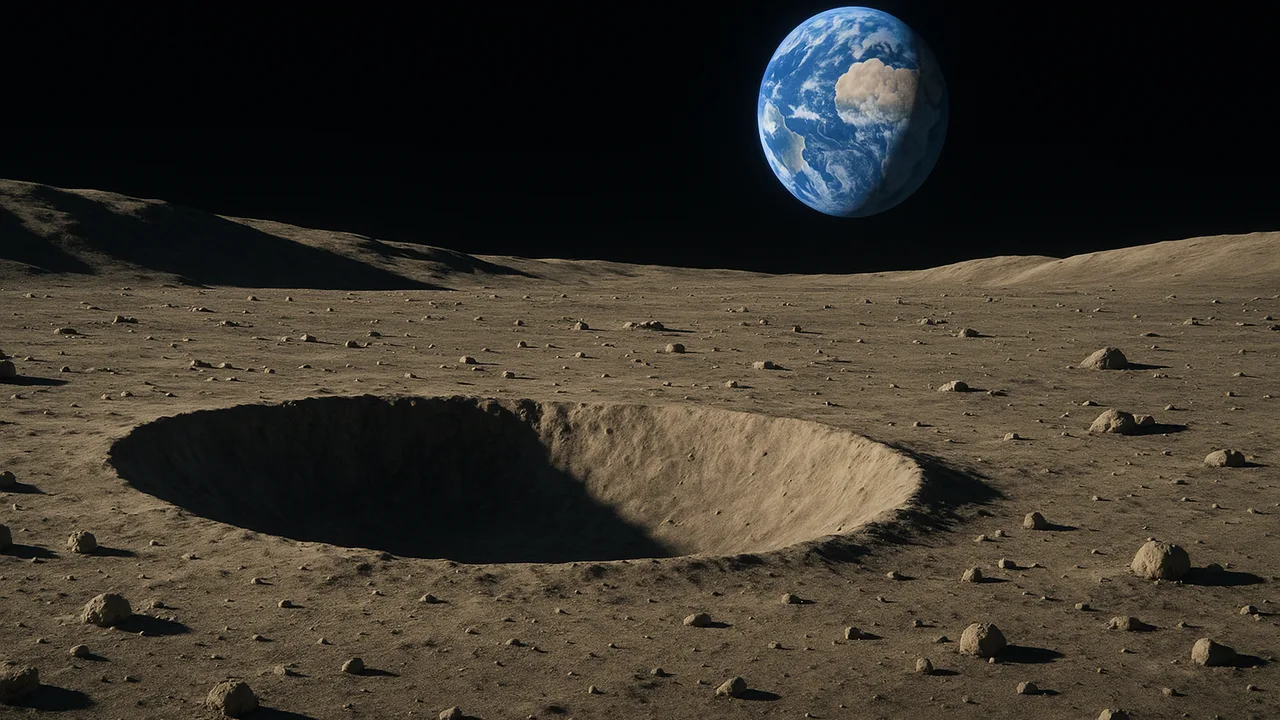
use radiometric ages of meteorites, lunar rocks and Earth’s oldest minerals and rocks to build a timeline of the early solar system, compare the composition of solar system objects, and explain why Earth has so few ancient craters.
- I can explain that Earth formed along with the rest of the solar system about 4.6 billion years ago.
- I can describe how the early Earth was bombarded by impacts, similar to other objects in the solar system.
- I can explain why erosion and plate tectonics have destroyed much of the evidence of early impacts on Earth, making impact craters relatively scarce compared to other planetary surfaces.
- I can describe the age and composition of Earth’s oldest rocks, lunar rocks, and meteorites as determined by radiometric dating.
- I can compare the composition of solar system objects.
- I can analyze the size and distribution of impact craters on Earth and other solar system bodies, and describe the activity of plate tectonic and surface processes like volcanism and erosion on Earth.
- I can use evidence from radiometric dating of lunar rocks, meteorites, and Earth’s oldest rocks to explain that the solar system formed about 4.6 billion years ago and Earth’s solid crust formed about 4.4 billion years ago.
- I can use patterns of impact cratering on other planetary surfaces to infer that Earth also had many impact craters early in its history.
- I can reason that the scarcity of impact craters and the younger age of most rocks on Earth compared to other solar system bodies is due to processes like volcanism, plate tectonics, and erosion reshaping Earth’s surface.
Phase 3: Make Sense
Warm-Up ~5 min
Do Now. Compare two photos: the near side of the Moon through a small telescope and a satellite view of a continent on Earth. Estimate how many craters you can see in each, and write one hypothesis for the difference.
From your dating puzzle: which was older, the stony meteorite (about 4.57 billion years) or the zircon from one of Earth's oldest rock bodies (about 4.0 billion years)?
Instruction ~10 min
Why we cannot just date Earth. Earth is geologically alive. Its rocks have been melted, eroded, buried and recycled for billions of years, so no rock survives from the very first days. To find Earth’s age, scientists date objects that formed at the same time but have not been recycled: meteorites, which are pieces of asteroids, and rocks brought back from the Moon.
The evidence table. These are rounded published radiometric ages, mostly from uranium–lead dating.
| Material | Age (billion years) | What it records |
|---|---|---|
| Calcium-aluminum-rich grains in primitive meteorites | 4.567 | the first solids to condense in the disk around the young Sun |
| Most stony meteorites (chondrites) | about 4.56 | the assembly of small bodies from that disk |
| Earth, from meteorite and terrestrial lead | 4.54 ± 0.05 | Earth’s formation as a planet |
| Oldest lunar highland rocks | about 4.4–4.5 | the Moon’s first crust |
| Oldest zircon grains on Earth | 4.4 | solid continental-type crust, and probably liquid water, very early |
| Dark lava plains (maria) on the Moon | 3.1–3.9 | lava that flooded giant impact basins |
| Oldest known intact Earth rocks | about 4.0 | small surviving pieces of early crust |
| Most ocean floor | younger than about 0.2 | crust constantly made at ridges and recycled at trenches |
Worked example 1: building the timeline. Jordan placed the ages on a strip from 4.6 billion years ago to today. The meteorite grains, the meteorites and Earth’s age cluster within about 30 million years of each other, only about 0.6% of the timeline: the solar system formed fast, about 4.6 billion years ago. Lunar highland rocks and Earth’s oldest zircons follow within about 150 million years, showing that the Moon and Earth both had a solid crust by about 4.4 billion years ago. Then there is a gap: Earth’s oldest intact rocks are only about 4.0 billion years old. The gap is evidence that Earth destroyed its earliest crust; the zircons survived as tough grains eroded out of rocks that are gone.
Comparing compositions. Primitive stony meteorites contain the non-gaseous elements (iron, magnesium, silicon, calcium and others) in nearly the same proportions as the Sun’s atmosphere: they are leftover building material. Earth, by contrast, is differentiated: dense iron sank to form a core and lighter silicates formed the mantle and crust. Iron meteorites look like the cores of small worlds that broke apart. Moon rocks have nearly the same oxygen isotope ratios as Earth rocks but much less iron and fewer easily evaporated elements, evidence for the leading idea that the Moon formed from debris after a Mars-sized body hit the young Earth about 4.5 billion years ago.
Craters as a second clock. On a surface with no erosion, craters pile up over time, so more craters per area means an older surface. Worked example 2 (sample counts). Mei counted craters wider than 20 km in equal-sized photo squares: lunar highlands 52, lunar maria 6, a stable continental interior on Earth 0. Radiometric ages agree with the counts: highlands about 4.4 billion years, maria about 3.5. The highlands are so crowded that new craters erase old ones, a record of very heavy bombardment before about 3.8 billion years ago. Earth, sharing the same neighborhood and a bigger target, must have been hit even more often.
So where did Earth’s craters go? About 200 impact structures have been confirmed on Earth, most younger than a few hundred million years. Three processes erased the rest: plate tectonics recycles ocean floor into the mantle, so almost no seafloor is older than about 200 million years; erosion by water, ice and wind wears down crater rims and fills basins with sediment; and volcanism buries old surfaces under new lava. The Moon, with no plates, no running water and almost no air, kept its scars.
Reading. OpenStax Astronomy 2e, chapters 8 (Earth as a planet), 9 (cratered worlds) and 14 (cosmic samples and the origin of the solar system), CC BY 4.0. Ages are rounded published values.
Guided Exercises ~15 min
Use the evidence table and your timeline strip.
Independent Practice ~10 min
Make the deep-time timeline for the Earth’s Age panel.
Draw a timeline from 4.6 billion years ago to today and place every material from the evidence table. Then write a claim–evidence–reasoning paragraph answering: How do we know Earth and the solar system are about 4.5–4.6 billion years old? Use at least three rows of the table and explain which nuclear clock produced them.
Explain, using erosion, volcanism and plate tectonics, why most of Earth's rocks are much younger than the Moon's highlands, and why that does not mean Earth is younger than the Moon.
Closure ~5 min
We now have the science for every panel. Next phase, we design the interactive half-life model and draft the exhibit.
Exit ticket: a visitor says, “If the oldest rock is 4 billion years old, Earth must be 4 billion years old.” Answer in three sentences a 12-year-old would follow.
Teacher notes
Materials: generic photos of the lunar near side and of a continental landscape from orbit, printed evidence table, adding-machine tape or a 4.6 m paper strip for a 1 m = 1 billion years timeline, rulers.
Setup: on a 4.6 m strip, the first 30 million years is only 3 cm; let students feel how crowded the start is. Crater counts in worked example 2 are sample values for teaching.
Listen for: “the Moon has more craters because it has no atmosphere” (partly true for small meteors, but large impactors reach both; the real difference is resurfacing); “meteorites came from Earth”; “Earth is 4.0 billion years old.”
Support / stretch: provide a partly filled timeline and CER frame. Stretch: the giant-impact debris disk formed the Moon about 4.5 billion years ago, yet the oldest zircons are 4.4; argue whether the impact would have destroyed any earlier crust, using what heat does to a radiometric clock.