2.01 Foam in Seconds, Flat After a Year: What Sets a Reaction’s Speed?
Fast on the Surface, Stable on the Shelf: A Rate and Stability Brief for a Cleaning Co-op
Why does the same hydrogen peroxide foam out of a flask in seconds yet slowly fade in a bottle over months, and how can a cleaning co-op use reaction rates and equilibrium to keep its cleaner strong on the shelf and warn customers when storage is spoiling it?
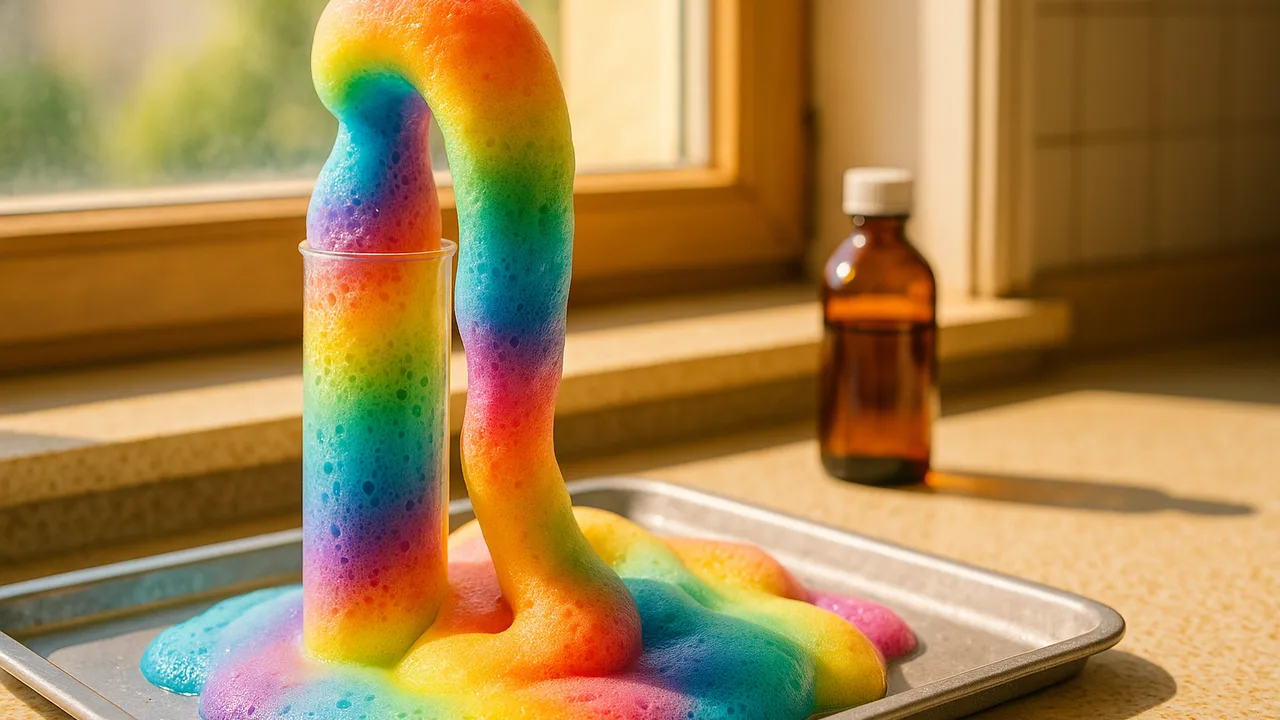
The mystery: In a teacher demo, warm yeast and a squirt of dish soap turn a flask of drugstore hydrogen peroxide into a column of foam that climbs out of the flask in seconds. Beside it stands a clear bottle of the same peroxide that sat on a sunny windowsill for a year. Poured on yeast, it barely fizzes.
describe the decomposition of hydrogen peroxide with a balanced equation, define reaction rate, and use a first collision model to ask testable questions about why the same reaction can be fast or slow.
- I can explain that molecules must collide to break bonds and form new molecules during a reaction.
- I can describe how the probability of bonds breaking in a collision depends on whether the colliding molecules have enough kinetic energy.
- I can explain that higher temperature means molecules have more kinetic energy, so collisions are more likely to break bonds and form new molecules.
Phase 1: Spark
Warm-Up ~5 min
Do Now. Your teacher pours warm yeast into a tall flask of 3% hydrogen peroxide mixed with dish soap. Foam rises out of the flask in seconds. Next to it is a clear bottle of the same peroxide that sat in a sunny window for a year. Write what you think is in the foam bubbles, and one question the pair raises for you.
The year-old window bottle is poured onto the same yeast. What do you predict?
Instruction ~10 min
The phenomenon. The foam in the demo is soap film wrapped around bubbles of oxygen gas. The oxygen comes from hydrogen peroxide breaking apart. The same reaction was happening in the window bottle all year, only slowly, and the oxygen leaked away through the cap. One reaction, two speeds: seconds in the flask, months on the shelf. This unit is about what controls that speed and about reactions that can run both ways.
The reaction. Hydrogen peroxide decomposes into water and oxygen: 2H2O2(aq) → 2H2O(l) + O2(g). Count atoms: 4 H and 4 O on the left; 4 H and 2 + 2 = 4 O on the right. The reaction releases energy. From standard enthalpies of formation (H2O2(l) −187.8 kJ/mol, H2O(l) −285.8 kJ/mol), ΔH = 2(−285.8) − 2(−187.8) = −196.0 kJ for the equation as written. So why does the bottle not decompose all at once?
What rate means. The rate of a reaction is how fast a reactant is used up or a product forms, per unit of time. We will measure it as the volume of oxygen collected per second (mL/s). A fast rate fills a measuring cylinder in under a minute; a slow one takes months to make the same gas.
Worked example 1: an average rate. Jordan collected oxygen from a yeast and peroxide mixture (sample data): 0 mL at 0 s and 24 mL at 30 s. Average rate = change in volume ÷ change in time = (24 mL − 0 mL) ÷ (30 s − 0 s) = 0.80 mL/s. Two significant figures in, two out.
A first collision model. For two H2O2 molecules to become water and oxygen, bonds must break (the weak O–O bond in each peroxide molecule) and new bonds must form (O=O in oxygen, more O–H in water). Molecules break bonds when they collide with each other, with water, or with a surface, and only when the collision carries enough energy. Most collisions at room temperature are too gentle, so most do nothing. That idea, collision theory, is our starting model.
What the yeast does. Yeast cells contain catalase, an enzyme that gives peroxide molecules an easier path to break apart. With the enzyme present, a far larger share of encounters succeed, so the same reaction runs thousands of times faster. The yeast is not used up; it is a catalyst. We will test catalysts in 2.04.
Worked example 2: how much gas can one bottle make? Ana asked how much oxygen a 100 mL bottle of 3% peroxide holds in reserve. 3% means about 3.0 g of H2O2 per 100 mL. Molar mass = 2(1.008) + 2(15.999) = 34.01 g/mol, so 3.0 g ÷ 34.01 g/mol = 0.088 mol. The equation gives 1 mol O2 per 2 mol H2O2: 0.044 mol O2. At 22 °C and 1 atm one mole of gas fills about 24.2 L, so the bottle can release about 0.044 × 24.2 = 1.1 L of oxygen. The window bottle lost much of that liter slowly.
Asking good questions. “Why is peroxide weird?” cannot be tested. “Does warmer peroxide release oxygen faster with the same amount of yeast?” can. Sort today’s questions into ones we can test in the lab, ones published data can answer, and ones that need a particle model.
Reading. OpenStax Chemistry 2e, chapter 12.1 (chemical reaction rates) and Appendix G (standard enthalpies of formation), CC BY 4.0.
Guided Exercises ~15 min
Work with a partner. Show every calculation with units.
Independent Practice ~10 min
In your Rate Notebook, use the sample data below from a yeast and peroxide trial.
| Time (s) | 0 | 10 | 20 | 30 | 40 | 50 | 60 |
|---|---|---|---|---|---|---|---|
| O2 collected (mL, sample) | 0 | 8 | 16 | 24 | 31 | 37 | 42 |
Calculate the average rate for 0–30 s and for 30–60 s. Which is faster? Suggest one particle-level reason the rate changed.
Closure ~5 min
We have a phenomenon, an equation and a first model. Next class, you meet the client whose product depends on this reaction.
Exit ticket: use the words collision and energy to explain why the window bottle lost its strength slowly instead of all at once.
Teacher notes
Materials: teacher demo only: 3% hydrogen peroxide (about 100 mL), one packet of dry yeast stirred into 45 mL warm water, a squirt of dish soap, food coloring, a 500 mL flask on a tray; a clear bottle of peroxide left in a sunny window (or a bottle you have diluted to model it), a second cup of yeast.
Safety: the tall foam seen in videos uses about 30% peroxide and potassium iodide; that concentration is corrosive and is never used in this course. Wear goggles for the demo; the foam is soap, water and oxygen and can go in the sink.
Listen for: “the foam is carbon dioxide from the yeast” (yeast fermentation is far too slow); “the yeast reacts and is used up”; rate confused with amount.
Support / stretch: give a rate formula card (“rate = change in amount ÷ change in time”). Stretch: how much heat could the bottle’s 0.088 mol of peroxide release? (0.088 × 98.0 kJ/mol, about 8.6 kJ.)