4.02 Project Brief and Wonder Board: How Do We Know How Old It Is?
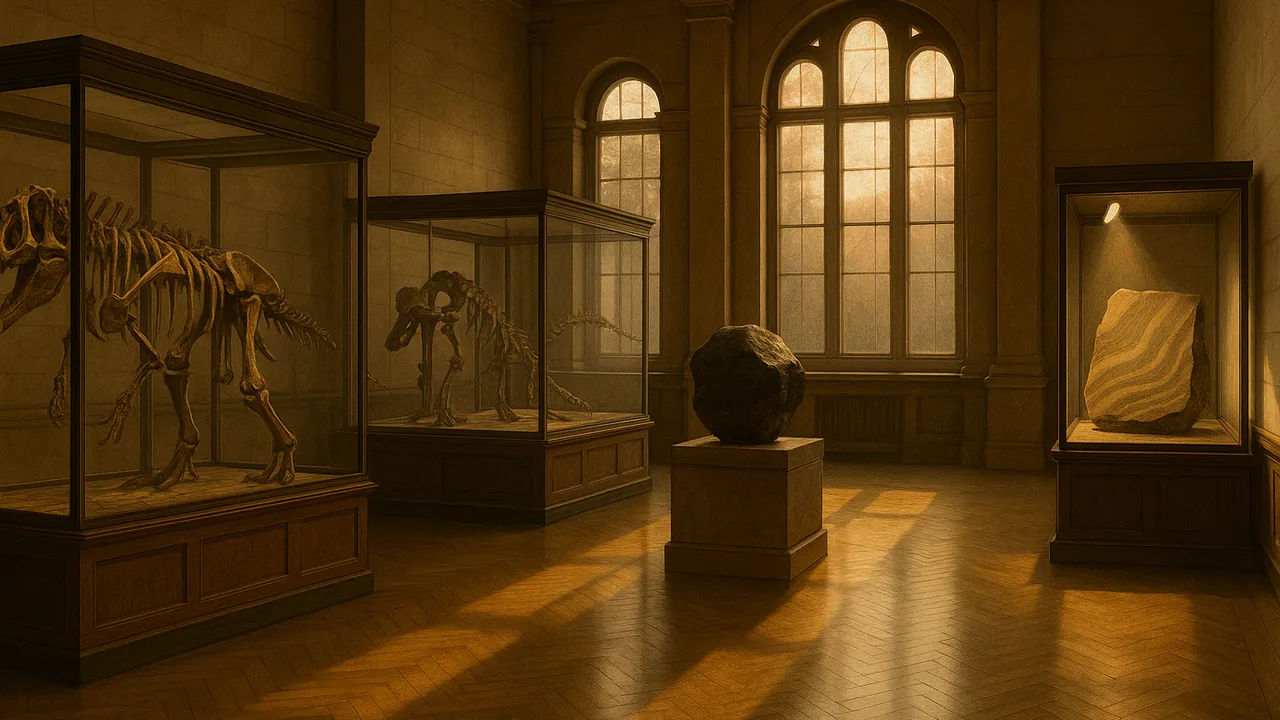
How Do We Know How Old It Is? Exhibit Panels and a Half-Life Model for a Natural History Museum
How can a few atoms locked inside a crystal smaller than a grain of sand tell us that Earth is about 4.5 billion years old, and how does the same nuclear physics keep a smoke detector working and help doctors see inside the body?
The mystery: A crystal of the mineral zircon, too small to see clearly without a magnifier, has been dated to about 4.4 billion years old: older than any known rock on Earth. On a kitchen ceiling nearby, a smoke detector holds a speck of americium-241 that has been giving off radiation, quietly and safely, every second since the day it was installed.
Questions we will figure out together in this unit:
- How can atoms inside a crystal act like a clock?
- Why can’t carbon-14 date a dinosaur bone?
- How do we know a meteorite is older than any rock on Earth?
- Why does the Moon have so many craters and Earth so few?
- Does a smoke detector’s source ever run out?
- If radiation is everywhere, how much is too much?
- How can a doctor use radiation to see inside a body safely?
- How do we know decay rates never changed in the past?
explain the museum’s request, describe alpha, beta and gamma radiation and what each does to a nucleus, write balanced nuclear equations, and turn our questions about Earth’s age into need-to-knows.
- I can model and explain the differences in the types of energy (like kinetic energy and electromagnetic radiation) and particles (like alpha and beta particles) released during alpha, beta, and gamma decay, and describe how these decays can change one element into another.
- I can model and explain that the total number of protons and neutrons stays the same before and after a nuclear process, even though the numbers of each can change.
- I can compare and model how the energy released in nuclear processes is much greater than in chemical processes.
- I can explain that Earth formed along with the rest of the solar system about 4.6 billion years ago.
- I can describe how the early Earth was bombarded by impacts, similar to other objects in the solar system.
- I can explain why erosion and plate tectonics have destroyed much of the evidence of early impacts on Earth, making impact craters relatively scarce compared to other planetary surfaces.
Phase 1: Spark
Warm-Up ~5 min
Do Now. Write down how old you think Earth is, and one reason someone might believe that number. Then write how you would convince a museum visitor who does not believe you.
Review from 4.01: carbon-14 has 6 protons. How many neutrons does it have?
Instruction ~10 min
Meet the client. The exhibits team of a regional natural history museum has written to our class. Next year they open a gallery called How Do We Know How Old It Is? Visitors already see dinosaur bones labeled “66 million years” and a meteorite labeled “4.6 billion years,” and the most common question at the information desk is, “How can anyone know that?” The team asks for three things:
- A set of exhibit panels (about 150–200 words each) explaining how carbon-14, uranium–lead and potassium–argon dating work, with a balanced nuclear equation on each.
- A panel on Earth’s age that uses meteorites, Moon rocks and the oldest zircons to explain why scientists say about 4.5 to 4.6 billion years, and why Earth’s own surface has so few old craters.
- An interactive half-life model a visitor can use in under two minutes, plus one panel on how a medical isotope helps doctors, so visitors see that the same physics helps people.
Driving question. How can a few atoms locked inside a crystal smaller than a grain of sand tell us that Earth is about 4.5 billion years old, and how does the same nuclear physics keep a smoke detector working and help doctors see inside the body?
Three kinds of radiation. Unstable nuclei release energy in three main ways. Alpha (α): a helium-4 nucleus, 42He, charge +2; heavy and slow by nuclear standards, stopped by a sheet of paper, the outer layer of skin or a few centimeters of air. Beta-minus (β−): a fast electron, 0−1e, made when a neutron in the nucleus turns into a proton; stopped by a few millimeters of aluminum. A related decay, beta-plus, emits a positron, 0+1e, when a proton turns into a neutron. Gamma (γ): a photon of very high-energy electromagnetic radiation with no mass and no charge, released when a nucleus drops to a lower energy state; it takes several centimeters of lead or thick concrete to reduce it greatly.
Balancing a nuclear equation. Two sums must match on both sides: the mass numbers (total nucleons) and the atomic numbers (total charge). The numbers of protons and neutrons may each change, but their total does not. Worked example 1: alpha decay. Kenji wrote the decay of thorium-232 (Z = 90): 23290Th → 22888Ra + 42He. Mass: 232 = 228 + 4. Charge: 90 = 88 + 2. Element 88 is radium, so the element changed.
Worked example 2: beta-minus decay. Potassium-40 (Z = 19), found in every banana and in the rocks of the museum’s volcano exhibit, usually decays like this: 4019K → 4020Ca + 0−1e. Mass: 40 = 40 + 0. Charge: 19 = 20 + (−1). One neutron became a proton, so the mass number stayed 40 while the element moved up one place to calcium. Gamma emission changes neither number: 99m43Tc → 9943Tc + γ (the m means a high-energy, “metastable” nucleus).
The big number. Radiometric dating of meteorites and of the oldest Earth and Moon materials shows that the Sun, Earth and the other planets formed together from a disk of gas and dust about 4.6 billion years ago. The young Earth was battered by impacts, as the cratered Moon still shows. Earth’s own early craters are mostly gone, erased by erosion, volcanism and plate tectonics. We will test each of those claims with evidence in this unit.
Teacher demonstration: a cloud chamber. Your teacher sets a clear box on a slab of dry ice with a felt strip soaked in isopropyl alcohol at the top. The alcohol vapor cools until it is ready to condense, and any fast charged particle passing through leaves a trail of droplets, like a jet’s contrail. With no source at all, you will see thin tracks from cosmic-ray muons and short, thick tracks from natural radioactivity in the air: radiation is around us all the time.
Team roles. Teams of four rotate weekly: Lead Scientist (keeps the team on the question), Data Analyst (tables, graphs, half-life math), Lab Manager (materials and safety checks) and Exhibit Writer (drafts panel text and checks it reads well for a 12-year-old visitor).
Reading. OpenStax Chemistry 2e, section 21.3 (radioactive decay), CC BY 4.0.
Guided Exercises ~15 min
Use the periodic table and the client’s letter. Check both sums for every nuclear equation.
Independent Practice ~10 min
Start your Exhibit Notebook and team charter.
In 3–4 sentences, restate the museum's three requests and break the project into at least four sub-problems (for example: explain decay, do half-life math, date real materials, design the interactive).
Describe what you saw in the cloud chamber demonstration. Which tracks were thin and which were short and thick, and which kind of radiation might have made each? Use charge and mass in your answer.
Closure ~5 min
We know the client, the driving question and the three kinds of radiation. Next phase, we model half-life in the lab and solve a dating puzzle.
Exit ticket: write and check the nuclear equation for the alpha decay of americium-241 in a smoke detector, and explain why the alpha particles do not escape the detector.
Teacher notes
Materials: the client letter (generic museum, on letterhead you design), periodic tables, role cards, chart paper for the Wonder Board. Cloud chamber (teacher demo): a clear plastic or glass box with lid, black felt or card for the floor, a felt strip for the top, 99% isopropyl alcohol, a block of dry ice on an insulated tray, insulated gloves and tongs, a flashlight. Prepare the chamber 10–15 minutes before class and darken the room.
Setup: keep the Wonder Board posted all unit; 4.06 and 4.09 return to it. The museum is fictional; keep real ticket or budget figures out of the letter.
Listen for: “radiation makes things glow”; “beta particles were electrons sitting in the nucleus” (the electron is created in the decay); nuclear equations balanced in mass but not charge.
Support / stretch: provide a two-sum checking template (“top: __ = __ + __; bottom: __ = __ + __”). Stretch: carbon-11 (Z = 6) emits a positron; write the equation (product boron-11) and explain why Z drops.