3.04 Shells Over Days: Carbonate Chemistry and Mass Loss
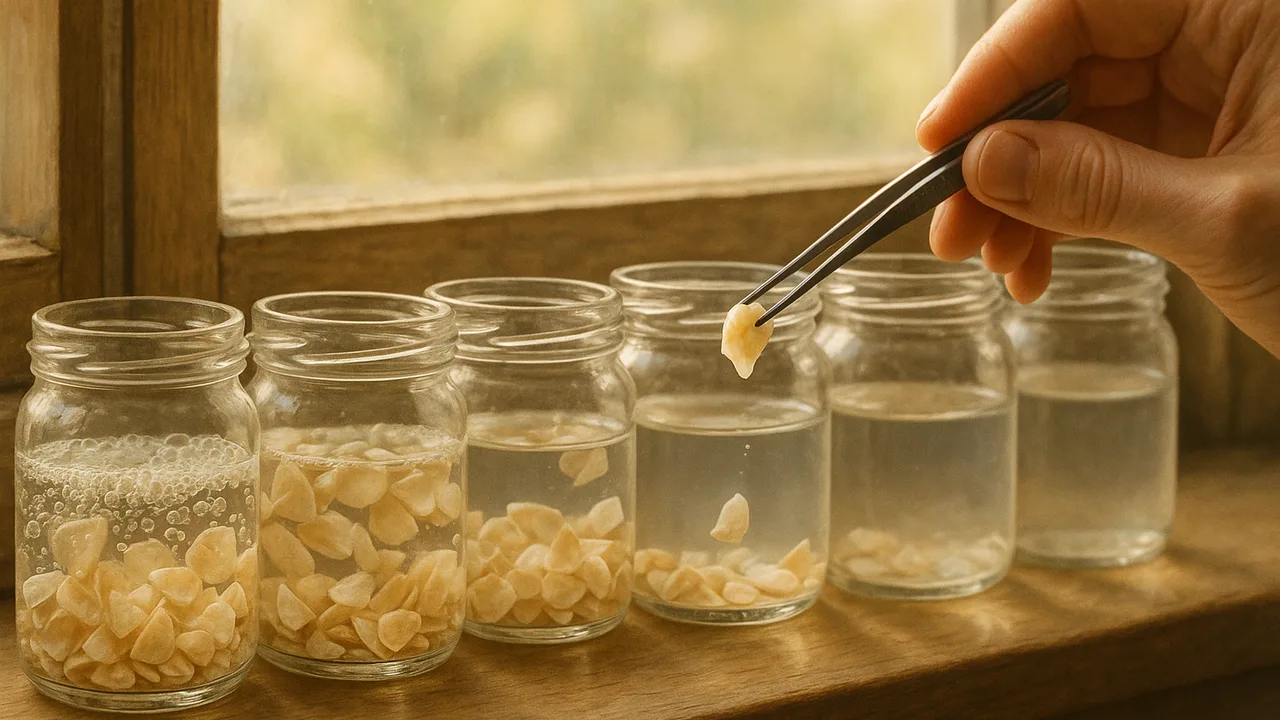
set up a multi-day test of shell mass loss at different pH, use the carbonate equilibria to explain why added CO2 removes carbonate, and track where the dissolved shell’s carbon goes.
- I can use my model to show that carbon is conserved as it cycles through Earth’s systems.
- I can identify and compare the amounts of carbon found in the hydrosphere, atmosphere, geosphere, and biosphere.
- I can create a model that shows how carbon moves between the hydrosphere, atmosphere, geosphere, and biosphere.
- I can use a model to describe how carbon cycles between the hydrosphere, atmosphere, geosphere, and biosphere.
- I can explain the amounts and rates at which carbon moves between different spheres of the Earth.
- I can show in my model how plants capture carbon dioxide and how human activities increase carbon dioxide in the atmosphere, affecting the climate.
Phase 2: Investigate
Warm-Up ~5 min
Do Now. Seltzer is water with extra CO2 dissolved under pressure; its pH is about 4. Predict whether a shell chip loses mass in seltzer over three days, and whether it loses more or less than in vinegar (pH about 2.4). Explain.
Four equal shell chips sit for three days in vinegar, seltzer, tap water and baking-soda solution. Which ranking of mass loss do you expect?
Instruction ~10 min
Why a lab here. The hatchery’s water is never as acidic as vinegar. To connect the dramatic demo with the subtle ocean problem, we need a slow, quantitative test: equal shell chips, solutions spanning pH 2 to 8, and a balance. Set-up today; the chips soak for three days and are dried and reweighed at the start of 3.06.
The carbonate chain. When CO2 dissolves in water it takes part in a chain of equilibria:
CO2(g) ⇌ CO2(aq)
CO2(aq) + H2O ⇌ H2CO3
H2CO3 ⇌ H+ + HCO3− (Ka1 = 4.3 × 10⁻⁷)
HCO3− ⇌ H+ + CO32− (Ka2 = 4.7 × 10⁻¹¹)
The constants are for pure water at 25 °C (OpenStax Chemistry 2e, Appendix H); in salty seawater the effective values are larger, which is why seawater holds much more carbonate than fresh water. In surface seawater today the dissolved inorganic carbon is roughly 90% bicarbonate, 9% carbonate and 1% dissolved CO2 (NOAA ocean acidification program).
Le Chatelier at sea. Add CO2 and, as you saw in Unit 2, each equilibrium shifts to use it up, making more H+. But the extra H+ does not stay free: most of it is grabbed by carbonate, CO32− + H+ → HCO3−. The net result is CO2 + H2O + CO32− → 2HCO3−. Rising CO2 lowers pH a little and lowers carbonate a lot, and carbonate is exactly what a larva needs.
Worked example 1: rain and Henry’s law. The amount of a gas that dissolves is proportional to its partial pressure: [CO2(aq)] = KH × P. For CO2 at 25 °C, KH ≈ 0.034 mol/(L·atm) (NIST Chemistry WebBook). Priya used today’s air, 420 ppm = 4.20 × 10⁻⁴ atm: [CO2(aq)] = 0.034 × 4.20 × 10−4 = 1.4 × 10⁻⁵ M. With only the first ionization mattering, [H+] ≈ √(4.3 × 10−7 × 1.4 × 10−5) = 2.5 × 10⁻⁶ M, pH 5.6. That is why clean rain is slightly acidic. At the pre-industrial 280 ppm the same steps give pH 5.7. Seawater sits near pH 8 instead because it is buffered, which is 3.05’s topic.
Saturation state. Whether calcium carbonate forms or dissolves depends on the product [Ca2+][CO32−] compared with its value at saturation. Chemists call the ratio Ω (omega): Ω > 1, the water is supersaturated and shells can form; Ω < 1, shells tend to dissolve. Calcium in seawater barely changes, so Ω rises and falls with carbonate. Typical open-ocean surface water today has Ω for aragonite (the form larvae build first) of roughly 3, higher in warm water and lower in cold water; upwelled water along some coasts has been measured near or below 1 (NOAA).
Procedure. (1) Dry four shell chips (or calcium carbonate chalk pieces) of about 2.5 g; record each mass to 0.01 g. (2) Place each in a labeled cup with 50 mL of vinegar, seltzer, tap water or baking-soda solution; record each solution’s meter pH. (3) Cover loosely with plastic wrap (the seltzer keeps more CO2 that way) and store out of the sun. (4) After three days, rinse each chip with distilled water, dry overnight, and reweigh. (5) Compute percent mass loss.
Worked example 2: following the carbon. Sample class data: the vinegar chip went from 2.50 g to 1.35 g, so 1.15 g of CaCO3 dissolved (46.0% loss). 1.15 ÷ 100.09 = 0.0115 mol CaCO3, which contains 0.0115 × 12.01 = 0.138 g of carbon. In vinegar nearly all of it left as CO2 gas, 0.0115 × 44.01 = 0.506 g. The seltzer chip lost 0.12 g (4.8%), but there much of the carbon stayed dissolved as bicarbonate: CaCO3 + CO2 + H2O → Ca2+ + 2HCO3−. Either way the carbon is conserved; only its reservoir changes. This same reaction, acting on limestone over thousands of years, is how rock weathering slowly pulls CO2 out of the air and carries it to the ocean.
Guided Exercises ~15 min
Work through these while your chips soak.
Independent Practice ~10 min
In your notebook, while the chips soak.
Use the four equilibria to explain, step by step, why upwelled water rich in CO2 has a lower Ω than surface water. End with what that means for a larva building its first shell.
Predict your four percent mass losses and justify each with the solution's measured pH. You will compare with the real results in 3.06.
Closure ~5 min
The chips are soaking. Next class: why seawater does not just follow rainwater down to pH 5.6.
Exit ticket: rising CO2 changes seawater pH only a little but changes carbonate a lot. Explain in two sentences why the hatchery should care more about the second change.
Teacher notes
Materials (per team): four clean shell chips or calcium carbonate chalk pieces of about 2.5 g (oyster or clam shell from a seafood shop, scrubbed and dried), a 0.01 g balance, four cups with plastic wrap, 50 mL each of white vinegar, fresh plain seltzer, tap water and baking-soda solution, a pH meter, labels, splash goggles. A drying rack or low oven (teacher only, about 100 °C) for drying chips.
Timing: set-up 20 minutes; reweigh at the start of 3.06 after overnight drying. Wet chips weigh more; insist on drying.
Listen for: “carbonate turns into CO2 gas in seawater”; “Ω is the pH”; mass loss reported without the starting mass.
Support / stretch: give a flow diagram of the four equilibria with arrows to annotate. Stretch: repeat the Henry’s law calculation for exhaled air (4% CO2) and compare with the breath result from 3.03 (about pH 4.6 at equilibrium).