1.07 How Much Helium, How Big, When It Pops: Flight Profile and Payload Box Version 1
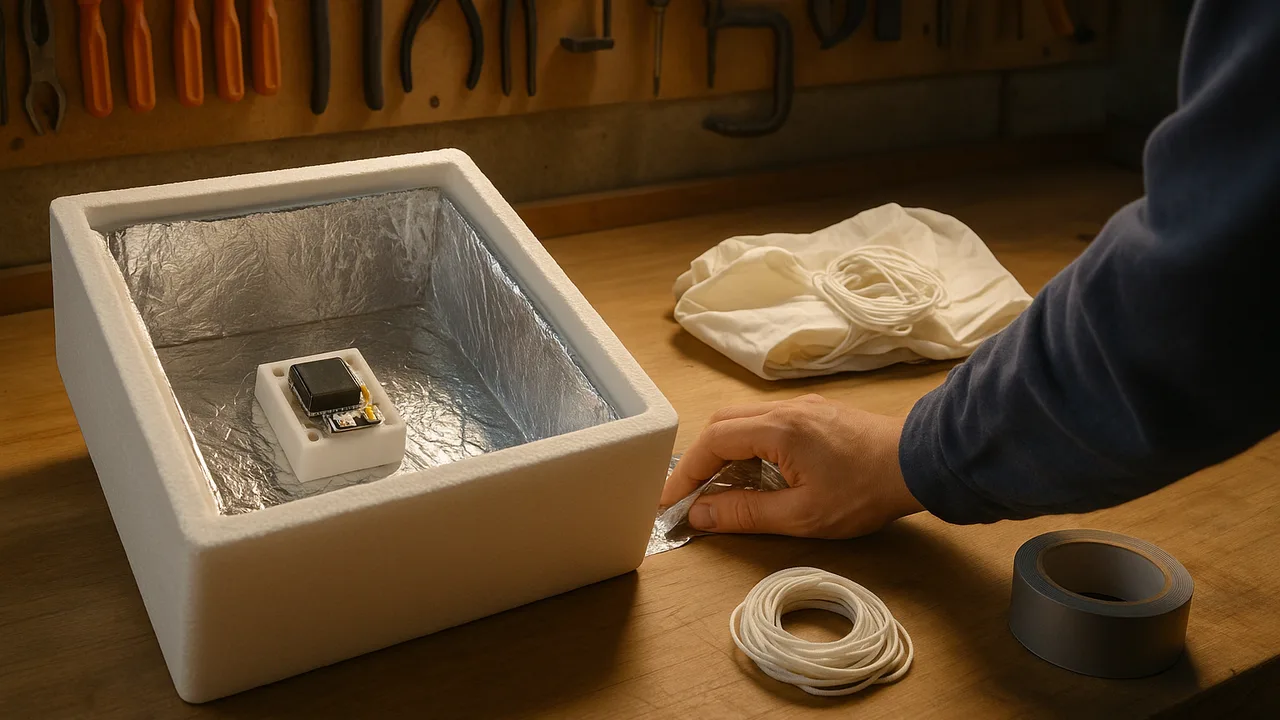
calculate the helium fill and the balloon’s size at each altitude, estimate the burst altitude, and build and test version 1 of an insulated payload box using an energy-flow model.
- I can use my models to illustrate that energy at the macroscopic scale can be explained as a combination of energy from the motion of particles or objects and energy from their relative positions, at both the macroscopic and microscopic scales.
- I can use my models to show that in closed systems, energy is conserved at both the macroscopic and molecular/atomic scales, so that as one form of energy changes, the total energy stays constant, as shown by other forms of energy changing by the same amount or only by the energy transferred into or out of the system.
Phase 4: Build
Warm-Up ~5 min
Do Now. A warm battery sits in −50 °C air. Draw the battery’s surface and a few air particles next to it. Use arrows to show which way energy moves when they collide, and write one material that would slow it down.
Which payload box design will keep a warm bottle warmest for 30 minutes in a freezer?
Instruction ~10 min
Two deliverables, one model. Today teams build the flight profile (numbers from the gas laws) and version 1 of the payload box (an energy-flow design). Both rest on the same particle model.
Class criteria and constraints (sample values set by the class and the station). The flight plan must (1) give the helium fill as a volume, moles and mass, with the conditions stated; (2) give the balloon’s volume and diameter at 0, 5, 10, 20, 25 and 30 km; (3) estimate the burst altitude from the balloon’s rated burst diameter of 6.0 m (sample spec for a 600 g latex balloon). The payload box must (4) keep the battery stand-in (100 mL of water starting at 40 °C in a capped bottle) at or above 30 °C after 30 minutes in the class freezer (about −18 °C); (5) weigh no more than 150 g empty; (6) cost no more than 10 sample budget points; and (7) leave room for the sensor board and an opening for the antenna wire.
Worked example 1: sizing the fill. Aiyana’s team needs the balloon to lift itself (0.60 kg), the payload (1.0 kg, the station’s limit) and about 0.5 kg of extra “free lift” so it climbs at a steady rate. From d = PM/RT at 101.3 kPa and 288 K, air has density 1.23 kg/m3 and helium 0.169 kg/m3, so each cubic meter of helium lifts about 1.06 kg. Needed lift 2.1 kg ÷ 1.06 kg/m3 = 2.0 m3. From 1.05, that is 84.6 mol, or 339 g of helium.
Worked example 2: the flight profile and the burst estimate. Using the combined gas law from a 2.0 m3 launch at 101.3 kPa and 288 K, and diameter d = ∛(6V/π):
| Altitude (km) | P (kPa) | T (K) | V (m3) | Diameter (m) |
|---|---|---|---|---|
| 0 | 101.3 | 288 | 2.0 | 1.6 |
| 5 | 54.0 | 256 | 3.3 | 1.9 |
| 10 | 26.5 | 223 | 5.9 | 2.2 |
| 20 | 5.5 | 217 | 28 | 3.8 |
| 25 | 2.5 | 222 | 62 | 4.9 |
| 30 | 1.2 | 227 | 133 | 6.3 |
A 6.0 m burst diameter is a volume of π(6.0)3/6 = 113 m3, reached between 25 km (62 m3) and 30 km (133 m3). Because volume grows roughly exponentially with altitude here, the team estimated a burst near 29 km. Real balloons burst over a range of altitudes, since latex varies and the day’s atmosphere differs from the standard table, so the brief should report an estimate with a range.
The payload box as an energy-flow system. The battery stand-in is the system; the cold air and the box are its surroundings. Energy moves from the warm bottle into the slower particles of the cold air through collisions, at the bottle’s surface and through the box wall. Three design levers follow from the particle model: (1) slow conduction with thick walls of trapped still air (foam, bubble wrap); (2) block convection by sealing gaps so cold air cannot flow past the bottle; (3) store energy nearby, for example a second warm-water pack, or water that releases energy as it freezes.
Measuring energy loss. The energy the stand-in lost is Q = mcΔT, with c = 4.18 J/(g·°C) for water. Sample result: 100 g of water that cooled from 40.0 °C to 32.0 °C lost 100 × 4.18 × 8.0 = 3,340 J. That energy did not vanish: it went into the box, the freezer air and the freezer’s walls.
Procedure. (1) Sketch two concepts and score them in a decision matrix against criteria 4–7. (2) Build version 1. (3) Weigh it empty. (4) Fill the bottle with 100 mL of 40 °C water, insert the thermometer probe through the lid, close the box and put it in the freezer with a bare control bottle beside it. (5) Read both temperatures every 5 minutes for 30 minutes.
Guided Exercises ~15 min
Use the flight-profile table and your test data.
Independent Practice ~10 min
Complete the flight profile and the version 1 data table.
Recalculate the 10 km and 30 km volumes yourself from the combined gas law and check them against the class table. Then compute Q for your boxed bottle and your control bottle, and state whether version 1 meets criterion 4.
Closure ~5 min
Version 1 is built and tested, and the flight profile is drafted. Next class, gallery critique and version 2.
Exit ticket: name the criterion your box came closest to missing, and one change that would help without breaking another criterion.
Teacher notes
Materials (per team): two small capped plastic bottles, a thermometer probe or digital thermometer that fits through a lid hole, foam sheet, foam cups, bubble wrap, cardboard, aluminum foil, felt, tape, a kitchen scale, scissors, access to a class freezer (or a large cooler packed with ice packs, about −10 to −18 °C), a budget sheet with sample prices.
Timing: profile calculations 15 minutes, design and build 20 minutes, freezer test 30 minutes (start the test early; analyze while it runs).
Listen for: “cold gets in” (energy goes out); “foil keeps cold out” (foil mainly reduces radiation; on its own it conducts well); “more helium means higher.”
Support / stretch: provide the profile table with one row blank. Stretch: estimate the time to burst at a typical ascent rate of 5 m/s (29 km ÷ 5 m/s ≈ 5,800 s, about 1.6 hours) and say what that means for the freezer test length.