1.09 Performance Task: The Weather Balloon Launch Brief
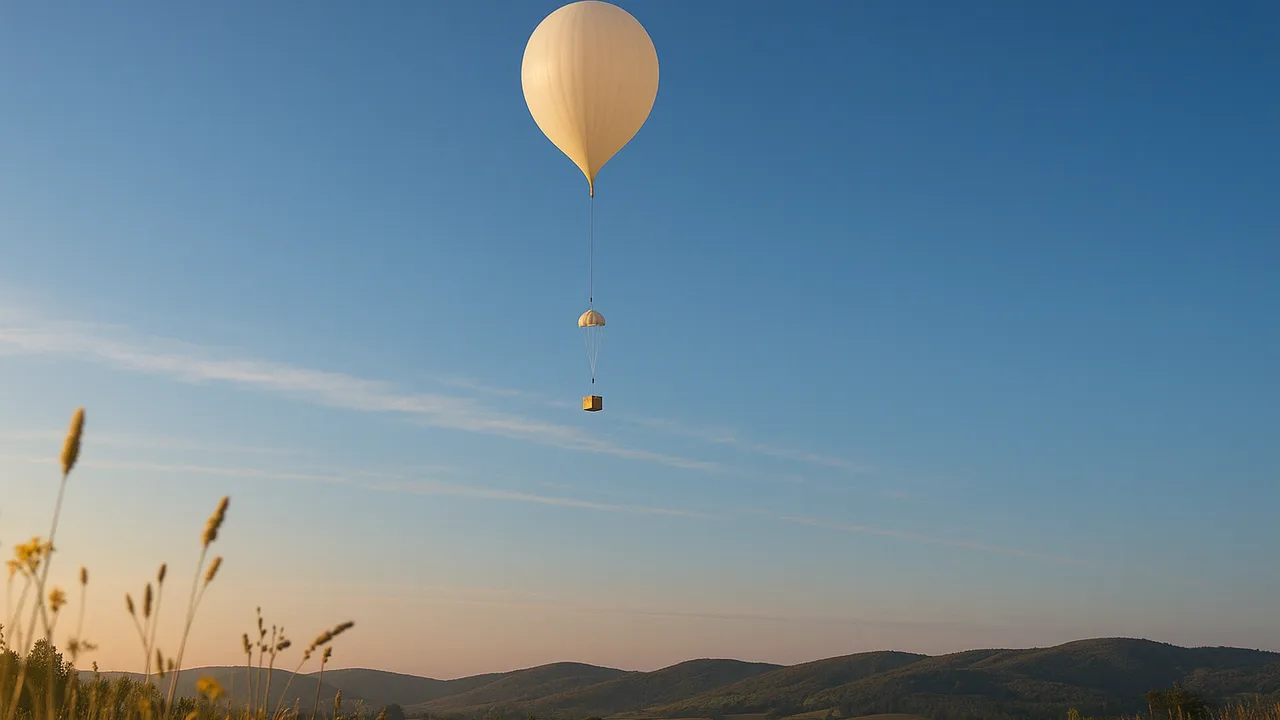
use the kinetic molecular model and the gas laws to recommend a helium fill, predict the balloon’s size and burst altitude, and justify the payload insulation with an energy-flow model backed by my team’s test data.
- I can develop models that identify and describe all parts of a system and its surroundings, showing how energy flows between them.
- I can clearly represent both macroscopic (large-scale) and molecular/atomic (small-scale) views of a system in my models.
- I can show in my models how energy appears in different forms at both the macroscopic scale (like motion, sound, light, thermal energy, potential energy, or energy in fields) and the molecular/atomic scale (like kinetic energy of particles, potential energy from positions in fields, and energy in fields).
- I can use my models to show that in closed systems, energy is conserved at both the macroscopic and molecular/atomic scales, so that as one form of energy changes, the total energy stays constant, as shown by other forms of energy changing by the same amount or only by the energy transferred into or out of the system.
- I can use my models to illustrate that energy at the macroscopic scale can be explained as a combination of energy from the motion of particles or objects and energy from their relative positions, at both the macroscopic and microscopic scales.
Phase 5: Prove It
Warm-Up ~5 min
Do Now. List the three strongest pieces of evidence you have collected this unit (a lab result, a calculation, a standard-atmosphere value, a box test). Next to each, write the claim it supports.
Why does the balloon keep growing all the way up even though the air gets colder?
Instruction ~10 min
The context. The volunteer weather station wants its first high-altitude launch to be safe, legal and successful, and to give local schools a real profile of the atmosphere above them. Its volunteers are careful observers but not chemists. They need a brief that turns the particle model into decisions.
Your job. Write a launch brief that answers the station’s four questions and explains each answer with the kinetic molecular model. You are not asked to choose the launch date or handle aviation paperwork; you are asked to explain the science and specify criteria and constraints, which is how engineers begin (HS-ETS1-1).
What the science section must do. (a) Give the helium fill as a volume, moles and mass from PV = nRT, with conditions stated. (b) Give the flight profile (volume and diameter at six altitudes) from the combined gas law and the standard atmosphere, with one calculation shown. (c) Estimate the burst altitude with a range, and explain why more helium means a lower burst. (d) Include a two-scale model (a labeled diagram) of the balloon and the payload as systems with surroundings, showing energy as particle motion and, for the water pack or any phase change, as particle position. (e) Explain with energy conservation why the helium cools as it expands and why the battery loses energy to the cold air. (f) Explain qualitatively, with Graham’s law, why the balloon should be filled on launch day.
What the engineering section must do. Report your version 2 payload box data against the class criteria, with Q = mcΔT for the stand-in; name at least two criteria and two constraints for the launch (for example, payload mass limits, cost, safety for aircraft and people downwind, recovering the payload, never inhaling helium); and name at least one limitation of the freezer test. Cite OpenStax Chemistry 2e and the standard atmosphere for every published value; label any estimate as illustrative and any class data as sample.
Worked example: a strong paragraph. “At 20 km the outside pressure is 5.5 kPa, about 5% of sea level, so far fewer air particles hit each square meter of the balloon each second. The helium atoms keep pushing the latex outward until their collisions per area match, so the balloon grows to about 28 m3, 14 times its launch volume. As it expands it does work on the surrounding air, and that energy comes from the helium atoms’ motion, so the gas cools; total energy is conserved.” Every sentence names a particle, a number or a mechanism.
Quality bar. Strong briefs connect every claim to particle motion, collisions, positions or energy transfer. They check one result two ways (for example, moles from PV = nRT and from molar volume) and say whether they agree.
Stages. Plan, draft, get a peer review with a checklist, revise, and present to the station’s volunteers (your class and visitors). The presentation is four minutes, live or recorded, followed by one question about your evidence.
Guided Exercises ~15 min
Plan and peer-review checks.
Independent Practice ~10 min
Write and revise the brief across the work sessions.
Write the science section of your brief (about 500 words), with the flight-profile table, the fill calculation and your two-scale model.
Write the engineering section: payload box data with Q, criteria, constraints and one limitation, with sources cited.
Project task: The Weather Balloon Launch Brief (900-1,200 words) + four-minute presentation
Task: For the volunteer weather station, recommend a helium fill (volume, moles, mass), predict the balloon’s volume and diameter from launch to 30 km, estimate the burst altitude with a range, and justify the payload box design with an energy-flow model and your test data. Explain every answer with the kinetic molecular model: energy as particle motion and relative position, conserved across systems and surroundings. Include a flight-profile table, a two-scale model diagram and at least three cited sources (OpenStax Chemistry 2e, the standard atmosphere, NIST).
Submission workflow
- Stage 1 — Plan. Outline with your four answers, the evidence and calculation for each, and a list of sources.
- Stage 2 — Peer-reviewed draft. A partner checks each claim for particle-level reasoning, each calculation for kelvin and units, and each number against its source; submit their notes and your revision plan.
- Stage 3 — Final brief. 900–1,200 words with the flight profile, the fill calculation, the two-scale model, version 2 data and criteria and constraints.
- Stage 4 — Presentation and defense. Four minutes to the station’s volunteers, live or recorded, answering one question about your evidence.
How it is scored
| Criterion | What proficient looks like |
|---|---|
| Two-scale energy model (HS-PS3-2) | Diagram and text identify systems and surroundings and show energy as particle motion and position at both scales, with energy conserved. |
| Gas-law calculations | Fill, flight profile and burst estimate are correct, in kelvin and matching units, with one calculation shown in full. |
| Use of data | Cites standard-atmosphere values and box-test data accurately and checks one result two ways. |
| Criteria and constraints (HS-ETS1-1, HS-ETS1-3) | At least two criteria and two constraints, including safety ones, with one stated limitation of the freezer test. |
| Communication | Clear structure; the presentation answers a question with evidence. |
Closure ~5 min
Your brief turns a unit of evidence into a launch plan. Next: the unit checkpoint.
Exit ticket: what question did the volunteers ask your team, and how did you answer it with evidence?
Teacher notes
Timing: the brief runs across about three sessions: this lesson launches it and covers planning and peer review; drafting and the presentations need further work time.
Materials: peer-review checklist, the standard-atmosphere table, OpenStax links, the class flight-profile table, version 2 data, rubric copies for visiting “volunteers.”
Listen for: Celsius in the combined gas law; “the balloon pops from cold”; insulation described as making or keeping in “cold.”
Support / stretch: give a paragraph frame for each of (a)–(f). Stretch: add a section comparing helium and hydrogen as lifting gases, using molar mass, density and safety.